
When you hear change blockchain data, the idea of altering records on a public, tamper-proof ledger, it sounds impossible. And for good reason—blockchains are built to resist changes. But here’s the truth: distributed ledger technology, a broader system for recording data across multiple computers without a central authority doesn’t mean every piece of data is locked in stone forever. Some changes happen on-chain. Most happen off-chain. And many projects you think are "blockchain-based" aren’t changing the ledger at all—they’re just updating pointers or metadata.
Think of it like a public Google Doc that everyone can see but no one can delete. If you want to fix a typo, you don’t erase the old version—you add a new note saying "Correction: X is now Y." That’s how blockchains work in practice. The original transaction stays. But new transactions override its effect. This is why state channels, off-chain networks that let users transact privately and quickly before settling the final state on-chain exist. They let users trade, swap, or update balances without flooding the main blockchain with every tiny change. The Lightning Network for Bitcoin and Raiden for Ethereum are real-world examples. They solve the speed and cost problem by keeping most data changes off-chain, then only recording the final result. That’s not cheating—it’s how scaling actually works.
And here’s where most people get confused: a token price change isn’t a blockchain data change. A project relaunching its smart contract isn’t editing the old one—it’s deploying a new one. Even when you see "updated whitepaper" or "new roadmap," those are usually hosted on centralized servers, not on the blockchain. The only things truly written in stone are the transaction hashes, timestamps, and signatures. Everything else? It’s layered on top. That’s why you’ll see posts here about fake airdrops, ghost exchanges, and dead tokens—they’re not blockchain failures. They’re people exploiting the gap between what blockchain promises and what people assume it delivers. You can’t change the data on a blockchain without creating a new record. But you can easily change what people think the data means. That’s the real risk.
What follows is a collection of real cases where blockchain data was misunderstood, misused, or misrepresented. You’ll see how projects claim to be decentralized while hiding changes behind centralized servers. You’ll learn how some exchanges pretend to update balances on-chain when they’re just adjusting internal databases. And you’ll find out why some "immutable" records—like token distributions or airdrop claims—turn out to be false the moment you dig into the on-chain data. This isn’t theory. It’s what’s happening right now. And knowing how blockchain data actually changes—or doesn’t—is the only way to avoid losing money to the illusion of transparency.
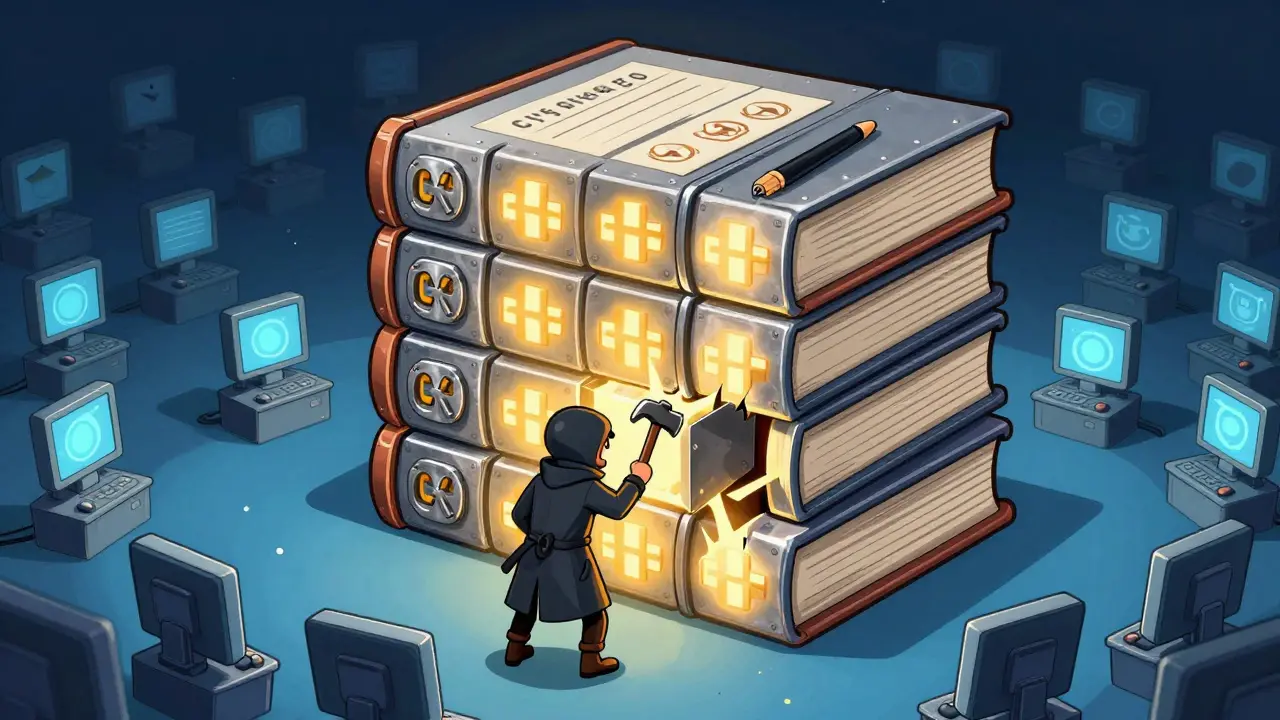
Blockchain data is designed to be unchangeable, but it's not impossible to alter. Learn how, when, and why blockchain immutability can be bypassed-with real examples from Ethereum, Bitcoin Gold, and enterprise systems.