
When you send Bitcoin or trade an altcoin, a blockchain timestamp, a digital record that proves exactly when a transaction was added to the chain. Also known as block time, it's what makes crypto trustless—you don’t need a bank to verify when money moved, because the network itself records it forever. This isn’t just a date and time stamp like your email receipt. It’s cryptographically sealed into a block, linked to the one before it, and broadcast to every node on the network. Change one timestamp? You break the whole chain.
That’s why blockchain immutability, the idea that once data is written, it can’t be altered isn’t just marketing—it’s engineering. Every timestamp is hashed with the previous block’s hash, creating a chain of proof. If someone tries to rewrite history—say, to double-spend coins—they’d need to redo every single block after the tampered one, faster than the whole network keeps adding new ones. That’s nearly impossible on Bitcoin and Ethereum, but we’ve seen it happen on smaller chains like Bitcoin Gold after 51% attacks. That’s why timestamps aren’t just about time—they’re about security.
And it’s not just about money. distributed ledger technology, a broader system for recording data across multiple computers without a central authority uses timestamps to prove when contracts were signed, when NFTs were minted, or when a supply chain item changed hands. That’s why companies like Walmart and Maersk use private blockchains—they need to know exactly when a shipment left port, not just that it did.
But here’s the catch: timestamps alone don’t mean a project is real. Look at all those abandoned coins like Quebecoin or Celestial—those had timestamps too. The chain recorded their birth, but no one ever showed up to use them. A timestamp proves an event happened. It doesn’t prove it mattered.
That’s why the posts below dive into the real stories behind the numbers. You’ll find deep dives on how blockchain data can be changed (yes, it happens), how fake airdrops exploit trust in timestamps, and why exchanges with zero volume still have perfect-looking ledgers. Some entries show how governments track crypto payments using timestamp data. Others expose scams that pretend to be legitimate because their tokens have a date on the chain.
Whether you’re checking if a coin’s first trade was real, verifying a token’s release date, or just trying to understand why your wallet shows a transaction from 2021—you’re looking at a blockchain timestamp. And now you know: it’s not magic. It’s math. And it’s the reason crypto works at all.
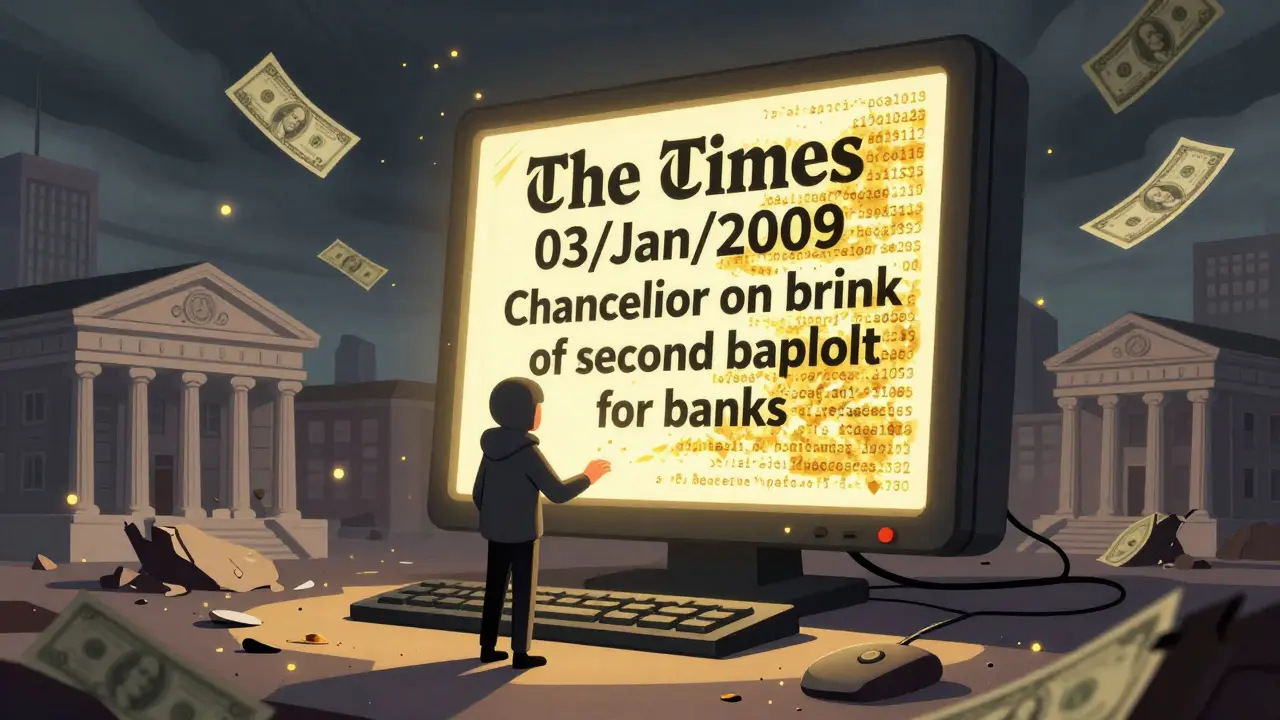
The Genesis Block of Bitcoin contains a hidden message quoting a 2009 newspaper headline about bank bailouts. It's not just a timestamp - it's a political statement that defines Bitcoin's purpose.