
When you think of Satoshi Nakamoto, the pseudonymous creator of Bitcoin and the person who wrote the original whitepaper that launched the entire blockchain movement. Also known as the ghost founder of crypto, it changed how money works—without ever showing a face, voice, or real name. Satoshi didn’t just invent a currency. They built a system where trust isn’t placed in banks or governments, but in code, math, and networks of strangers. That idea—decentralization—is why Bitcoin still stands after 15 years, while hundreds of other coins have vanished.
What’s wild is that Satoshi didn’t work alone in a lab. They released Bitcoin as open-source software in 2009, letting anyone download, study, and improve it. That’s why today you see projects like SushiSwap on Polygon, state channels on Ethereum, and even obscure meme coins on Base—all built on the same core idea: no central control. Satoshi’s code didn’t just create a coin; it created a movement. And even though they disappeared in 2011, their fingerprints are everywhere: in the 51% attacks people warn about, in the blockchain immutability debates, in the SEC’s crackdowns on unregistered tokens, and in the underground crypto traders in Egypt and Vietnam who use P2P platforms to bypass bans.
Behind every airdrop scam claiming to be "from Satoshi" or every fake token promising "Satoshi’s secret wallet," there’s a truth: no one has ever proven they’re the real Satoshi. Not Craig Wright. Not Dorian Nakamoto. Not even a group of cryptographers. And that’s the point. The mystery isn’t a flaw—it’s the feature. It keeps power from concentrating in one person’s hands. Even today, when exchanges like BitFex or BTCsquare promise "no KYC" and "anonymous trading," they’re trying to live up to the spirit Satoshi started. You won’t find a whitepaper signed by them anymore. But you’ll find their legacy in every decentralized app, every hard fork, every trader using a take-profit order to lock in gains without asking anyone’s permission.
What follows isn’t a biography. It’s a collection of real stories that show how Satoshi’s ideas still shape crypto today—whether it’s abandoned coins like Quebecoin, fake airdrops pretending to be official, or exchanges that vanish overnight. These aren’t just tech reviews. They’re tests of the original promise: can money really work without a face behind it? And if so, who’s really in charge now?
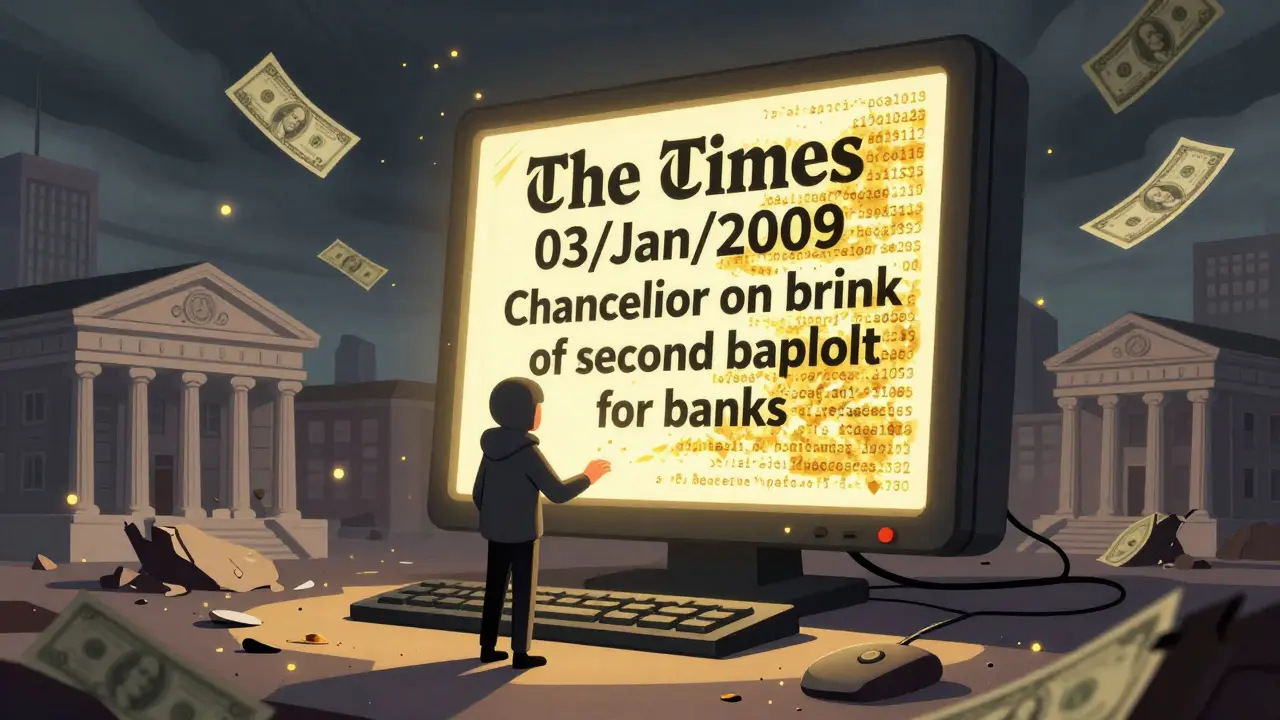
The Genesis Block of Bitcoin contains a hidden message quoting a 2009 newspaper headline about bank bailouts. It's not just a timestamp - it's a political statement that defines Bitcoin's purpose.