

When you're looking at a blockchain project - whether it's a new cryptocurrency, a DeFi protocol, or a Web3 platform - how do you know if it's worth your money? Not just because everyone’s talking about it, but because the numbers, the team, and the market actually back it up? That’s where fundamental analysis frameworks come in. These aren’t just fancy charts or hype cycles. They’re proven systems for figuring out what a project is truly worth - based on facts, not emotions.
Why Fundamental Analysis Matters in Blockchain
Most people new to crypto see price charts and think that’s all there is. But blockchain assets behave differently than stocks. They’re not tied to quarterly earnings reports or balance sheets in the traditional sense. Still, the same logic applies: if you want to hold something for years, you need to understand its real value. Take Bitcoin. In 2017, it hit $20,000. In 2021, it hit $69,000. But between those peaks, it dropped below $3,000. People who bought at the top and sold at the bottom lost everything. Those who looked deeper - at network growth, hash rate, on-chain transaction volume, and adoption by institutions - held on and profited. That’s the power of fundamental analysis in crypto. Unlike technical analysis, which tracks price patterns, fundamental analysis asks: What’s the underlying business? Who’s using it? Is the team credible? Is the tokenomics sustainable? Is the protocol solving a real problem?The Three Frameworks: Top-Down, Bottom-Up, and Hybrid
There are three main ways to structure your analysis. Each works best for different types of investors.Top-Down: Start with the Big Picture
Top-down analysis begins with macro trends and narrows down to individual projects. In traditional markets, this means looking at interest rates, inflation, and GDP before picking a stock. In blockchain, it looks like this:- Global macro conditions: Are central banks tightening or loosening monetary policy? Higher interest rates hurt speculative assets like crypto. Lower rates often spark risk-on behavior.
- Regulatory environment: Is the U.S. cracking down on exchanges? Is the EU enforcing MiCA? Is Japan approving Bitcoin ETFs? Regulation can make or break entire sectors.
- Adoption trends: Are banks integrating blockchain? Are governments testing CBDCs? Are major companies like PayPal or Stripe adding crypto payments?
- Sector rotation: Is DeFi dying? Is AI + blockchain gaining traction? Is real-world asset tokenization picking up steam?
Bottom-Up: Dig Into the Project Itself
This is where most crypto investors spend their time. Bottom-up analysis zooms in on the individual project. You’re not looking at the market - you’re looking at the code, the team, and the token. Here’s what to check:- Tokenomics: What’s the total supply? Is there a max cap? How are tokens distributed? Are early investors holding 30%? That’s a red flag. Is 50% locked in vesting schedules? That’s a good sign.
- On-chain activity: Are daily active addresses growing? Is the transaction volume increasing? Are large holders (whales) accumulating or dumping? Use tools like Nansen or Dune Analytics to see real-time behavior.
- Revenue and fees: Does the protocol generate revenue? Ethereum earns fees from gas. Uniswap earns trading fees. A protocol that makes money is more sustainable than one that just burns tokens.
- Team and advisors: Are the founders anonymous? Do they have a track record? Have they built successful projects before? Are advisors from reputable firms like a16z or Coinbase?
- Competitive advantage: What makes this project better than others? Is it faster? Cheaper? More secure? Does it have network effects? A strong “economic moat” - like Ethereum’s developer ecosystem - is hard to copy.
- Valuation metrics: Market cap divided by daily revenue? That’s the P/R ratio (Price-to-Revenue). Compare it to similar protocols. If a DeFi project has a $500M market cap but only $1M in daily fees, it’s likely overvalued.
Hybrid: Combine Both Approaches
The smartest investors don’t pick one. They blend top-down and bottom-up. Think of it like this: you wouldn’t buy a house in a sinking neighborhood just because the kitchen looks nice. And you wouldn’t ignore a great kitchen just because the neighborhood is trending. A hybrid framework might look like this:- Macro: Interest rates are falling → risk assets are favored.
- Industry: AI agents are emerging as a new use case for blockchain.
- Project: A protocol called “Ocean Protocol” lets AI agents buy and sell data on-chain. Their revenue grew 300% last quarter. Their token has a 6-month lockup for team members. Their community is growing fast.
Fundamental vs. Technical Analysis: What’s the Difference?
Many traders use both, but they serve different purposes.| Aspect | Fundamental Analysis | Technical Analysis |
|---|---|---|
| Focus | Intrinsic value, tokenomics, adoption, team | Price patterns, volume, chart indicators |
| Time Horizon | Months to years | Minutes to days |
| Data Used | On-chain metrics, whitepapers, revenue, team history | Price charts, RSI, MACD, moving averages |
| Best For | Long-term holders, value investors | Day traders, swing traders |
| Limits | Slow to react to sudden news; can’t predict short-term swings | Ignores real-world value; useless if the project fails |

What Experts Say - And What They Got Wrong
Benjamin Graham, the father of value investing, said you should buy assets trading below their intrinsic value with a “margin of safety.” In crypto, that means buying a token when its market cap is far below what its usage and revenue suggest. Warren Buffett didn’t invest in Bitcoin. But he didn’t need to. His principles work here too: avoid what you don’t understand. If you can’t explain how a token creates value, don’t invest. Peter Lynch, who managed Fidelity’s top-performing fund, said the best investments often come from “tenbaggers” - companies you understand better than the market. In crypto, that’s often small DeFi protocols nobody’s talking about - until they explode. But here’s the catch: traditional valuation models fail in crypto. Discounted Cash Flow (DCF) doesn’t work when a protocol doesn’t have predictable cash flows. That’s why experts like Aswath Damodaran say you need to adapt. For blockchain, use:- Network Value to Transactions (NVT) ratio: Market cap divided by daily on-chain transaction volume. Think of it as P/E for crypto.
- Protocol Revenue Multiples: Market cap divided by annual revenue. A healthy ratio is under 10x for mature protocols.
- Active Address Growth: If daily users grow 10% month-over-month, that’s a strong signal.
Common Mistakes and How to Avoid Them
Even smart people blow it with fundamental analysis in crypto. Here’s what goes wrong:- Chasing hype: “This project has 100K Twitter followers!” Doesn’t matter if only 500 people use it daily.
- Ignoring tokenomics: A project with 1 billion tokens and no supply cap? That’s inflation waiting to happen.
- Overlooking team incentives: If the team gets 20% of tokens and can sell them all in 6 months, they have zero incentive to build long-term.
- Using outdated metrics: Market cap alone is meaningless. A $100M market cap on a project with $1M in revenue is overvalued. A $50M market cap on a project with $5M in revenue? That’s undervalued.
- Not checking regulatory risk: A DeFi protocol operating in the U.S. without a license is a ticking time bomb.
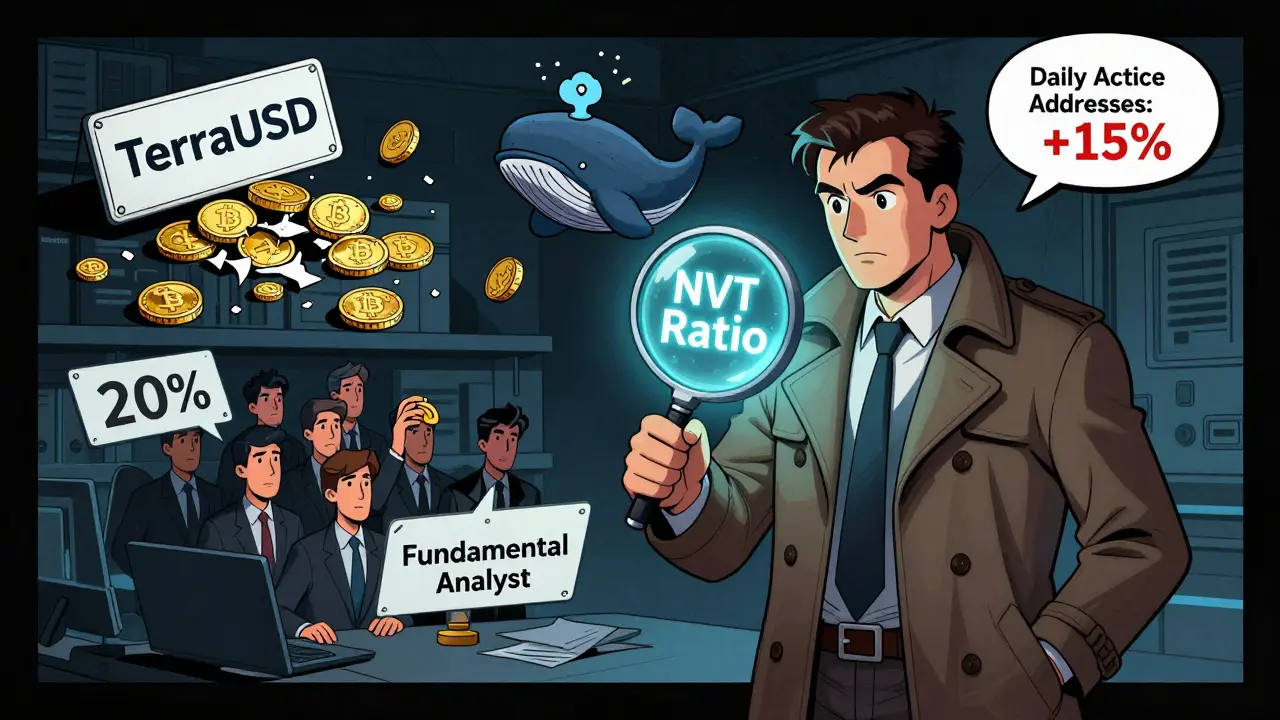
How to Start Using Fundamental Analysis Today
You don’t need a finance degree. You just need a system.- Choose one project: Pick something you’re curious about - not because it’s trending, but because you understand its purpose.
- Read the whitepaper: Skip the marketing. Look for: problem statement, solution, token utility, revenue model.
- Check on-chain data: Go to Dune Analytics or Nansen. Look at active addresses, transaction volume, and token distribution.
- Find revenue: Does the protocol charge fees? Where does the money go? Is it burned? Paid to stakers? Locked in treasury?
- Compare valuation: Use NVT ratio or revenue multiple. Compare it to similar projects.
- Ask: Would I still buy this if the price dropped 50% tomorrow? If the answer is yes, you’ve passed the fundamental test.
The Future: AI and Augmented Fundamental Analysis
The game is changing. AI tools like JPMorgan’s LOXM can now read a 200-page blockchain whitepaper and extract key metrics in minutes. They spot hidden risks - like a team member with a history of rug pulls - that humans miss. BlackRock’s Aladdin Climate now factors in carbon footprint of proof-of-work chains. ESG is no longer optional. If your token runs on a high-energy blockchain and you’re targeting European investors, you’re at a disadvantage. But here’s the truth: AI doesn’t replace fundamental analysis. It enhances it. The best investors now use AI to scan 100 projects, then spend 20 hours digging into the 3 that pass the filter. As Howard Marks warned: “When fundamental analysis requires 50-variable models, it risks becoming the tail wagging the dog.” Don’t overcomplicate it. Stick to the basics: who’s using it? How much is it earning? Is the team aligned? Is the token scarce?Final Thought: Value Doesn’t Disappear - It Just Gets Hidden
Crypto moves fast. But value doesn’t vanish because the price drops. It just gets buried under noise. The projects that survive are the ones with real utility, strong economics, and teams that care more about building than pumping. Fundamental analysis is your flashlight in the dark. It won’t tell you when the next pump is coming. But it will tell you which projects are worth holding when the lights go out.That’s not speculation. That’s investing.
What is the main goal of fundamental analysis in blockchain investing?
The main goal is to determine a blockchain project’s intrinsic value by examining its economic model, user adoption, team credibility, revenue streams, and tokenomics - not just its price. This helps investors identify undervalued assets and avoid speculative bubbles by focusing on long-term sustainability rather than short-term hype.
How is fundamental analysis different for crypto versus stocks?
Traditional stock analysis relies on financial statements like income statements and balance sheets. Crypto lacks these, so fundamental analysis uses on-chain data - like daily active addresses, transaction volume, and token distribution - along with protocol revenue, team background, and regulatory risk. Instead of P/E ratios, investors use NVT ratios (network value to transactions) and revenue multiples.
Can fundamental analysis predict short-term price movements in crypto?
No. Fundamental analysis is designed for long-term decisions, not timing entries or exits. Crypto prices can swing wildly due to news, social media, or macro events - factors fundamental analysis doesn’t capture. That’s why it’s paired with technical analysis for traders, but only fundamental analysis helps you decide what to hold for years.
What are the most important metrics to check in a blockchain project?
The top five are: 1) Daily active addresses (user adoption), 2) Protocol revenue (how much it earns), 3) Token supply and distribution (is it fair or concentrated?), 4) Team credibility and vesting schedules (do they have skin in the game?), and 5) Regulatory exposure (is the project compliant or at risk?).
Is fundamental analysis still useful if a project is anonymous?
Yes - but with caution. Anonymous projects like Bitcoin or Monero still have strong fundamentals: transparent code, active development, and clear utility. But if a project is anonymous AND has no public code, no revenue, and a large team allocation with no lockup, it’s high risk. Focus on what you can verify - the tech, the usage, the economics - not the names behind it.
How do ESG factors affect fundamental analysis in crypto?
ESG is becoming a key filter, especially in regulated markets. Proof-of-work blockchains like Bitcoin face scrutiny for energy use, while proof-of-stake chains like Ethereum are favored. Investors in Europe and institutional funds now require ESG scoring. A project with high carbon emissions may be technically sound but legally or reputationally risky - which impacts long-term value.


Athena Mantle
Okay but like... if you're not using NVT ratios and on-chain active addresses as your core metrics, you're just gambling with a fancy spreadsheet 🤡. Real investors don't care about Twitter followers. They care about who's actually moving the tokens. Period.