
Smart contracts were supposed to be the unbreakable code of blockchain - self-executing, transparent, and trustless. But in 2025, over $2.8 billion vanished because of flaws in those very contracts. The era of waiting for a post-deployment audit is over. Today, if your DeFi protocol doesn’t have security baked into every line of code from day one, you’re already behind.
Why Audits Alone Don’t Cut It Anymore
Five years ago, a smart contract audit was enough. Teams would write their code, hire a firm like OpenZeppelin or CertiK, wait a few weeks, get a clean report, and launch. That’s how you got hacked in 2025. The problem? Hackers stopped targeting simple reentrancy bugs. They now chain exploits across multiple protocols. A vulnerability in a lending pool on Ethereum could trigger a cascade through a bridge, a yield aggregator, and a derivatives market on Arbitrum - all in under 90 seconds. That’s not a bug. That’s a system failure. In 2025, 64% of all DeFi losses came from cross-chain bridge attacks. The old audit model only looked at one contract in isolation. It didn’t ask: What happens if this contract talks to that one on Solana? Or: What if the oracle feeds false data during a liquidity crunch?The New Security Stack: Layers That Actually Work
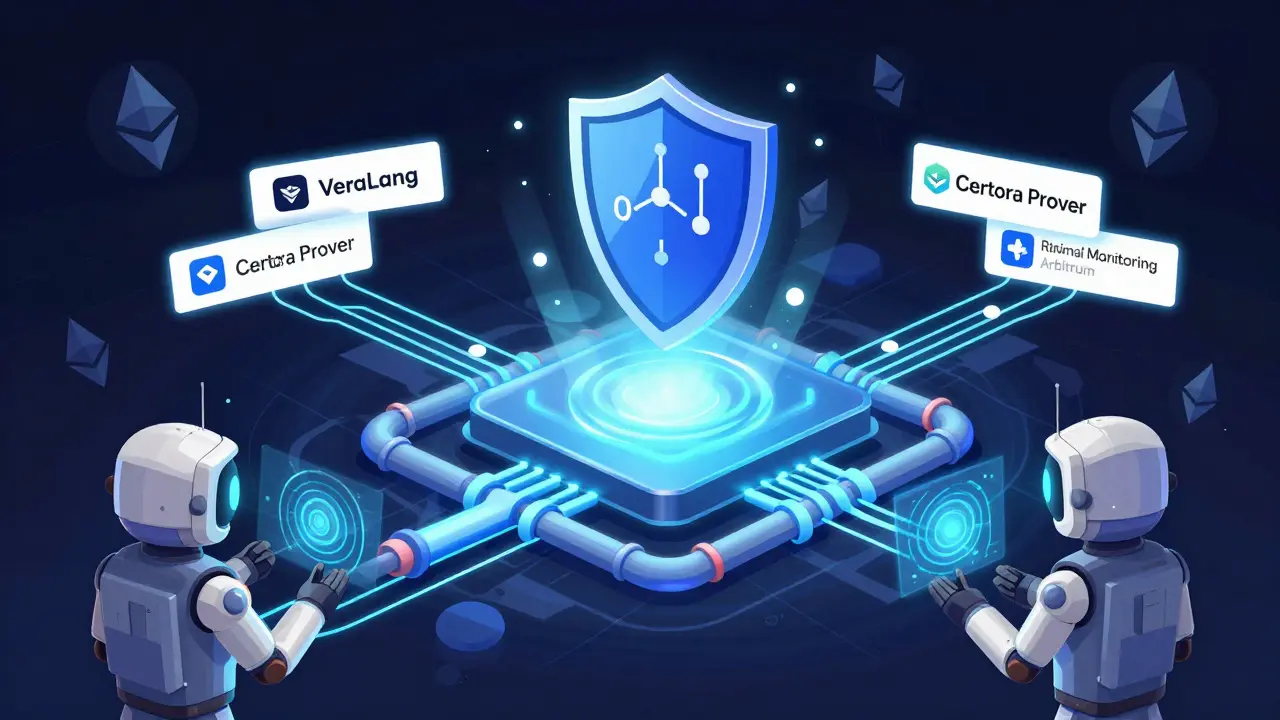
Modern smart contract security isn’t one tool. It’s a stack. And the top three layers are now non-negotiable.- Formal Verification - This isn’t just fancy math. Tools like VeraLang and Certora Prover use mathematical proofs to show that a contract must behave correctly under all possible inputs. In 2026, 67% of DeFi projects handling over $50 million in TVL use it. And guess what? Every single one of them avoided a critical exploit last year.
- Runtime Monitoring - Once your contract goes live, you can’t just sit back. Forta Network and similar systems watch every transaction in real time. They detect anomalies - like a sudden 300% spike in withdrawals from a wallet that’s never traded before - and trigger alerts in under a second. Some even auto-freeze suspicious transfers.
- MPC-Based Key Management - Protocol treasuries used to be guarded by 3-of-5 multisig wallets. One person gets hacked, and the whole fund drains. Now, top protocols use Multi-Party Computation (MPC). No single key exists. Transactions require coordinated signatures from distributed nodes. This cuts single-point failures by 92%.
What’s Changing in Development
The shift isn’t just technical. It’s cultural. In 2023, only 12% of DeFi teams integrated security tools into their CI/CD pipeline. By Q4 2025, that jumped to 87%. Now, every code commit triggers automated scans. Slither checks for known patterns. Echidna runs thousands of random inputs to find edge cases. Certora verifies logic before merging. Developers aren’t waiting for auditors anymore. They’re learning formal methods themselves. A Reddit thread from January 2026 titled “Real-world experience with VeraLang” had 147 comments. One lead dev wrote: “It added 3 weeks to our timeline. But we cut critical bugs by 92%. We’re not going back.” The learning curve is steep. ConsenSys Academy’s 2026 survey found developers need 8-12 weeks of focused training just to use these tools properly. That’s why security roles are now among the highest-paid in blockchain. Hourly rates for auditors hit $285 - up from $120 in 2023.
The Cross-Chain Nightmare (And How to Fix It)
The biggest blind spot? Bridges. Every bridge is a handshake between two blockchains. But each chain has different rules, gas models, and consensus mechanisms. A flaw in one doesn’t just break that bridge - it can corrupt the entire flow of assets across DeFi. In 2025, 73% of bridge exploits came from interactions nobody tested. A contract on Polygon assumed a certain timestamp format. The bridge on Avalanche sent it differently. Boom - funds drained. The fix? Standardized interoperability layers. Chainlink’s CCIP security protocol, for example, adds a verification layer that checks message integrity across chains. Teams using it saw bridge-related vulnerabilities drop by 54%. But adoption is still uneven. Only 31% of new bridges implement it.Regulation Is Forcing Change
Governments aren’t waiting for another $1 billion hack. The EU’s Blockchain Security Directive now requires formal verification for all public-sector smart contracts over €1 million. The SEC’s December 2025 guidance says DeFi platforms operating in the U.S. must meet minimum security standards - or face enforcement. These aren’t suggestions. They’re legal requirements. And they’re pushing even conservative institutions into action. Deloitte’s January 2026 survey found 61% of Fortune 500 companies now have formal smart contract security policies.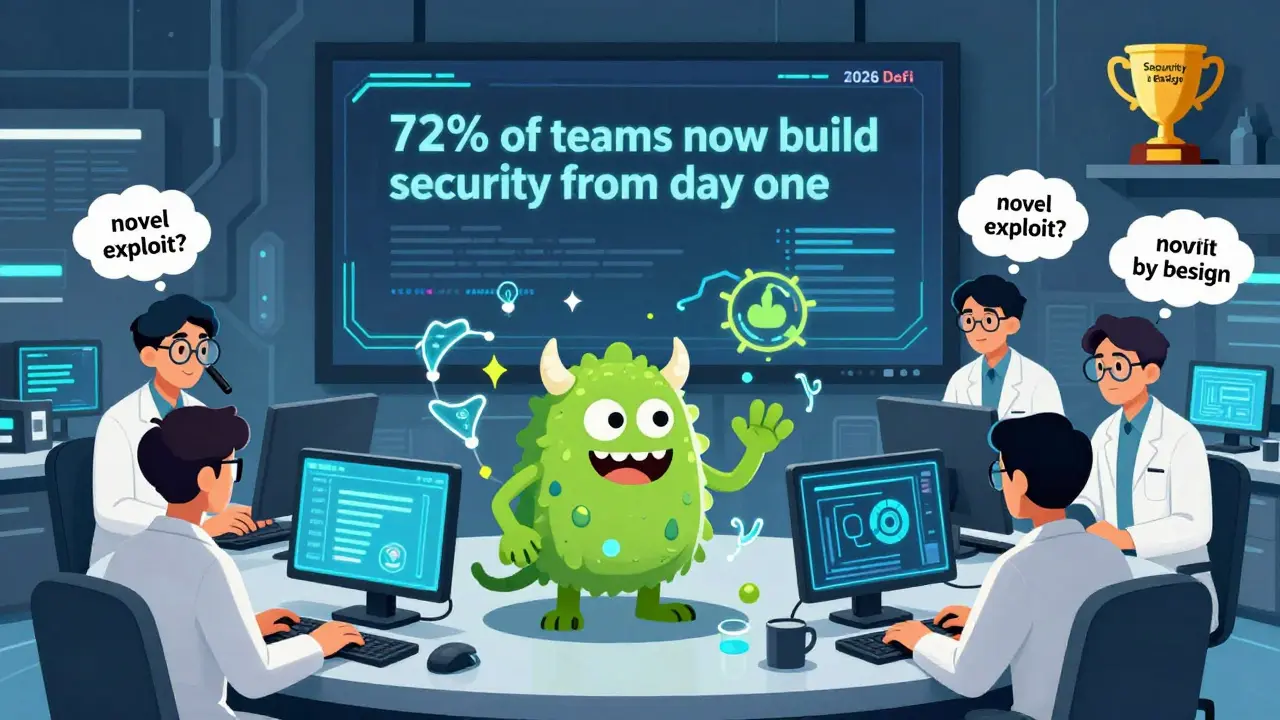
The Dark Side: AI, Quantum, and New Threats
It’s not all progress. AI-generated exploits increased 300% in Q4 2025. Tools trained on past hacks now auto-generate novel attack vectors. Human auditors still catch 31% more novel threats than AI tools, according to Trail of Bits. That’s why the best teams combine both: AI for volume, humans for creativity. Quantum computing is another looming threat. While it won’t break Ethereum’s signature scheme overnight, future high-value contracts are already testing quantum-resistant cryptography. The trade-off? Gas costs jump 18-22%. But for treasuries holding billions, that’s a cost worth paying.What the Future Looks Like
By 2027, Gartner predicts 85% of new smart contracts will use AI-assisted security. Forrester says quantum-resistant code will be standard for high-value contracts by 2028. But the real winner? Security by design. In 2023, only 28% of teams considered security during initial design. By 2026, that number is 72%. The best protocols now treat security like plumbing - invisible, essential, and built in from the ground up. McKinsey’s January 2026 outlook found that protocols with full-stack security have 5.3x higher survival rates over five years. That’s not a competitive edge anymore. It’s survival.How to Get Started
If you’re building or investing in smart contracts today, here’s what you need:- Use formal verification for any contract handling over $10 million. Tools like VeraLang and Certora Prover are free for open-source projects.
- Integrate runtime monitoring with Forta or similar networks. Set up alerts for unusual token flows.
- Switch to MPC for treasury management. Safeheron and Fireblocks offer enterprise-grade solutions.
- Test cross-chain interactions before launch. Use Chainlink CCIP or similar bridge security layers.
- Don’t trust AI alone. Use it to find patterns, but always pair it with human audits.
The future of smart contract security isn’t about finding the next漏洞. It’s about building systems that can’t be broken in the first place.
Is formal verification worth the extra development time?
Yes - if you’re handling more than $10 million in value. Projects using formal verification saw 89% fewer critical vulnerabilities after deployment, according to ConsenSys Diligence’s 2025 study. The upfront cost - typically 2-3 extra weeks - pays off in avoided losses. In 2025, every protocol that implemented formal verification avoided a major exploit. Those that didn’t? Half of them got hacked.
Can AI tools replace human auditors?
No. AI is great at spotting known patterns - like reentrancy or integer overflows - but it misses novel attacks. Trail of Bits found AI tools missed 31% of exploits that human auditors caught. The best approach combines both: AI scans every line of code, then a human auditor reviews edge cases, logic flows, and cross-protocol risks. AI finds the obvious holes. Humans find the ones that kill you.
Why are bridge hacks so common and dangerous?
Bridges connect different blockchains, each with unique rules. A contract on Ethereum might assume a timestamp is in seconds, but one on Solana uses milliseconds. When the bridge translates between them, a mismatch can let attackers drain funds. In 2025, 73% of bridge exploits came from these unforeseen interactions. The fix? Use standardized interoperability layers like Chainlink’s CCIP, which adds verification checks across chains.
What’s the difference between MPC and multisig wallets?
Multisig wallets require multiple private keys to sign a transaction - if one key is stolen, the whole system is at risk. MPC splits the key into distributed shares. No single party holds the full key. Transactions require collaboration between nodes, making theft nearly impossible without compromising multiple independent systems. MPC reduces single-point failures by 92% compared to multisig, according to Safeheron’s 2025 report.
Are regulatory requirements making security harder or easier?
Easier - if you’re building right. The EU and SEC aren’t creating new rules out of nowhere. They’re codifying best practices that top protocols already use: formal verification, runtime monitoring, MPC. Compliance now means you’re doing security right. For startups, it’s a checklist. For hackers, it’s a wall. The bar is higher, but so is the survival rate for compliant projects.


Ken Kemp
Man, I remember when we used to just throw code up and hope for the best. Now I gotta run formal verification, monitor runtime, and lock down keys with MPC? Feels like I’m building a bank, not a smart contract. But honestly? Worth it. Saw a buddy’s project get wiped last year because they skipped the stack. Never again.