
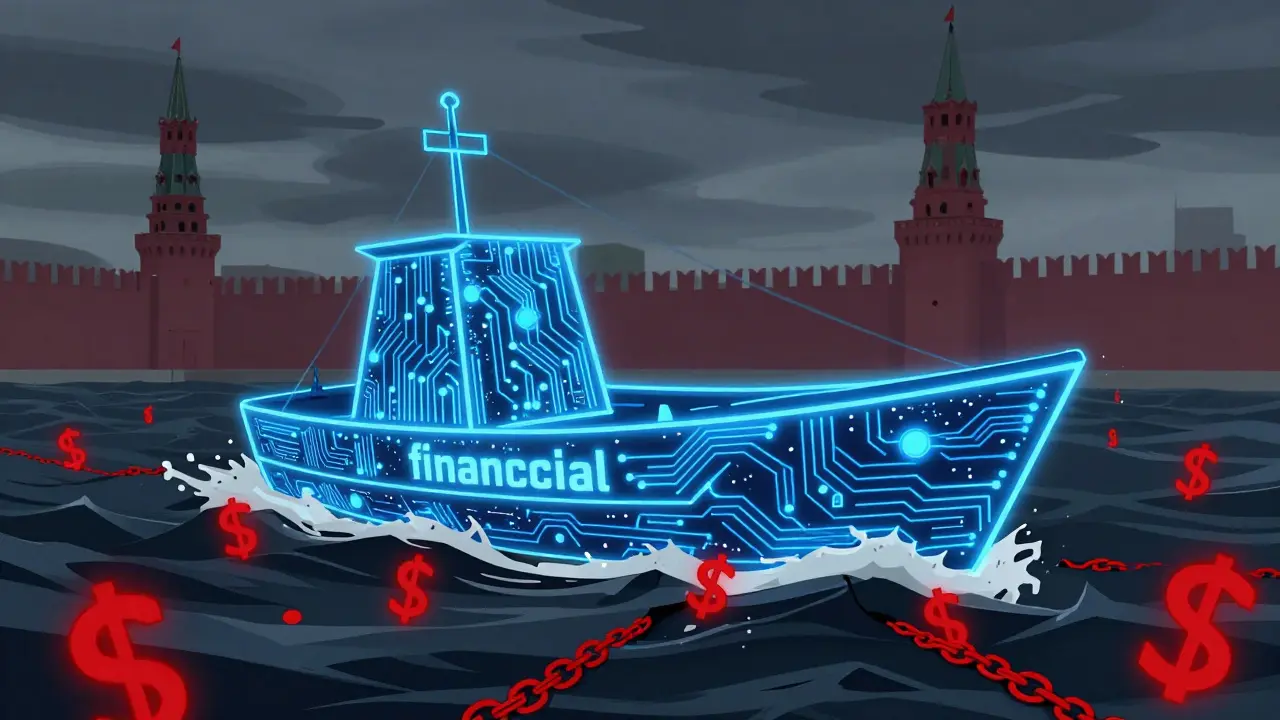
Imagine trying to run a global economy while being locked out of the world's most important financial networks. That's exactly the position Russia found itself in after February 2022. To survive, the Kremlin didn't just look for new trading partners; it decided to rewrite the rules of money. By legalizing crypto mining is the process of using powerful hardware to secure a blockchain network and earn new digital coins as a reward and cross-border digital payments, Russia is attempting to build a "financial lifeboat" that operates completely outside the reach of the US dollar and European banks.
The Rise of a Shadow Crypto Economy
Russia isn't just letting a few hobbyists run rigs in their basements. It has strategically developed what Chainalysis calls a "shadow crypto economy." This isn't a random collection of traders, but a coordinated network of sanctioned exchanges, money laundering services, and military procurement channels. The goal is simple: keep the money moving when traditional wires are blocked.
This infrastructure relies on a few key pillars. First, there are the exchanges. You have Garantex, which has long been a hub for Russian crypto activity despite US sanctions. When that became too difficult, newer entities like Grinex popped up in 2024, specifically designed by former Garantex employees to slip through the cracks of international oversight. These platforms create an insular ecosystem where rubles can be swapped for digital assets without ever touching a Western-controlled bank.
A7A5: The Ruble-Backed Weapon
While Bitcoin is the most famous digital asset, Russia realized that volatility makes it a poor choice for buying oil or military hardware. They needed something stable. Enter A7A5, a ruble-backed stablecoin launched in February 2025. Unlike typical stablecoins pegged to the dollar, A7A5 is designed to maintain the value of the ruble in a digital format, making it a perfect tool for state-sponsored trade.
The numbers behind A7A5 are staggering. From its launch through July 2025, the network processed over $51.17 billion in transactions. Much of this activity happened on business days, which tells us this isn't retail speculation-it's commercial trade. The coin was issued by Old Vector, a Kyrgyzstan-based company backed by the state-owned Promsvyazbank. By routing payments through Kyrgyzstan and using a custom stablecoin, Russia can move billions of dollars with far less visibility than a standard SWIFT transfer.
| Entity | Role | Key Attribute | Status |
|---|---|---|---|
| A7A5 | Stablecoin | Ruble-backed; $51B+ volume | Active/Targeted |
| Old Vector | Issuer | Kyrgyzstan-based; PSB backed | Sanctioned |
| Garantex | Exchange | High-volume Russian liquidity | US Sanctioned |
| Grinex | Exchange | Sanctions-bypass specialist | US/UK Sanctioned |
How Mining Fits Into the Strategy
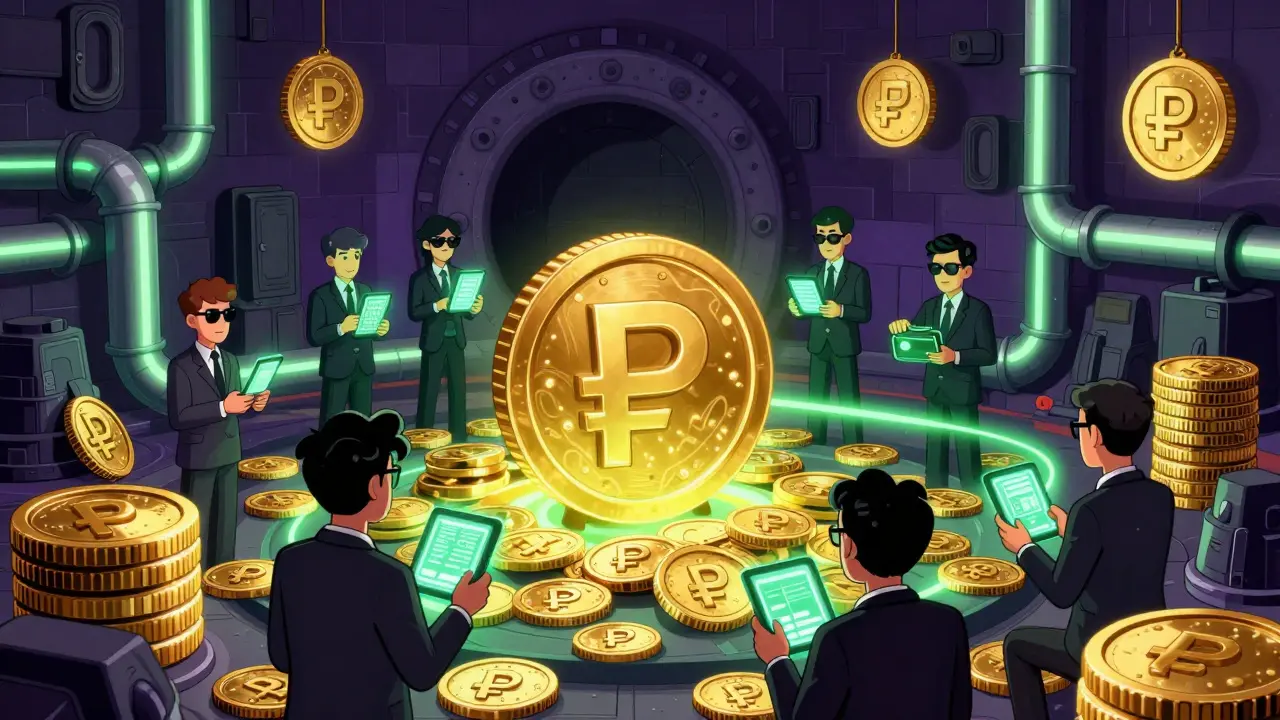
You might wonder why crypto mining matters if they already have a stablecoin. Mining provides the raw "fuel" for the system. Russia reportedly operates the third-largest virtual currency mining industry globally. By legalizing mining, the state ensures a steady supply of newly minted assets that can be used to gain liquidity in foreign markets without needing to exchange rubles for dollars first.
This is a strategic play for independence. When you mine Bitcoin or other Proof-of-Work assets, you are creating value from electricity and hardware-things Russia has in abundance. This allows them to accumulate assets that are globally recognized and liquid, providing a hedge against the crashing value of the ruble and a way to pay for imports in a currency that no single government can "turn off."

The Western Counter-Strike
The US and UK haven't just been watching from the sidelines. On August 20, 2025, the Office of Foreign Assets Control (known as OFAC) did something unprecedented: they designated a virtual currency mining company for the first time. This sent a clear message that the technical infrastructure-the warehouses full of GPUs and ASICs-is now a legitimate target.
The UK's Office of Financial Sanctions Implementation (OFSI) mirrored these moves, targeting the human networks behind the scenes. They focused on the intermediaries in Kyrgyzstan and Luxembourg who act as the "glue" between Russian banks and crypto wallets. The goal is to make the "on-ramps" and "off-ramps"-where crypto turns back into usable cash-so risky that the system collapses under its own weight.
Can Crypto Actually Replace the Dollar?
Despite the billions flowing through A7A5, there is a massive reality check here. The Bitcoin Policy Institute argues that Bitcoin is simply too small to replace the dollar or euro in global trade. Before the war, Russia's annual exports were around $400 billion. That's nearly half of Bitcoin's entire market cap. If Russia tried to move that much volume into Bitcoin, the price would swing wildly, making it an unstable currency for buying heavy machinery or grain.
Furthermore, the very thing that makes blockchain attractive to Russia-its decentralization-is also its biggest weakness: transparency. Every transaction on a public ledger is permanent. Western intelligence agencies are using blockchain analytics to map out exactly who is paying whom. It's a high-stakes game of cat-and-mouse where the "cat" has a perfect record of every move the "mouse" has ever made.
The Bigger Picture: A Global Trend
Russia isn't the only one trying this. We're seeing a pattern where "pariah states" use digital assets to survive. North Korea and Venezuela have used similar tactics to evade sanctions. It suggests we are entering an era of "fragmented finance," where the world is split between the traditional Western banking system and a shadow network of state-sponsored digital assets.
For the average person, this means the volatility of crypto is no longer just about "moon shots" and memes; it's becoming a tool of geopolitical warfare. The fight over the A7A5 stablecoin and the mining farms in Siberia is really a fight over who controls the flow of value in the 21st century.
Why would Russia legalize crypto mining if they want to avoid detection?
Legalization allows the state to regulate and tax the industry while ensuring a steady production of digital assets. By controlling the mining infrastructure, Russia can generate a supply of cryptocurrency that can be used for international payments without relying on Western exchanges that might freeze their accounts.
What is the A7A5 stablecoin and how does it work?
A7A5 is a digital currency backed by the Russian ruble, designed to facilitate trade and evade sanctions. It was launched in 2025 by Old Vector and is used by commercial entities to move funds across borders, specifically through networks in Kyrgyzstan, avoiding the traditional SWIFT banking system.
Can the US actually stop crypto-based sanctions evasion?
While they can't stop the blockchain itself, the US Treasury (OFAC) targets the "choke points." This includes sanctioning the exchanges (like Grinex), the companies issuing the coins (like Old Vector), and the mining operations that produce the coins. By cutting off the ability to turn crypto into traditional currency, they make the system less useful.
Is Bitcoin effective for large-scale state trade?
Generally, no. Due to its relatively small market capitalization compared to global trade volumes and its high price volatility, Bitcoin is impractical for multi-billion dollar commodity trades. This is why Russia developed the ruble-backed A7A5 stablecoin instead.
What role do other countries like Kyrgyzstan play in this?
Countries like Kyrgyzstan act as financial intermediaries. By hosting companies like Old Vector and allowing the use of their local banks to facilitate crypto-to-fiat transfers, they provide the necessary infrastructure for Russia to move money into the global market without triggering immediate red flags in Western banks.


Surender Kumar
pretty wild how they just build a whole shadow economy like this lol