
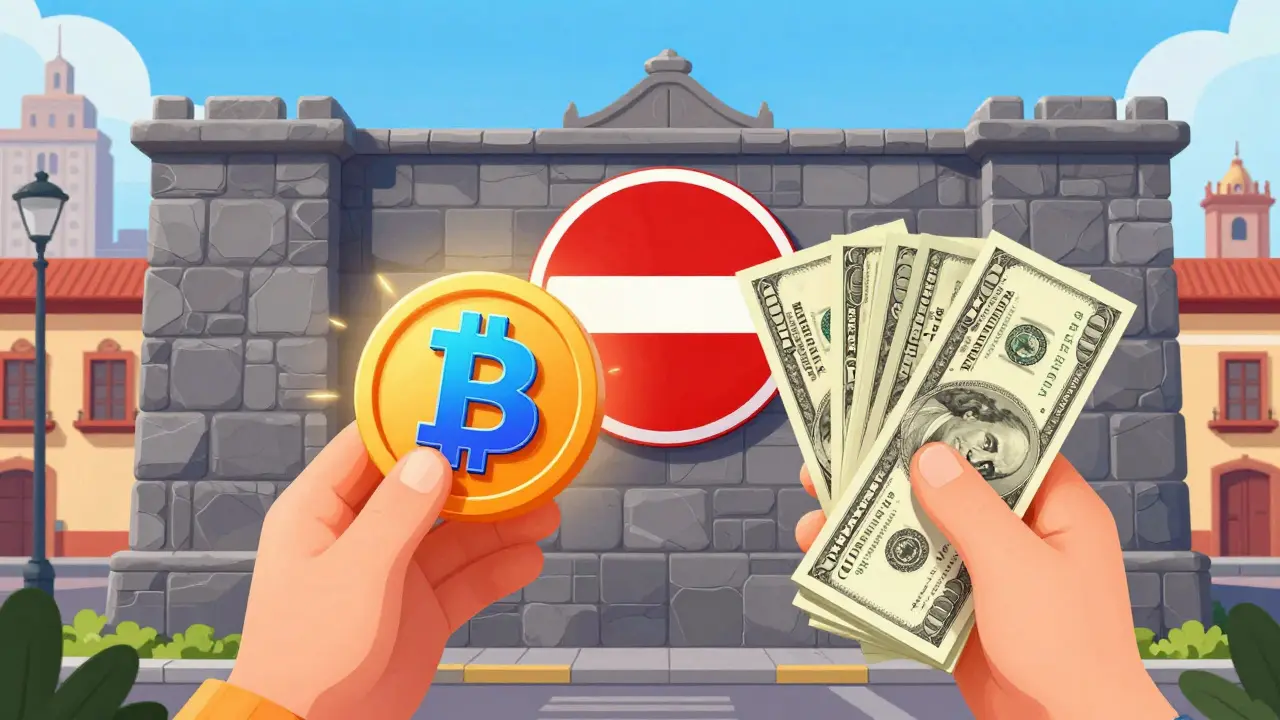
If you're trying to use digital assets in Ecuador, you'll quickly find that the country is a bit of a paradox. While you aren't breaking the law just by owning a few fractions of a coin, the moment you try to spend them at a store or move money through a local bank, you'll hit a brick wall. In a region where neighbors like Mexico and Paraguay are carving out formal spaces for digital assets, Ecuador has chosen a path of cautious distance. The core problem? The government is terrified that any alternative to the US dollar will destabilize the country's dollarized economy.
| Status | Restriction/Rule | Impact |
|---|---|---|
| Ownership | Legal | You can buy and hold assets privately. |
| Payments | Prohibited | Cannot be used as legal tender for goods/services. |
| Banking | Blocked | Banks routinely freeze crypto-related transfers. |
| Taxes | Progressive | Gains are taxed as income (up to 35%). |
The Legal Gray Area: Ownership vs. Usage
To understand the situation, we have to look at the Central Bank of Ecuador (BCE), which is the ultimate authority on money in the country. According to the BCE's August 2024 stance, cryptocurrencies are not legal tender. This isn't just a suggestion; it's backed by Article 94 of the Organic Monetary and Financial Code. Essentially, if it isn't a US dollar, it's not an authorized means of payment.
But here is where it gets confusing: the BCE has admitted it has no power to ban private transactions. This means that Bitcoin and other tokens exist in a "gray area." You can legally buy them and hold them in a wallet, but you can't walk into a cafe in Quito and pay for your coffee with them. If a business accepts crypto, they are technically operating outside the authorized payment framework, and the government provides zero consumer protection for these deals. If you get scammed in a P2P trade, don't expect the authorities to help you get your funds back.
Banking Barriers and the "Freeze" Effect
The biggest headache for any crypto enthusiast in Ecuador is the banking system. The Superintendency of Banks (SB) keeps a tight leash on how money moves. They essentially prohibit any cryptocurrency-related transfers within the formal financial system. This creates a nightmare scenario for users: you try to send a transfer to an exchange like Binance, and your bank account is frozen within 24 hours.
This isn't just an occasional glitch. Local users on community forums frequently report account freezes for amounts as small as $800. Because card acquirers flag crypto exchanges as high-risk, using a local debit or credit card to buy assets is nearly impossible. This has pushed the market underground, where people rely on peer-to-peer (P2P) networks and Telegram-based over-the-counter (OTC) desks. In these circles, you typically trade USD cash for stablecoins like USDT, often paying a premium of 8% to 12% above the global market price just to get around the banking blocks.
The Mining Struggle: Power and Costs
You might wonder why Ecuador hasn't become a mining hub like some other Latin American nations. The answer comes down to economics and infrastructure. While mining isn't explicitly illegal, it's practically unsustainable for large-scale operations. Electricity costs average around $0.145/kWh, which is about 23% higher than the regional average. When you add in 35% import duties on specialized hardware, the math simply doesn't work for big firms.
Furthermore, the power grid is unreliable. Data from 2023 shows Andean grid outages averaging nearly 15 hours per month. For a miner, a power cut isn't just an annoyance; it's lost revenue and potential hardware damage. As a result, mining in Ecuador is mostly a hobbyist activity, with small setups tucked away in residential areas of Quito or the coast. The total hash rate is a tiny fraction of the global capacity, making the country a non-player in the industrial mining scene.

Taxes and Compliance: The SRI's Role
Just because the government doesn't like crypto as a payment method doesn't mean they don't want a piece of the profit. The Internal Revenue Service (SRI) treats realized cryptocurrency gains as Ecuador-source income. This means if you sell your assets for a profit, you're on the hook for taxes.
For individuals, this is a progressive tax that can climb up to 35%. For firms, the rate is typically around 25%. The catch is that since there's no formal regulatory framework for crypto businesses, most people ignore these taxes until they try to move large sums of money back into the formal banking system, at which point the SRI and the Superintendency of Banks may start asking questions about the origin of the funds.
Remittances: The Driving Force of Adoption
Despite all these hurdles, cryptocurrency restrictions in Ecuador haven't stopped people from using digital assets. The primary driver is remittances. Ecuador receives billions of dollars annually from citizens working abroad, but the fees are brutal-averaging around 6.3%.
For a family receiving money from the US or Spain, using a stablecoin to bypass traditional remittance agencies is a lifesaver. It's faster and often cheaper, even after factoring in the fees charged by informal OTC desks. This is why, despite the BCE's warnings, a dedicated community of users continues to grow. They aren't looking to overthrow the dollar; they just want a cheaper way to get money home to their families.
Regional Comparison: How Ecuador Stacks Up
When you look at the map, Ecuador is an outlier. While it shares a border with countries moving toward clarity, it remains stuck in a cycle of avoidance. Let's look at how it compares to its neighbors:
- Paraguay: Has a 2022 law that allows crypto payments and mining, provided you register and follow anti-money laundering (AML) rules.
- Mexico: Uses its 2018 Fintech Law to classify crypto as virtual assets, creating a clear (though strict) licensing path for service providers.
- Peru: Recently required Virtual Asset Service Providers (VASPs) to register with their Financial Intelligence Unit, moving toward a managed-risk model.
Ecuador's strategy is focused entirely on protecting the dollar. The government fears that if a digital asset becomes too popular, it could lead to capital flight-essentially, money leaking out of the country in ways the BCE cannot track. This fear has led them to ignore the potential for financial inclusion, leaving about 50% of the adult population without a bank account but with no legal way to access modern fintech tools.
Looking Ahead: CBDCs and the 2026 Outlook
Is there any hope for a more open system? The BCE has been playing around with the idea of a retail Central Bank Digital Currency (CBDC). The plan is to create a digital version of the dollar, pegged 1:1. This would allow the government to modernize payments without giving up control to decentralized assets like Bitcoin.
By 2026, we expect a clash between the government's desire for control and the market's demand for efficiency. Fintech startups are already pushing for a regulatory framework, arguing that the current "gray area" actually increases risk by pushing all activity into unregulated Telegram groups. If Ecuador follows the regional trend, we might see a shift toward a registration-based system, but for now, the official word remains: don't use it as money, and don't expect your bank to help you.
Is it illegal to own Bitcoin in Ecuador?
No, it is not illegal to buy, own, or sell cryptocurrencies in Ecuador. The government does not ban the private ownership of digital assets. However, they are not recognized as legal tender, meaning you cannot legally use them to pay for goods or services in a commercial setting.
Why do Ecuadorian banks block crypto transfers?
The Superintendency of Banks prohibits financial institutions from facilitating cryptocurrency transactions. Because these assets are not authorized means of payment, banks view transfers to exchanges as high-risk or unauthorized, which often leads to the account being frozen for investigation.
How are cryptocurrency gains taxed in Ecuador?
The Internal Revenue Service (SRI) taxes realized gains from cryptocurrency as source income. For individuals, this falls under a progressive tax scale that can reach up to 35%, while firms are generally taxed at a rate of 25%.
Can I mine cryptocurrency in Ecuador?
Yes, mining is not expressly prohibited. However, it is very difficult to make a profit due to high electricity costs (averaging $0.145/kWh), frequent power outages, and expensive import duties (35%) on mining hardware.
What is the best way to buy crypto in Ecuador given the restrictions?
Most users rely on Peer-to-Peer (P2P) platforms or trusted local OTC desks. By trading cash (USD) directly with another person, users can bypass the banking blocks, though this often involves paying a premium over the global market price and carries a higher risk of fraud.
Next Steps for Users
If you are currently navigating the Ecuadorian crypto landscape, your approach depends on your goal:
- For Long-term Holders: Avoid using local bank accounts for direct exchange transfers. Use P2P methods to fund your account and store assets in a hardware wallet to minimize risk.
- For Remittance Users: Stick to stablecoins like USDT to avoid volatility. Always verify your OTC provider through community-vetted lists on platforms like Reddit or Telegram to avoid common scams.
- For Entrepreneurs: Be aware that any fintech service must now be incorporated as a sociedad anónima with a minimum capital of $200,000 to be legally compliant in 2025/2026.