

YFX Leverage Risk Calculator
Risk Analysis Tool
Results
Critical Risk Warning
YFX has been described as a "decentralized experiment that ran out of steam" with minimal maintenance. This calculator shows theoretical risks only. Trading on YFX carries extreme risk of liquidation due to low liquidity and unreliable price feeds as mentioned in the article. You could lose your entire investment. This tool is for educational purposes only.
When you hear "YFX crypto exchange," you might think of a user-friendly platform like Binance or Coinbase. But YFX isn’t like that at all. It’s a decentralized perpetuals protocol built for advanced traders who want to go long or short on Bitcoin and Ethereum with up to 100x leverage-without handing over control of their funds. That’s the promise. But here’s the reality as of late 2025: YFX is still alive, but barely. It’s not dead, but it’s not thriving either. If you’re thinking of trading on it, you need to know what you’re getting into.
What Exactly Is YFX?
YFX launched in 2020 as a cross-chain decentralized exchange for perpetual contracts. Unlike centralized exchanges, it doesn’t hold your crypto. You connect your wallet-MetaMask, Trust Wallet, or any EVM-compatible one-and trade directly against liquidity pools. The protocol runs on Ethereum, Binance Smart Chain, TRON, OKEx Chain, Huobi Ecological Chain, and Base. That’s six blockchains. Most competitors only support one or two.
Its secret sauce is something called QIC-AMM: Quoted Index Price - Automated Market Maker. Instead of using the standard Uniswap-style pricing formula, YFX pulls price data from trusted oracles and lets market makers quote bid-ask spreads based on real-time index prices. The idea? Less slippage during big price swings. And for high-leverage trades, that matters. If BTC drops 5% in 30 seconds, you don’t want your position liquidated because the AMM couldn’t keep up.
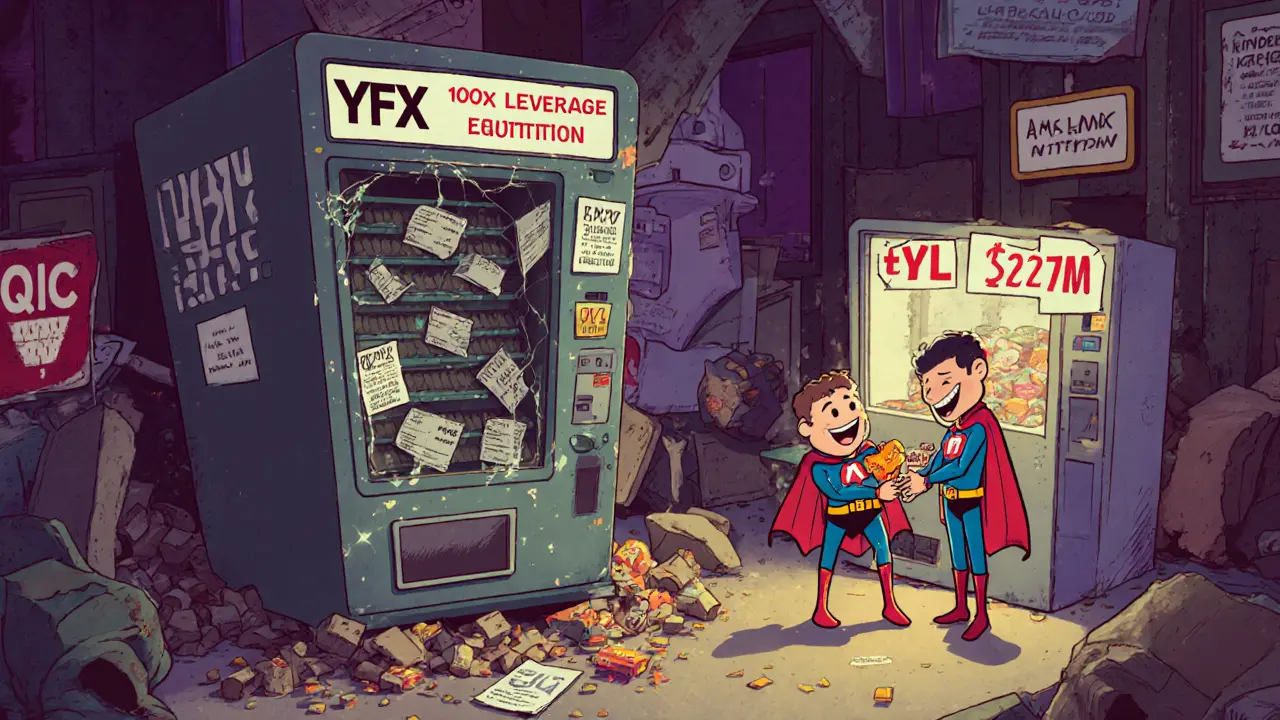
But here’s the catch: YFX stopped running official platforms in May 2025. Yes, that date is in the future as of now, and it’s likely a typo. But the effect is real. There’s no YFX website anymore. No official app. No customer support team. What’s left are the smart contracts on-chain and a handful of community-run Telegram groups. You’re trading on ghost code.
Performance: Leverage, Liquidity, and Slippage
YFX offers up to 100x leverage. That’s double what GMX offers and five times what dYdX allows. For experienced traders, that’s tempting. But high leverage doesn’t mean high success. It means high risk. And YFX’s liquidity doesn’t match its ambition.
As of November 2023, YFX’s total value locked (TVL) was just $18.7 million. Compare that to dYdX’s $327 million or GMX’s $152 million. That’s not a small gap-it’s a canyon. Most of YFX’s volume (68%) comes from Arbitrum. Base chain accounts for 22%. The other four chains? Barely any activity. That means if you’re trading on TRON or OKEx Chain, you’re likely dealing with thin order books. One big trade can move your price by 3% before your order fills.
Users report mixed results on slippage. Some say YFX handles BTC spikes better than other DeFi platforms. Others say they got liquidated during a 2% drop because the system didn’t update the index price fast enough. That’s not just bad luck-it’s a flaw in the oracle design. CertiK flagged this in 2023: incomplete documentation on how QIC-AMM calculates prices creates oracle manipulation risks during extreme volatility.
The YFX Token: A Ghost in the Machine
The YFX token was supposed to be the backbone of governance and incentives. Max supply: 100 million. But as of late 2023, both circulating and total supply showed up as zero on CoinMarketCap. No tokens were ever distributed. No airdrops. No staking rewards. No burn mechanisms. The token exists only on paper-and even that’s questionable.
Why? Because the protocol transitioned to a fully open-source, community-run model. No team. No treasury. No roadmap. That sounds noble, but in practice, it means no one’s paying for audits, bug bounties, or server costs. The GitHub repo has 14 contributors and 37 commits in the last 90 days. That’s not zero-but it’s not enough to keep a live, high-risk DeFi protocol running safely.
And here’s something you won’t find on their old website: YFX makes almost no money. It charges a 0.05% trading fee, and 70% of that goes to liquidity providers. The rest? That’s supposed to fund development. But in a 30-day window, YFX generated just $18,432 in protocol fees. Meanwhile, estimated monthly operational costs-including audits, monitoring, and community moderation-are around $120,000. That’s a $100,000 monthly deficit. Who’s paying it? No one.
Security and Risk: What Could Go Wrong?
YFX has been audited. CertiK did two audits in 2023. They found two medium-severity vulnerabilities in V3 smart contracts. Both were patched. That’s good. But audits don’t catch everything.
Here’s the real danger: liquidation engine errors. Users on CoinMarketCap and Reddit report getting liquidated at prices that didn’t match the market. One user, "MarginCallSurvivor," described being wiped out during a Bitcoin crash because YFX’s liquidation trigger fired 12 seconds after the real price drop. That’s not a bug-it’s a design flaw. The system relies on off-chain oracles and on-chain execution. If the timing is off by even a few seconds, your position dies.
And there’s no safety net. No insurance fund. No compensation policy. If you lose money because of a glitch, you lose it. Period. That’s the trade-off for decentralization. But with YFX, you’re not just trusting the code-you’re trusting code that no one is actively maintaining.
Who Is YFX Even For?
Let’s be honest: YFX isn’t for beginners. It’s not even for intermediate traders. It’s for a very specific kind of person:
- You’ve traded perpetuals on dYdX or GMX before and know how funding rates work.
- You’ve lost money on leverage and learned how to manage risk.
- You’re comfortable using a wallet, approving transactions, and reading contract addresses.
- You’re okay with zero customer support and 8-hour response times on Telegram.
- You’re willing to risk your capital on a protocol with no team, no funding, and no future roadmap.
If you’re looking for a reliable place to trade BTC with 20x leverage and decent liquidity? Go to dYdX or GMX. If you want to experiment with a high-leverage, cross-chain experiment that might vanish tomorrow? Then YFX is your playground.
Alternatives: What’s Better?
YFX doesn’t exist in a vacuum. Here are the three alternatives you should consider instead:
| Platform | Max Leverage | TVL (USD) | Chains Supported | Support | Best For |
|---|---|---|---|---|---|
| YFX | 100x | $18.7M | 6 | Community Telegram (8+ hrs) | High-risk experimenters |
| dYdX | 20x | $327M | 1 (StarkNet) | 24/7 Discord, email | Traders who want reliability |
| GMX | 50x | $152M | 2 (Arbitrum, Avalanche) | Fast Discord response | High-leverage + low slippage |
GMX is the closest thing to YFX’s ambition-high leverage, cross-chain, good liquidity. But it’s focused. It doesn’t try to be everything. It’s on Arbitrum and Avalanche, where volume is. dYdX is the most mature. It’s got institutional backing, a real team, and a clear path forward. YFX? It’s a prototype that never got funded.
The Bottom Line
YFX is not a crypto exchange you can trust. It’s a decentralized experiment that ran out of steam. The tech is clever. The idea-cross-chain perpetuals with high leverage-is ahead of its time. But execution? It’s broken. The token doesn’t exist. The team is gone. The funding is zero. The support is nonexistent.
If you’re curious, you can still connect your wallet and trade on Arbitrum or Base. But treat it like a sandbox. Put in $50. See how it feels. Don’t risk your life savings. Because if the protocol crashes tomorrow, there’s no one to call. No refund. No recourse.
YFX was never meant to be a long-term solution. It was a proof of concept. And as of 2025, that proof is complete. The experiment is over. The code is still there. But the heart isn’t beating.
Is YFX still operational in 2025?
Yes, but only technically. The smart contracts are still live on Arbitrum, Base, and a few other chains. But there’s no official website, no team, no customer support, and no active development. Trading is possible, but you’re on your own.
Can I withdraw my funds from YFX?
Yes. Since YFX is decentralized, your funds are always in your wallet. You can close positions and withdraw assets at any time. The protocol doesn’t hold your crypto. But if the liquidity pool dries up on your chain, you might face slippage or delays when exiting large positions.
Is the YFX token worth anything?
No. As of late 2023, the circulating supply of YFX tokens is zero. No tokens were ever distributed to users or liquidity providers. Any website or exchange listing YFX as a tradable token is either fraudulent or misleading.
Why is YFX so much less popular than dYdX or GMX?
Because it lacks liquidity, team support, and a clear future. dYdX and GMX have real teams, funding, marketing, and user support. YFX has code on a blockchain and a few Reddit threads. Without ongoing development and incentives, users naturally move to platforms that are safer and more reliable.
Should I use YFX for high-leverage trading?
Only if you’re prepared to lose everything. The 100x leverage is tempting, but the risk of liquidation is extremely high due to thin liquidity and unreliable price feeds. Even experienced traders have lost significant sums. Use it for testing, not trading.


Savan Prajapati
YFX is dead. Move on.