
You might think Non-Fungible Tokens (NFTs) are just expensive JPEGs or digital collectibles. But underneath the hype lies a complex technical infrastructure that determines how you buy, sell, and own these assets. That infrastructure is built on NFT token standards. These standards act as the rulebook for blockchains, ensuring that your wallet can read your asset and that marketplaces can display it correctly. Without them, digital ownership would be a chaotic mess of incompatible codes.
The journey from experimental code to global standard has been rapid and messy. We’ve moved from clunky early experiments to sophisticated systems that allow tokens to have their own wallets. Understanding this evolution isn’t just for developers; it helps creators choose the right platform, investors avoid broken links, and users understand why some transactions cost $0.001 while others cost $50. Let’s look at how we got here and where we’re going.
Pre-History: Before the Standards Existed
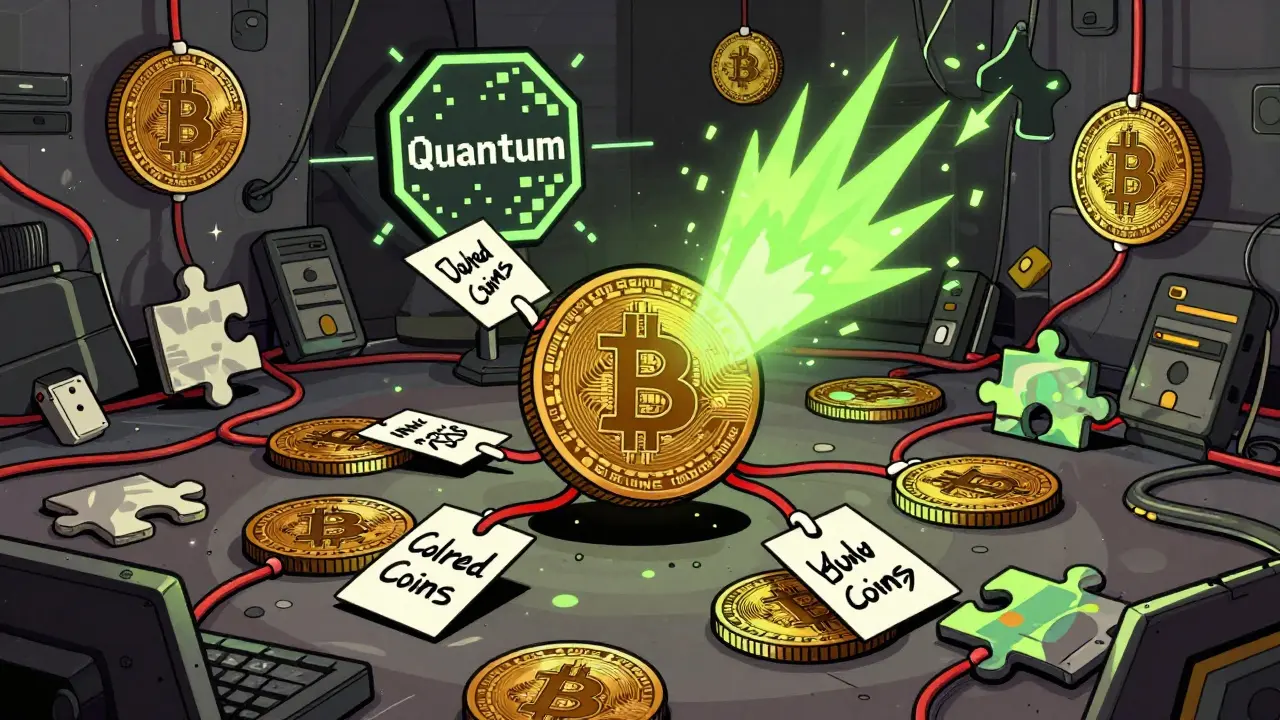
Before there were formal rules, there was experimentation. The concept of representing unique assets on a blockchain started way before Ethereum became the go-to chain for NFTs. In 2012, Meni Rosenfield published a paper introducing "Colored Coins" on the Bitcoin network. The idea was simple: use Bitcoin’s ledger to track metadata for real-world assets like real estate. It was a clever hack, but Bitcoin wasn’t designed for this kind of complexity. The process was slow, expensive, and limited in functionality.
Then came the first actual NFT. On May 3, 2014, digital artist Kevin McCoy created a piece called "Quantum" on the Namecoin blockchain. It was a pixelated octagon that changed color and pulsed. It didn’t have a standardized contract; it was a one-off experiment. For years, these isolated projects struggled because every developer wrote their own custom code. If you bought an NFT on one platform, you couldn’t necessarily move it to another. Interoperability was non-existent.
The Breakthrough: ERC-721 and CryptoKitties
The game-changer arrived in January 2018 with the publication of ERC-721. This Ethereum Improvement Proposal established the first formal guidelines for creating, managing, and transferring non-fungible tokens. It defined mandatory functions like `balanceOf` (checking how many tokens you hold), `ownerOf` (who owns a specific token), and `transferFrom` (moving tokens between addresses).
Why did ERC-721 take off? Because of CryptoKitties. Launched in November 2017 using an early version of what would become ERC-721, CryptoKitties was a viral hit. People were breeding digital cats and selling them for thousands of dollars. The demand was so high that it actually congested the entire Ethereum network, causing transaction fees to skyrocket. While this highlighted scalability issues, it also proved that people wanted standardized, tradable digital scarcity. By Q2 2023, over 87% of NFT collections on Ethereum still used ERC-721. Its simplicity made it the default choice for high-value digital art, including iconic projects like CryptoPunks.
Solving Efficiency: Enter ERC-1155
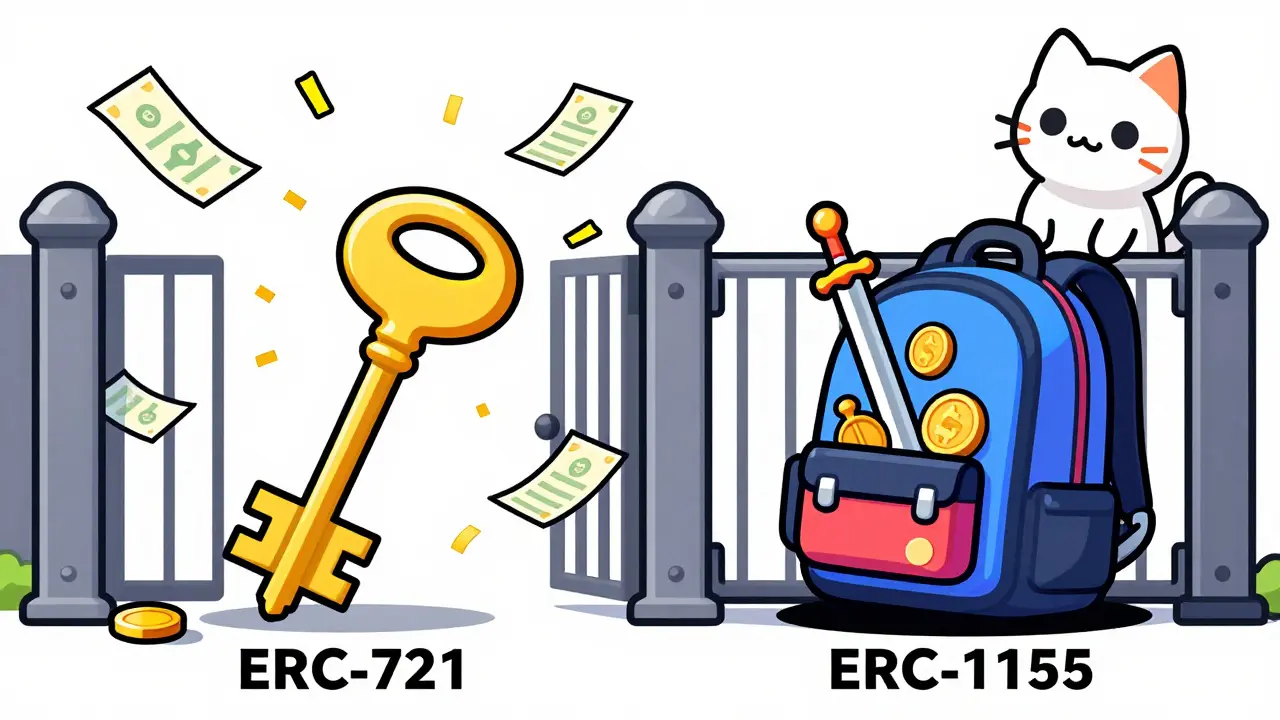
ERC-721 had a major flaw: inefficiency. Every time you transferred an ERC-721 token, it required a separate transaction. If you wanted to send 10 different items to a friend, you paid gas fees ten times. This was a nightmare for gaming applications where players might trade dozens of items daily.
In June 2018, Witek Radomski from Enjin proposed ERC-1155. This multi-token standard allowed both fungible (like currency) and non-fungible tokens to exist within a single smart contract. The biggest benefit? Batch transfers. You could send multiple different tokens in one transaction, reducing gas costs by up to 90%. Gaming platforms loved it. Axie Infinity, for example, migrated 2.1 million assets from ERC-721 to ERC-1155 in late 2021, cutting their gas costs by 83%. Today, ERC-1155 dominates the gaming sector, handling everything from rare swords to common gold coins efficiently.
| Feature | ERC-721 | ERC-1155 | Solana Metaplex |
|---|---|---|---|
| Primary Use Case | High-value digital art | Gaming, utility tokens | High-volume social NFTs |
| Batch Transfers | No (inefficient) | Yes (highly efficient) | Yes |
| Avg. Transfer Cost | $1.42+ (Ethereum) | $0.15 (batched) | $0.00025 |
| Market Share (Ethereum) | ~87% | ~11% | N/A (Different Chain) |
| Key Limitation | High gas fees | Complex implementation | Lower security guarantees vs. ETH |
Beyond Ethereum: Alternative Chains
While Ethereum set the initial standard, other blockchains developed their own approaches to address speed and cost. Solana, for instance, uses the Metaplex protocol. Solana’s architecture allows for thousands of transactions per second, making NFT transfers nearly free-averaging $0.00025 per transfer in mid-2023. This made Solana popular for social media NFTs and high-volume drops. However, critics argue that Solana’s security model lacks the robustness of Ethereum’s long-tested ecosystem. Choosing between Ethereum and Solana often comes down to a trade-off: Ethereum offers higher security and prestige for blue-chip assets, while Solana offers speed and affordability for mass-market adoption.
The Next Frontier: Smart NFTs and Interoperability
The latest developments aim to make NFTs more than just static images. They are becoming active participants in the blockchain economy.
One significant update is EIP-6454, finalized in May 2023. This proposal introduces a standardized way to verify token ownership without transferring the asset itself. This is crucial for membership models. Imagine needing to prove you own a specific ticket to enter a virtual event without handing over the ticket. EIP-6454 enables this seamless verification, which platforms like OpenSea and Rarible have already integrated into their creator verification systems.
Even more revolutionary is ERC-6551, proposed in early 2023. This standard creates "token-bound accounts." Essentially, it gives an NFT its own wallet. Your NFT can now hold other assets, interact with DeFi protocols, and have its own transaction history independent of your personal wallet. This turns an NFT from a passive image into an active digital entity. For example, a virtual land deed could automatically pay property taxes or earn rental income through its own associated wallet.
Practical Challenges for Users and Developers
Despite these advancements, friction remains. A persistent issue is "link rot." Many ERC-721 contracts store metadata (the image URL and description) on centralized servers. If the project team shuts down their server, the NFT becomes a blank square. A 2023 report by Nansen found that 12.7% of NFT collections had broken metadata links. To combat this, developers increasingly recommend using decentralized storage solutions like IPFS or Filecoin’s NFT Storage for permanent pinning.
For developers, the learning curve varies. Implementing a basic ERC-721 contract takes experienced Solidity developers about 8-12 hours using libraries like OpenZeppelin. Beginners, however, may spend 40-60 hours debugging issues like incorrect token URI resolution. The community has grown significantly to support this, with Ethereum’s NFT Developers Discord expanding to nearly 50,000 members, offering regular office hours with core protocol developers.
Future Outlook: Standardization and Regulation
As we move further into 2026, the trend is toward hybrid standards and greater interoperability. Gartner predicts that by 2025, 70% of enterprise NFT implementations will use hybrid standards combining elements of ERC-721, ERC-1155, and custom extensions. This reflects a need for flexibility that single standards cannot provide.
Cross-chain bridges are also evolving. Protocols like Polygon’s PoS bridge handle millions of NFT transfers monthly, allowing assets to move between Ethereum and Layer 2 solutions. However, regulatory clarity remains a hurdle. The Bank for International Settlements noted in 2023 that current standards lack the regulatory framework needed for widespread financial integration. As governments catch up, we may see new compliance-focused standards emerge, potentially integrating identity verification directly into token structures.
What is the main difference between ERC-721 and ERC-1155?
The primary difference is efficiency. ERC-721 treats each token as a unique, separate entity, requiring individual transactions for transfers. ERC-1155 allows multiple token types (both fungible and non-fungible) to exist in a single contract, enabling batch transfers that significantly reduce gas fees. ERC-721 is best for unique art pieces, while ERC-1155 is ideal for gaming items or large collections.
Why do some NFTs turn into blank squares?
This happens due to "link rot." Many older NFTs store their image files on centralized web servers rather than decentralized storage like IPFS. If the project team goes bankrupt or shuts down their server, the link to the image breaks, leaving your wallet displaying a blank placeholder even though you still own the token ID.
Is Solana better than Ethereum for NFTs?
It depends on your needs. Solana offers much lower transaction fees ($0.00025 vs. $1.42+) and faster speeds, making it great for high-volume, low-cost items like social badges. Ethereum offers higher security, a larger established market, and better liquidity for high-value assets. Most serious collectors keep assets on Ethereum, while casual users often prefer Solana.
What does ERC-6551 mean for NFT owners?
ERC-6551 gives NFTs their own "wallets." This means your NFT can hold other assets, interact with decentralized finance apps, and maintain a separate transaction history. It transforms NFTs from static collectibles into active digital entities that can generate value or perform tasks independently.
How do I ensure my NFT metadata stays safe?
If you are creating NFTs, always store metadata and image files on decentralized storage networks like IPFS or Arweave. Avoid relying solely on centralized servers. For buyers, check if the project uses decentralized storage; reputable projects will list their IPFS hashes in the contract details.