
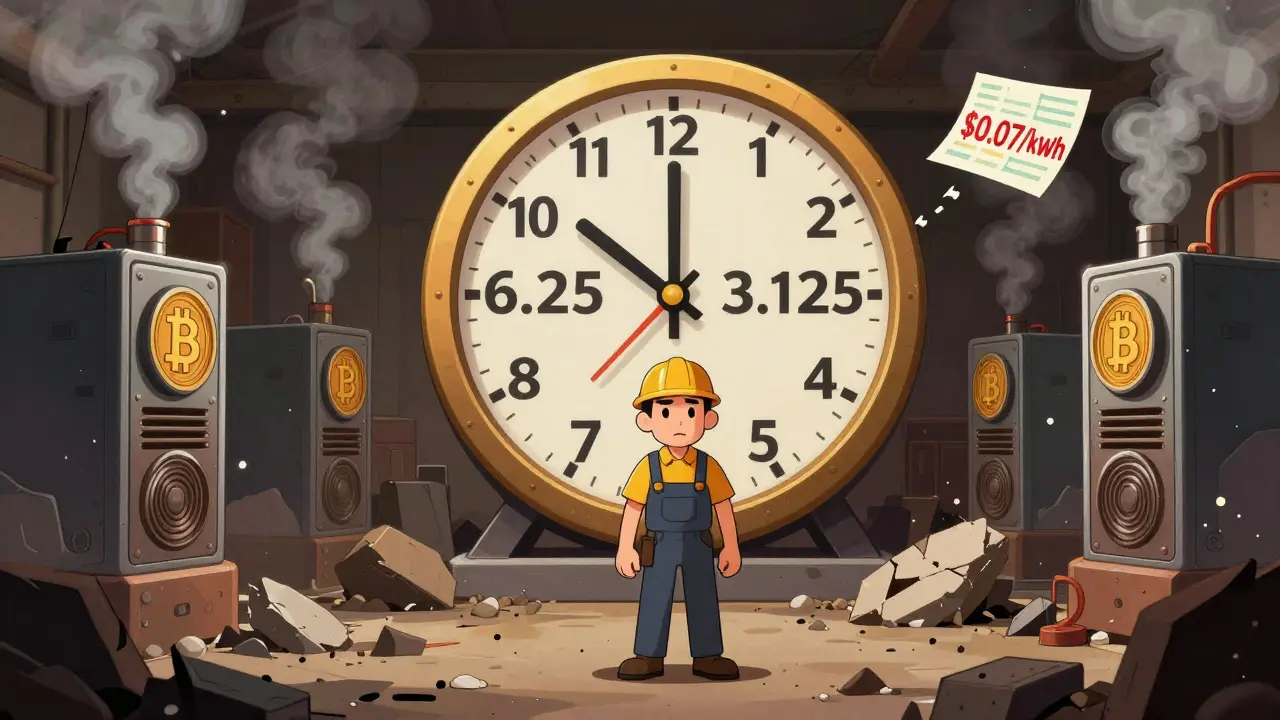
When Bitcoin’s block reward cuts in half, it doesn’t just change a number on a screen-it reshapes the entire mining industry. For miners, this isn’t a theoretical event. It’s a financial earthquake that happens every four years, and the one that hit in April 2024 was the most brutal yet. Suddenly, every miner got paid exactly half as much Bitcoin for the same amount of electricity and hardware they used before. That’s not a slowdown. That’s a full-on revenue shock.
What Exactly Happens During a Halving?
Bitcoin’s halving is built into its code. Every 210,000 blocks, the reward miners get for validating transactions drops by 50%. Before April 2024, miners earned 6.25 BTC per block. After the halving, that dropped to 3.125 BTC. It’s a hard rule, no exceptions. This mechanism was designed by Satoshi Nakamoto to slowly reduce Bitcoin’s supply, making it deflationary over time. But for miners, it’s pure survival mode.
Before the halving, block rewards made up about 98% of miner income. Transaction fees? Barely a footnote. But after the cut, that 98% becomes 49%. Suddenly, the tiny slice of revenue from fees-usually under 5%-is now almost half of what keeps the lights on. That’s why miners watch Bitcoin’s price like hawks after a halving. If the price doesn’t rise fast enough, many simply can’t afford to keep mining.
The Immediate Aftermath: Who Gets Hurt First?
The first thing you notice after a halving is the drop in production. In the weeks following the April 2024 event, major mining companies saw their Bitcoin output plummet. Bitdeer dropped 31%. Marathon Digital lost 28%. Iris Energy, Cleanspark, Bitfarms, Riot Platforms, and Terawulf all saw declines between 20% and 25%. These weren’t glitches. These were math. Each machine was now producing half the Bitcoin it did before, with no change in power bills or maintenance costs.
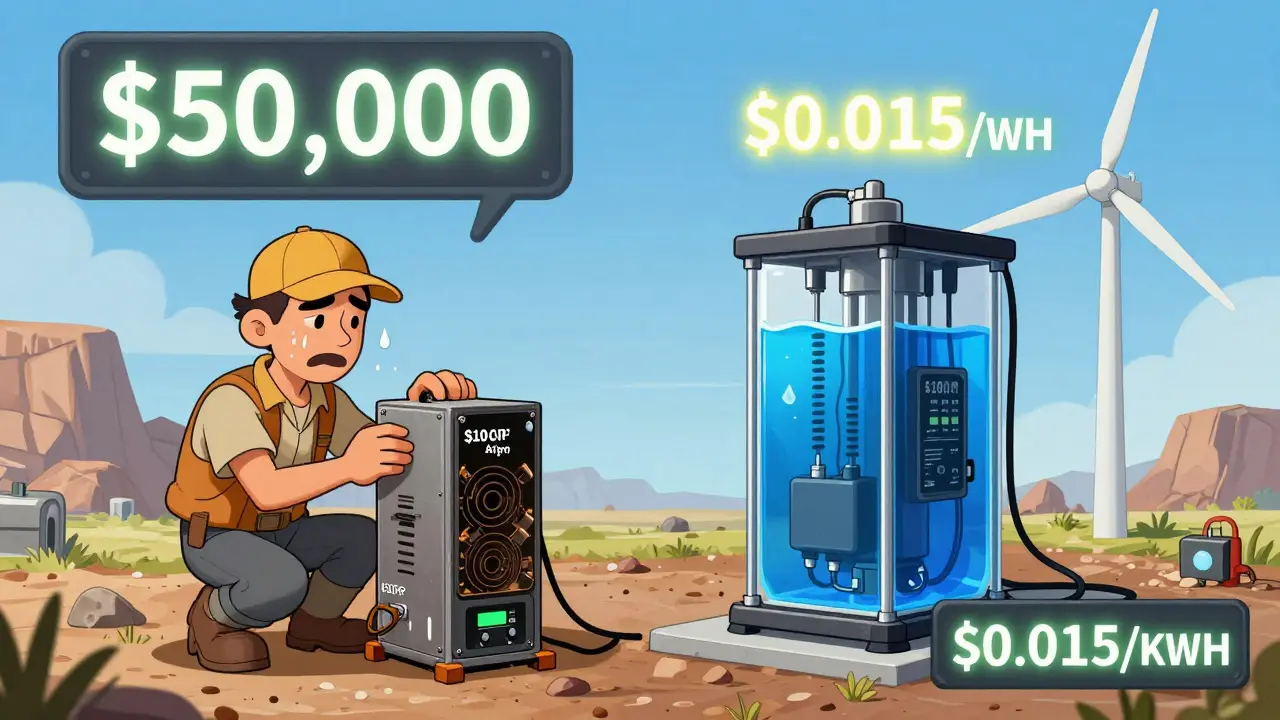
Miners with high electricity costs got hit hardest. If you’re paying more than $0.08 per kWh, your break-even price for Bitcoin jumped from around $35,000 to over $50,000 overnight. That’s not a small adjustment. That’s a deal-breaker. On Reddit, one miner named MiningGuru87 said he shut down 40% of his Antminer S19j Pro rigs because his electricity cost hit $0.07 per kWh. "My break-even price jumped from $28,000 to $49,000," he wrote. "I had no choice."
Smaller miners without access to cheap energy or deep cash reserves were forced out. Some sold their machines. Others shut down entire facilities. The result? A temporary drop in the network’s hash rate-total computing power-by 15% to 30%. That’s what happened after every previous halving. It’s not a bug. It’s a feature. The system purges the least efficient operators.
The Winners: Who Survives-and Thrives?
The miners who made it through the 2024 halving didn’t just survive. They adapted. The winners had three things in common: cheap energy, modern hardware, and financial buffer.
Take Iris Energy. They didn’t just cut costs-they reinvented their setup. By switching to immersion cooling (a method where mining rigs are submerged in non-conductive liquid), they boosted efficiency by 18%. That allowed them to stay profitable even when Bitcoin was trading at $32,000. Meanwhile, another miner, HashRateHero, moved his entire operation to a natural gas site in Texas where electricity cost just $0.015 per kWh. That’s less than half the price of the average U.S. grid rate.
Companies with access to stranded energy-hydroelectric dams, flare gas from oil fields, excess wind power-gained a massive edge. In places like Canada, Iceland, and parts of Texas, electricity can cost as little as $0.02 to $0.03 per kWh. Miners there didn’t just survive. They expanded.
And then there’s capital. The biggest players didn’t wait for the halving to prepare. They spent months before it securing loans, locking in long-term energy contracts, and buying next-gen ASICs. Fidelity Digital Assets says miners need at least six months of operating expenses in cash or stablecoins to weather the post-halving price slump. Those who didn’t? They got squeezed out.
The Hardware Race: Why Your Miner Is Already Obsolete
Before the 2024 halving, a typical mining rig lasted about 24 months. Now? It’s 14 months. That’s not a typo. The average lifespan of a Bitcoin miner has been cut in half.
Why? Because efficiency matters more than ever. Newer ASICs like the Bitmain Antminer S21 and MicroBT WhatsMiner M56S are 30-40% more energy-efficient than models from just two years ago. If you’re still running an S19 Pro, you’re losing money on every hash. That’s why miners are replacing rigs faster than ever. The industry’s hardware refresh cycle is now a race, not a slow upgrade.
Even more telling: 22% of major mining firms are now repurposing their excess computing power for AI workloads. Iris Energy signed a $200 million deal with an AI startup to use idle mining rigs as data centers. It’s not just mining anymore. It’s computing infrastructure.
What About Transaction Fees? Will They Save Us?
One big hope after a halving is that transaction fees will rise to fill the gap. And for a while, it looked promising. After the April 2024 halving, BRC-20 token inscriptions spiked. Transaction fees jumped 37% in May 2024, contributing 6.8% of total miner revenue-up from 3.2% in April.
But here’s the catch: that spike was temporary. Inscription activity doesn’t equal sustainable demand. The network still needs 35% of miner income to come from fees by 2028 to maintain security. Right now, it’s under 7%. That gap is huge. If Bitcoin doesn’t become a daily transactional currency-and not just a store of value-miners could face a long-term revenue crisis.
LSEG warns that if fees never rise enough, the network could become vulnerable. Fewer miners mean less hash rate, which makes a 51% attack more possible. That’s not a fear. It’s a mathematical risk.
The Bigger Picture: Is Halving Good or Bad for Bitcoin?
Some say halvings make Bitcoin more secure. Others say they make it fragile. The truth? Both are right.
On one hand, halvings force the network to evolve. They push miners to use renewable energy. They kill inefficient rigs. They consolidate operations into larger, better-funded companies. According to the Bitcoin Mining Council, the energy used per Bitcoin transaction dropped from 1,544 kWh in 2021 to just 782 kWh by June 2024. That’s a 50% efficiency gain in three years-mostly because halving made waste unaffordable.
On the other hand, the transition is painful. 12 major mining companies merged or were acquired in the six months after the 2024 halving. The top 10 mining pools now control 65% of the network’s hash rate, up from 58% earlier that year. That’s centralization. And centralization is a threat to Bitcoin’s core promise: decentralization.
Still, the long-term trend is clear: Bitcoin mining is becoming an industrial business. Not a hobby. Not a side hustle. It’s a capital-intensive, energy-optimized, globally distributed utility. The miners who thrive aren’t the ones with the most rigs. They’re the ones with the cheapest power, the smartest engineers, and the deepest pockets.
What’s Next? The 2028 Halving and Beyond
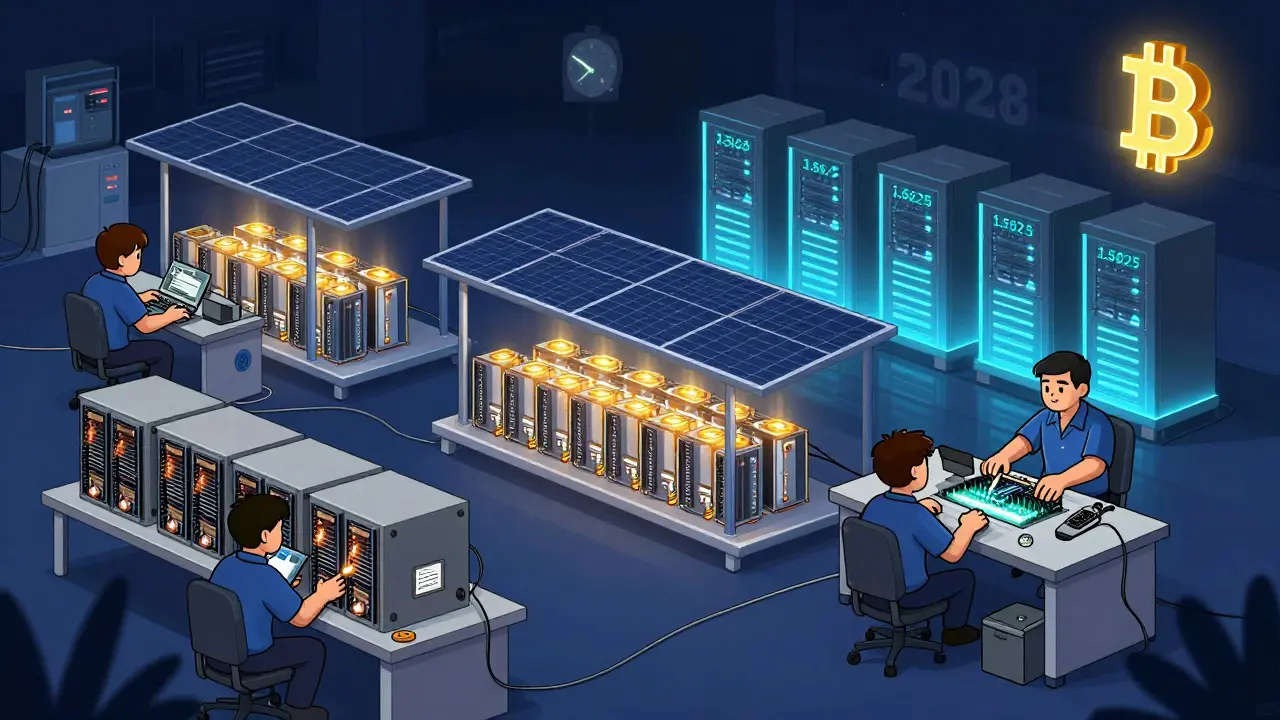
The next halving is scheduled for August 2028. By then, the block reward will drop to 1.5625 BTC. That’s less than a quarter of what miners earned before the 2024 event. If Bitcoin’s price doesn’t rise significantly by then, and if transaction fees don’t surge, the network’s security budget could be in serious trouble.
Blockstream’s modeling says miners will need fees to make up at least 35% of revenue by 2028 to keep the network secure. That’s a massive leap from today’s 7%. The only way that happens is if Bitcoin becomes a widely used digital currency-not just a speculative asset.
For now, miners are betting on price. And they’re betting on innovation. The ones who survive will be the ones who treat mining like a utility company-not a lottery ticket.


Mansoor ahamed
In India, we see this differently. Cheap solar and wind power are making mining viable even after halving. No need for $0.015/kWh Texas deals - just use rooftop panels and battery buffers. It's not about location, it's about adaptation.