

Buying cryptocurrency with Russian rubles isn’t just possible in 2025-it’s a daily reality for nearly 19 million Russians. Despite sanctions, banking restrictions, and shifting regulations, the market has adapted in ways no one predicted. You don’t need a foreign bank account or a VPN to buy Bitcoin, USDT, or Ethereum with RUB. But if you’re new to this, the system can feel like a maze. Banks use color-coded cards. Platforms require passport scans. Some transactions take minutes. Others drag for hours. This guide cuts through the noise. Here’s how to actually buy crypto with rubles in Russia today-without getting scammed, delayed, or locked out.
Understand the Rules Before You Start
Russia doesn’t ban crypto. It just controls how you buy it with rubles. The key law is Federal Law No. 115-FZ, updated in January 2025. It forces exchanges to verify your identity if you’re using RUB. That means: Russian passport, INN (tax ID), and sometimes proof of address. Without this, you’re capped at 600,000 RUB per day. Verified? You can move up to 5 million RUB daily. Crypto-to-crypto trades? No KYC needed. But if you’re putting rubles in, you’re entering the regulated system. And that’s where things get tricky. State banks like Sberbank block direct crypto payments. So platforms created workarounds. You’ll see terms like "green card" and "yellow card"-those aren’t random. Green means Sberbank. Yellow means Tinkoff (now T-Bank). These labels tell you which banks are allowed to process payments. If you pick the wrong one, your payment fails. And you lose time.Choose Your Method: Instant, P2P, or Exchange
There are three main ways to buy crypto with RUB. Each has trade-offs in speed, cost, and safety.- Instant Card Purchases (Best for under 500,000 RUB): Platforms like ChangeNOW and Bitget Wallet let you buy crypto with a debit or credit card in under 10 minutes. No account needed. Just enter your wallet address, pay with your card, and get crypto instantly. Fees? 1.5% to 3.9%. Good for small, quick buys. But you’re limited to 17-20 coins. No trading, no staking. Just buy and go.
- P2P Marketplaces (Best for larger amounts): This is where most Russians trade. Bybit leads here. You pick a seller, agree on a price, pay them via bank transfer, and they release crypto. Fees are lower-0.5% to 2%. Exchange rates are better. But you’re dealing with real people. That means risk. You must check their completion rate. Anything under 95%? Avoid. Minimum 50 transactions? Non-negotiable. Look for "green" (Sberbank) or "yellow" (Tinkoff) labels. Tinkoff has a 92% success rate. Sberbank is 87%. Stick to yellow if you want reliability.
- Traditional Exchanges (Best for advanced users): Bitbanker and EXMO offer full trading interfaces. You can place limit orders, use margin, or just buy instantly. They support bank transfers, SWIFT, and even physical cash deposits in Moscow, Dubai, and Bishkek. Fees average 1.8%. But they require full KYC. Withdrawal delays? Common. Trustpilot shows 327 complaints about slow payouts in Q3 2025. Only use if you’re buying over 1 million RUB and need deep liquidity.
Step-by-Step: Buying Crypto on Bybit (P2P)
Bybit handles over 80% of Russia’s P2P volume. Here’s how to use it:- Download the Bybit app or go to bybit.com. Create an account.
- Complete KYC: Upload your Russian passport and INN. Wait 12-48 hours. Don’t skip this. You’ll hit limits fast without it.
- Click Buy Crypto > P2P Trading.
- Switch to the Sell tab. You’re buying crypto, so you’re buying from sellers.
- Select USDT (Tether). It’s the most liquid RUB pair.
- Filter by RUB as the fiat currency.
- Sort by Completion Rate (highest first). Only pick sellers with 95%+ and 50+ trades.
- Check the bank icon: Yellow = Tinkoff (T-Bank). Green = Sberbank. Yellow is more reliable.
- Click Buy. Enter the amount in RUB.
- Pay within 15 minutes using the bank details shown. Use your Tinkoff or Sberbank app.
- Once you send the money, click Payment Sent in the app.
- Wait for the seller to release USDT. It usually takes 5-20 minutes.
Pro tip: Never release crypto before you see the money hit your account. Always use the platform’s escrow. If a seller pressures you to skip it? Walk away.

Instant Buy: ChangeNOW in 5 Minutes
If you need crypto fast and don’t want to register:- Go to changenow.io.
- Select RUB as your currency.
- Select USDT or BTC as your crypto.
- Enter your wallet address (Bitcoin, Ethereum, etc.). Double-check it.
- Click Exchange.
- You’ll get a bank account number and amount to pay.
- Pay via Sberbank Online, Tinkoff, or MIR card.
- Wait 5-10 minutes. Crypto arrives.
No account. No KYC. But fees are higher. And you can only buy 17 coins. Great for emergencies. Not for long-term holding.
What Banks Work? The Color Code System
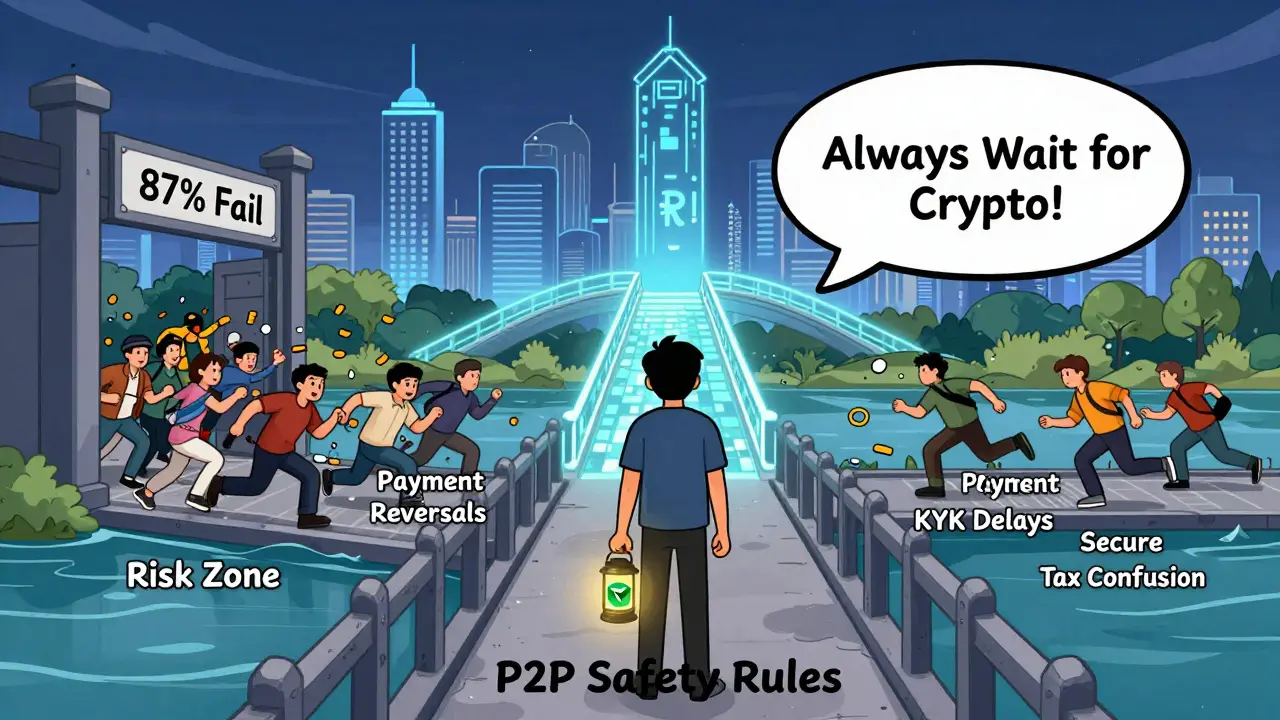
This is critical. Russian banks aren’t treated equally. Platforms classify them by color:- Green Card = Sberbank. Most common, but highest failure rate. 87% success. Payments often get flagged by bank filters.
- Yellow Card = Tinkoff (T-Bank). Best performance. 92% success. Faster processing. Fewer blocks.
- Blue Card = VK Bank, Alfa-Bank. Acceptable. 89% success. Good alternative.
- Red Card = VTB, Gazprombank. Avoid. These banks actively block crypto-related transfers. Even if a seller lists them, payments will likely fail.
Why? State-owned banks like Sberbank and VTB are under pressure from regulators. Tinkoff, as a private bank, has more flexibility. That’s why 78% of successful P2P trades use Tinkoff. If you can, open a Tinkoff account. It’s free. Takes 10 minutes online.
Watch Out for These Traps
The system works-but it’s full of pitfalls.- Payment Reversals: Fraudsters send money, wait for crypto to arrive, then claim they didn’t pay and ask their bank to reverse it. Solution: Only trade with sellers who have 95%+ completion rates and 50+ trades. Never rush.
- KYC Delays: Expect 12-48 hours to get verified. Submit documents during business hours (9 AM-6 PM Moscow time). Weekends? Slower.
- Exchange Rate Slippage: In P2P, prices change fast. Use platforms with price lock. Bybit and Bitget offer 15-minute locks. If you don’t pay in time, the rate resets.
- Withdrawal Freezes: During market spikes, platforms freeze withdrawals. This happened in March 2025. Have a backup plan. Keep some crypto on a non-custodial wallet like Trust Wallet or MetaMask.
- Tax Confusion: The Russian government still hasn’t clarified crypto taxes. 78% of users don’t know if they owe anything. Keep records of every buy/sell. Use apps like Koinly or CoinTracker. You’ll need them when rules change.
What’s Next? Digital Ruble and 2026
The Central Bank launched its digital ruble in July 2025. It’s not replacing crypto. It’s working alongside it. The digital ruble is meant for everyday payments-groceries, bills, salaries. Crypto? That’s for savings, cross-border transfers, and inflation protection.Big changes are coming. Deloitte Russia predicts transaction costs will drop 35-50% by 2026 as the digital ruble connects with crypto platforms. Sberbank’s blockchain lab is already testing integrations with three exchanges. But full banking access? Unlikely before 2026.
For now, the system is messy. But it works. Russians are buying $285 million in crypto daily using rubles. You can too. Just follow the rules. Stick to verified sellers. Use Tinkoff. Avoid Sberbank for large transfers. And never skip KYC.
Final Checklist Before You Buy
- ✅ Do you have a Russian passport and INN? (Required for KYC)
- ✅ Are you using Tinkoff (yellow) or a blue card? (Avoid Sberbank for big buys)
- ✅ Is your seller’s completion rate above 95% with 50+ trades?
- ✅ Are you using a price lock feature?
- ✅ Did you send payment within 15 minutes?
- ✅ Did you wait for crypto to arrive before marking payment as done?
- ✅ Did you store your crypto in a non-custodial wallet?
If you answered yes to all, you’re ready. The system is built for people who move carefully. Not for those who rush.
Can I buy crypto with Sberbank in Russia?
Yes, but it’s risky. Sberbank (green card) has an 87% success rate for crypto payments, lower than Tinkoff’s 92%. Many transactions get blocked by Sberbank’s filters. For small amounts under 200,000 RUB, it works fine. For larger purchases, use Tinkoff (yellow card) or VK Bank. Avoid VTB and Gazprombank-they actively block crypto payments.
Do I need to pay taxes on crypto bought with rubles in Russia?
The Russian government hasn’t issued clear tax rules yet. But under current law, you may owe 13% income tax if you sell crypto for profit. Keep records of every buy and sell-dates, amounts, prices. Use a crypto tax app like Koinly. If you hold crypto for more than three years, you might qualify for a tax exemption. But until formal guidelines are published, assume you owe tax on profits.
What’s the fastest way to buy crypto with RUB?
ChangeNOW or Bitget Wallet. Both let you buy crypto with a card in under 10 minutes, no account needed. You pay with your MIR, Visa, or Mastercard, enter your wallet address, and get crypto instantly. Fees are higher (up to 3.9%), but speed is unmatched. Best for small, urgent purchases under 500,000 RUB.
Is P2P trading safe in Russia?
Yes-if you follow the rules. Use only sellers with 95%+ completion rate and 50+ trades. Never release crypto before seeing payment. Use escrow. Stick to Tinkoff (yellow) or VK Bank. Avoid new sellers with low ratings. 31% of users reported fraud attempts in 2025, but 99% of those cases involved ignoring safety rules. The system works when you’re careful.
Can I use USDT to send money out of Russia?
Yes. USDT is the most common way to move value out of Russia. Since ruble transfers are restricted, many use P2P to sell USDT for rubles locally, then buy USDT again abroad to send to exchanges in Turkey, UAE, or Kazakhstan. It’s not illegal, but it’s gray. Always keep records. The digital ruble may change this by 2026, but for now, USDT is the most reliable cross-border tool.
Why is Bitbanker recommended for large purchases?
Bitbanker connects directly to 17 Russian banks and offers physical cash deposits in Moscow, Dubai, and Bishkek. It supports transfers up to 5 million RUB per day with full KYC. While it has more complaints about delays than Bybit, it’s the only platform that lets you deposit cash in person. If you’re buying over 1 million RUB and need flexibility, it’s the best option. Just expect verification to take 24-48 hours.
What happens if my bank blocks my crypto payment?
The payment will fail. You’ll see an error in your bank app or receive a notification. Don’t panic. Contact the seller immediately and explain. They’ll usually give you another payment method or wait. If you’re using Sberbank and it fails, switch to Tinkoff. Most sellers accept multiple banks. Never try to force a payment through a blocked bank-this can trigger fraud alerts and freeze your account.


roxanne nott
lol at the "green card" thing. like, is this a bank or a DMV? also, why is Tinkoff magically better? because it's private? wow. revolutionary insight.