

PVARA License Eligibility Checker
Check Your Eligibility
This tool determines if your exchange meets the basic requirements for applying for a PVARA license in Pakistan. Based on article information, only licensed foreign exchanges with strong compliance systems qualify.
What You Need to Know About Getting a Crypto Exchange License in Pakistan
In July 2025, Pakistan took a major step toward regulating cryptocurrency by launching the Pakistan Virtual Asset Regulatory Authority (an independent federal regulator for virtual assets established under the Virtual Assets Ordinance 2025). For the first time, crypto exchanges operating in Pakistan can apply for legal status - but only if they meet strict international standards. This isn’t a free-for-all. It’s a carefully controlled gateway designed to keep out risky operators and invite only the most compliant global players.
Before this, Pakistan’s stance on crypto was messy. The State Bank of Pakistan (SBP) had banned banks from dealing with digital assets. Cryptocurrencies weren’t legal tender. Yet, millions of Pakistanis were still using crypto for remittances, trading, and savings. The government couldn’t ignore it. So instead of banning it outright, they created PVARA - a new body with clear rules, international benchmarks, and a slow, deliberate rollout.
Who Can Apply for a License?
You can’t just start a crypto exchange in Pakistan and file paperwork. PVARA only accepts applications from companies that are already licensed by top-tier regulators abroad. That means you need proof you’re clean and compliant in your home country before you even think about entering Pakistan.
Eligible regulators include:
- U.S. Securities and Exchange Commission (SEC)
- UK Financial Conduct Authority (FCA)
- European Union’s VASP framework
- United Arab Emirates’ Virtual Assets Regulatory Authority (VARA)
- Monetary Authority of Singapore (MAS)
If your exchange is licensed by any of these, you’re eligible to apply. If you’re registered with a lesser-known or unverified regulator, your application will be rejected before it’s even reviewed. This isn’t about size - it’s about trust. PVARA wants operators who’ve already passed the toughest global audits.
What Documents Do You Need to Submit?
Applying isn’t a form you fill out in 10 minutes. It’s a deep dive into your company’s operations. PVARA requires a full dossier, including:
- Complete corporate structure and ownership details
- Proof of existing licenses from recognized regulators (with jurisdiction and issuing authority clearly stated)
- Detailed description of services offered - trading, custody, staking, payments, tokenization
- Technical infrastructure and cybersecurity protocols
- Assets under management (AUM) figures and revenue history for the last three years
- Compliance records - any past fines, investigations, or sanctions
- A Pakistan-specific business model showing how you’ll serve local users
All documents must be submitted as a single PDF to PVARA’s official email address. The subject line must read: “EoI VASP Licensing [Your Company Name]”. No exceptions. No partial submissions. No last-minute additions after filing.
Compliance Is Non-Negotiable
PVARA doesn’t just want your paperwork. They want proof you’re serious about stopping crime. Every applicant must demonstrate full compliance with:
- Anti-Money Laundering (AML) - systems to detect suspicious transactions
- Combating the Financing of Terrorism (CFT) - screening against global terror lists
- Know Your Customer (KYC) - verified identity checks for every user, including biometrics and address verification
These aren’t suggestions. They’re requirements set by the Financial Action Task Force (FATF), the global watchdog on financial crime. Pakistan used to be on FATF’s grey list for weak AML controls. Now, they’re using crypto regulation to prove they’ve changed. If your exchange fails any of these checks, your application is dead.
The Process Takes at Least Three Months
Don’t expect a quick approval. PVARA is not rushing. Even if your documents are perfect, the process takes a minimum of three months from submission to license issuance.
Why so long? Because they’re reviewing each application individually - not in batches. This rolling review system means you don’t have to wait for a group of applicants to finish before your turn comes. But it also means there’s no fixed timeline. If your application has gaps, PVARA will ask for clarification. That adds time. If they find inconsistencies, they may delay or deny.
There’s no public dashboard to track your status. You’ll be contacted directly if they need more info. Patience is part of the process.
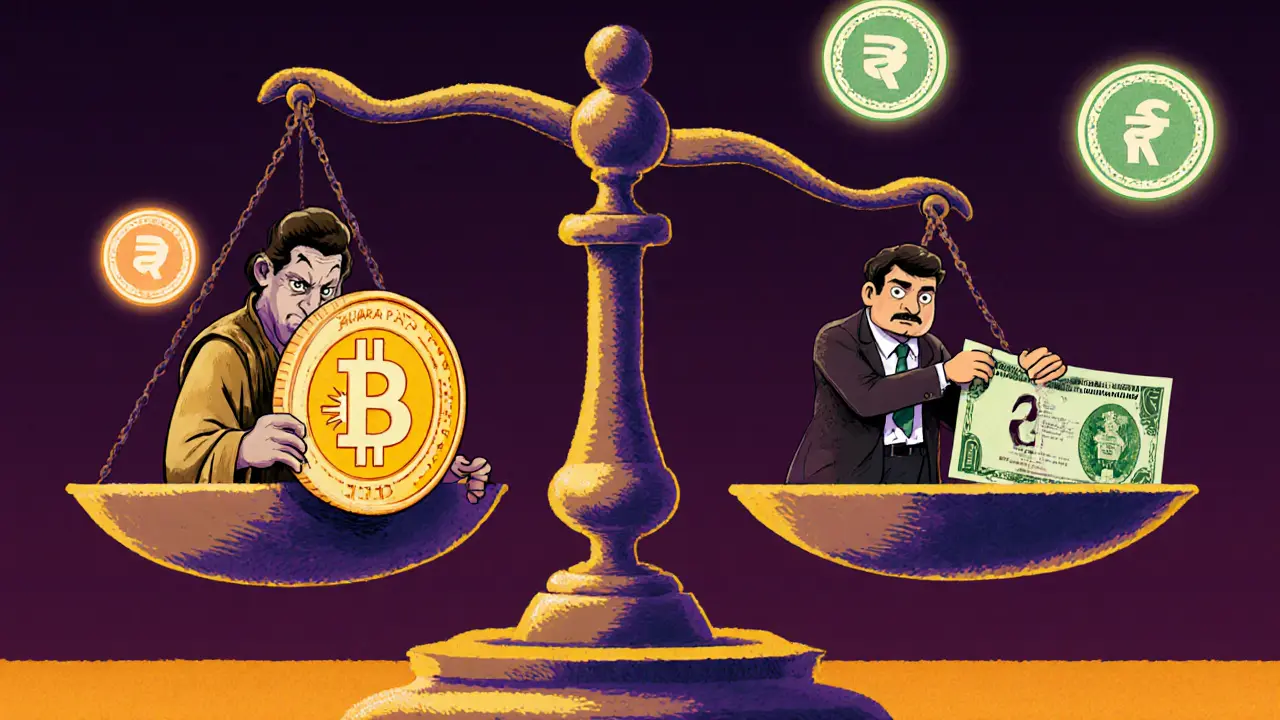
The Contradiction: Legal on Paper, Illegal in Practice
Here’s the catch: even if you get a PVARA license, you’re still walking a tightrope.
The State Bank of Pakistan (SBP) still bans banks from handling cryptocurrency transactions. That means you can’t open a Pakistani bank account to receive fiat deposits from users. You can’t use local payment processors. You can’t settle trades in Pakistani rupees through normal channels.
This creates a legal grey zone. PVARA says you’re legal. SBP says you’re not. The result? Licensed exchanges operate in a kind of regulatory limbo. They serve users, but they can’t integrate with the formal financial system. Many rely on offshore banking or peer-to-peer (P2P) networks to move money - which brings back some of the risks the government wanted to eliminate.
Analysts call this a paradox. The government wants innovation, but won’t let exchanges connect to the banking system. Until SBP changes its stance, the ecosystem will remain fragmented.
Shariah-Compliant Crypto Is a Big Opportunity
Pakistan is a Muslim-majority country. That’s why PVARA created regulatory sandboxes specifically for Shariah-compliant crypto products.
These sandboxes let companies test tokenized assets, halal staking platforms, and blockchain-based zakat systems under supervision. If your exchange can prove its services don’t involve interest (riba), gambling (maysir), or uncertainty (gharar), you could become a pioneer in Islamic fintech.
Several global firms are already exploring this space. One UAE-based exchange is developing a halal staking protocol that distributes profits as profit-sharing (mudarabah), not fixed interest. If approved, it could become the first Shariah-compliant crypto product in South Asia.

What’s Next for Crypto in Pakistan?
There’s more on the horizon - but it’s uncertain.
In early 2025, the Pakistan Crypto Council (PCC) announced plans for a government-backed Strategic Bitcoin Reserve and a 2,000 MW mining project powered by subsidized electricity. The idea was to turn Pakistan into a crypto mining hub. But the International Monetary Fund (IMF) pushed back hard. They warned that cheap power for mining would strain the national grid and cost taxpayers billions.
By September 2025, the Senate recommended moving the PCC from the Ministry of Finance to the Ministry of Information Technology - a sign that crypto is being treated more as a tech issue than a financial one. A Senate committee is also working on amendments to the Virtual Assets Ordinance to fix the contradictions between PVARA and SBP.
Meanwhile, the State Bank of Pakistan is quietly preparing a pilot Central Bank Digital Currency (CBDC). That’s a digital version of the Pakistani rupee - not crypto, but still digital money. It suggests the government is serious about digital finance, even if it’s not ready to fully embrace Bitcoin or Ethereum.
Is It Worth It to Apply?
For a global exchange with strong compliance systems, yes. The license gives you legitimacy. It opens doors to institutional investors. It signals to users that you’re trustworthy.
But if you’re a small startup with no international license, no AML infrastructure, or no plan to solve the banking problem - don’t bother. The system isn’t built for you. It’s built for the big players who can afford global compliance teams and offshore banking setups.
For users, the licensing process means safer platforms. But until banks join in, crypto in Pakistan will still feel like it’s operating in the shadows.
What’s Missing?
The biggest gap? A clear path for local users to convert rupees to crypto and back. Without that, crypto remains a niche tool for tech-savvy traders and remittance senders - not a mainstream financial option.
PVARA’s framework is smart. It’s cautious. It’s aligned with global standards. But until the State Bank of Pakistan gets on board, Pakistan’s crypto future will be half-built.
Can a Pakistani company apply for a PVARA license?
No. Only foreign companies already licensed by recognized international regulators (like the SEC, FCA, or MAS) can apply. PVARA does not issue licenses to locally founded exchanges unless they first obtain a license abroad.
How long does the PVARA licensing process take?
A minimum of three months from the date of submission. The process is rolling, not batch-based, so there’s no fixed schedule. Delays happen if documents are incomplete or compliance gaps are found.
Is cryptocurrency legal in Pakistan?
It’s complicated. PVARA licenses exchanges, making them legal under its authority. But the State Bank of Pakistan still bans banks from handling crypto. Cryptocurrencies are not legal tender. So while you can operate a licensed exchange, you can’t legally use Pakistani banks to deposit or withdraw fiat currency.
Can I use a Pakistani bank account to fund my crypto exchange?
No. The State Bank of Pakistan prohibits financial institutions from engaging with cryptocurrency businesses. Even licensed exchanges must use offshore banking or P2P networks to move money.
Are there any Shariah-compliant crypto options allowed in Pakistan?
Yes. PVARA has created regulatory sandboxes specifically for Shariah-compliant products, such as profit-sharing staking platforms and blockchain-based zakat systems. Companies testing these models can operate under supervision and may gain official approval.
What happens if my application is rejected?
PVARA does not publish rejection reasons publicly. You’ll receive feedback privately, and you can reapply after fixing the issues. There’s no limit on reapplications, but each new submission requires a full, updated dossier.
Does PVARA allow Bitcoin mining in Pakistan?
Not yet. A proposal for a 2,000 MW government-backed Bitcoin mining project was announced in early 2025, but the IMF rejected it due to concerns over energy subsidies and grid strain. The plan remains under review and is not part of the current licensing framework.
Can I operate a crypto exchange without a PVARA license?
Technically, yes - but it’s risky. Unlicensed exchanges operate in a legal grey zone. Users have no protection, and authorities can shut them down at any time. Licensed exchanges have regulatory backing and can build trust with users and partners.


diljit singh
This whole thing is a joke. They want global licenses but won't let you use local banks? So what's the point? Just another power trip by bureaucrats who don't understand crypto.