
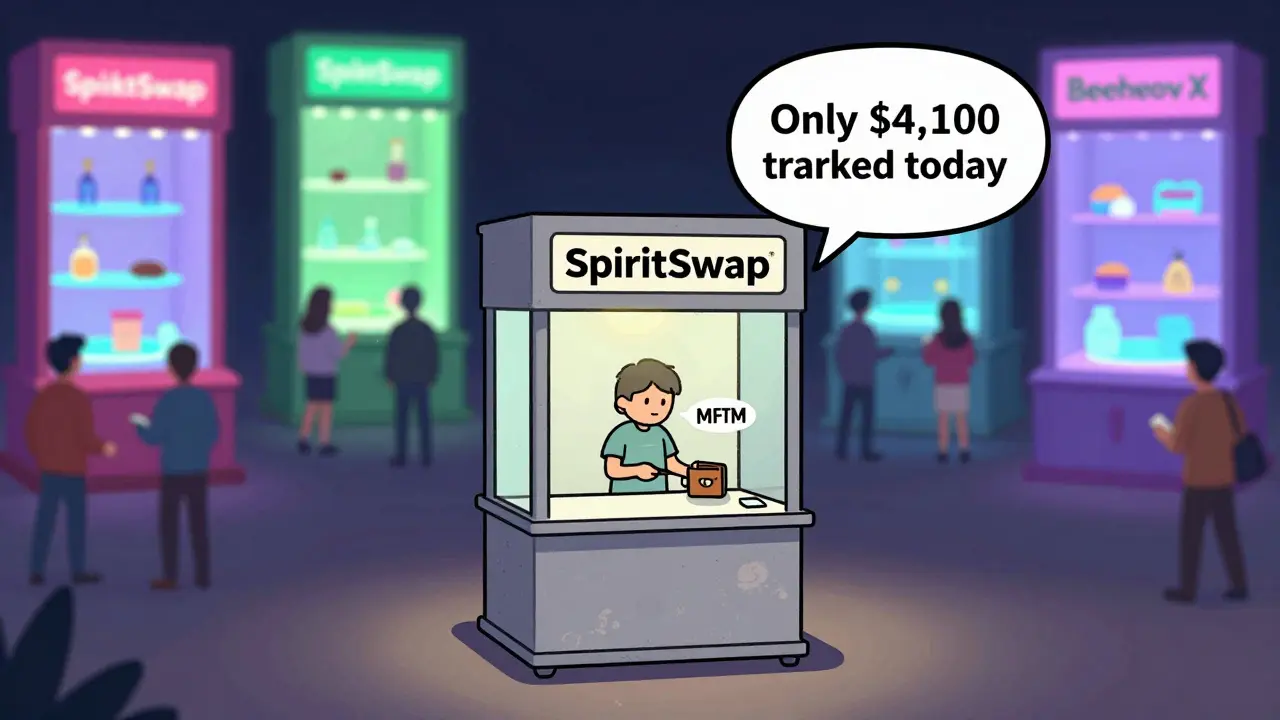
When you're looking to trade crypto on Fantom, SpiritSwap pops up as one of the few native options. But with only 677 monthly visits and a 24-hour trading volume of just over $4,100, you have to ask: is this exchange actually useful, or just another DeFi project fading into obscurity?
What Is SpiritSwap?
SpiritSwap is a decentralized exchange built entirely on the Fantom Opera Chain. Launched in 2021, it uses the same automated market maker (AMM) model as Uniswap-meaning no order books, no middlemen, just smart contracts that match trades using liquidity pools. If you want to swap WFTM for MIM or any other token on Fantom, SpiritSwap is one of the few places you can do it directly.
Unlike centralized exchanges like Binance or Coinbase, SpiritSwap doesn’t hold your funds. You connect your wallet-MetaMask, Trust Wallet, or any EVM-compatible one-and trade directly from your account. That means no KYC, no account freezes, and no bank-style delays. But it also means you’re fully responsible for your own security.
The platform supports 32 tokens and 40 trading pairs. The most active pair is MIM/WFTM, which accounts for nearly 40% of all volume. That tells you something: most users aren’t trading obscure altcoins. They’re moving stablecoins and the network’s native token. That’s not a sign of deep liquidity-it’s a sign of narrow use.
How SpiritSwap Works
Every trade on SpiritSwap runs through liquidity pools. If you want to swap WFTM for SPIRIT, the platform looks at how much of each token is in the pool and calculates a price based on the constant product formula: x * y = k. The more liquidity in the pool, the tighter the price slippage. But here’s the catch: SpiritSwap’s pools are tiny.
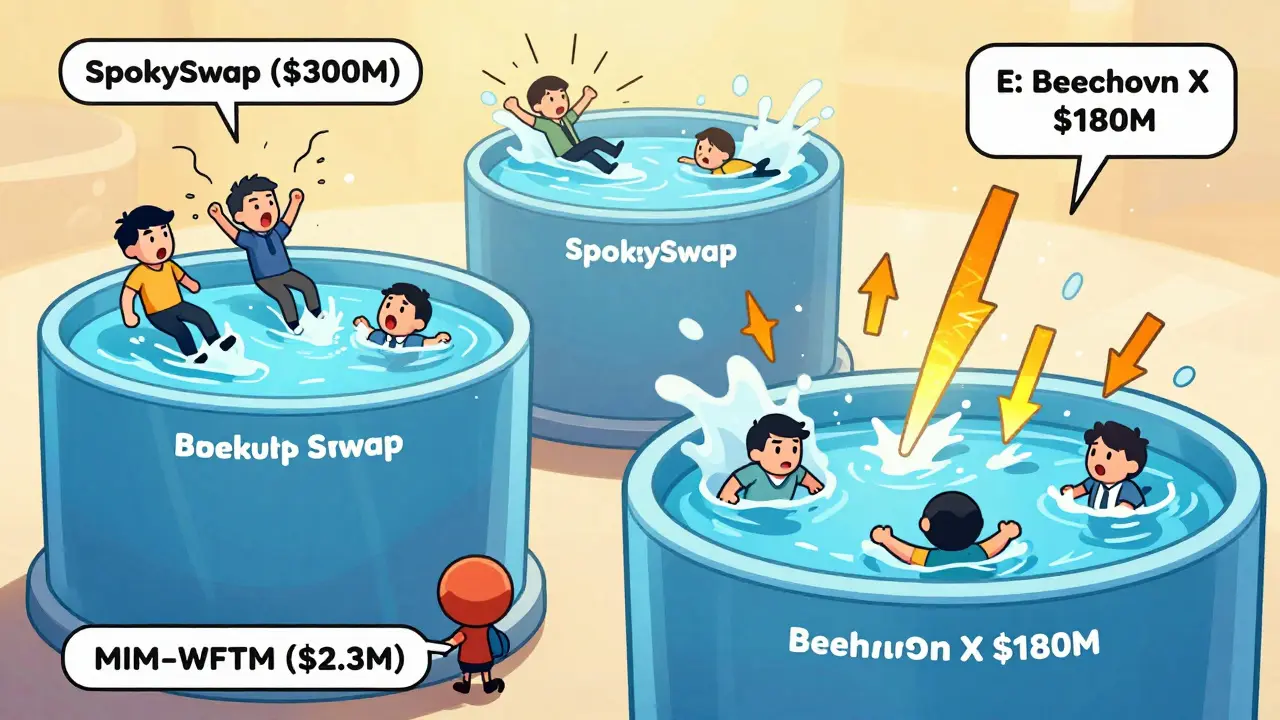
For example, the MIM/WFTM pool holds around $2.3 million in total value locked (TVL). That sounds decent until you compare it to PancakeSwap’s $1.2 billion on BSC or Uniswap’s $10 billion on Ethereum. Smaller pools mean bigger price swings. A $10,000 trade could move the price by 5% or more. That’s not trading-it’s gambling.
Every trade costs 0.30%, split between liquidity providers and SPIRIT token stakers. That’s standard for DEXs. But here’s where SpiritSwap tries to stand out: it lets you earn extra rewards by staking SPIRIT tokens. If you lock up your SPIRIT, you get boosted yields on certain liquidity pools. It’s a way to incentivize long-term holders, but it’s also a sign the platform needs help attracting liquidity.
Trading Experience and Interface
The website is clean, simple, and fast. No clutter. No pop-ups. You connect your wallet, pick your tokens, and hit swap. The interface doesn’t try to be a trading terminal-it’s built for one thing: swapping tokens. That’s good for beginners. But it’s also a red flag. If you’re looking for limit orders, stop-losses, or margin trading, you won’t find them here. SpiritSwap offers 1:1 leverage at best. No shorting. No futures. No advanced tools.
Mobile access works well. The site is responsive, and wallet connections are smooth. But again, the lack of volume means you’re likely to get poor execution. A $500 trade might take 10 seconds and cost you 2% in slippage. That’s not because the platform is broken-it’s because there’s not enough money in the system to absorb trades cleanly.
Yield Farming and SPIRIT Token
SpiritSwap’s biggest draw is yield farming. You can deposit tokens into liquidity pools and earn SPIRIT rewards. Some pools even offer boosted APYs if you stake SPIRIT in their governance contract. The idea is simple: lend your crypto, get paid in SPIRIT, then stake that SPIRIT to earn even more.
But here’s the reality: SPIRIT’s price is volatile and largely disconnected from real demand. As of early 2026, SPIRIT trades between $0.00001 and $0.0008 depending on the source. WalletInvestor predicts it could drop to $0.000002 by 2030. TradingBeast sees a slow decline to $0.0003. PricePrediction.net thinks it might hit $0.0009. These numbers aren’t predictions-they’re guesses. No one knows what SPIRIT is worth because no one uses it outside of earning rewards.
Staking SPIRIT gives you voting power in governance, but proposals rarely get traction. There are no major upgrades on the roadmap. No new token listings. No integrations with other chains beyond basic bridging. The community is quiet. The developers are silent. That’s not a sign of a thriving project. It’s a sign of stagnation.
Security and Regulation
SpiritSwap is not regulated. Not by the SEC, not by ASIC, not by anyone. That’s normal for DeFi. But it also means there’s no recourse if something goes wrong. If a smart contract bug drains your funds, you’re out of luck. If the team abandons the project, you can’t file a complaint. There’s no customer service. No email. No support ticket system.
The code is open-source and has been audited by reputable firms like CertiK, which gives it a clean bill of health. But audits don’t prevent rug pulls or liquidity drains. They just check for obvious bugs. The real risk here is liquidity. If major holders pull their funds, the pools collapse. Prices crash. And you’re left holding SPIRIT tokens worth pennies.

How SpiritSwap Compares to Other DEXs
Let’s put SpiritSwap in context. On Fantom, there are two other major DEXs: SpookySwap and Beethoven X. SpookySwap has over $300 million in TVL. Beethoven X has $180 million. SpiritSwap? Around $20 million. That’s a 15x difference. Even on a smaller chain like Arbitrum, Uniswap V3 has over $1 billion. SpiritSwap is barely a footnote.
Here’s a quick comparison:
| Feature | SpiritSwap | SpookySwap | Beethoven X |
|---|---|---|---|
| TVL (USD) | $20M | $300M | $180M |
| 24h Volume | $4,106 | $18.5M | $12.1M |
| Trading Pairs | 40 | 120+ | 90+ |
| Fee to LPs | 0.30% | 0.25% | 0.17%-0.30% |
| Native Token | SPIRIT | BOO | BEE |
| Mobile Friendly | Yes | Yes | Yes |
| Active Community | Low | High | Medium |
SpookySwap and Beethoven X have bigger teams, more features, and real marketing. SpiritSwap? It’s a ghost town.
Who Should Use SpiritSwap?
There are only two people who should use SpiritSwap right now:
- Users who need to swap MIM or WFTM and don’t have access to SpookySwap or Beethoven X.
- Speculators chasing high APYs who are okay risking their capital for short-term SPIRIT rewards.
If you’re new to DeFi, avoid it. The low volume means high slippage. The token is volatile. The community is inactive. You’re not getting a reliable trading experience-you’re gambling on a dying project.
If you’re an experienced DeFi user with a small amount of crypto to spare, and you’re okay with the risk, then SpiritSwap can be a side experiment. But don’t deposit more than you’re willing to lose. And never rely on it as your main exchange.
Final Verdict
SpiritSwap isn’t dead. But it’s not alive either. It’s in limbo.
It has a solid tech foundation. The code is clean. The interface is simple. The fees are fair. But none of that matters if no one is using it. With trading volume down 53% in 24 hours and only 671 organic visits a month, SpiritSwap is losing ground fast. The Fantom ecosystem is moving on. SpookySwap and Beethoven X are where the action is.
If you’re looking for a reliable DEX on Fantom, go elsewhere. SpiritSwap might have been a good idea in 2021. In 2026, it’s a cautionary tale.
Is SpiritSwap safe to use?
The smart contracts have been audited and show no major vulnerabilities. But safety in DeFi isn’t just about code-it’s about liquidity and community. SpiritSwap has low TVL and little active development. If liquidity vanishes, your funds could be trapped or devalued. Use only small amounts you can afford to lose.
Can I earn passive income on SpiritSwap?
Yes, through yield farming. You can deposit tokens into liquidity pools and earn SPIRIT rewards. Some pools offer boosted APYs if you stake SPIRIT. But these rewards are often unsustainable. The token’s price is unstable, and rewards can drop overnight. Treat this as speculative income, not a reliable stream.
What’s the best way to trade on SpiritSwap?
Only trade small amounts. Use the MIM/WFTM pair-it has the deepest liquidity. Avoid trading obscure tokens. Always check the slippage before confirming. Set it to 1% or higher if you’re unsure. Never use more than 5% of your total crypto portfolio on SpiritSwap.
Does SpiritSwap support cross-chain swaps?
SpiritSwap has a bridging feature that allows limited cross-chain transfers, but it’s not well-documented. Most users still trade only within the Fantom network. For true multi-chain swaps, use a dedicated bridge like Synapse or LayerZero, then swap on a more active DEX.
Should I buy SPIRIT tokens?
Only if you’re speculating. SPIRIT has no utility beyond governance and yield boosts. There’s no roadmap, no team updates, and no adoption growth. Price predictions range from $0.000002 to $0.0009-this isn’t analysis, it’s guessing. Don’t invest. Only hold if you’re farming and plan to sell rewards immediately.
Why is SpiritSwap’s volume so low?
It’s outcompeted. SpookySwap and Beethoven X offer better rewards, more pairs, and stronger communities. SpiritSwap hasn’t updated its features in over a year. The team is quiet. Users have migrated. Low volume creates a death spiral: less volume → higher slippage → fewer traders → even less volume.