

Stablecoin Risk Assessment Tool
Evaluate the safety of your stablecoin trading based on key factors like issuer transparency, market liquidity, and your risk tolerance.
When you trade Bitcoin or Ethereum on a crypto exchange, you're probably not using USD or EUR directly. Instead, you're trading against a stablecoin - most likely USDT or USDC. These pairs are the backbone of crypto markets, handling over 95% of all spot trades. But what makes them so popular? And why are they also one of the biggest hidden risks in crypto?
Why Stablecoin Trading Pairs Dominate Crypto Markets
Most people think of crypto trading as buying Bitcoin with dollars. But in reality, you’re rarely doing that. Banks don’t operate 24/7, and wire transfers take days. Stablecoins solve that. They’re digital tokens pegged to real money - usually the US dollar - so 1 USDT or 1 USDC is always worth $1. That makes them the perfect middleman between volatile crypto and real-world value. You can buy Bitcoin with USDT in seconds, sell it back when the price drops, and move your funds anywhere without waiting for bank approvals. That’s why over $165 billion in stablecoins are in circulation as of late 2023. USDT alone makes up nearly 70% of that total, followed by USDC at 20%. On Binance, the BTC/USDT pair trades over $38 billion a day. That’s more than the entire daily volume of the S&P 500. This isn’t just for big traders. In countries like Nigeria and Turkey, where capital controls limit access to dollars, over 98% of crypto trades happen through stablecoin pairs. People use them to protect savings, send money across borders, or just avoid inflation. Stablecoins became the unofficial global currency of crypto.The Three Types of Stablecoins - And Why It Matters
Not all stablecoins are built the same. There are three main types, and each carries different risks:- Fiat-backed - USDT and USDC. These are supposed to be backed 1:1 by cash or short-term government bonds. USDC publishes monthly audits by Grant Thornton. Tether (USDT) only does quarterly, unaudited reports. That’s a big difference in transparency.
- Crypto-backed - DAI is the main one. It’s backed by other crypto assets like ETH, but over-collateralized (150-200%). If ETH crashes 30%, DAI’s system has to absorb that loss without breaking its $1 peg. It’s clever, but fragile during extreme market stress.
- Algorithmic - These used to be popular, like TerraUSD (UST). They didn’t hold any reserves. Instead, they used smart contracts to mint or burn tokens to keep the price stable. It worked until it didn’t. In May 2022, UST collapsed in under a week, wiping out $45 billion in value. The algorithm couldn’t handle panic.
The Real Benefits: Speed, Access, and Cost
Stablecoin pairs aren’t just convenient - they’re cheaper and faster than fiat. You can trade Bitcoin on Binance at 2 a.m. on a Sunday. No bank. No approval. No waiting. That’s huge when markets move fast. On fiat pairs, you’d be stuck until Monday morning. Fees add up. Converting USD to EUR, then buying ETH? You pay 0.5% to 1.2% per transaction in exchange and bank fees. With USDC, you pay a small network fee - often under $1.50 - and get instant settlement. Coinbase’s 2022 data showed traders save hundreds of dollars a month just by switching to stablecoin pairs. Liquidity is another win. BTC/USDT has a deeper order book than BTC/USD. On Binance, you can trade 2.7 BTC within 0.1% of the current price. On USDC, it’s only 1.9 BTC. That means less slippage, better fills, and tighter spreads. For active traders, that’s money in the bank.
The Hidden Risks: De-Pegging, Counterparty Risk, and Collapse
Here’s the catch: stablecoins aren’t magic. They’re digital IOUs. And if the issuer fails, so does your peg. In March 2023, USDC briefly dropped to $0.85 after Silicon Valley Bank collapsed. Circle, the issuer, had $3.3 billion in reserves tied up in SVB. Even though they eventually made it whole, traders who held USDC during that window saw their positions lose value overnight. Exchanges paused withdrawals for hours. Some lost out on trades. USDT has had similar moments. In June 2022, it traded at $0.94 on some exchanges. Not because of a bank failure - because people lost trust in Tether. Even though Tether kept redeeming at $1, the market didn’t believe them. That’s counterparty risk: you’re trusting a private company to hold your money. And then there’s the systemic risk. If a major stablecoin like USDT suddenly lost its peg, it could trigger a cascade. Traders holding leveraged positions on BTC/USDT would get liquidated. DeFi protocols relying on USDT as collateral would freeze. Lending platforms would collapse. J.P. Morgan and the Bank for International Settlements both warn this could become a global financial event.How Traders Are Actually Using Stablecoin Pairs
Real traders don’t just buy and sell. They use stablecoin pairs for strategy. Arbitrage is common. In 2022, one trader made 12.7% annually by buying BTC on Korean exchanges (where prices were higher due to demand) and selling on global exchanges using USDT. But by 2023, spreads narrowed to 0.35%. The opportunity vanished. Others use stablecoins as a “parking spot.” When markets look shaky, they convert BTC or ETH into USDC and wait. No need to cash out to a bank. Just hold stablecoins until the dip ends. But mistakes happen. One Reddit user lost $287,000 in 72 hours during the UST crash because they held leveraged LUNA/UST positions. They didn’t realize how fast algorithmic stablecoins can fail. On Trustpilot, users report USDT deposits failing on Binance due to Tron network congestion. Others say USDC withdrawals on Coinbase take over 24 hours during volatility spikes. These aren’t theoretical - they’re real, daily problems.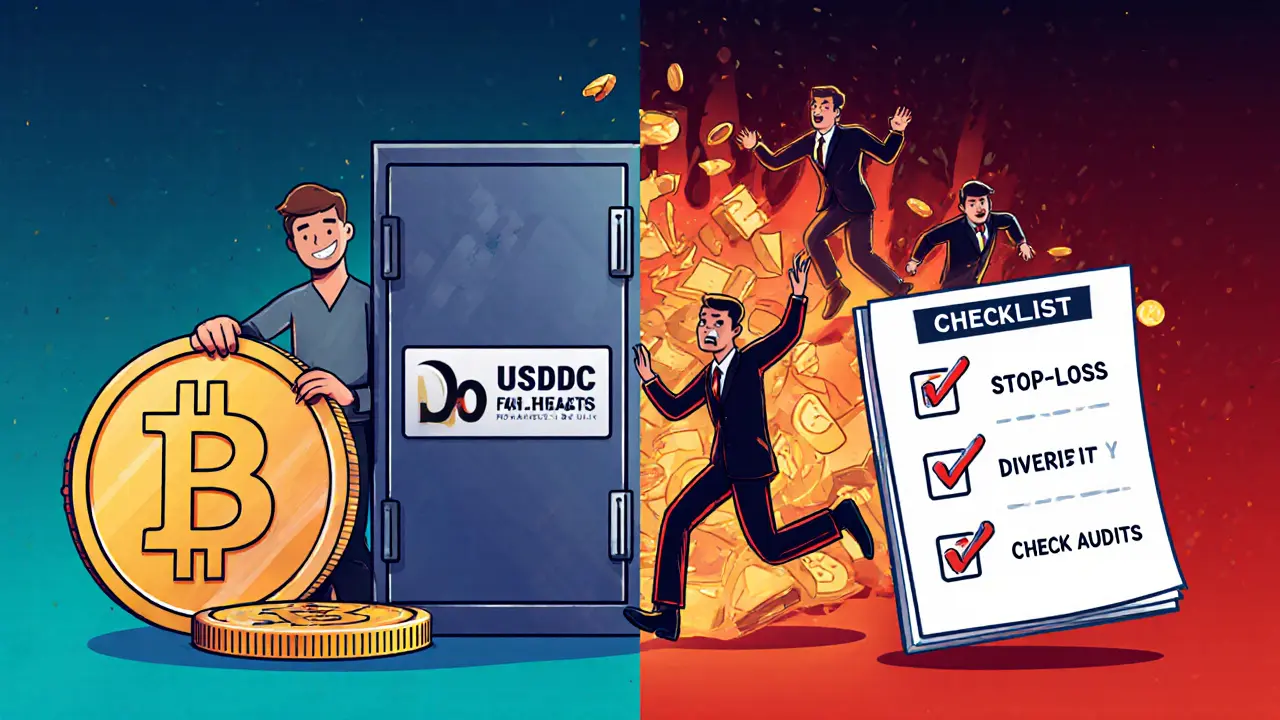
What You Should Do - Practical Tips for Safe Trading
You don’t need to avoid stablecoin pairs. You just need to trade them smartly.- Stick to USDT or USDC. Avoid DAI unless you understand over-collateralization. Stay away from algorithmic ones completely.
- Don’t put all your capital in one stablecoin. Capital.com recommends keeping no more than 35% of your trading funds in any single stablecoin. Diversify between USDT and USDC.
- Monitor the peg. Use CoinGecko’s Stablecoin Confidence Index or Glassnode to track on-chain activity. If USDT starts trading below $0.99 consistently, get out.
- Set stop-losses at 0.8% below the peg. That’s enough to protect you from sudden drops without triggering on normal noise.
- Check issuer transparency. USDC’s monthly audits are public. Tether’s aren’t. If you care about safety, choose the one with better reporting.
The Future: CBDCs, Hybrid Stablecoins, and Global Shifts
The game is changing. JPMorgan’s JPM Coin is already used for institutional trades. First Digital Trust launched FDUSD, which blends fiat and crypto collateral. The European Central Bank is testing a Digital Euro - set to launch around 2027. By 2025, J.P. Morgan predicts we’ll see trading pairs between central bank digital currencies (CBDCs) and stablecoins. That could make crypto markets even more integrated with traditional finance. But here’s the truth: no matter what happens, stablecoin pairs aren’t going away. They’re too useful. Too fast. Too cheap. The question isn’t whether they’ll survive - it’s whether you’ll understand how to use them safely.Are stablecoin trading pairs safe?
Stablecoin pairs are convenient but not risk-free. USDT and USDC are generally safe for trading because they’re backed by real assets, but they’re not government-insured like bank deposits. The biggest risk is de-pegging - when the token loses its $1 value due to loss of confidence or issuer problems. Always monitor reserve transparency and avoid algorithmic stablecoins like UST, which collapsed in 2022.
Which is better for trading: USDT or USDC?
USDT has higher liquidity and lower trading spreads, making it ideal for active traders. USDC is more transparent, with monthly audits and clearer reserve reporting. If you prioritize safety over speed, USDC is better. If you want the deepest market depth and fastest fills, USDT wins. Many traders split their exposure between both.
Can stablecoins lose their $1 peg?
Yes. USDT dropped to $0.94 in June 2022 during a panic. USDC fell to $0.85 in March 2023 after its bank reserves were frozen. Even DAI has briefly deviated from $1 during extreme crypto crashes. These events are rare but possible. Always assume a peg can break - and plan for it with stop-losses and diversification.
Do I need to pay taxes on stablecoin trades?
Yes. In most countries, trading one crypto for a stablecoin is a taxable event - even if you’re not converting to fiat. For example, selling BTC for USDT triggers capital gains tax on the profit from your BTC purchase. Treat stablecoin trades like any other crypto-to-crypto exchange. Keep detailed records of every trade and its value in USD at the time.
What’s the difference between a stablecoin and a CBDC?
Stablecoins are issued by private companies like Tether or Circle. CBDCs (Central Bank Digital Currencies) are issued by governments - like a digital dollar or euro. Stablecoins rely on market trust; CBDCs rely on government backing. CBDCs could eventually replace stablecoins in regulated markets, but for now, stablecoins dominate because they’re faster, global, and not subject to the same banking restrictions.
How do I check if a stablecoin is truly backed?
For USDC, check Circle’s monthly attestation reports on their website - they’re done by Grant Thornton. For USDT, Tether provides quarterly reports, but they’re unaudited and less detailed. Use tools like CoinGecko’s Stablecoin Confidence Index, which tracks reserve transparency, trading volume, and price stability. Avoid stablecoins that don’t publish regular, third-party verified reports.


Sara Lindsey
Stablecoins are the unsung heroes of crypto trading honestly
One minute you're holding BTC the next you're chilling in USDT while the market throws a tantrum
No bank delays no drama just instant liquidity
And yeah USDT is messy but it's the only thing keeping emerging markets alive right now