

If you're hunting for a new way to swap tokens on the BASE is a Layer 2 blockchain solution developed by Coinbase that allows for faster and cheaper transactions than the Ethereum mainnet network, you might have stumbled across SharkSwap. At first glance, it looks like any other decentralized exchange (DEX). But in the world of DeFi, a clean interface doesn't always mean a safe bet. Before you connect your wallet, you need to know if this platform is a hidden gem or a liquidity trap.
The short answer? SharkSwap is a high-risk, niche player that struggles to compete with the giants. While it offers the speed of the Base network, it lacks the one thing that makes a DEX actually usable: liquidity. If you're trading small amounts, you might get by, but for anyone moving serious capital, the red flags are hard to ignore.
The Basics: What is SharkSwap?
SharkSwap is a decentralized exchange (DEX) operating as an automated market maker (AMM) on the Base blockchain. For those not fluent in crypto-speak, an AMM removes the need for a traditional order book. Instead of waiting for a buyer or seller to match your price, you trade against a pool of assets. It's the same tech that powers Uniswap, the gold standard of DEXs.
Technically, SharkSwap is a fork of the Uniswap V2 model. This means it uses a standard 0.3% trading fee. On paper, the benefits are clear: because it sits on Base, transaction fees are tiny-averaging around $0.02. Compare that to the Ethereum mainnet, where a single swap can cost $1.25 or more depending on network congestion. However, low fees don't matter if you can't actually execute your trade.
The Liquidity Problem: A Deal-Breaker
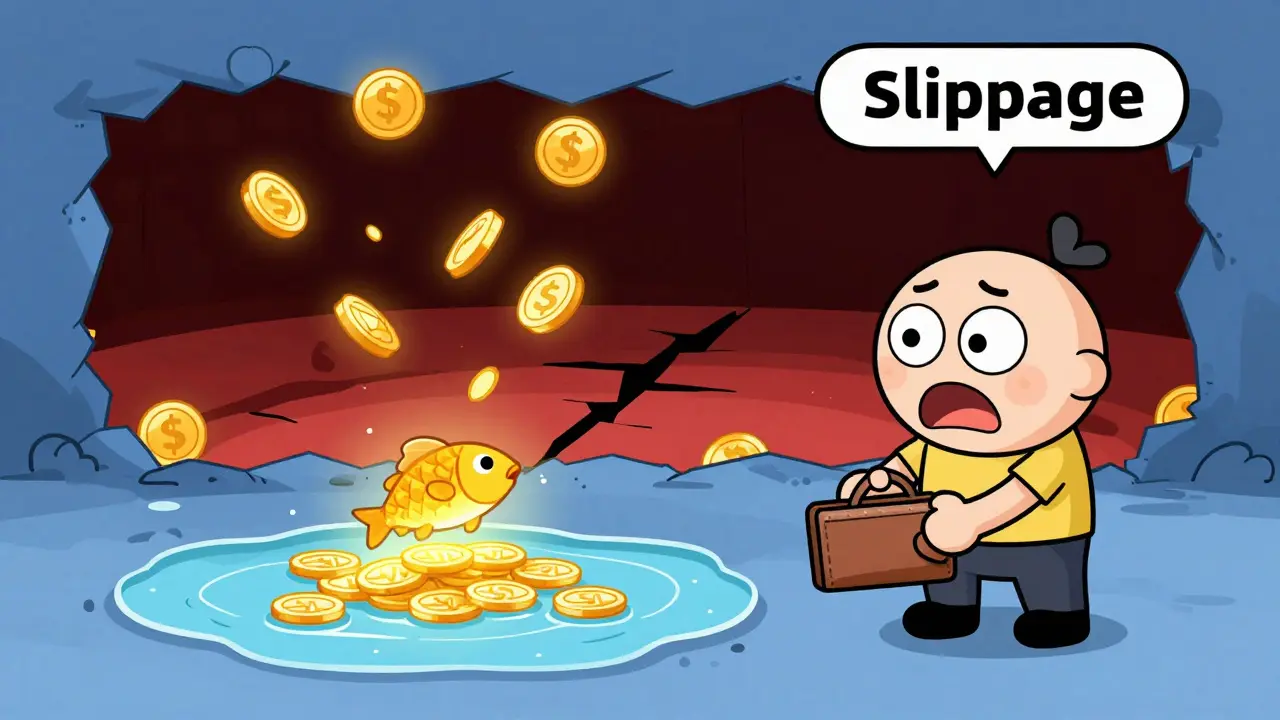
In a DEX, liquidity is everything. It's the amount of money available in the pools. If a pool is "shallow," a relatively small trade can move the price significantly, leading to something called slippage. This is where you end up receiving far fewer tokens than the market price suggests.
SharkSwap has a massive liquidity problem. While Uniswap handles billions in Total Value Locked (TVL), SharkSwap has hovered around a meager $0.2 million. This isn't just a statistic; it's a practical nightmare. Users have reported trying to swap as little as $200 USDC to DAI and failing three times, even with a 12% slippage tolerance. For most traders, any slippage over 1% is annoying; 12% is an immediate loss of funds.
| Feature | SharkSwap | Uniswap | PancakeSwap |
|---|---|---|---|
| Blockchain | Base | Multi-chain | BNB Chain / Multi-chain |
| Approx. TVL | ~$200,000 | Billions | Billions |
| Trading Volume | Untracked (Low) | Very High | Very High |
| Audit Status | No Public Audit | Extensively Audited | Extensively Audited |
| Main Benefit | Low Base Fees | Deep Liquidity | Staking Rewards |
Security and Trust: Proceed With Caution
When you use a DEX, you are trusting your funds to a smart contract. If that contract has a bug or a "backdoor," your money can vanish instantly. The gold standard for security is a public audit from a reputable firm like CertiK or OpenZeppelin. SharkSwap has no such public audits available.
This lack of transparency is a major warning sign. In fact, some fraud databases, such as CryptoLegal.uk, have listed SharkSwap under a category for "Emerging DEX Platforms with Unverified Contracts." While this doesn't explicitly label the site as a scam, it puts it in a "High Risk" bracket. When you combine unverified contracts with a total lack of developer activity-only three GitHub commits in a 90-day window-it looks like a project that has been abandoned by its creators.
The User Experience: A Frustrating Ride
Connecting your MetaMask wallet is the easy part. The trouble starts when you try to find a pair that actually has money in it. The interface often shows pools that are practically empty, meaning you spend more time searching for a viable trade than actually trading.
The operational friction is staggering. In a real-world test, a simple $50 swap took 43 minutes to complete because of repeated failures. Compare that to the 8 minutes it takes on a professional platform. Then there's the tax headache. SharkSwap provides no way to export your transaction history. If you're tracking your gains for the IRS or other tax authorities, you'll have to manually dig through blockchain explorers for every single trade, which can take upwards of 25 minutes per transaction.
Is There Any Reason to Use SharkSwap?
You might be wondering if there's a "silver lining." The only real advantage is the transaction speed of the Base blockchain, which can confirm trades in about 2 seconds. But here's the catch: that speed is useless if the trade fails due to slippage.
Unlike PancakeSwap, which offers staking rewards and an NFT marketplace, SharkSwap offers nothing extra. No staking, no yield farming, and no cross-chain functionality. It is a bare-bones fork that fails to solve any problem that the bigger exchanges haven't already solved better.
Final Verdict: Should You Use It?
In the current market, liquidity is king. A DEX without liquidity is just a fancy website that can't move money. SharkSwap is currently in a downward spiral, with its TVL dropping over 60% in the last year. Industry analysts predict that most "untracked" DEXs like this one will simply cease to exist by mid-2026.
If you are looking for a safe, efficient way to trade on Base, you are much better off using an aggregator like 1inch or Matcha. These tools scan multiple pools to find the best price and the lowest slippage, removing the guesswork and the risk of using a ghost-town exchange.
Is SharkSwap a scam?
While there is no definitive proof of a "rug pull," SharkSwap is flagged as high-risk by several security databases due to unverified smart contracts and a lack of public audits. The extreme lack of liquidity and developer activity are typical warning signs of an unsustainable or abandoned project.
Why are my trades failing on SharkSwap?
Most failures are due to extremely low liquidity in the pools. When there isn't enough money in a pool to support your trade, the price shifts too much, exceeding your "slippage tolerance" and causing the transaction to fail.
What is the slippage tolerance on SharkSwap?
The platform allows you to set your own tolerance, but because liquidity is so low, users often have to set it as high as 12% just to get a trade to go through. This is generally considered unacceptable and results in significant financial loss.
How does SharkSwap compare to Uniswap?
SharkSwap is essentially a simplified copy of Uniswap V2. However, Uniswap has billions in liquidity and rigorous audits, whereas SharkSwap has very little liquidity and no public audits, making Uniswap vastly safer and more efficient.
Can I get customer support from SharkSwap?
No. There are no functional support channels, and reported attempts to use their contact forms have gone unanswered for days, indicating that the platform is not actively managed.


Miranda Jamieson
Imagine actually thinking a fork of Uniswap V2 with zero audits is a viable platform in 2025. It's practically begging to be rug-pulled.