
When you buy or sell Bitcoin, Ethereum, or any other cryptocurrency on the spot market, you’re not betting on future prices-you’re trading at today’s price. But every time you do it, the exchange takes a cut. That cut is your spot trading fee. And it might be the single biggest thing eating into your profits-even if you’re not even thinking about it.
Let’s say you trade $10,000 worth of ETH every week. At a 0.1% fee, you’re paying $10 per trade. That’s $40 a month. Over a year? $480 gone. Now imagine you switch to an exchange that charges 0.05%. Suddenly, you’re paying $240 a year. That’s $240 extra in your pocket. No magic. Just fees.
How Spot Trading Fees Actually Work
Most exchanges use a maker-taker model. It sounds fancy, but it’s simple:
- Makers place limit orders-they set a price they’re willing to buy or sell at, and wait for someone else to match it. They’re adding liquidity to the market. Exchanges reward them with lower fees.
- Takers place market orders-they buy or sell immediately at the best available price. They’re removing liquidity. Exchanges charge them more.
For example: if you put a limit order to buy BTC at $60,000 and someone else sells at that price, you’re the taker. If your order sits in the book until someone else buys from you, you’re the maker.
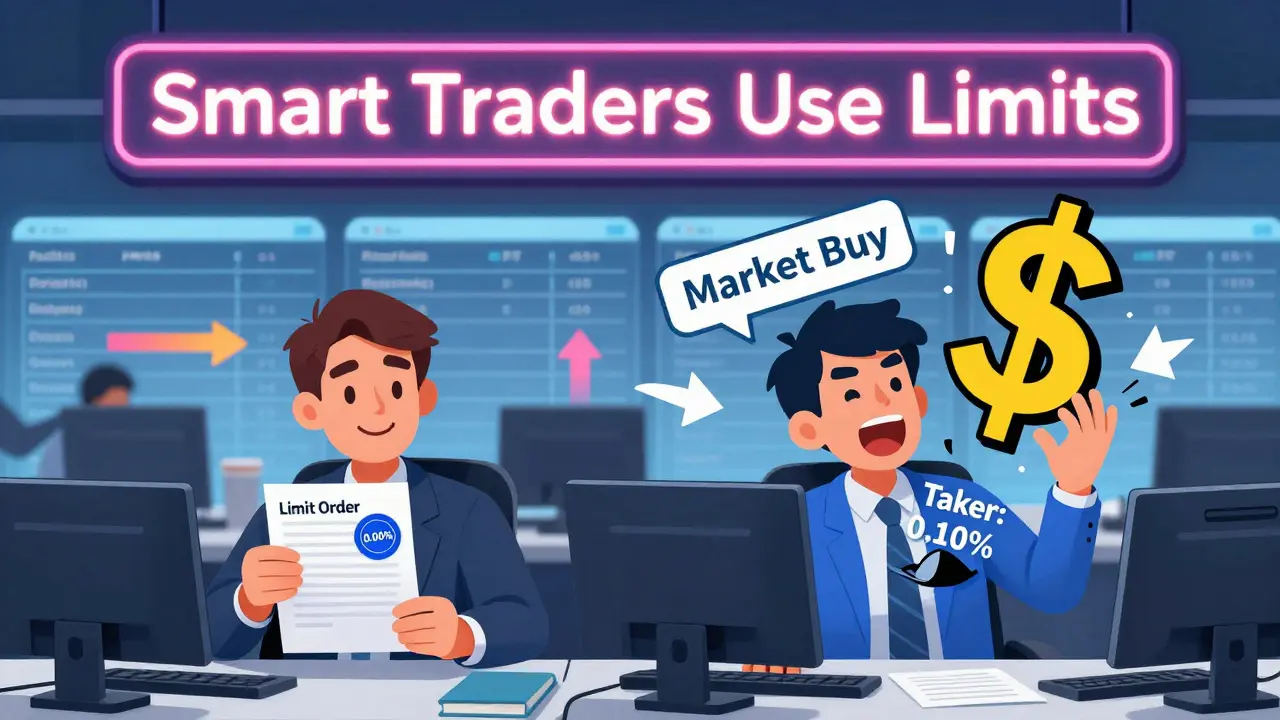
That’s why smart traders use limit orders. They don’t just get better prices-they pay less. On most exchanges, maker fees are 20% to 100% lower than taker fees. For high-frequency traders, this isn’t a perk-it’s survival.
Who Has the Lowest Fees? The Real Numbers
As of November 2025, here’s what the top exchanges charge for spot trading:
| Exchange | Maker Fee | Taker Fee | Notes |
|---|---|---|---|
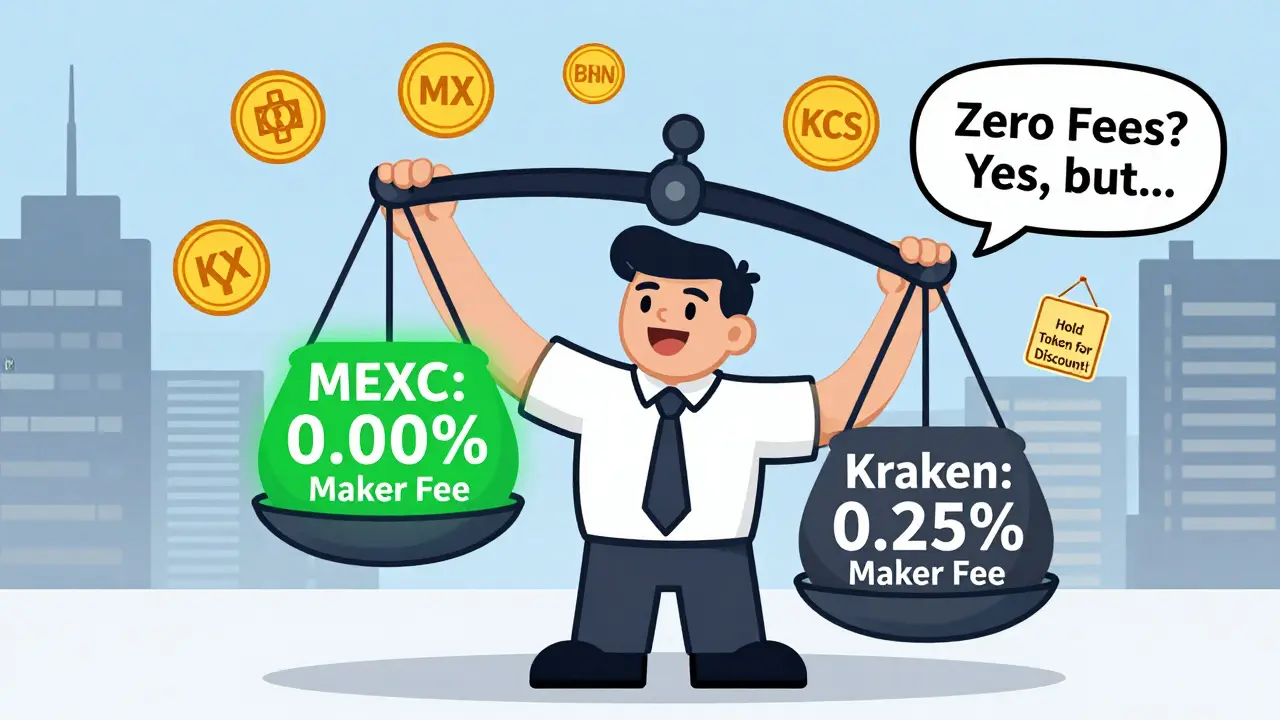
| MEXC | 0.00% | 0.05% | Lowest maker fee in the market. Requires MX token holdings for best rates. |
| Binance | 0.08% | 0.10% | Discounts up to 25% with BNB. VIP tiers drop fees further. |
| Bitunix | 0.08% | 0.10% | New entrant with competitive pricing. |
| Bybit | 0.10% | 0.10% | Flat fee structure. Simple, predictable. |
| Bitget | 0.10% | 0.10% | 778 trading pairs. Good for niche altcoins. |
| KuCoin | 0.10% | 0.10% | Up to 20% off with KCS token payments. |
| OKX | 0.14% | 0.23% | Higher taker fee. Less competitive for active traders. |
| Kraken | 0.25% | 0.40% | Higher base rates, but lower with volume. U.S.-compliant. |
MEXC leads with a 0.00% maker fee-zero. That’s unheard of on a major platform. But here’s the catch: to get the full benefit, you need to hold MX tokens. Without them, your maker fee jumps to 0.08%. Same goes for Binance: if you don’t use BNB, you’re paying 0.10% maker, not 0.08%.
Kraken is the outlier. Their fees are higher, but they’re the only major exchange with full U.S. regulatory compliance. That matters if you’re in the States. You’re paying more for security, audits, and legal backing-not just trading.
It’s Not Just About the Fee Percentage
Chasing the lowest fee can backfire. Here’s what most people miss:
- Withdrawal fees: Some exchanges with low trading fees charge $5 to send BTC out. Kraken? $0.0005 BTC. That’s less than 50 cents.
- Fiat on-ramps: Buying crypto with a credit card? You’ll pay 3-5% regardless of the exchange. Spot fees don’t apply here.
- Liquidity: MEXC has 0.00% maker fees, but if you’re trading a small altcoin, the spread might be wider than the fee you saved. Kraken has tighter spreads on BTC and ETH because of higher volume.
- Platform reliability: In November 2025, a major exchange with 0.00% fees suffered a 12-hour outage. Traders couldn’t cancel orders. Lost money. Fees aren’t everything.
David Shim, CEO of Lukka, put it bluntly: “A 0.05% fee difference compounded over 100 trades equals a 5% reduction in potential profits.” That’s not theoretical. That’s real money.
How to Actually Save on Fees
Here’s what works in practice:
- Use limit orders. Don’t click “Market Buy.” Set your price. Wait. You’ll pay maker fees and often get a better price.
- Hold the native token. BNB on Binance, KCS on KuCoin, MX on MEXC. These aren’t gimmicks-they’re fee discounts. Holding 100 BNB can cut your fees by 25%.
- Check volume tiers. If you trade over $1 million a month, you qualify for VIP levels. Binance drops to 0.06% maker. That’s a 25% saving from standard rates.
- Use referral links. Most exchanges give you 10% off your fees for the first 3 months if you sign up through a friend.
- Avoid fiat deposits. Buying crypto with a card or bank transfer? You’re paying 3-5% on top of trading fees. Use crypto-to-crypto trades instead.
One trader on Reddit, u/CryptoTrader88, switched from Binance to Kraken and was shocked: “Paid 0.38% on Kraken versus 0.1% on Binance for the same ETH/BTC trade. Cost me $38 extra on a $10,000 trade.” But he didn’t account for the fact that he was using market orders and didn’t hold BNB. He was paying 0.10% on Binance without the discount.
What’s Changing in 2026?
Fees are falling. Fast.
MEXC announced in November 2025 that starting December 1, users staking 1,000+ MX tokens will get completely fee-free spot trading. That’s not a promo-it’s a permanent tier. Binance just lowered its standard maker fee from 0.08% to 0.075%. Delphi Digital predicts average maker fees will drop to 0.05% by mid-2026.
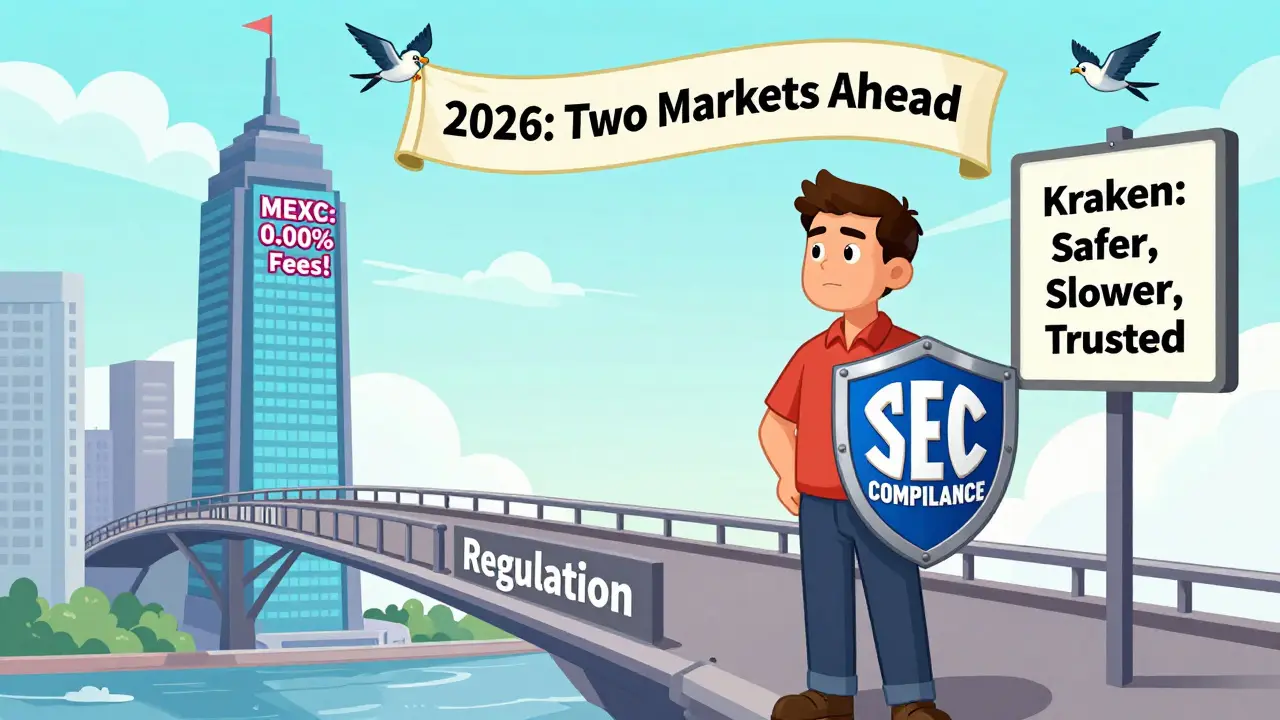
But here’s the twist: regulatory pressure is rising. The U.S. SEC is pushing new rules that could force exchanges to spend 15-20% more on compliance. That means Kraken and Coinbase might raise fees by 3-5% in 2026. Meanwhile, offshore exchanges like MEXC and Bybit can keep cutting prices.
So the trend isn’t just “lower fees.” It’s two-tiered markets: one for compliant, higher-cost platforms, and another for aggressive, low-fee global exchanges.
Should You Switch?
If you’re trading under $10,000 a month? Stick with Binance or KuCoin. Use BNB or KCS. Set limit orders. You’re already saving enough.
If you’re trading over $50,000 a month? Test MEXC. The 0.00% maker fee is real. But monitor liquidity on your favorite pairs. If the spread is too wide, you’re not winning.
If you’re in the U.S.? Kraken is still the safest bet-even if it costs more. You can’t put a price on regulatory peace of mind.
And if you’re new? Don’t get obsessed with fees. Learn how to use limit orders first. Understand maker vs taker. Use a referral link. Do that, and you’ll save more than any fee comparison ever will.
What’s the difference between maker and taker fees?
Maker fees apply when you place a limit order that doesn’t execute immediately-you’re adding liquidity to the order book. Taker fees apply when you place a market order that executes right away-you’re removing liquidity. Makers pay less, often 20-100% less than takers.
Which exchange has the lowest spot trading fees?
As of November 2025, MEXC offers the lowest standard maker fee at 0.00%, with taker fees at 0.05%. However, these rates require holding MX tokens. Without them, fees rise. Binance and Bitunix offer 0.08% maker fees without token requirements, making them more accessible for beginners.
Do I need to hold the exchange’s native token to get low fees?
Not always, but it helps. Binance, KuCoin, MEXC, and others offer discounts (up to 25%) if you pay fees in their native token (BNB, KCS, MX). Without it, you pay the standard rate. For most users, holding a small amount of the token is worth it-it’s like getting a permanent discount card.
Why are Kraken’s fees higher than Binance’s?
Kraken is fully compliant with U.S. regulations, including KYC, AML, and SOC 2 audits. These cost money. Binance operates globally and avoids many of these costs, allowing lower fees. If you’re in the U.S., Kraken’s higher fees come with legal protection and fewer regulatory risks.
Can I avoid fees by using a decentralized exchange (DEX)?
DEXs like Uniswap charge a flat 0.30% trading fee, but you also pay blockchain gas fees-usually $1.50 to $5 per trade on Ethereum. For small trades, that’s more expensive than centralized exchanges. For large trades, the total cost can be competitive. But DEXs lack liquidity for many altcoins, so you might get worse prices.
How much do withdrawal fees cost?
Withdrawal fees vary widely. Binance charges 0.0005 BTC for Bitcoin withdrawals-about $30 at $60,000/BTC. Kraken charges the same. Some exchanges charge fixed USD amounts like $5. Always check the withdrawal page before depositing funds. High trading fees are bad, but surprise withdrawal fees can ruin your budget.
Is it worth switching exchanges just for lower fees?
Only if you’re trading over $10,000 a month. For smaller traders, the time and risk of switching (account setup, KYC, transfer delays) outweigh the savings. For active traders doing hundreds of trades a month, even a 0.02% difference saves hundreds per month. Track your volume and calculate the break-even point before switching.


nalini jeyapalan
Zero maker fees? Yeah right. MEXC’s 0.00% is a trap. You think you’re saving money until you realize your limit order never gets filled because liquidity’s a ghost on altcoins. I traded 12 ETH last week on MEXC-ended up paying more in slippage than I saved on fees. Don’t fall for the shiny number. Real traders care about execution, not percentage points.