
1-10 Million Pound Fines for Crypto Trading in Egypt: What You Need to Know

Home 1-10 Million Pound Fines for Crypto Trading in Egypt: What You Need to Know

1-10 Million Pound Fines for Crypto Trading in Egypt: What You Need to Know

23 Nov 2025

Egypt Crypto Fine Calculator

Calculate Fine Impact

This tool converts Egyptian Pound fines to USD and shows how many months of average salary they represent.

Note: Average monthly salary in Egypt: 7,000 EGP
Current exchange rate: 1 USD = 19.37 EGP (approximate)

$0.00
USD Equivalent
0
Months of Salary
0
Years of Salary

If you're trading cryptocurrency in Egypt, you're breaking the law. Not just a little bit - crypto trading here carries fines between 1 million and 10 million Egyptian pounds. That’s $51,634 to $516,340 USD. And it’s not just a fine. You could also go to jail.

Why Egypt Banned Crypto Trading

Egypt’s government doesn’t see cryptocurrency as money. It sees it as a threat. Back in 2018, the Central Bank of Egypt (CBE) warned that Bitcoin and other digital currencies aren’t backed by anything real - no gold, no government guarantee, no oversight. They called them risky, volatile, and easy to use for crime.

By 2020, those warnings became law. Law No. 194 of 2020 made it illegal to issue, trade, promote, or operate any crypto exchange in Egypt. It didn’t just target big businesses. It covered anyone who buys, sells, or even posts about crypto on social media.

The goal? Stop money laundering, fraud, and cybercrime. The government says crypto moves too fast, too anonymously, and outside the banking system. That makes it dangerous for the economy. So they slammed the door shut - no exceptions, no gray area.

The Fines and Penalties

Under Article 206 of Law No. 194 of 2020, the punishment is clear:

  • 1 million to 10 million Egyptian pounds in fines
  • Or imprisonment
  • Or both
There’s no minimum jail time listed, but the fines alone are massive. For context, the average monthly salary in Egypt is around 7,000 EGP. A 1 million EGP fine is equal to over 140 months’ pay. A 10 million EGP fine? That’s more than 14 years’ income.

The Egyptian Financial Regulatory Authority (FRA) adds another layer. They say promoting crypto - even sharing a link to a crypto exchange on Instagram or WhatsApp - counts as illegal advertising. If you’re running a Telegram group that teaches people how to buy Bitcoin, you’re breaking the law.

Who’s Getting Caught?

The government isn’t just talking. They’re watching.

The FRA has publicly named websites and social media pages that are pushing crypto investments. They’ve asked citizens to report them. In 2023, they released a list of unlicensed financial platforms - many of them crypto-related - and warned that operating one could lead to arrest.

There’s no public record of how many people have been fined or jailed, but enforcement is active. Banks are required to flag suspicious transactions. Crypto wallet addresses linked to Egyptian IDs can be traced. And since most people use local banks to buy crypto through peer-to-peer platforms, the trail doesn’t vanish.

One trader in Cairo told a local news outlet in 2024 that he was called in for questioning after a friend used his bank account to send funds to a Binance P2P seller. He wasn’t charged, but he lost his account and had to open a new one under his mother’s name.
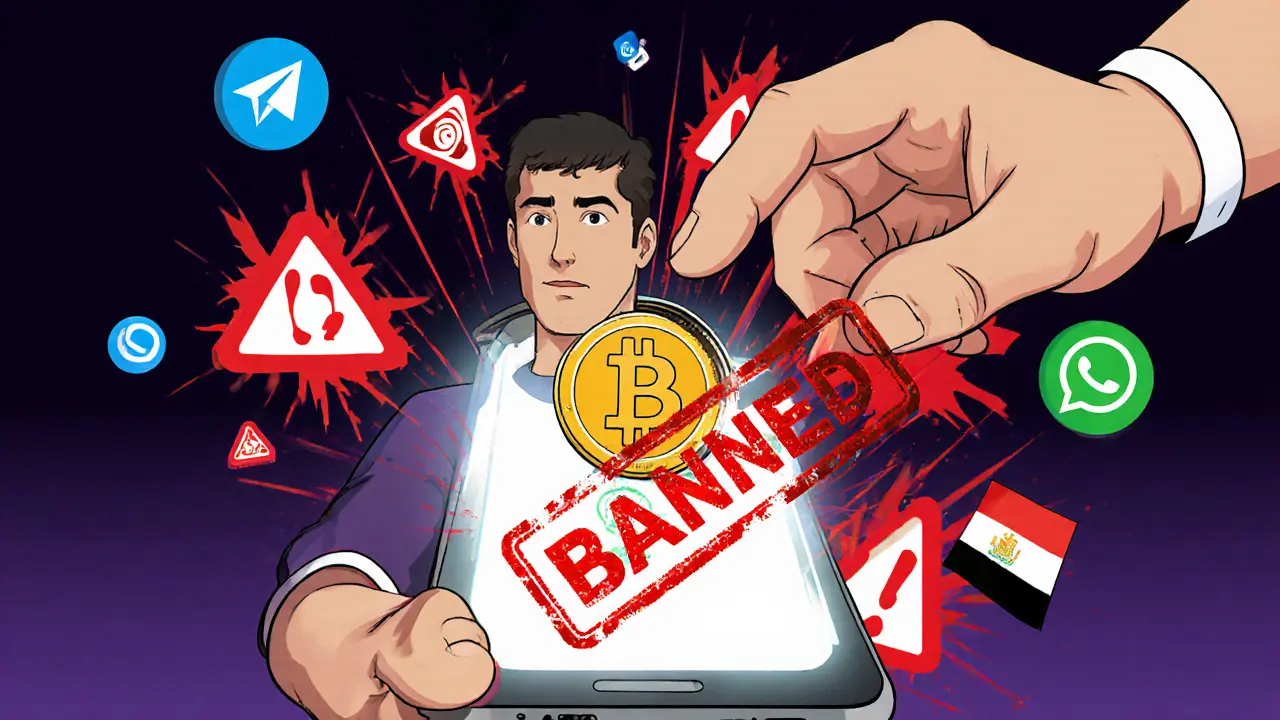
A freelancer receiving crypto payments as a giant hand stamps it banned by the central bank.

But People Are Still Trading

Here’s the twist: despite the risks, Egypt has one of the highest crypto adoption rates in Africa and the Middle East.

A 2022 report by TripleA found that over 1.7 million Egyptians - about 1.75% of the population - owned cryptocurrency. That’s more than the entire population of Norway. Egypt ranked second in the Arab world, behind only Morocco.

Why? Because crypto solves real problems. Inflation in Egypt hit 38% in 2023. The Egyptian pound lost over 60% of its value against the dollar since 2022. People are using Bitcoin and USDT to protect their savings. Remittances from Egyptians abroad are a lifeline - and crypto is faster and cheaper than Western Union.

Young people use crypto to buy digital services, pay for freelancing gigs, or invest in global projects. They know the risk. But they also know the alternative: watching their money disappear in a collapsing currency.

What This Means for Businesses

If you run a business in Egypt and accept crypto payments - even accidentally - you’re at risk. That includes freelancers on Upwork who get paid in USDT, or e-commerce stores that list crypto as an option.

International companies trying to operate in Egypt face a nightmare. They can’t use crypto to pay local vendors. They can’t settle invoices with global partners using Bitcoin. Every payment has to go through slow, expensive, and heavily monitored banks.

Blockchain startups? Dead on arrival. No legal way to incorporate. No way to raise capital. No way to hire developers who want to be paid in crypto. Egypt is missing out on innovation because it refuses to regulate - it only bans.
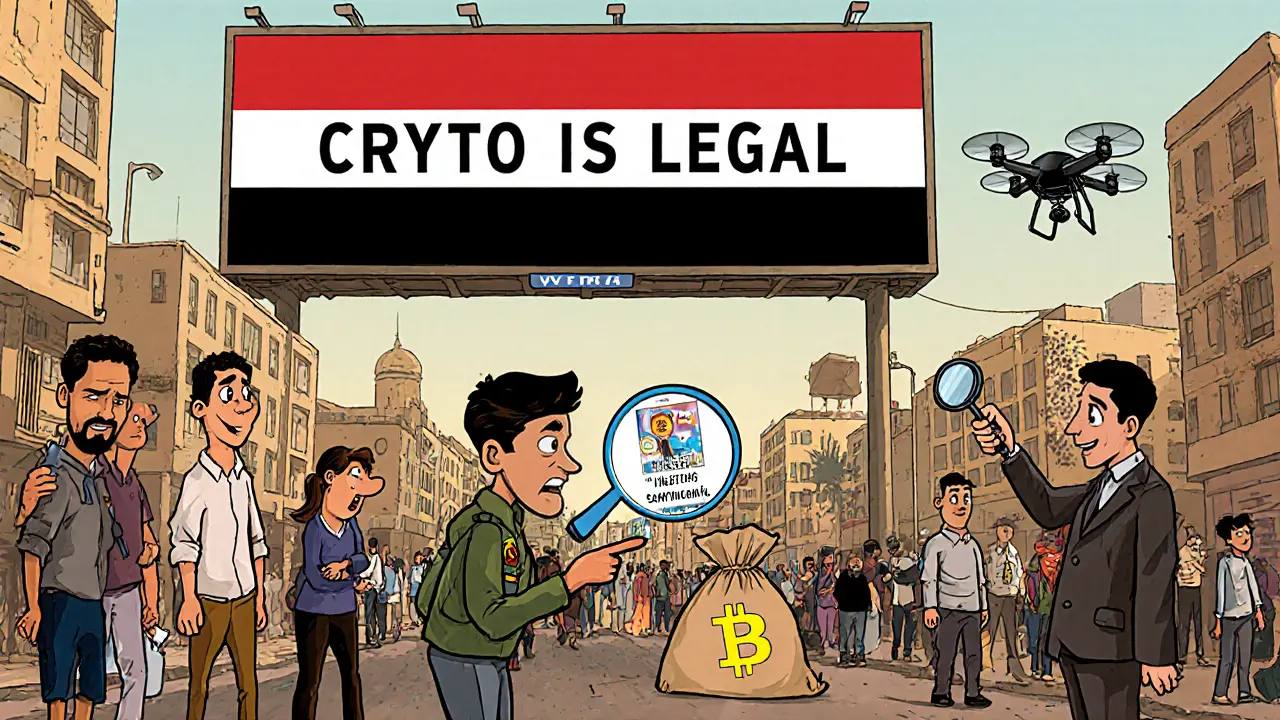
People secretly trading crypto in Cairo while authorities monitor them from above with drones.

What Should You Do?

If you’re in Egypt and you own crypto:

  • Don’t promote it. Don’t post about it. Don’t join crypto groups on social media.
  • Don’t use local banks to buy crypto. Use P2P platforms with cash deposits - but know that your bank may still flag you.
  • Don’t trade on exchanges registered in Egypt. There aren’t any. All are illegal.
  • If you’re a freelancer, ask clients to pay in USD or EUR via bank transfer. It’s slower, but safer.
If you’re thinking about starting a crypto-related business in Egypt - don’t. The legal risk isn’t worth it. Even if you think you can hide, the government is building systems to catch you.

What’s Next?

There’s no sign Egypt will soften its stance. The Central Bank and FRA are aligned. They’ve made it clear: crypto is not money. It’s not a technology. It’s a threat.

But the numbers don’t lie. People are still buying. The demand isn’t going away. The question isn’t whether Egypt will ban crypto - it already did. The question is whether it will ever be able to enforce that ban completely.

For now, the law is clear. The fines are real. And the risk is high.

Is it illegal to own cryptocurrency in Egypt?

Yes, owning cryptocurrency isn’t explicitly illegal, but any activity around it - buying, selling, trading, promoting, or using it as payment - is. The law targets transactions, not possession. But if you’re caught trading, even with a personal wallet, you can be fined or jailed.

Can you get arrested for using Binance in Egypt?

Yes. While Binance isn’t based in Egypt, using it to trade crypto is illegal under Law No. 194 of 2020. The Egyptian authorities track transactions linked to Egyptian bank accounts and IDs. If you’re identified as a user, you can be summoned, fined, or prosecuted - even if you never visited the platform from within Egypt.

Are there any legal crypto exchanges in Egypt?

No. There are zero licensed cryptocurrency exchanges operating in Egypt. Any platform claiming to be legal is either a scam or misinformed. The Egyptian Financial Regulatory Authority has not approved any crypto exchange under its rules.

What happens if you get caught trading crypto in Egypt?

You could face a fine between 1 million and 10 million Egyptian pounds (roughly $51,600 to $516,000 USD), imprisonment, or both. Banks may freeze your accounts. Your identity could be flagged by the Central Bank. Even if you’re not jailed immediately, you’ll be on a government watchlist, making it harder to open bank accounts or travel abroad.

Can you send crypto to someone in Egypt legally?

No. Receiving crypto in Egypt is considered a transaction under the law. Even if you’re just receiving funds from a family member abroad, it’s still classified as illegal under Law No. 194 of 2020. The only legal way to receive foreign money is through approved banking channels.

Is Bitcoin recognized as legal tender in Egypt?

No. Bitcoin and all other cryptocurrencies are not legal tender in Egypt. Only the Egyptian pound is recognized as official currency. The Central Bank of Egypt has repeatedly stated that digital currencies have no legal status and are not protected by any government guarantee.

Can you mine cryptocurrency in Egypt?

Mining crypto is illegal under Law No. 194 of 2020. Mining is considered an operation of a cryptocurrency exchange or service, which requires authorization - and no such authorization exists. Even if you’re mining for personal use, you’re still breaking the law. Authorities have raided homes in Cairo and Alexandria where mining rigs were found.

Do Egyptian banks block crypto transactions?

Yes. Major Egyptian banks like CIB, NBE, and QNB Al Ahli monitor transactions for signs of crypto trading. If you send money to a known P2P platform like Binance or Paxful, your account may be flagged, frozen, or closed. Some customers report being asked to explain the purpose of their transfers - and if they mention crypto, they’re often shut down.

Is there a chance Egypt will legalize crypto in the future?

Unlikely in the near term. The Central Bank and FRA have shown no interest in regulation - only prohibition. Unlike countries like Nigeria or India, Egypt hasn’t explored a central bank digital currency (CBDC) or licensing framework. The political stance remains hardline: crypto is a threat, not a tool. Change would require a major shift in economic policy - and there’s no sign that’s coming.

What’s the punishment for promoting crypto on social media in Egypt?

Promoting crypto on social media is treated as illegal advertising under Capital Market Law No. 95 of 1992. The Egyptian Financial Regulatory Authority has issued warnings about this specifically. You can be fined up to 10 million EGP and face criminal charges, even if you’re just a regular user sharing a YouTube video or running a Telegram channel. Enforcement targets influencers and small promoters more than large exchanges.

Comments
Tejas Kansara
Tejas Kansara
Nov 24 2025

Crypto is the only way to save money here. Inflation is eating everything alive.

John Borwick
John Borwick
Nov 26 2025

I get why Egypt’s scared. But banning tech because it’s hard to control is like banning phones because criminals use them. People need tools to survive, not just rules.

My cousin in Cairo uses USDT to pay her freelance clients. She’s not laundering money-she’s just getting paid. The bank takes 10 days and 15% in fees. Crypto takes 10 minutes.

The government’s fighting the future. They don’t see that crypto isn’t the problem-it’s the symptom. The real issue is a collapsing currency and broken banking.

They should regulate, not punish. Jail time for trading Bitcoin? That’s not policy, that’s panic.

And yeah, I know they’ll say ‘it’s for security.’ But if you’re scared of crypto, why not build a digital pound? Nigeria did. India’s trying. Egypt’s just deleting the problem.

People will keep using it. They always do. The only thing that changes is how much pain it causes when they get caught.

It’s like Prohibition. You don’t stop demand by making it illegal. You just make it dangerous.

Matthew Prickett
Matthew Prickett
Nov 28 2025

They’re lying. This isn’t about crime. It’s about control. The government doesn’t want people to have money they can’t track. They’re scared of a population that can bypass them.

Ever notice how every time a country cracks down on crypto, the dollar gets stronger? Coincidence? Nah. They’re using fear to keep people dependent on the system.

They’ve got cameras everywhere, banks reporting everything, and now they’re hunting crypto users like criminals. This isn’t finance-it’s surveillance with a fine.

And don’t tell me ‘it’s for stability.’ The pound’s collapsing. The real instability is their refusal to adapt.

I bet they’re secretly buying Bitcoin on the side. Everyone does. The rich always do.

Rajesh pattnaik
Rajesh pattnaik
Nov 28 2025

Interesting read. I live in India where crypto is also messy but not banned. Here people still use it for remittances and savings too.

Hope Egypt finds a middle path soon. People need options, not just fear.

Kathy Alexander
Kathy Alexander
Nov 29 2025

Let me guess-next they’ll ban VPNs and say ‘it’s for national security.’

They’re not protecting the economy. They’re protecting their own power. Crypto exposes how weak their system really is.

And don’t even get me started on how they claim to fight money laundering while ignoring the billions flowing through shell companies and real estate. Hypocrisy is their official currency.

preet kaur
preet kaur
Dec 1 2025

I’ve seen friends in Cairo trade crypto just to buy groceries without losing half their cash to inflation. It’s not about speculation-it’s survival.

It’s heartbreaking to see a country with so much potential shut down innovation because they’re afraid of change.

Maybe one day they’ll realize that technology doesn’t disappear because you ban it. It just goes underground-and then it’s harder to help people who need it.

Amanda Cheyne
Amanda Cheyne
Dec 2 2025

They’re using crypto as a scapegoat. The real problem? The Central Bank is corrupt. The elite are hoarding dollars while normal people watch their savings vanish.

They’re not banning crypto to stop crime-they’re banning it to stop people from escaping their economic prison.

And the fact that they’re tracking wallet addresses? That’s not security. That’s a digital dossier on every citizen who dares to be independent.

They think they’re in control. But they’re just building the cage they’ll eventually be locked in.

Omkar Rane
Omkar Rane
Dec 4 2025

Man, this whole thing is wild. I’m from India and we’ve got our own crypto chaos-taxes, confusion, but not jail time. Egypt’s going full dystopia here.

I read somewhere that over a million people are using crypto there. That’s like the whole population of Iceland doing something illegal. You can’t just arrest a whole country.

And the fact that they’re fining people for sharing links? That’s next level. What’s next, jail for Googling ‘how to buy Bitcoin’?

Also, mining rigs being raided? Bro, those things are loud. You don’t need fancy tech to find them. Just walk down the street.

But here’s the thing-people are still doing it. Because the alternative is worse. The pound’s trash. Banks are slow. And the government? Doesn’t care.

So yeah, fine them. Lock them up. But the crypto ain’t going anywhere. It’s already in their phones. In their wallets. In their dreams.

And when the economy finally collapses? They’ll wish they’d just regulated it instead of pretending it didn’t exist.

Tyler Boyle
Tyler Boyle
Dec 5 2025

Let’s be real-Egypt’s ban is a textbook case of regulatory failure disguised as policy.

First, they don’t have a CBDC. Second, they don’t have a clear legal framework for digital assets. Third, they’re not investing in blockchain education or infrastructure. So instead of building, they’re burning.

Meanwhile, Nigeria’s building a digital currency. India’s creating a regulatory sandbox. Even Saudi Arabia is testing crypto licenses.

Egypt? They’re treating Bitcoin like a cult. They’re not thinking about financial inclusion. They’re not thinking about remittances. They’re not thinking about youth unemployment. They’re thinking about control.

And here’s the kicker: they’re failing at control. People are still trading. They’re using cash P2P. They’re using offshore wallets. They’re using aliases. The law is a ghost-it exists on paper but not in practice.

So what’s the real cost? Not the fines. It’s the brain drain. The startups that never launch. The developers who leave. The entrepreneurs who give up.

They’re not protecting the economy. They’re killing its future.

Jennifer Morton-Riggs
Dec 6 2025

It’s funny how governments panic when tech outpaces their control. They call it a threat. But really, it’s just a mirror. Crypto shows how broken the system is.

People aren’t using it because they’re greedy. They’re using it because they’re desperate.

And the fact that they’re punishing social media posts? That’s not law. That’s fear. That’s authoritarianism wearing a suit.

They think they’re stopping crime. But they’re just making it harder for honest people to survive.

And don’t tell me ‘it’s for stability.’ Stability without freedom is just stagnation with extra steps.

Soham Kulkarni
Soham Kulkarni
Dec 6 2025

Been following this for a while. People in Egypt are smart. They know the risks. But they also know the system is rigged.

It’s not about Bitcoin. It’s about dignity. About not being stuck while the world moves on.

Hope they change soon. Not because of pressure. But because they finally see people as humans, not problems to solve.

Lisa Hubbard
Lisa Hubbard
Dec 7 2025

Okay but let’s be honest-this whole article reads like a crypto influencer’s manifesto. They make it sound like Egypt is the only country with inflation. Like no one else has ever tried to regulate digital assets.

Also, ‘1.7 million users’ sounds impressive until you realize that’s less than 2% of the population. Most people are still using cash.

And the idea that banning crypto is ‘stifling innovation’? What innovation? People are trading coins, not building apps. There’s no blockchain startup ecosystem there. It’s just gambling with a side of desperation.

Maybe instead of blaming the government, people should focus on fixing the economy instead of chasing digital magic bullets.

Belle Bormann
Belle Bormann
Dec 8 2025

Just a heads up-some banks in Egypt are starting to flag even regular transfers if they go to P2P platforms. If you’re using Binance or Paxful, even with cash, your account might get frozen.

Best bet? Use cash in person, don’t talk about it, and never link your ID to anything. But yeah, it’s risky.

Also, if you’re a freelancer, ask for USD via Western Union. Slower, but safer. No one’s gotten arrested for that yet.

Write a comment