
Blockchain Storage Cost Calculator
How much data do you need to store?
Calculate costs for on-chain storage versus off-chain alternatives
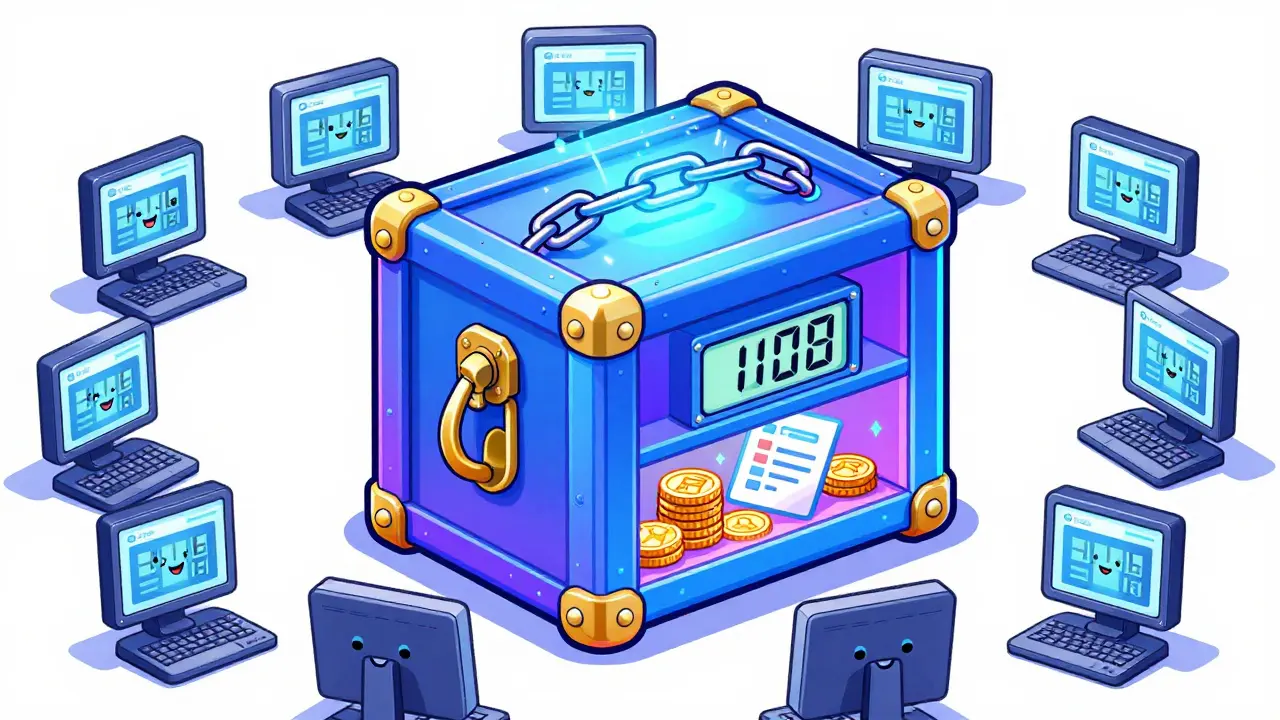
When you send Bitcoin or Ethereum, where does that data actually go? It doesn’t vanish into the cloud or get saved on a single server. Instead, it’s locked into a blockchain block-a permanent, tamper-proof container that’s copied across thousands of computers worldwide. This isn’t just digital paperwork. It’s a cryptographic system designed to make fraud nearly impossible and trust unnecessary.
What’s Inside a Blockchain Block?
Every block is built like a digital envelope with three main parts: the header, the transaction counter, and the actual transaction data. The header is the most critical piece. It contains a unique fingerprint of the previous block, which links it to the one before it. That’s what makes it a chain. Change one block, and every block after it breaks because the fingerprints no longer match.The header also includes a timestamp, a nonce (a random number used in mining), and the Merkle root. The Merkle root is a single hash that represents all the transactions in the block. Think of it like a summary of a book’s entire content condensed into one string of letters and numbers. If even one word in the book changes, the summary changes completely. This lets nodes quickly verify that all transactions in the block are valid without downloading every single one.
The transaction counter simply tells you how many transactions are packed into the block. Bitcoin blocks can hold up to 4MB of data after SegWit, while Ethereum uses a dynamic gas limit-currently around 30 million gas per block-which translates to roughly 15-30 transactions per second depending on complexity.
How Transactions Are Structured
Each transaction inside a block has its own set of data. For Bitcoin, that includes the sender’s address (a 160-bit string like1A1zP1eP5QGefi2DMPTfTL5SLmv7DivfNa), the recipient’s address, the amount in satoshis (the smallest unit of Bitcoin), and a digital signature proving the sender owns the funds. Ethereum transactions add more: gas price (how much you’re willing to pay per unit of computational work), gas limit (maximum you’ll spend), and optional data fields for smart contracts.
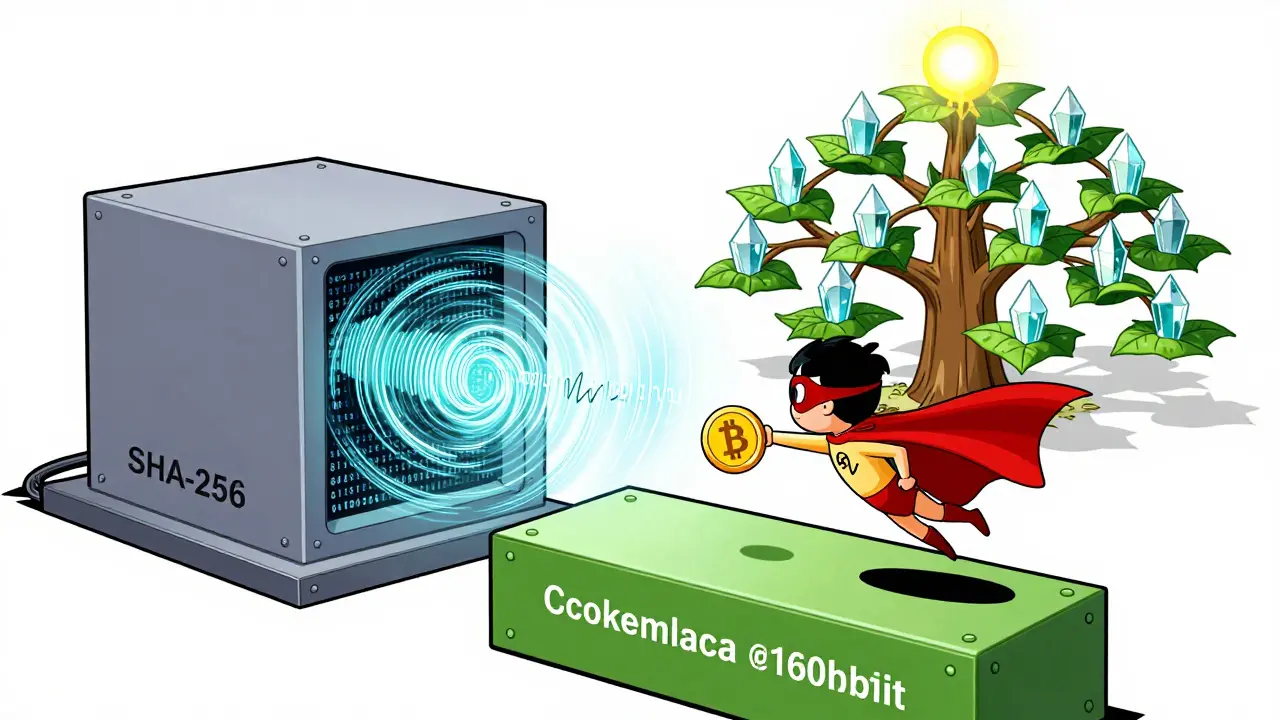
All of this data is run through a cryptographic hash function. Bitcoin uses SHA-256. Ethereum uses Keccak-256. These functions turn any input-whether it’s a single letter or a megabyte of data-into a fixed 64-character hexadecimal string. Even changing one digit in a transaction completely alters the hash. This is called the avalanche effect, and it’s why tampering is so obvious. If someone tried to alter a transaction after it was added, the hash wouldn’t match. The network would reject it instantly.
On-Chain vs. Off-Chain Storage
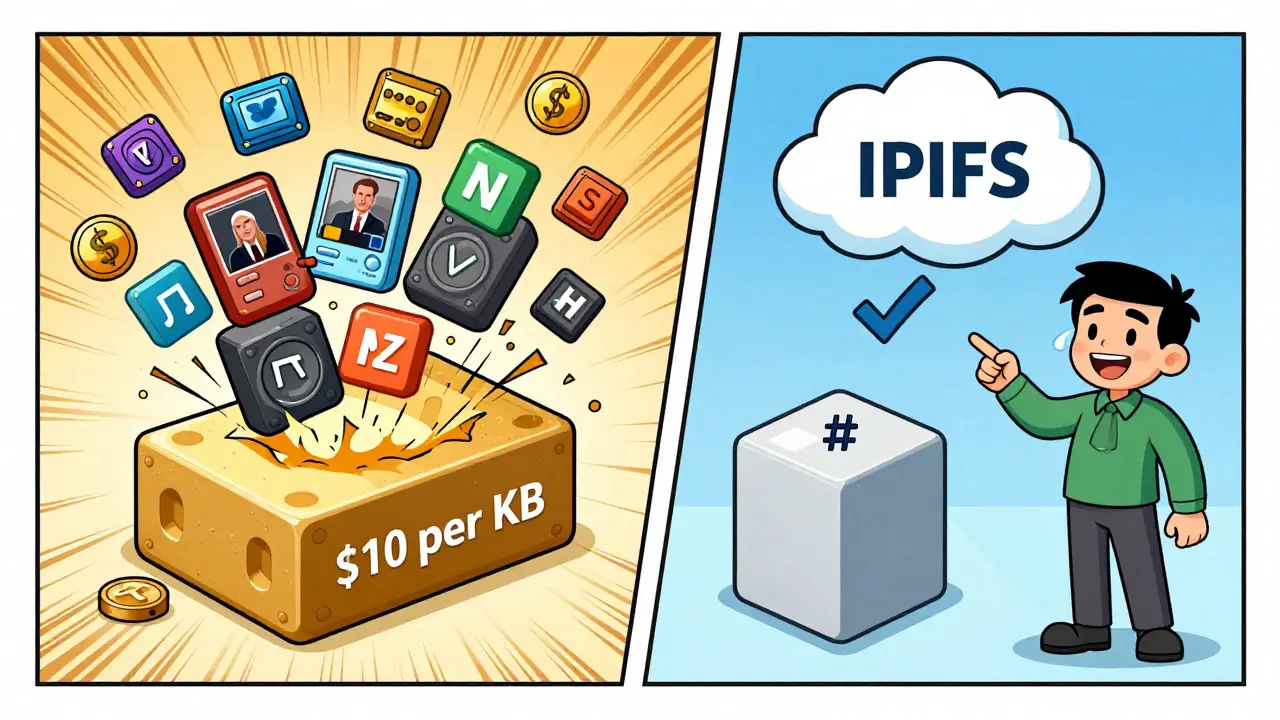
Not everything needs to live inside a block. Storing large files like images, videos, or documents directly on-chain is expensive and inefficient. On Ethereum, storing 1KB of data costs about $10 as of late 2023. That’s why most NFTs, like Beeple’s $69 million artwork, only store a hash on-chain and keep the actual file on centralized servers or decentralized networks like IPFS.Off-chain storage solves this by keeping the bulk data outside the blockchain but recording a cryptographic hash of it on-chain. This way, you can prove the file hasn’t changed without bloating the blockchain. Filecoin and IPFS are popular for this. You pay pennies to store the hash, and the file stays safely distributed across thousands of nodes. If someone tries to swap the file, the hash won’t match, and the system knows it’s fake.
Bitcoin’s blockchain has grown to 475GB as of December 2023. Ethereum’s is over 1.2TB. That’s because every node stores a full copy. It’s redundant by design. But that redundancy is what makes it secure. There’s no single point of failure. Even if half the nodes go offline, the rest still hold the complete history.
Why Immutability Is a Double-Edged Sword
Once data is in a block and confirmed by the network, it’s nearly impossible to remove. That’s great for preventing fraud. But it’s also dangerous if you make a mistake. In July 2017, a bug in a popular Ethereum wallet called Parity froze $300 million in ETH permanently. No one could move it. No one could delete it. The code was flawless-it just did exactly what it was told. And because the blockchain doesn’t forgive, the money stayed locked forever.This is why smart contract developers test relentlessly. One developer on Ethereum Stack Exchange spent 17 hours fixing a bug where they stored user profiles as strings instead of structured data. The mistake cost $1,200 in gas fees for just 1,000 users. On-chain storage isn’t forgiving. It’s final.
Private vs. Public Blockchains
Not all blockchains are built the same. Bitcoin and Ethereum are public-anyone can join, verify, and write data. But enterprises often use private blockchains like Hyperledger Fabric. These restrict who can participate. Data is only visible to authorized members. That’s useful for supply chains or banking systems where privacy matters more than public transparency.Hyperledger Fabric can handle 3,500 transactions per second. Bitcoin maxes out at 7. That’s because private chains skip proof-of-work and use faster consensus methods. They don’t need to be decentralized to be secure-they just need to be trusted by a small group. But they lose the key benefit of public blockchains: censorship resistance.
What’s Changing in 2024 and Beyond
Blockchain storage is evolving fast. Ethereum’s Dencun upgrade, expected in early 2024, introduces proto-danksharding. This lets blocks carry temporary data blobs that aren’t stored permanently on every node. Instead, they’re verified and then discarded after a short time. This could reduce data storage costs by 90% and boost transaction speed to over 100,000 per second.Projects like Celestia and Avail are taking this further. They split blockchain functions into separate layers: one for consensus, one for data availability, one for execution. This lets each layer scale independently. Celestia can handle 10,000 transactions per second with 10MB blocks, while keeping storage costs low.
Zero-knowledge proofs (ZKPs) are another game-changer. Networks like Aleo and StarkNet let you prove a transaction is valid without revealing any details. You can verify someone sent $5,000 without seeing who sent it or to whom. This brings privacy to public chains without sacrificing security.
Real-World Use Cases
The Estonian government has been using a blockchain called KSI since 2012 to secure 1.2 billion health records. Not the records themselves-just their hashes. Every time a record is accessed or updated, a new hash is added. If anyone tries to alter the original file, the hash won’t match. There have been zero breaches in over a decade.On the consumer side, someone using Polygon to verify document ownership spends $0.03 per verification. Traditional notaries charge $2.50. That’s 99% cheaper. For someone processing 12,000 verifications a month, that’s $360 instead of $30,000.
But adoption isn’t easy. Maersk’s TradeLens blockchain failed because too few shipping companies joined. Blockchain only works if enough people use it. The same goes for enterprise systems-87 of the Fortune 100 are using blockchain, but mostly for niche tasks like auditing or supply chain tracking, not replacing their entire database.
What You Need to Know Before Using It
If you’re building on blockchain, you need the right tools. Ethereum developers use Solidity. Solana uses Rust. Hyperledger uses Go. Learning one takes 3-6 months. Setting up a full Ethereum node requires 2TB of SSD storage, 16GB of RAM, and a fast internet connection. It costs $800-$1,200 in hardware alone.Gas fees are unpredictable. During NFT mania in late 2021, Ethereum gas spiked from 20 gwei to 1,800 gwei overnight. That meant a simple transfer cost $50 instead of $0.50. Developers must optimize every line of code. OpenZeppelin found 68% of smart contracts waste 20-40% of gas on inefficient storage.
Regulations are catching up. The EU’s MiCA law, effective December 2024, requires blockchain systems to have clear reconciliation rules for financial data. The SEC says storing securities data on public chains must follow Rule 17a-4-meaning you need backups and audit trails.
Blockchains aren’t replacing databases. They’re replacing trust. They’re for when you need to prove something happened, without relying on a bank, a government, or a tech company. If you need speed, low cost, and privacy, use off-chain storage with on-chain verification. If you need absolute immutability and public transparency, then yes-put it on-chain. But only if you’re ready for the cost and the permanence.
How are transactions stored inside a blockchain block?
Transactions are stored as a list inside each block, after the block header. Each transaction includes sender and recipient addresses, amount, timestamp, digital signature, and optional data (like smart contract calls). All transactions are hashed together into a single Merkle root, which is stored in the block header. This allows nodes to verify all transactions quickly without downloading the full block.
Why can’t you delete data from a blockchain?
Blockchain data is immutable because each block contains the cryptographic hash of the previous block. Changing any data would require altering every subsequent block and gaining control of over 51% of the network’s computing power. This is computationally infeasible on major blockchains like Bitcoin and Ethereum, making deletion practically impossible.
Is storing data on-chain expensive?
Yes. On Ethereum, storing 1KB of data costs around $10 as of late 2023. That’s why most applications store only hashes on-chain and keep large files (like images or documents) on decentralized storage like IPFS or Filecoin, then record the hash to prove authenticity without the cost.
What’s the difference between Bitcoin and Ethereum block storage?
Bitcoin blocks are limited to 4MB and store mostly simple payments. Ethereum blocks have no fixed size limit but use a gas cap (around 30 million gas) to control computational load. Ethereum blocks also store smart contract code and state changes, making them more complex and larger on average. Bitcoin uses SHA-256; Ethereum uses Keccak-256 for hashing.
Can blockchain be used for storing large files like videos?
Technically yes, but it’s impractical. Storing a 1GB video on Ethereum would cost over $10 million. Instead, files are stored off-chain on decentralized networks like IPFS or Arweave, and only their cryptographic hash is recorded on-chain. This proves the file hasn’t changed without bloating the blockchain.
How do new blockchains reduce storage costs?
New systems like Ethereum’s proto-danksharding (EIP-4844) store temporary data in "blobs" that aren’t permanently kept by all nodes. Projects like Celestia and Avail separate data availability from execution, letting nodes only download the data they need. Zero-knowledge proofs also reduce storage by only recording verification proofs, not full transaction details.