
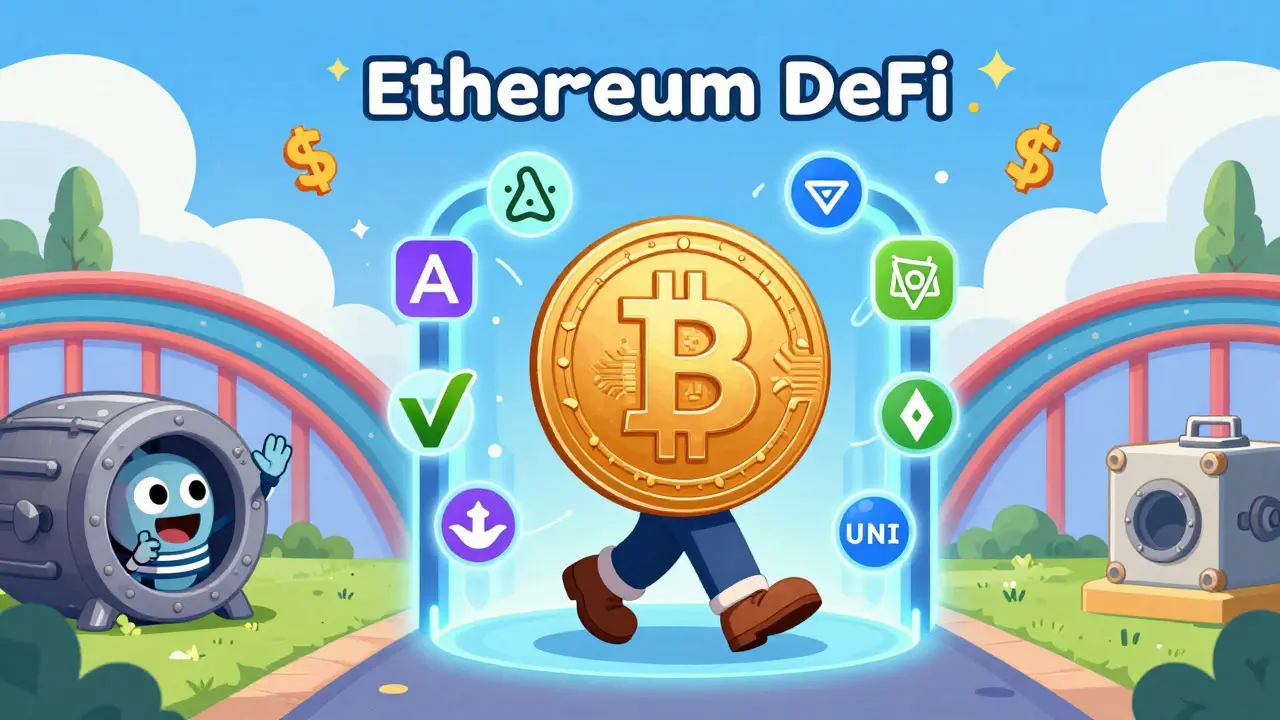
Imagine holding Bitcoin but wanting to earn interest on it-without selling it. Or using your Litecoin to supply liquidity on a decentralized exchange, even though it was never built for that. This isn’t science fiction. It’s happening right now, thanks to wrapped tokens.
Wrapped tokens are digital clones of cryptocurrencies that let them work on blockchains they weren’t originally designed for. They’re not magic. They’re smart contracts and locked reserves working together. For example, Wrapped Bitcoin (WBTC) is a token on Ethereum that’s backed 1:1 by actual Bitcoin held in custody. When you use WBTC, you’re not trading Bitcoin. You’re trading a token that represents Bitcoin on Ethereum. And that tiny difference unlocks a whole new world of finance.
Unlocking Bitcoin in Ethereum DeFi
Bitcoin is the OG cryptocurrency. But for years, it was locked out of Ethereum’s DeFi ecosystem. Why? Because Ethereum apps run on ERC-20 tokens, and Bitcoin runs on its own blockchain. No overlap. No compatibility. That changed with WBTC.
WBTC lets Bitcoin holders lend, borrow, and farm yield on platforms like Aave, Compound, and Uniswap. You don’t have to sell your Bitcoin. You wrap it. You lock your BTC with a custodian. In return, you get WBTC-an ERC-20 token that behaves exactly like ETH or DAI on Ethereum. You can swap it, stake it, or use it as collateral. Over $10 billion in Bitcoin has been wrapped into WBTC since its launch. That’s not a small number. It’s the biggest bridge between two of the most important blockchains.
And it’s not just WBTC. Wrapped Litecoin (wLTC), Wrapped Chainlink (wLINK), and Wrapped Filecoin (wFIL) do the same thing for their native assets. Suddenly, assets that used to sit idle can now be active participants in DeFi.
Breaking Down Cross-Chain Liquidity
DeFi isn’t just on Ethereum anymore. There’s Solana, Arbitrum, Polygon, Base, and dozens more. But liquidity is scattered. If you hold XLM (Stellar’s token), you can’t use it on Uniswap. Or Curve. Or Aave. Not unless you wrap it.
Wrapped Stellar (wXLM) changes that. It’s a tokenized version of XLM on Ethereum. Now, XLM holders can supply liquidity to ETH-based pools, earn trading fees, and participate in yield strategies. Same goes for Wrapped Tezos (wXTZ). XTZ was stuck on its own chain. Now it’s usable on any DeFi app that accepts ERC-20 tokens.
This isn’t just about convenience. It’s about capital efficiency. Your assets don’t have to sit in one place. They can move. They can multiply. Wrapped tokens turn isolated assets into mobile capital. You’re no longer forced to choose between holding Bitcoin and earning yield. You can do both.
Why This Matters for Smaller Tokens
Not all cryptocurrencies are big. Many have tiny trading volumes. That makes them risky to use in DeFi. Liquidity pools for obscure tokens dry up fast. Prices swing wildly. No one wants to trade them.
Wrapped tokens fix that. Take Wrapped Filecoin (wFIL). Filecoin’s native network is focused on decentralized storage, not finance. But wFIL lets FIL holders access DeFi protocols on Ethereum. Suddenly, FIL has a new market. More people trade it. More liquidity forms. The price stabilizes. The original asset benefits from exposure it never had before.
This works for any asset. Wrapped Dogecoin? Wrapped Polkadot? Wrapped Solana? They all follow the same pattern. Wrap it. List it. Let the market decide. It’s a simple formula, but it’s reshaping how we think about asset utility.
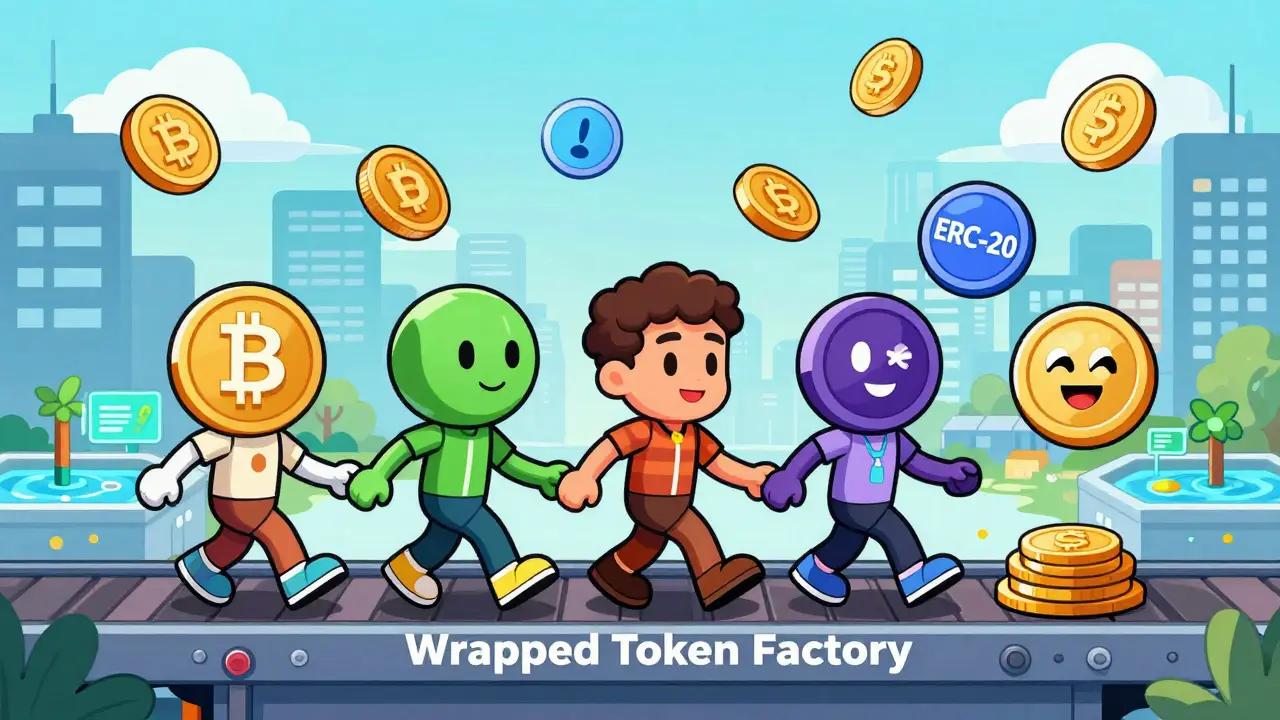
How Wrapped Tokens Actually Work
It’s not magic. It’s mechanics.
Here’s how it happens:
- You send your Bitcoin (or Litecoin, or XLM) to a trusted custodian.
- The custodian locks it in a secure wallet-usually a multi-sig vault controlled by multiple parties.
- A smart contract on Ethereum mints an equal amount of WBTC (or wLTC, or wXLM) and sends it to your wallet.
- Now you can use that token anywhere ERC-20 tokens are accepted.
- When you want your original asset back, you send the wrapped token to the contract. It burns the token and releases the original from custody.
The system relies on trust-but not blind trust. Custodians are often audited. The minting and burning are transparent. The 1:1 backing is verifiable. If a custodian tries to mint more than they hold, the system collapses. That’s why major wrapped tokens like WBTC are backed by reputable institutions like BitGo and Kyber.
The Bigger Picture: Beyond Cryptocurrency
Wrapped tokens aren’t just for Bitcoin and Ethereum. The same concept applies to real-world assets.
Imagine wrapping gold. Or U.S. dollars. Or even shares in a company. Projects are already experimenting with tokenized real estate and commodities. Wrapped tokens are the bridge. They turn physical or legacy assets into blockchain-compatible units. That opens up DeFi to investors who’ve never touched crypto before.
Even NFTs can be wrapped. A rare digital artwork on Solana? Wrap it. List it on Ethereum. Now it’s part of a new market. The possibilities aren’t theoretical-they’re being built right now.

Security Risks and What to Watch For
Wrapped tokens aren’t risk-free. The biggest danger? The custodian.
If the entity holding your Bitcoin gets hacked, or goes offline, or disappears, your wrapped tokens become worthless. That’s why WBTC is so widely trusted-it’s backed by a consortium of audited institutions. But not all wrapped tokens are like that.
Some are created by small teams with little oversight. Always check: Who’s holding the underlying asset? Is it a well-known custodian? Is the contract audited? Are there regular proofs of reserves?
Also, don’t assume all wrapped tokens are equal. WBTC is the gold standard. Others? They’re experimental. Use them cautiously.
Why Wrapped Tokens Are Here to Stay
DeFi was supposed to be open. But for years, it was siloed. Bitcoin couldn’t join. Litecoin couldn’t join. Even Ethereum’s own tokens couldn’t easily move between its Layer 2 chains.
Wrapped tokens broke those walls. They turned isolated assets into universal ones. They gave users choice-without forcing them to sell what they believe in.
As blockchains keep growing, the need for interoperability will only get stronger. Wrapped tokens are the simplest, most proven solution we have. They’re not perfect. But they work. And they’re used by millions.
Whether you’re holding Bitcoin, Chainlink, or even a niche altcoin, wrapped tokens let you participate in the DeFi economy on your terms. No liquidation. No compromise. Just access.


Lauren Brookes
It’s wild how something as simple as wrapping an asset can unlock so much potential. I’ve been holding BTC for years, never thought I’d use it in DeFi-but now I’m earning yield on it without selling a single coin. Feels like the blockchain version of renting out your house while still keeping the keys.
Worth noting: the real magic isn’t the tech. It’s the cultural shift. People are finally starting to treat crypto like capital, not just speculation.