

COCOCOIN (COCO) isn't another Bitcoin clone. It doesn't promise to revolutionize payments or fix blockchain scalability. Instead, it’s a meme token built on the BNB Chain with one clear goal: to turn a viral frog into a community movement. Launched in August 2024, COCO was never meant to be a serious investment-it was designed to be shared, traded, and talked about. And somehow, it worked.
How COCOCOIN Started: A Community-Driven Airdrop
COCOCOIN didn’t raise money the usual way. Between June and August 2024, the project collected over $24 million in USDT, BNB, and ETH from early supporters. But here’s the twist: by August 7, 2024, every single dollar was refunded. Not kept. Not invested. Refunded. In exchange, everyone who contributed got an airdrop of COCO tokens at a 1:10 ratio. If you sent $10, you got 100 COCO tokens. No lock-ups. No hidden fees. Just a clean reset.This wasn’t a scam. It was a strategy. By refunding funds and distributing tokens directly to participants, the team removed any legal gray area around fundraising. The project became entirely community-owned from day one. There’s no central team holding a big wallet. No private investors. Just people who believed in the idea enough to join early.
The Viral Frog and the 34.2 Billion Token Supply
The symbol of COCOCOIN? A frog. Not a lion. Not a rocket. A frog. The Viral Frog became the face of the project because memes spread faster than whitepapers. And that’s the point. COCO isn’t about complex DeFi yields or smart contract upgrades. It’s about recognition, inside jokes, and shared identity.The total supply? Exactly 34.2 billion COCO tokens. And that’s it. No more will ever be created. No inflation. No future minting. All 34.2 billion are already in circulation. The distribution was split three ways:
- 80.41% went straight to community members via airdrop
- 9.36% was set aside for marketing and early promotion
- 10.23% locked as initial liquidity on decentralized exchanges
This means over 80% of the supply is held by regular users-not whales or insiders. That’s rare in crypto. Most tokens are concentrated in a few hands. COCO flipped that script.
Security and Transparency: What’s Actually Locked In
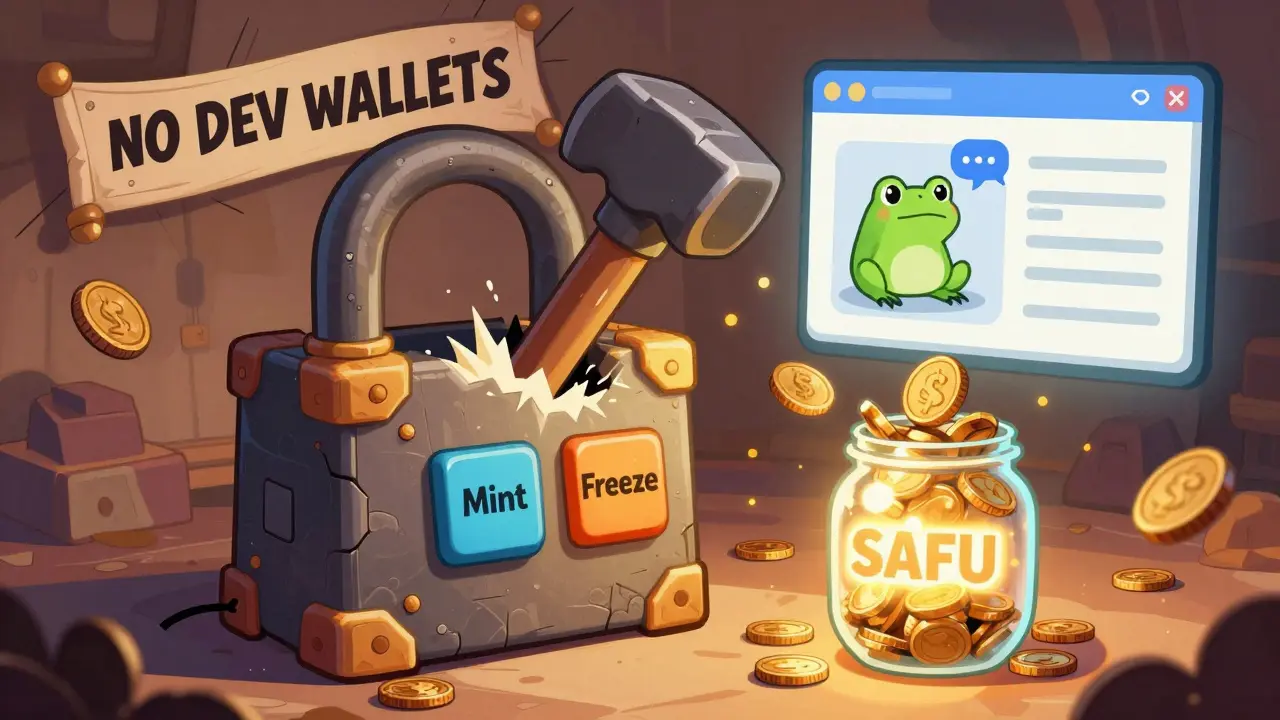
You hear “meme coin” and you think “rug pull.” But COCO took steps most projects don’t even consider.First, it passed a full audit by Certik, one of the most respected security firms in crypto. The report is public. You can check it. Second, on August 12, 2024, the team permanently burned their ability to change the contract. No more minting. No more freezing wallets. No more emergency stops. The code is frozen. Forever.
Then came liquidity locking. The 10.23% set aside for trading pairs was locked in a smart contract that can’t be touched. That means the token can’t be dumped overnight by developers. If the price crashes, they can’t just pull the plug and run.
And here’s another layer: 10% of every trade fee is automatically sent to a SAFU fund-Secure Asset Fund for Users. It’s like an insurance pool. If something goes wrong, this fund can help cover losses. It’s not perfect, but it shows they’re thinking about user safety, not just hype.

Where COCO Trades and How Much It’s Worth
COCO is listed on MEXC, Crypto.com, and CoinSwitch. You can trade it directly with USDT, BNB, or ETH. It’s also compatible with MetaMask, so if you already have a crypto wallet, you can add COCO in seconds.But here’s the messy part: price data doesn’t agree. CoinGecko says COCO is worth $0.000004735. Crypto.com says $0.000004527. CoinMarketCap says something different again. Why? Because trading volume is thin. On some days, total volume hits $1 million. On others, it’s under $100,000. That kind of inconsistency means prices can swing wildly based on a single large trade.
The market cap? Around $160,000 USD. That’s tiny. For comparison, Bitcoin’s market cap is over $1 trillion. COCO is ranked #3244 on CoinGecko. It’s not even in the top 1000. But here’s the catch: it has over 170,000 token holders. That’s more than many coins with 10x the market cap.
Why the Price Is So Volatile
COCO hit an all-time high of BTC 0.072959. That’s roughly $2.50 per token. Today? It trades around BTC 0.000094619. That’s a 97.9% drop. That’s not unusual for meme coins. It’s expected.Most meme tokens spike because of social media buzz. A viral tweet. A Reddit thread. A Discord hype wave. Then, as quickly as it came, the crowd moves on. COCO’s 7-day price change? Down 10.2%. The broader crypto market? Up 0.9%. So it’s underperforming. But that’s not the whole story.
When a token has a fixed supply and no future emissions, its price isn’t driven by inflation. It’s driven by demand. And demand for COCO isn’t about financial returns-it’s about belonging. People hold it because they like the frog. Because they were part of the airdrop. Because they believe in the community. That kind of loyalty doesn’t show up in charts. But it does show up in wallet counts.
What COCO Is Actually Used For
There’s no DeFi staking. No lending protocol. No NFT marketplace. COCO doesn’t have a utility token use case like Ethereum or Solana. Its purpose is social.The team launched a DApp in August 2024-a simple, secure platform where holders can interact, share memes, join challenges, and earn more COCO just for participating. Think of it like a crypto version of Reddit or TikTok, but with tokens instead of likes.
There’s no big corporate partnership. No celebrity endorsement. No institutional backing. Just a group of people who decided to build something fun. And it’s working. The project’s roadmap for 2025 focuses on expanding the DApp, adding new community features, and maybe even cross-chain support. But none of it hinges on price.
Is COCOCOIN Worth Buying?
If you’re looking for a safe investment? No. COCO is not for you.If you’re curious about how a meme can turn into a movement? Maybe. If you like the idea of owning a token with zero inflation, no dev wallets, and 170,000 real holders? Maybe. If you’ve been burned by crypto scams before and want to see something that actually burned its own access keys? Definitely.
COCO doesn’t promise returns. It promises participation. And in a space full of hype and hidden agendas, that’s worth something.
Is COCOCOIN (COCO) a scam?
No, COCO isn’t a scam. The team refunded all raised funds, burned contract privileges, locked liquidity permanently, and passed a Certik audit. There’s no team wallet holding a large supply, and no ability to create more tokens. While it’s a high-risk meme token, the project has taken more transparency steps than most.
Can I buy COCO on Coinbase or Binance?
No, COCO is not listed on Coinbase or Binance. It’s available on MEXC, Crypto.com, and CoinSwitch. You’ll need to use one of those exchanges to buy it. Make sure you’re on the official site to avoid fake listings.
How many COCO tokens are there?
Exactly 34.2 billion COCO tokens exist. That’s the total, circulating, and maximum supply. No more will ever be created. All tokens are already in the hands of users or locked in liquidity pools.
What blockchain is COCOCOIN on?
COCOCOIN runs on the BNB Chain (Binance Smart Chain). Its contract address is 0xf563e86e461de100cfcfd8b65daa542d3d4b0550. You can verify this on BscScan. Some sources mention Solana, but those are incorrect-COCO is only active on BNB Chain.
Why does COCO have such low trading volume?
COCO’s trading volume varies because it’s listed on only a few exchanges, and most holders aren’t actively trading-they’re holding as part of the community. At its peak, volume hit $3 million daily. Now, it’s lower, but that’s normal for meme tokens after the initial hype fades. The liquidity is still locked, so it’s not a liquidity crisis-it’s just a quiet phase.
Can I stake COCO to earn more tokens?
No, COCO doesn’t have staking, yield farming, or any DeFi mechanisms. The only way to earn more COCO is by participating in the community DApp-joining challenges, sharing content, or helping grow the platform. There are no passive income features.
Is COCO a good long-term investment?
COCO isn’t designed as a long-term investment. It’s a social experiment. Its value comes from community engagement, not financial returns. If you’re looking for a store of value or a growth asset, look elsewhere. But if you want to be part of a crypto community that actually listens to its users, COCO might be worth exploring.


Graham Smith
The structural elegance of COCO’s tokenomics is a masterclass in decentralized governance. By eschewing traditional venture capital models and implementing a full refund protocol coupled with a non-inflationary supply, the project has achieved what most DeFi initiatives only aspire to: true community sovereignty. The 80.41% airdrop distribution isn’t just generous-it’s revolutionary. When 97% of meme coins are controlled by five wallets, COCO’s dispersal model renders the entire whale paradigm obsolete. This isn’t speculation; it’s a sociopolitical experiment in tokenized belonging.