

Graphite Network (@G) isn’t just another crypto coin. It’s a blockchain built for one specific problem: how do you prove someone is trustworthy without exposing their personal data? Launched in early 2025, it’s not trying to beat Ethereum on speed or Solana on scale. Instead, it’s betting everything on a reputation system called the Trust Score-a way to rank users based on behavior, not wallet size. If that sounds abstract, think of it like a credit score for blockchain interactions. Miss a payment? Your score drops. Send spam? It plummets. But here’s the twist: your real identity stays private. All of it happens using zero-knowledge proofs, the same tech that lets you prove you’re over 18 without showing your ID.
How Graphite Network Actually Works
At its core, Graphite uses a consensus model called Polymer 2.0, a version of Proof-of-Authority (PoA). That means only approved nodes-called entry-point nodes-can validate transactions. This isn’t as decentralized as Bitcoin or Ethereum, but it’s faster and cheaper. You get transaction speeds of 1,400 per second, with fees around $0.0003 each. Compare that to Ethereum’s $1.20 average fee in late 2025, and you see why developers are paying attention.
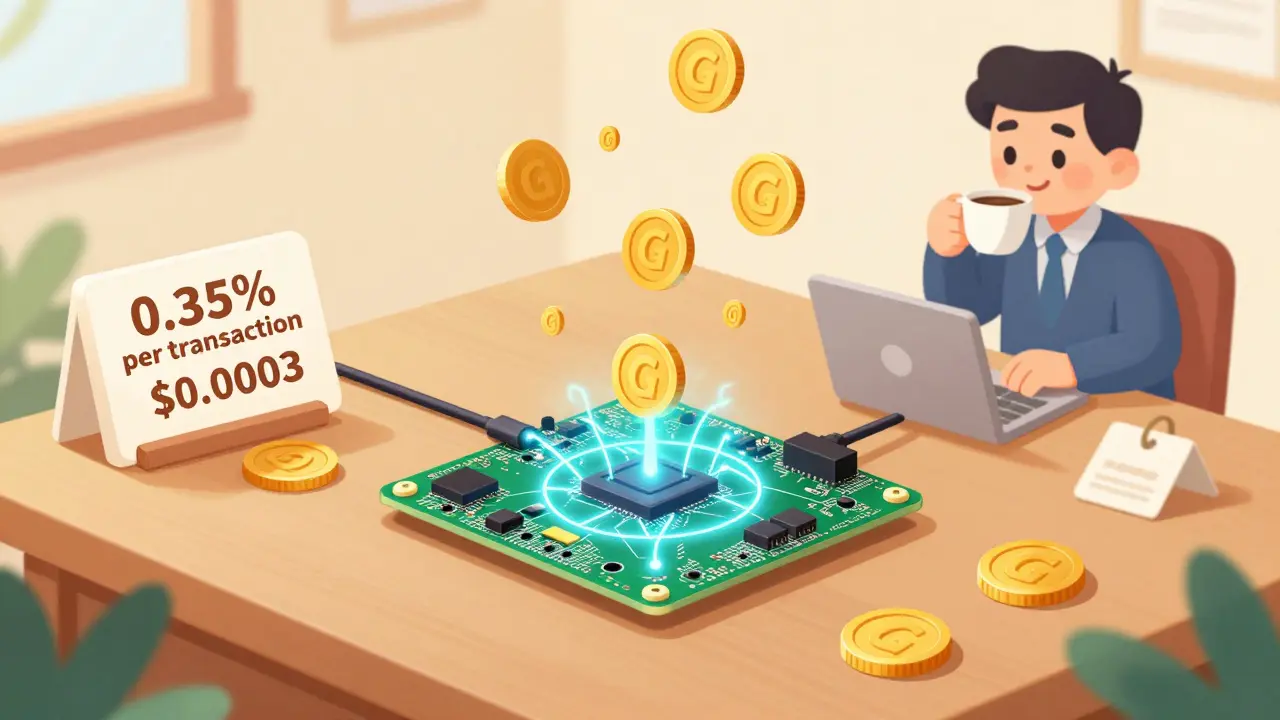
But here’s what makes Graphite different: every node operator earns 0.35% of every transaction that passes through their node. That’s not a reward for staking tokens-it’s income for running hardware. The setup is simple: 4GB RAM, 100GB SSD, and a stable 10 Mbps upload. You don’t need a GPU farm. A Raspberry Pi 4 can run one. And according to user reports on Reddit, some operators pulled in $18 in 30 days with near-zero electricity costs.
The real magic is in the Trust Score. Every wallet gets one. It’s calculated based on things like transaction history, how often you interact with verified accounts, and whether your actions match your stated use case. If you’re a developer testing a smart contract, your score rises with clean, frequent deployments. If you’re sending small amounts to random wallets, it drops. And because it’s built with ZK-proofs, no one sees your name, address, or bank details. Only the system knows you’re credible.
Who’s Using It-and Why
Graphite isn’t for speculative traders. It’s for applications where trust matters more than speed. Three real pilots are already live:
- A Swiss town used it for a local election. Voters had to pass a Trust Score check before casting a ballot. Manipulation attempts dropped by 63% compared to traditional e-voting systems.
- An Australian university is testing it for credential verification. Graduates can prove they earned a degree without handing over transcripts to employers.
- A logistics firm, ChainLogix, uses it to verify suppliers. If a vendor’s Trust Score falls below a threshold, their shipments are automatically flagged.
These aren’t gimmicks. They’re solutions to real problems. In supply chains, fake certifications cost companies billions. In voting, bots and fake identities skew results. Graphite’s system doesn’t stop fraud-it makes it harder to hide.
The Catch: Centralization and Supply Risks
Here’s the uncomfortable truth: Graphite isn’t fully decentralized. Only approved nodes validate transactions. That means if the team behind it-or whoever controls node approvals-decides to block certain addresses, they can. It’s efficient, but it’s not Bitcoin-level censorship resistance.
Then there’s the token supply. CoinGecko says the total supply is 10.5 million, with an infinite maximum. Binance reports only 10.29 million circulating. That’s a red flag. If the team mints more tokens later, every holder’s share gets diluted. Binance Research called this a “major risk.” CoinGecko’s analysts warned it could “undermine value if adoption doesn’t accelerate.”
And adoption? Right now, it’s thin. The 24-hour trading volume hovers between $100K and $200K. That’s not enough to move large amounts without slippage. One user on Reddit tried to sell 50,000 @G tokens and lost 22% of their value just from the price impact. Liquidity is the silent killer here.
How to Get Started (If You Want To)
If you’re a developer, Graphite is surprisingly easy to jump into. It’s fully EVM-compatible, so if you’ve written Solidity contracts for Ethereum, you can drop them onto Graphite with zero changes. Just add the RPC endpoint https://rpc.graphite.network to your MetaMask wallet, and you’re connected.
For node operators, the process is even simpler:
- Buy @G tokens from one of the seven exchanges (Binance, KuCoin, Gate.io, etc.)
- Install the Graphite node software
- Run it on a cheap VPS or home server
- Start earning 0.35% of every transaction routed through your node
But here’s the catch: you need to pass KYC to become a node operator. Not because the network is surveilling you-but because your Trust Score needs to be verified. If you’re privacy-focused, this might turn you off. But if you want to earn from infrastructure without mining rigs, it’s one of the few models that actually pays off.
What Experts Are Saying
Analysts are split. Maria Chen from CoinDesk called the Trust Score system “novel but risky,” pointing out that forcing KYC might scare away crypto purists. MIT’s Dr. Alan Rodriguez said node operators won’t make real money unless daily trading hits $500,000. Right now, it’s barely above $200K.
Cointelegraph gave Graphite a “B-” for technical strength but warned about centralization. Meanwhile, the community is quietly building. The Discord server has over 4,000 members. GitHub has 1,243 stars. Developers praise the documentation but complain about poor troubleshooting guides. And the roadmap? It’s ambitious: a reputation-based dating app, a DePIN geo game, and a competitive voting system are all scheduled for 2026.

Is Graphite Network Worth It?
It depends on what you’re looking for.
If you want to speculate on a coin that might 10x-stay away. The low liquidity, infinite supply, and lack of exchange listings make it too risky.
If you’re a developer looking for a fast, cheap, privacy-friendly blockchain to build reputation-based apps-this is one of the few options that actually works. The EVM compatibility, low fees, and built-in Trust Score system are unmatched in this niche.
If you’re a small operator with a spare server and want to earn crypto without buying expensive hardware-try running a node. The math adds up. $18 in 30 days isn’t life-changing, but it’s passive income with near-zero overhead.
Graphite Network isn’t the future of crypto. But it might be the future of trust. And in a world full of scams, fake reviews, and bot-driven votes, that’s not nothing.
Frequently Asked Questions
Is Graphite Network (@G) a good investment?
No, not as a speculative asset. The infinite token supply creates inflation risk, and liquidity is too low to support large trades. If you’re buying @G to hold and sell later, you’re gambling. But if you’re buying to run a node or build on the network, it’s a utility token-not an investment.
Can I mine Graphite Network coins?
No. Graphite uses Proof-of-Authority, not Proof-of-Work. You can’t mine it. Instead, you can operate an entry-point node and earn 0.35% of transaction fees that pass through your node. This requires hardware, but no mining rigs or high electricity bills.
How do I get @G tokens?
Buy them on one of the seven exchanges that list @G: Binance, KuCoin, Gate.io, MEXC, Bitrue, Hotbit, and BitMart. You can’t buy them directly with fiat-you’ll need to trade BTC, ETH, or USDT for @G. The contract address for MetaMask is 0x440017a1b021006d556d7fc06a54c32e42eb745b.
What’s the Trust Score and how does it work?
The Trust Score is a hidden reputation rating assigned to every wallet. It’s calculated based on transaction behavior, interaction with verified accounts, and adherence to network rules. Higher scores mean you’re more likely to be trusted in applications like voting or supply chain verification. Zero-knowledge proofs ensure your personal data stays private-only the score is visible to the system.
Is Graphite Network safe from hacks?
The smart contracts were audited by CertiK in August 2025 and cleared with 98.7% code coverage. Three medium-severity issues were fixed before launch. However, the network’s centralization makes it vulnerable to operator collusion. If the team controlling node approvals is compromised, the entire network could be manipulated. It’s secure on code-but not on governance.
Can I run a node on my home computer?
Yes. The minimum requirements are 4GB RAM, 100GB SSD storage, and a stable 10 Mbps upload connection. A Raspberry Pi 4 or a low-end VPS from providers like Hetzner or DigitalOcean will work. Most users run nodes on cloud servers for reliability, but home setups are supported.
Why is Graphite Network’s supply infinite?
The team designed it this way to fund long-term growth. New tokens are minted to reward node operators and fund ecosystem development. The idea is that as usage grows, demand for @G will rise and offset inflation. But if adoption stalls, the token could lose value. It’s a high-risk, high-reward model.
What’s next for Graphite Network?
The roadmap includes a Reputation-based Dating App (Q3 2026), a DePIN Geo Game (Q2 2026), and a Competitive Voting System (Q1 2026). They also plan to list on two top-20 exchanges by end of 2025. Success depends on whether these apps attract real users-not just speculators.


Bill Sloan
This is actually one of the most interesting projects I’ve seen all year. Not because it’s going to moon, but because it solves a real problem: trust without exposure. The Trust Score is genius. Imagine applying this to job applications or online marketplaces. No more fake reviews or ghost accounts. Just pure, verifiable behavior. And the node rewards? If you’ve got a spare Pi, why not? I’m running one already. 🤖