

So, you’ve seen the bull mascot and heard whispers of Mumu, a decentralized cryptocurrency token designed to unite the crypto community through its "muuvement." But what exactly is this asset, and why does it have such wild price swings?
Mumu (MUMU) isn’t your typical tech-heavy blockchain project. It’s a community-driven digital asset built on the principles of frictionless trading-specifically, zero taxes on buys and sells. While it sounds simple, that simplicity comes with high volatility and significant risk. Let’s break down what you’re actually holding when you buy MUMU.
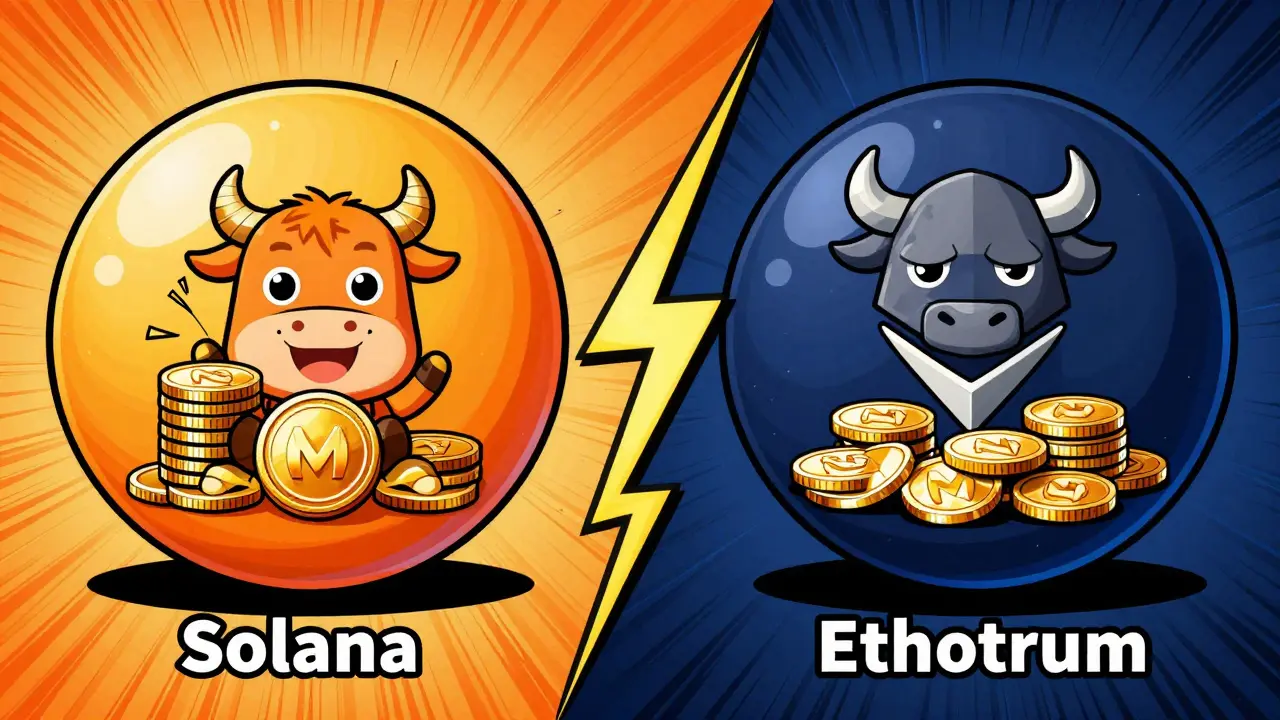
The Two Faces of Mumu: Ethereum vs. Solana
Here’s where things get tricky for new investors. Mumu doesn’t exist as just one token. It has multiple implementations across different blockchains, which can lead to confusion if you don’t know which contract address you’re interacting with.
The most actively tracked version is Mumu the Bull (SOL), a token launched on the Solana blockchain. This variant is the one you’ll see most often on major data aggregators like CoinMarketCap. It features a total supply of 2.32 trillion tokens, with about 98.3% already in circulation. The other major variant lives on the Ethereum network, using the contract address 0x2F573070E6090b3264Fe707e2C9F201716F123c7. These two versions trade independently, meaning their prices, liquidity, and market caps are not directly linked.
| Feature | Mumu the Bull (Solana) | Mumu (Ethereum) |
|---|---|---|
| Total Supply | 2.32 Trillion | Varies by Contract |
| Circulating Supply | ~2.28 Trillion (98.3%) | Lower Circulation % |
| Market Cap (May 2026) | $1.18 Million | $2.27 Million |
| Holders | 79,680 Unique Wallets | Not Specified |
Price Performance: A Story of Extreme Volatility
If you’re looking for stability, Mumu is probably not for you. The price history of MUMU reads like a rollercoaster ride that never quite levels out. Back in July 2024, the Solana-based token hit an all-time high of $0.0001202 USD. That was the peak of the "number go up" hype cycle.
Fast forward to May 2026, and the picture looks very different. The token trades around $0.0000005109 USD. That represents a staggering 99.57% decline from its highest point. Even more concerning is the recent low: on February 6, 2026, MUMU bottomed out at $0.0000004050 USD. The current price is only a 28.5% recovery from that rock-bottom level.
This kind of drop isn’t unusual for meme coins, but it highlights a critical reality: without fundamental utility or institutional backing, these assets rely entirely on community sentiment. When the hype fades, the price follows suit. Unlike Bitcoin or Ethereum, which recovered significantly from their 2022 lows, Mumu has struggled to regain any meaningful ground.
Community and Culture: The "Muuvement"
What drives Mumu then? It’s the culture. The project positions itself around a bull mascot and characters known as "mutoshi and his delinquents." Their stated mission is to "dethrone the establishment and forge the ultimate decentralized currency." It’s catchy branding, reminiscent of early Dogecoin or Shiba Inu campaigns.
The community is moderately active, with nearly 80,000 unique holders on the Solana chain. Social media mentions rank around #507 globally, indicating a niche but dedicated following. However, mainstream media coverage has dried up completely. As of mid-2026, there are zero recent news articles about Mumu, suggesting that the broader crypto world has moved on to newer trends.
Liquidity and Trading Realities
Before you buy, you need to understand how easy it will be to sell. Liquidity is fragmented. On CoinMarketCap, the 24-hour trading volume for the Solana variant sits at roughly $175,610 USD. That might sound like a lot, but compared to its $1.18 million market cap, it’s thin. The volume-to-market-cap ratio of 14.32% means large transactions could easily slip the price.
Exchange availability is also limited. Crypto.com explicitly states that MUMU is "not tradable yet" on their platform. You won’t find it on major centralized exchanges either. Most trading happens on decentralized exchanges (DEXs) like Raydium or Uniswap, depending on which blockchain version you hold. This adds complexity: you need a compatible wallet, enough native tokens (SOL or ETH) for gas fees, and a solid understanding of DEX interfaces.

Risks You Can’t Ignore
Let’s be blunt: investing in Mumu carries extreme risk. Here’s why:
- No Fundamental Value: There’s no underlying technology, revenue model, or real-world utility driving the price. It’s purely speculative.
- Regulatory Uncertainty: Community tokens with no formal governance structure face ongoing scrutiny from regulators like the SEC. If MUMU gets classified as an unregistered security, it could be delisted or banned.
- Fragmented Development: With multiple versions across blockchains and no cross-chain integration, the project lacks a unified direction. This confuses users and dilutes brand strength.
- Declining Momentum: The 99.57% drop from ATH and lack of recent news suggest the project is in a long-term downtrend. Technical bounces, like the 28.5% rise from February 2026, are likely short-lived.
Should You Buy Mumu?
Only if you fully understand what you’re doing. Mumu is not an investment; it’s a gamble. If you’re drawn to the "muuvement" and want to support the community, consider allocating only money you can afford to lose entirely. Never invest based on FOMO or past highs.
For those seeking safer exposure to crypto, established assets like Bitcoin, Ethereum, or even larger altcoins with clear use cases offer better risk-adjusted returns. Mumu remains a niche curiosity in a crowded field of thousands of similar community tokens launched during the 2023-2024 bull run.
Is Mumu (MUMU) a safe investment?
No, Mumu is considered a high-risk, speculative asset. It has dropped over 99% from its all-time high and lacks fundamental value drivers. Only invest what you can afford to lose entirely.
Where can I buy Mumu token?
Mumu is not available on major centralized exchanges like Coinbase or Crypto.com. You must trade it on decentralized exchanges (DEXs) such as Raydium (for Solana) or Uniswap (for Ethereum), using a compatible crypto wallet.
What is the difference between MUMU on Solana and Ethereum?
They are separate tokens with different contract addresses, supplies, and market caps. The Solana version (Mumu the Bull) is more widely tracked, while the Ethereum version has a slightly higher market cap but lower circulation. They do not interact directly.
Why did Mumu’s price drop so much?
Like many meme coins, Mumu relied heavily on initial hype. Without ongoing development, partnerships, or utility, interest faded. Regulatory uncertainty and broader market consolidation also contributed to its 99.57% decline from peak.
Does Mumu have any transaction taxes?
No, one of Mumu’s key features is 0% tax on all buy and sell transactions. This is designed to reduce friction for traders, though it offers no inherent advantage since many other tokens also operate without taxes.