
You want your crypto to work harder than it does sitting in a wallet. That’s why you’re here. You’ve heard about liquidity pools, those smart contracts that let you earn fees from every trade executed on decentralized exchanges (DEXs). But with total value locked (TVL) in DeFi hitting $185.7 billion by late 2025, the landscape is crowded. Some pools offer steady, low-risk yields; others promise triple-digit APYs but come with risks that could wipe out your principal if you aren’t careful.
Finding the best liquidity pools for high returns isn’t just about chasing the highest number on a dashboard. It’s about matching your risk tolerance, technical comfort, and capital size with the right protocol architecture. Whether you are looking for stablecoin stability or volatile trading pair excitement, the choice of platform dictates your success. Let’s break down which platforms actually deliver in 2026, how they work under the hood, and where the hidden traps lie.
How Liquidity Pools Actually Generate Returns
Before picking a pool, you need to understand where the money comes from. Unlike traditional investing where you buy shares hoping the company grows, liquidity provision is a service business. You provide the assets-usually pairs like ETH/USDC-that traders need to swap tokens without an order book. In return, you get a cut of the trading fees.
The math behind this was pioneered by Vitalik Buterin in 2016 with the constant product formula ($x*y=k$). This algorithm ensures that as one token becomes scarcer in the pool, its price rises relative to the other, preventing arbitrage bots from draining the pool instantly. Today, most major protocols use variations of this model. Uniswap uses concentrated liquidity to boost efficiency, while Curve uses a Stableswap invariant to minimize slippage for similar assets.
Your return consists of two parts:
- Trading Fees: A percentage of every swap (ranging from 0.01% to 1%) paid directly to liquidity providers (LPs).
- Yield Farming Rewards: Additional tokens issued by the protocol to incentivize liquidity, such as CAKE on PancakeSwap or CRV on Curve.
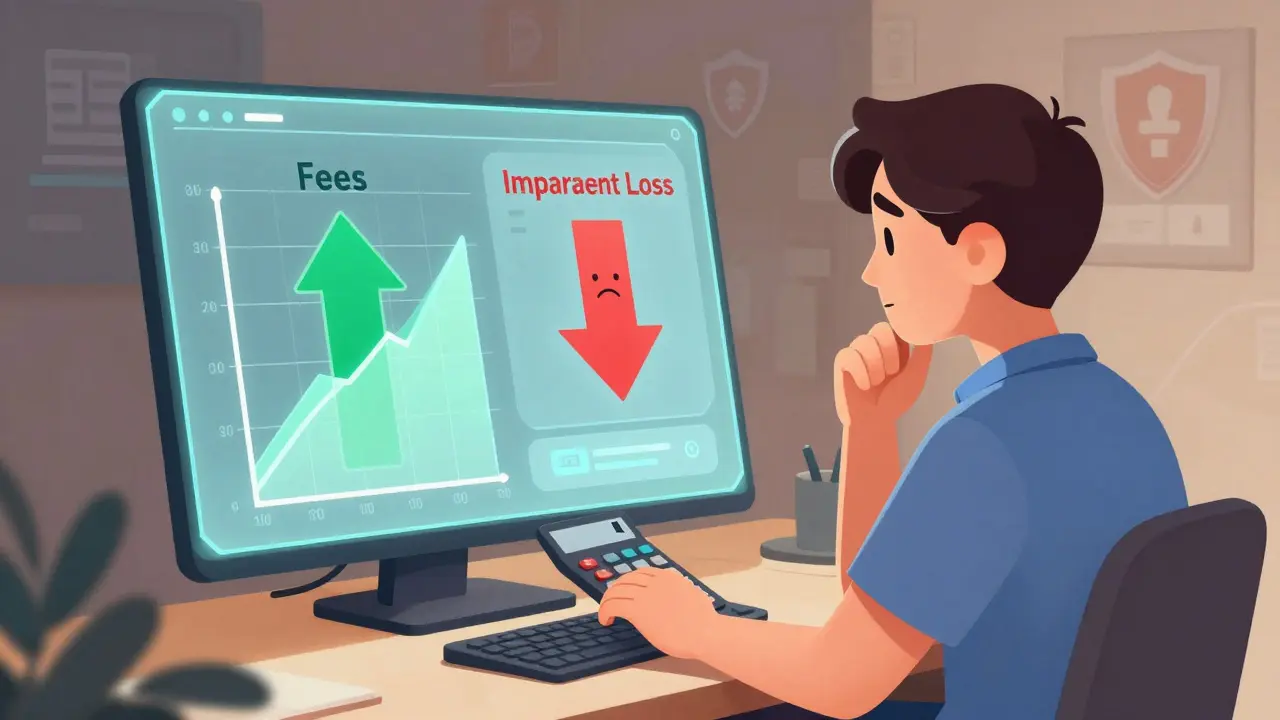
The catch? Impermanent loss. If the price of your deposited tokens diverges significantly from when you deposited them, you may end up with less value than if you had just held the tokens in your wallet. Understanding this trade-off is the first step toward sustainable high returns.
Top Contenders for High-Yield Liquidity in 2026
Not all pools are created equal. The "best" pool depends entirely on what kind of risk you are willing to take. Here is how the heavy hitters stack up based on performance data from late 2025 and early 2026.
Uniswap V3: The Capital Efficiency King
If you are serious about maximizing fee income on major pairs like ETH/USDC or WBTC/ETH, Uniswap V3 remains the gold standard. Launched in May 2021, it introduced concentrated liquidity, allowing you to allocate your capital within specific price ranges rather than spreading it across all possible prices.
This innovation boosts capital efficiency up to 4,000 times compared to previous versions. According to Dune Analytics data from December 2025, Uniswap holds 58.7% of Ethereum DEX volume with a TVL of $42.3 billion. However, this power comes with complexity. You must actively manage your positions. If the price moves out of your chosen range, your position stops earning fees until you rebalance. David S. Rose, Professor of Data Science at NYU, noted that this model allows providers to earn 3.2x more fees per dollar committed, but only if they monitor the market closely.
Best for: Experienced users who can dedicate time to monitoring price movements and rebalancing positions.
Curve Finance: The Stablecoin Sanctuary
If volatility keeps you up at night, Curve Finance is your safe haven. Founded by Michael Egorov in January 2020, Curve specializes in exchanging similar assets, primarily stablecoins like USDC, USDT, and DAI. Its Stableswap algorithm minimizes slippage to as low as 0.001%, making it incredibly efficient for large trades.
Dr. Elaine Chen, Chief Economist at Messari, highlighted that Curve’s design reduces impermanent loss for stablecoin LPs by 89% compared to standard AMMs. While the base fees might seem lower than volatile pairs, the combination of low risk, high volume (92% market share for USDC/USDT swaps), and CRV token rewards often results in highly competitive annual percentage yields (APYs). One user reported earning 42.3% APY on a FRAX/USDC pool after factoring in rewards.
Best for: Conservative investors seeking steady returns with minimal impermanent loss risk.
PancakeSwap V4: The High-Risk, High-Reward Play
Looking for higher raw percentages? PancakeSwap on BNB Chain offers some of the most aggressive yields in the industry. Operational since March 2024, V4 brings ultra-low transaction fees averaging just $0.0003 per swap. New token pools often launch with APYs exceeding 100% to attract initial liquidity.
However, high rewards signal high risk. These pools often involve newer, less established tokens that can crash rapidly. Additionally, PancakeSwap carries higher exposure to the BNB ecosystem. If BNB suffers a regulatory hit or network issue, these pools feel the pain first. Calibraint’s 2025 report rated PancakeSwap 4.9/5 for user experience but only 3.5/5 for security track record following past incidents.
Best for: Aggressive yield farmers comfortable with smart contract risks and volatile asset prices.
Raydium: Speed on Solana
For those who prioritize speed and low costs over Ethereum’s dominance, Raydium on Solana is a top pick. Launching in February 2021, Raydium integrates with Serum’s order book, enabling sub-second settlement times. With fees around $0.00025 per transaction, it’s ideal for frequent rebalancing.
Raydium processes 1.2 million daily transactions, offering deep liquidity for Solana-native tokens. However, you must weigh this against Solana’s historical stability issues. In Q4 2025, the network experienced four downtime incidents totaling 172 minutes. During these outages, liquidity is frozen, and you cannot exit your positions.
Best for: Traders focused on Solana ecosystem assets who accept network reliability risks.
| Platform | Primary Chain | Avg. Fee Tier | Impermanent Loss Risk | Complexity Level |
|---|---|---|---|---|
| Uniswap V3 | Ethereum | 0.05% - 1.00% | High (requires active management) | Advanced |
| Curve Finance | Ethereum / Multi-chain | 0.01% - 0.04% | Very Low (for stablecoins) | Intermediate |
| PancakeSwap V4 | BNB Chain | 0.01% - 0.25% | Very High (volatile assets) | Beginner to Advanced |
| Raydium | Solana | 0.01% - 0.30% | Medium to High | Intermediate |

Managing Risks: Impermanent Loss and Smart Contracts
Chasing high returns without understanding the risks is a recipe for disaster. Two main threats loom over every liquidity provider: impermanent loss and smart contract vulnerabilities.
Impermanent Loss occurs when the price ratio of your deposited tokens changes. For example, if you deposit ETH and USDC, and ETH doubles in price, the automated market maker will sell your ETH to maintain balance. You end up with more USDC and less ETH than if you had just held them separately. In a bull market, this means missing out on gains. In a crash, it means holding more of the losing asset. Tools like Tokenomik’s IL calculator are essential for estimating this impact before entering a pool.
Smart contract risk is the possibility of a bug or exploit draining the pool. While major protocols like Uniswap and Curve have been audited extensively, no code is immune. The May 2024 incident where a user lost $142,000 due to a misconfigured Uniswap V3 position highlights that human error is often the biggest vulnerability. Always start with small amounts to test your understanding of the interface.
Practical Steps to Start Providing Liquidity
Ready to dive in? Here is a streamlined process to get started safely.
- Choose Your Wallet: Set up a non-custodial wallet like MetaMask for Ethereum-based pools or Phantom for Solana. Ensure you have backed up your seed phrase offline.
- Select Your Pool: Based on the comparison above, decide if you want stability (Curve) or high yield (PancakeSwap/Uniswap V3).
- Acquire Tokens: Buy both tokens in the pair. For a 50/50 pool, you need equal value of each token. For example, if ETH is $3,000, you need $3,000 worth of ETH and $3,000 worth of USDC.
- Approve Transactions: Connect your wallet to the DEX interface. You will need to approve the tokens for spending. This costs gas fees on Ethereum but is negligible on BNB Chain or Solana.
- Add Liquidity: Enter the amount and set your price range if using Uniswap V3. Confirm the transaction.
- Monitor and Rebalance: Check your position regularly. Use alerts to know when the price exits your range so you can rebalance and resume earning fees.
Getting started typically takes 8-12 minutes for experienced users. However, mastering Uniswap V3’s concentrated liquidity requires about 15-20 hours of study according to Consensys Academy. Don’t rush into complex strategies without practicing first.
Future Outlook: What’s Next for Liquidity Pools?
The landscape is evolving rapidly. Uniswap announced V4 in November 2025, featuring hook-based pools that allow custom logic for liquidity provision, scheduled for Q1 2026. This could democratize advanced strategies previously reserved for developers. Curve Finance is implementing a V2 Redeployment to reduce gas costs by 40%. Meanwhile, institutional participation is rising, with regulated entities now providing 28.7% of liquidity on major pools.
Regulatory clarity is also improving. The SEC’s 2025 'Liquidity Pool Framework' provides guidelines that help legitimize the space, though 37.4% of non-stablecoin pools still face uncertainty. As Gartner predicts, by 2027, 65% of liquidity providers will use automated management tools to mitigate impermanent loss and optimize yields. Staying informed on these developments will keep you ahead of the curve.
What is the safest liquidity pool for beginners?
For beginners, stablecoin pools on Curve Finance are generally the safest option. They minimize impermanent loss because the assets (like USDC and USDT) peg to the same value. The returns are lower than volatile pairs, but the risk of significant capital erosion is much reduced. Avoid new token launches on PancakeSwap until you understand yield farming mechanics.
How do I avoid impermanent loss in Uniswap V3?
You cannot completely avoid impermanent loss in volatile pairs, but you can manage it. Use narrow price ranges only if you expect the price to stay within that band. Alternatively, choose wider ranges or stick to correlated assets like ETH/wBTC. Regularly monitoring your position and rebalancing when the price exits your range helps maximize fee earnings to offset potential IL.
Is it better to provide liquidity on Ethereum or BNB Chain?
It depends on your goals. Ethereum (via Uniswap) offers deeper liquidity, higher security standards, and access to blue-chip assets, but gas fees can eat into profits for smaller accounts. BNB Chain (via PancakeSwap) has near-zero fees and higher APYs due to incentive tokens, but carries higher smart contract and ecosystem risks. For large capitals, Ethereum is preferred; for smaller amounts testing strategies, BNB Chain is cost-effective.
Can I lose all my money in a liquidity pool?
Yes, although it is rare in reputable protocols. Total loss usually occurs due to smart contract exploits (hacks) or rug pulls in unverified, new token pools. To mitigate this, only use audited, well-established protocols like Uniswap, Curve, or Raydium. Never invest more than you can afford to lose, especially in high-yield farming pools with new tokens.
What are the tax implications of providing liquidity?
Tax laws vary by country, but generally, trading fees earned are considered taxable income. Yield farming rewards are also typically taxed as ordinary income upon receipt. When you withdraw your liquidity, you may trigger a capital gains event if the value of your tokens has changed. Always consult a local tax professional familiar with cryptocurrency regulations in your jurisdiction, such as the IRS guidelines in the US or ATO rules in Australia.