

Imagine setting up a sleek crypto startup in a country known for political stability and low taxes, only to hit a wall when trying to open a bank account. This is the daily reality for many entrepreneurs operating in Costa Rica, a Central American nation that has deliberately chosen not to recognize cryptocurrencies as legal tender or official currency. Unlike its neighbor El Salvador, which made Bitcoin money you can use at the grocery store, Costa Rica treats digital assets like a high-risk curiosity. You can hold them, trade them, and even build a business around them, but the government doesn't officially say they are "money."
If you are looking to launch a crypto project here, you need to understand one thing immediately: the rules are changing fast. For years, the country operated in a gray area. Now, with new bills passing through the legislature in 2025, that gray area is turning into a strict compliance zone. The question isn't whether crypto is legal-it is. The question is how much paperwork you will have to fill out to keep your license.
The Official Stance: Not Money, But Not Illegal Either
To understand where things stand, we have to look at what the Central Bank of Costa Rica (CBCR), the national monetary authority responsible for regulating financial institutions and currency policy in Costa Rica says. They have been clear: cryptocurrencies are not legal tender. They are not foreign currency. They don't have the status of "monetary currency." This means if you try to pay your taxes or buy coffee with Bitcoin, the merchant can legally refuse you, and the government won't back you up.
However, this lack of recognition doesn't mean prohibition. It means regulation. The current framework focuses heavily on preventing financial crime rather than encouraging adoption. Think of it less like a welcome mat and more like a security checkpoint. The government wants to know who is moving money and why, without necessarily endorsing the asset class itself. This approach puts Costa Rica in a unique middle ground. It’s not China, which banned most crypto activities in 2021. It’s not El Salvador, which went all-in on Bitcoin in 2021. It’s a cautious, compliance-first jurisdiction.
This distinction matters because it affects how banks treat you. Since crypto isn't "official" money, traditional banks see it as risky. They worry about anti-money laundering (AML) violations. So, while you aren't breaking the law by holding crypto, getting a bank to let you touch those funds can be a nightmare. Many founders report spending months just trying to convince a local bank that their business is legitimate.
New Laws Are Changing the Game
The landscape shifted significantly in mid-2025. The key player here is Bill 22.837, legislation proposed to amend Law No. 7786 to formally define virtual assets and establish regulatory requirements for service providers in Costa Rica. This bill passed its first debate in the Legislative Assembly in July 2025. Its main goal? To stop money laundering and terrorist financing using digital assets.
Here is what this bill actually does:
- Defines Virtual Assets: It creates a legal definition for "Activo Virtual" (Virtual Asset). Basically, any digital value that can be traded online but isn't legal tender falls under this umbrella.
- Creates the VASP Category: It introduces the concept of Virtual Asset Service Providers (VASPs), entities engaged in exchanging, transferring, storing, or managing virtual assets for others, subject to specific regulatory oversight. If you run an exchange, a wallet service, or a broker, you are a VASP.
- Mandates Registration: VASPs must register with the Superintendencia General de Entidades Financieras (SUGEF), the primary regulatory body in Costa Rica overseeing financial entities, including newly classified virtual asset service providers.
There is a catch, though. SUGEF has stated that registering does not equal government authorization. It’s more like putting your name on a list so they can watch you. This "registration without endorsement" model is designed to keep bad actors out while avoiding the risk of the government backing a volatile industry.
Another piece of legislation, Bill 23.415 (often called the "Cryptoassets Market Law"), is also moving through committees. This suggests a dual-track approach: one law for stopping crime (22.837) and another potentially for market structure. Experts predict these could be fully aligned with international FATF standards by early 2026.
Who Watches the Watchers? SUGEF Takes Charge
Before these laws, there was no single agency saying, "Hey, we handle crypto." Now, SUGEF, the Superintendencia General de Entidades Financieras, the Costa Rican financial supervisory authority tasked with monitoring compliance and risk in the financial sector is in the driver's seat. Their job is to ensure that anyone touching crypto follows strict Anti-Money Laundering (AML) and Counter-Terrorist Financing (CFT) rules.
What does this mean for you in practice? If you are a VASP, you need robust internal controls. You can't just rely on basic ID checks anymore. You need:
- Enhanced Due Diligence: Stricter identification protocols for clients, especially Politically Exposed Persons (PEPs).
- Transaction Monitoring: Systems capable of processing thousands of transactions per hour to flag suspicious activity.
- Risk Assessments: Regular, documented reviews of your business risks related to crypto flows.
- Record Keeping: Detailed logs of every transaction, preserved for years.
SUGEF plans to upgrade its KYC (Know Your Customer) platform by late 2025 with a $2.3 million budget allocation. This means they are building the tech to scrutinize businesses more closely. The message from regulators like Ricardo Quesada is clear: this legislation bolsters national defenses against financial crime. For legitimate businesses, this is good news-it levels the playing field. For shady operators, it’s a warning sign.

The Real Hurdle: Banking and Compliance Costs
Let’s talk about the part nobody likes: the cost and friction. While Costa Rica offers tax incentives and political stability, the operational headaches are real. According to data from 2025, opening a corporate bank account for a crypto business can take six to eight months. One founder shared that three major banks rejected their application before a smaller institution agreed to work with them under strict monitoring.
Why is it so hard? Because banks are scared. They fear being cut off from the global SWIFT network if they associate too closely with unregulated crypto flows. Even with new laws, trust takes time to build. Only a minority of financial institutions feel ready to service crypto companies properly.
Then there is the compliance cost. Setting up the necessary infrastructure isn't cheap. Here is a breakdown of what businesses are facing:
| Requirement | Timeframe | Estimated Cost (USD) |
|---|---|---|
| Company Registration | 15-20 business days | $1,000 - $3,000 |
| Minimum Capital (varies by scope) | Upfront | $10,000 - $50,000 |
| Compliance Infrastructure Setup | 3-6 months | $25,000 - $75,000 |
| Full-time Compliance Officer Salary | Monthly | $7,500 - $12,000 |
| Bank Account Opening Process | 6-8 months (average) | Variable (legal fees apply) |
You also need staff. About 65% of crypto companies in Costa Rica hire at least one full-time compliance officer. That’s a significant overhead. But compared to countries with heavy crypto taxes-like India’s 30% levy-Costa Rica remains attractive for its lower overall tax burden on foreign investment.
How Costa Rica Compares to Its Neighbors
To really get a sense of Costa Rica’s position, you have to look at the region. Central America is becoming a lab for crypto regulation, and each country is choosing a different path.
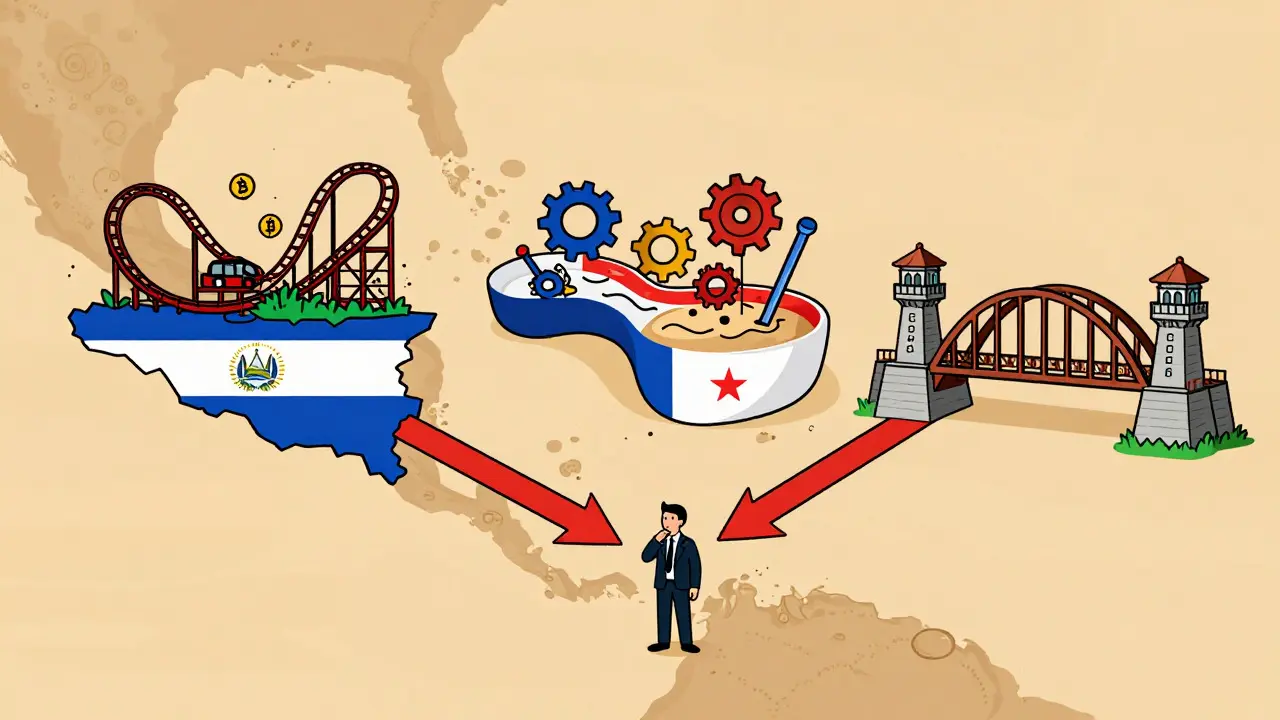
- El Salvador: Aggressive adoption. Bitcoin is legal tender. High volatility, high visibility. Great for tourists and speculators, but complex for regulated businesses.
- Panama: Innovation-focused. Passed Law 89 in 2023 to create a regulatory sandbox. More flexible for startups testing new models.
- Venezuela: Restrictive. Heavy state control and capital restrictions make it difficult for private enterprise.
- Costa Rica: Caution-first. No legal tender status, but strong AML/CFT focus. Stable, predictable, but slow to adapt.
Costa Rica is positioning itself closer to Panama in terms of sophistication, but with stricter initial hurdles. It aims to align with the OECD’s Crypto-Asset Reporting Framework (CARF). This makes it appealing to institutional players who want safety over speed. If you are a large fund looking to enter Latin America, Costa Rica’s stability might outweigh its bureaucracy. If you are a small startup wanting to move fast, Panama or even offshore jurisdictions might be easier.
Market Reality: Adoption and Growth
Despite the regulatory friction, people are using crypto here. As of mid-2025, about 14.3% of Costa Rican adults have owned cryptocurrency at some point. This is below the Latin American average of 22.7%, but higher than neighbors like Nicaragua (8.9%). The market size is estimated at $1.2 billion, representing nearly 2% of the region’s total.
There are currently around 287 registered entities providing crypto-related services. Most of these are exchanges, wallets, or consulting firms. The growth trajectory looks positive, with analysts projecting a 23.5% compound annual growth rate through 2028. This assumes the new laws pass smoothly and banks start warming up to the sector.
The Blockchain Association of Costa Rica reports that 78% of its members would still recommend the country for crypto business establishment. Why? Because the alternative-operating in a true legal vacuum-is worse. Having clear rules, even strict ones, provides a foundation to build on. Investors prefer knowing the worst-case scenario rather than guessing.
What Should You Do Next?
If you are considering launching in Costa Rica, don’t wait for perfect clarity. It won’t come overnight. Instead, prepare for compliance. Start building your AML/CFT policies now. Hire legal counsel familiar with Bill 22.837. Expect delays in banking and budget accordingly.
Keep an eye on SUGEF’s announcements regarding their KYC platform upgrades in late 2025. This will likely set the technical standard for how you report data. Also, monitor the progress of Bill 23.415, as it may introduce additional market structures or consumer protection rules.
Finally, network locally. The community is small but active. Joining groups like the Blockchain Association of Costa Rica can help you navigate the informal hurdles, like finding a bank willing to talk to you. In a market defined by caution, relationships matter more than anywhere else.
Is cryptocurrency legal in Costa Rica?
Yes, owning and trading cryptocurrency is legal in Costa Rica. However, it is not recognized as legal tender, meaning it cannot be used as official currency for payments or taxes. Businesses dealing in crypto must comply with emerging regulations focused on anti-money laundering.
Do I need a license to run a crypto exchange in Costa Rica?
Under the proposed Bill 22.837, entities acting as Virtual Asset Service Providers (VASPs) will need to register with SUGEF. While this registration does not constitute full government authorization, it is a mandatory step for legal operation. Failure to register could result in penalties for non-compliance with AML laws.
How hard is it to open a bank account for a crypto business in Costa Rica?
It is challenging. Traditional banks are often hesitant due to perceived risks. Founders report spending 6 to 8 months navigating the process, with multiple rejections common. Smaller regional banks may be more willing to engage, but they often impose strict monitoring conditions.
What is the difference between Costa Rica's approach and El Salvador's?
El Salvador adopted Bitcoin as legal tender, requiring merchants to accept it. Costa Rica has explicitly rejected legal tender status for crypto. Instead, Costa Rica focuses on regulating service providers to prevent financial crime, creating a more conservative but stable environment for businesses.
When will the new crypto regulations be fully enforced?
Bill 22.837 passed its first legislative debate in July 2025. Full implementation and alignment with international FATF standards are projected for early 2026. Businesses should prepare for compliance requirements to become stricter throughout late 2025 and 2026.
Are there tax benefits for crypto businesses in Costa Rica?
Costa Rica offers favorable tax regimes for foreign investors, including potential exemptions for income generated outside the country. However, specific tax treatment for crypto gains is still evolving. Consult a local tax expert to structure your entity correctly, as general corporate tax rates apply until specific crypto tax laws are finalized.


Subhash Kashyap Dm
the whole narrative of 'compliance' is just a smokescreen for state surveillance and capital control they are using the guise of AML to track every satoshi movement while simultaneously suppressing adoption because they fear losing monetary sovereignty it is not about safety it is about power dynamics and the central bank wants to maintain its monopoly on value transfer mechanisms by creating artificial friction in the banking sector to discourage organic growth of decentralized finance protocols which threaten their hegemonic position in the financial ecosystem