
Remember the chaotic September of 2020? That’s when SushiSwap, a decentralized exchange forked from Uniswap, burst onto the scene with an anonymous founder and a sushi-emoji logo. It was messy, controversial, and frankly, a bit of a rug-pull drama. But fast forward to late 2025, and SushiSwap has survived the hype cycle to become a legitimate heavyweight in Decentralized Finance (DeFi). With over $1.5 billion in Total Value Locked (TVL), it sits comfortably among the top five DEXs globally. If you’re wondering whether this platform is still worth your time-or if it’s just another relic of the DeFi Summer-this review breaks down exactly what you get, what it costs, and where it beats or loses to competitors like Uniswap.
The Core Mechanism: How It Actually Works
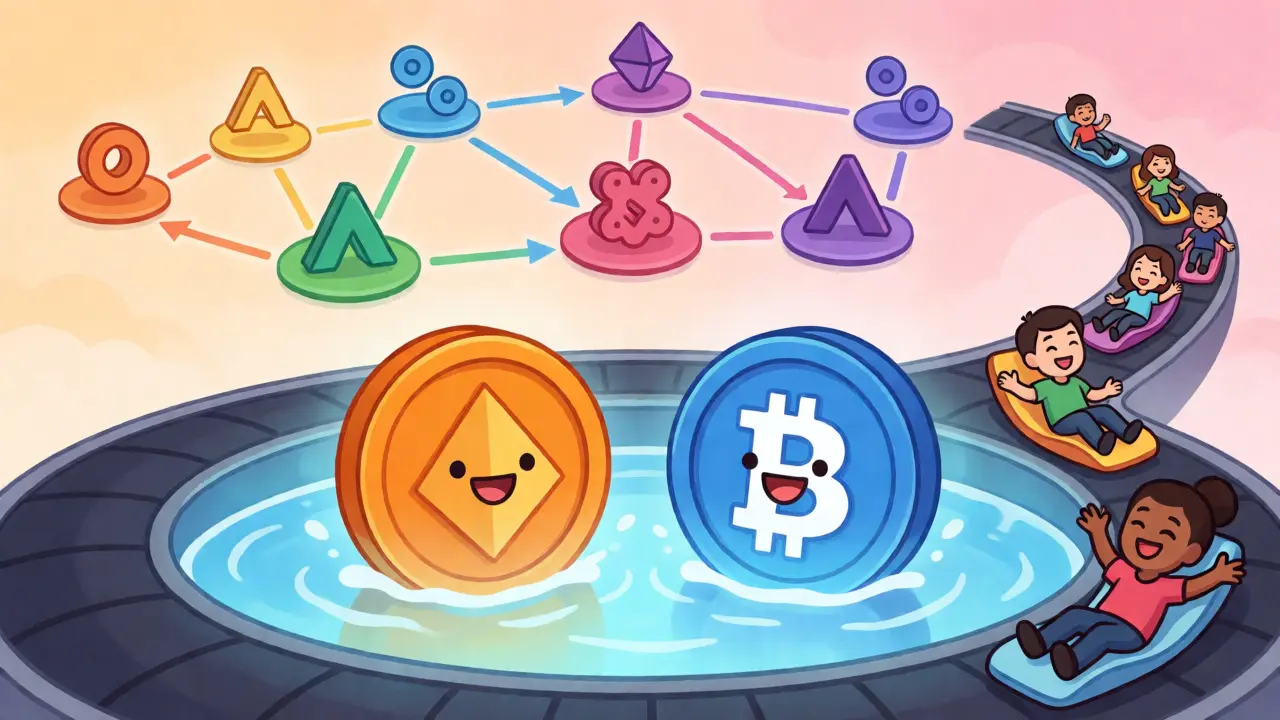
At its heart, SushiSwap is an Automated Market Maker (AMM). Unlike traditional exchanges that use order books matching buyers and sellers, AMMs rely on liquidity pools. You deposit two tokens in equal value, and the platform uses the constant product formula ($x \times y = k$) to determine prices. This means you aren’t trading against other people directly; you’re trading against a pool of assets provided by others.
What sets SushiSwap apart from its parent, Uniswap, is the dual-reward system for liquidity providers (LPs). Standard LPs earn 0.25% of every trade fee. But if you stake your SUSHI tokens into the "SushiBar" to get xSUSHI, you also capture 0.05% of all trading fees across the platform. It’s a clever way to align incentives: traders pay fees, LPs get paid, and token holders get a cut of the ecosystem’s success. As of November 2025, this model has attracted over 278,000 unique users to its "Onsen" reward programs, significantly outpacing similar initiatives on rival platforms.
Multi-Chain Support and User Experience
If you tried using Ethereum mainnet in early 2025, you know the pain of paying $45 in gas fees for a simple swap. SushiSwap learned this lesson quickly. While it launched on Ethereum, it now supports over 30 networks, including Binance Smart Chain (BSC), Polygon, Avalanche, and Arbitrum. This multi-chain strategy isn’t just marketing fluff; it’s essential for keeping costs low. According to recent data, while Ethereum still holds 62% of the TVL, BSC accounts for 23%, showing that users are actively moving to cheaper chains for everyday trades.
The interface itself has matured. New users often struggle with wallet connections, but SushiSwap’s integration with MetaMask is straightforward. A typical setup takes about 15-20 minutes. However, a common pitfall for beginners is token approvals. Many users accidentally approve unlimited allowances, risking their funds if a smart contract bug emerges later. Always check your approval limits via tools like Revoke.cash after trading.
| Feature | SushiSwap | Uniswap |
|---|---|---|
| Total Value Locked (TVL) | $1.52 Billion | $4.8 Billion |
| Daily Trading Volume | $470 Million | $3.2 Billion |
| Average Slippage ($10k Trade) | 0.85% | 0.62% |
| Supported Chains | 30+ | Ethereum + L2s |
| Token Pairs Available | 1,200+ | ~800 |
| Unique Users (Monthly) | 278,000 | 195,000 |
Fees and Hidden Costs
Let’s talk money. The headline fee on SushiSwap is 0.3% per transaction. But that’s not the whole story. Here is the breakdown:
- Liquidity Provider Fee: 0.25% goes directly to the people providing the liquidity.
- xSUSHI Holder Fee: 0.05% is distributed to those staking SUSHI tokens.
- Gas Fees: These vary wildly. On Ethereum, expect $1.50-$5.00 during normal times, spiking to $45+ during congestion. On Polygon or BSC, fees drop to pennies.
For small trades (under $500), SushiSwap’s aggregator routing often finds better rates than Uniswap because it scans multiple DEXs simultaneously. However, for large institutional-sized trades, Uniswap’s deeper liquidity means less slippage. If you’re swapping $10,000 worth of ETH, you’ll lose more to price impact on SushiSwap (0.85%) compared to Uniswap (0.62%).
Security and Trustworthiness
Security is non-negotiable in DeFi. SushiSwap’s smart contracts have undergone multiple audits, with the most recent comprehensive review by PeckShield in September 2025 finding zero critical vulnerabilities. They did recommend minor improvements to the Miso launchpad, which is standard practice. No major hacks have occurred on the core protocol since its inception, which is impressive given the billions flowing through it.
However, remember that "not your keys, not your coins" applies here too. Your risk isn’t just the code; it’s your own management. Phishing attacks targeting MetaMask users remain the biggest threat. Always verify the URL (sushi.com) and never share your seed phrase.

Who Should Use SushiSwap?
You don’t need to use every DEX. Pick the right tool for the job.
Use SushiSwap if:
- You want exposure to smaller-cap altcoins. With 1,200+ pairs, it lists many tokens that haven’t made it onto Uniswap yet.
- You are a long-term holder who wants passive income. Staking SUSHI gives you real yield from trading fees.
- You prefer community-driven governance. You can vote on proposals, such as the recent $5 million treasury allocation for Southeast Asian expansion.
Stick with Uniswap if:
- You trade large volumes and care deeply about minimizing slippage.
- You only trade major pairs (ETH, USDC, WBTC) and want the deepest liquidity possible.
The Road Ahead: Risks and Opportunities
The DeFi landscape shifts fast. Uniswap’s V4 release introduced "hooks," customizable features that could replicate some of SushiSwap’s unique offerings. Analysts at Galaxy Digital warn that SushiSwap must keep innovating to maintain its niche. The biggest regulatory risk remains the classification of the SUSHI token as a security by the SEC, which could restrict US access, similar to recent actions against other protocols.
On the upside, SushiSwap’s roadmap includes zkSync Layer 2 integration and expanded lending features via Kashi. Their focus on emerging markets suggests they’re playing the long game, aiming for user growth in regions where centralized exchanges face regulatory hurdles.
Is SushiSwap safe to use?
Yes, generally. The smart contracts are audited regularly, with no major breaches reported recently. However, always ensure you are on the official website (sushi.com) to avoid phishing sites, and manage your token approvals carefully.
How do I earn rewards on SushiSwap?
You can provide liquidity to pools to earn trading fees, or stake your SUSHI tokens in the SushiBar to receive xSUSHI. Holding xSUSHI entitles you to 0.05% of all platform trading fees, proportional to your holdings.
What are the fees on SushiSwap?
The standard swap fee is 0.3%. This is split between liquidity providers (0.25%) and xSUSHI holders (0.05%). Additionally, you must pay network gas fees, which vary by blockchain (cheaper on Polygon/BSC, expensive on Ethereum).
Can I buy SUSHI on centralized exchanges?
Yes, SUSHI is widely available on major centralized exchanges like Binance, Coinbase, and Kraken. You can buy it there and withdraw it to your self-custody wallet to use on the SushiSwap DEX.
Which blockchains does SushiSwap support?
SushiSwap supports over 30 networks, including Ethereum, Binance Smart Chain, Polygon, Avalanche, Fantom, Arbitrum, and Optimism. This allows users to choose the chain with the lowest fees for their specific needs.