
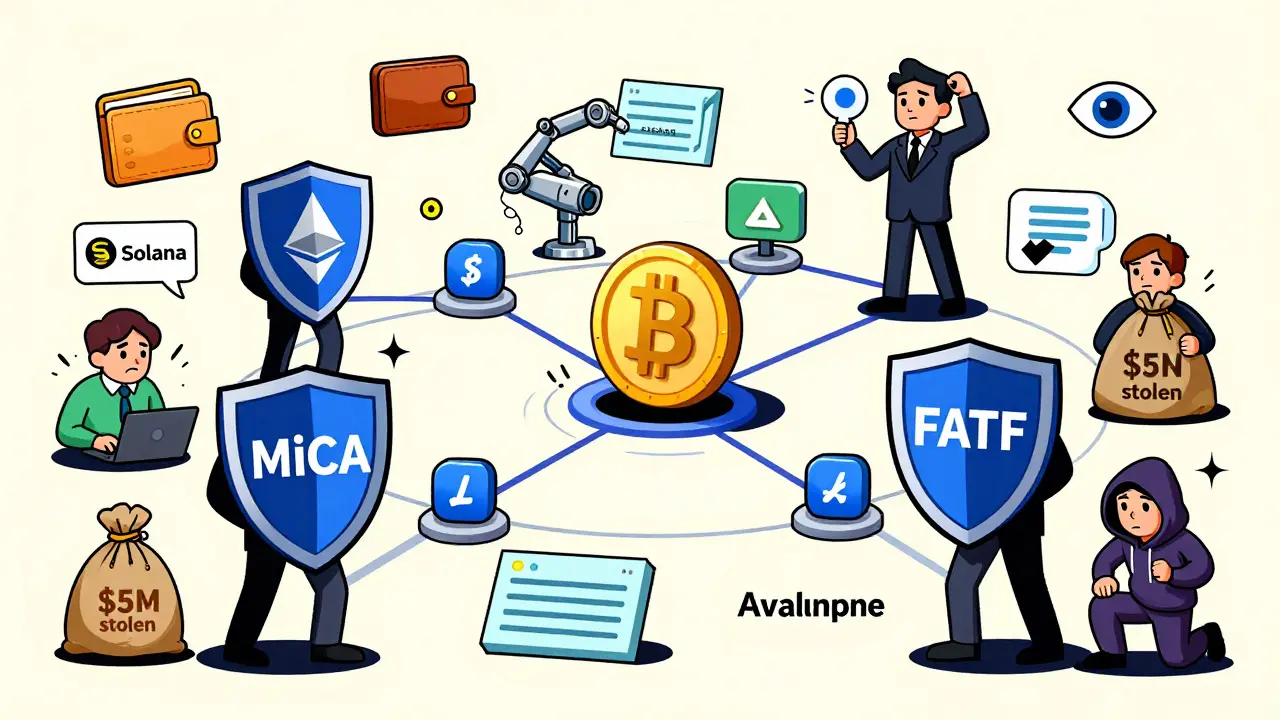
Decentralized Finance, or DeFi, was built on a promise: no banks, no intermediaries, no gatekeepers. Just code, crypto, and control in your own hands. But as of 2026, that dream is bumping hard into reality. Regulators aren’t asking for permission anymore-they’re enforcing rules, and DeFi is scrambling to keep up. The core problem? DeFi was never designed to comply. And now, compliance is no longer optional.
Why DeFi Can’t Just Ignore Regulators
DeFi protocols run on blockchains like Ethereum, Polygon, and Solana. They use smart contracts-self-executing code-that automate lending, trading, and staking. No company owns them. No CEO answers to regulators. That’s the beauty. It’s also the problem. Regulators don’t care how pretty the code is. They care about money laundering, tax evasion, and fraud. The FATF Travel Rule, updated in 2025, now demands that any platform handling crypto transfers over $1,000 must share sender and receiver details. But DeFi doesn’t collect names, addresses, or IDs. Wallets are just strings of letters and numbers. Who owns wallet0x742d...? No one knows. And that’s exactly what criminals love.
Cross-chain swaps make it worse. A hacker steals $5 million in ETH on Ethereum, swaps it to SOL on Solana, then to AVAX on Avalanche, and finally into Monero. Each hop breaks the trail. Regulators can’t track it. Not without cooperation from each chain’s infrastructure-and no chain is legally required to help.
The EU’s MiCA Regulation: The New Gold Standard
The European Union didn’t wait. In 2024, MiCA (Markets in Crypto-Assets Regulation) went fully into effect. It’s the first comprehensive law targeting DeFi. Here’s what it forces:- DeFi protocols that act like banks (lending, staking rewards) must register as VASPs-Virtual Asset Service Providers.
- They must implement KYC: Know Your Customer checks on every user, even if they’re just swapping tokens.
- They need real-time transaction monitoring using AI tools to flag suspicious behavior.
- They must report all transactions over €1,000 to national authorities.
The Custody Nightmare for Institutions
Institutional investors-hedge funds, pension funds, family offices-want to get into DeFi. But they’re stuck. Why? Because of the SEC’s Custody Rule 206(4)-2. Under this rule, any fund manager handling client crypto assets must store them with a qualified third-party custodian. Think banks like Fidelity or Coinbase Custody. But DeFi doesn’t use custodians. Assets live in smart contracts. A user locks their ETH in a lending pool. No one holds the keys except the code. The SEC says that’s not custody. It’s a liability. In 2025, Galois Capital got hit with a $225,000 fine for violating this rule. They were managing crypto assets for clients but storing them in MetaMask wallets and DeFi protocols. No third-party custodian. No audit trail. The SEC didn’t care that it was "decentralized." They cared that clients lost control. Now, institutional players are stuck between two walls: DeFi offers higher yields, but they can’t legally touch it without breaking custody rules. Many are waiting for regulators to clarify-until then, they sit on the sidelines.
Compliance Costs Are Skyrocketing
Implementing compliance in DeFi isn’t like adding a login page. It’s like rebuilding the entire engine while the car’s still moving. Smaller DeFi projects are getting crushed. A startup with 10,000 users might spend $500,000 a year just on:- Blockchain analytics tools (Chainalysis, Elliptic)
- KYC providers (Jumio, Onfido)
- Legal counsel across 5+ jurisdictions
- 24/7 monitoring systems for fraud and hacking
The Human Side: Users Are Confused
Behind every DeFi protocol is a person. And most of them have no idea they’re breaking the law. A user in Australia stakes $10,000 in USDC on a DeFi platform. They earn 8% APY. They don’t report it. In 2026, Australia’s ATO (Tax Office) started requiring all crypto income to be declared-even from DeFi yields. Miss it? You’re looking at fines, audits, or worse. Reddit threads are full of users asking: "Do I need to report my Uniswap trades?" "Is staking on Polygon taxable?" "Can I use a VPN to avoid KYC?" The answer? Yes. Yes. And no. But most users don’t know that. And that’s a compliance risk. Regulators aren’t just targeting protocols-they’re coming for retail users too. In 2025, the UK’s HMRC audited 12,000 crypto users. 7,000 owed back taxes. DeFi made it easy to hide. Now it’s easy to catch.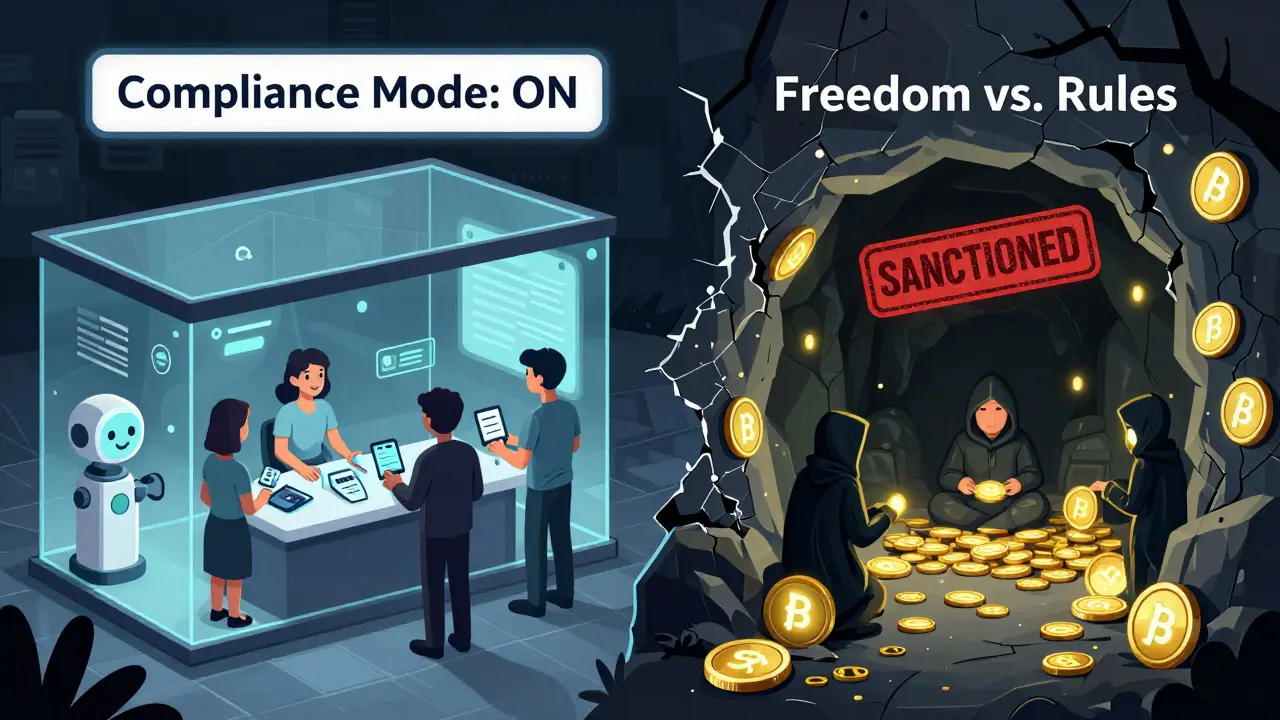
AI Is Making Things Worse-And Better
Here’s the twist: the same tech that powers DeFi is now being used to break it. AI-generated deepfakes are tricking users into giving up their seed phrases. A fake video of a DeFi founder says, "Send your ETH to this wallet to claim your bonus." People do. Millions lost. But AI is also the answer. Compliance tools now use machine learning to detect patterns:- Wallets that receive funds from darknet markets
- Transactions that mimic known laundering patterns
- Unusual activity after a wallet hasn’t moved for months
What’s Next? The Two Paths for DeFi
DeFi stands at a fork. There are two possible futures: Path 1: The Regulated DeFi - Protocols integrate KYC, report transactions, use licensed custodians, and follow MiCA, DORA, and FATF rules. They become "regulated DeFi"-slower, less anonymous, but legal. Think: Coinbase with smart contracts. Path 2: The Underground DeFi - Protocols go fully off-grid. No KYC. No reporting. No jurisdiction. They operate on privacy chains like Zcash or Tornado Cash. They’ll survive-but only for criminals, hackers, and risk-takers. The market is already splitting. Projects like Curve and Aave are adding KYC options for institutional users. Others, like Tornado Cash, are being sanctioned by the U.S. Treasury. There’s no middle ground anymore. You can’t have permissionless finance and full compliance. One has to give.Final Thought: The Trade-Off Is Real
DeFi promised financial freedom. But freedom without rules invites abuse. And abuse invites crackdowns. The question isn’t whether DeFi will comply. It’s how much of its soul it’s willing to sacrifice to survive. The next five years won’t be about innovation. They’ll be about adaptation. And the protocols that win aren’t the ones with the best code-they’re the ones that learned to play by the rules.Do I need to do KYC if I use DeFi as a regular user?
Yes-if the DeFi platform you’re using is regulated. Platforms serving users in the EU, UK, Australia, or the U.S. are now legally required to verify your identity. Even if you’re just swapping tokens, you may be asked to upload ID. If you refuse, you won’t be able to use the service. There’s no way around it anymore.
Can I use DeFi without reporting my taxes?
Technically, yes-but you’re taking a huge risk. Tax authorities in over 60 countries now track crypto transactions. DeFi yields, staking rewards, and even gas fees can be taxable. If you don’t report, you’re opening yourself to audits, fines, and in some cases, criminal charges. Tools like Koinly or CoinTracker help track your DeFi activity for tax purposes. Ignoring it isn’t smart.
Why are regulators targeting DeFi instead of just centralized exchanges?
Because DeFi is the next frontier. Centralized exchanges (like Binance or Coinbase) have always been easier to regulate-they have CEOs, offices, and bank accounts. DeFi has none of that. It’s harder to shut down. But it’s also harder to control. Regulators are moving fast because they know DeFi could become the main way people move money globally. If it stays unregulated, it becomes a haven for crime.
Is DeFi dead because of regulation?
No-but the wild west is over. DeFi isn’t dying. It’s maturing. Protocols that adapt will thrive. Those that cling to "no KYC, no rules" will either be banned, shut down, or pushed underground. The most successful DeFi projects in 2026 will be the ones that blend decentralization with compliance-not fight it.
What happens if I’m a DeFi developer and I don’t add compliance features?
You’re not just risking your project-you’re risking your personal freedom. In 2025, the U.S. DOJ charged a DeFi developer for operating an unlicensed money transmitting business. He wasn’t even the CEO-he just wrote the smart contract. If your code enables illegal activity and you knew or should have known, you can be held criminally liable. Compliance isn’t optional anymore. It’s part of your code.


Michael Sullivan
DeFi is dead. Long live DeFi. 😈
Regulators didn’t kill it-they just gave it a midlife crisis. Smart contracts don’t need KYC. They need freedom. Now we’re stuck with compliance dashboards and tax forms like some corporate drone. 🤡
The real tragedy? The code was beautiful. Now it’s got HR policies.