
You’ve heard the stories. Someone interacts with a new protocol, waits six months, and suddenly wakes up to find $10,000 worth of tokens in their wallet. It sounds like luck, but it’s rarely just chance. In the current blockchain landscape, crypto airdrop eligibility requirements are strict, calculated, and designed to filter out casual browsers from genuine users.
If you want to qualify for these distributions, you can’t just guess. You need to understand how projects decide who gets paid. The days of signing up for a newsletter and getting rich are mostly gone. Today, eligibility is built on data-specifically, your on-chain history and your behavior within an ecosystem. This guide breaks down exactly what those requirements look like right now, how to meet them without wasting time or money, and how to stay safe while doing it.
The Snapshot: The Moment That Defines Your Fate
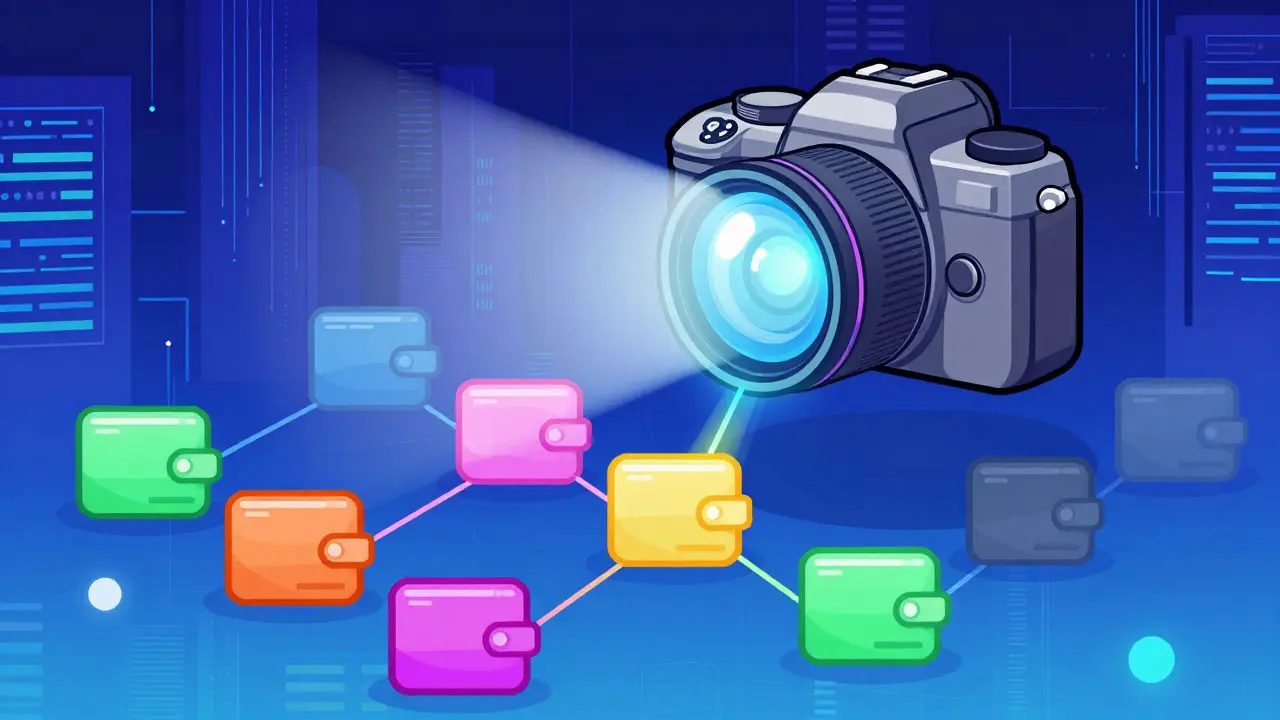
At the heart of every major airdrop is the snapshot. Think of this as a photograph taken by the blockchain project at a specific second in time. At that exact moment, the protocol records every wallet address that has interacted with its system. If your wallet isn’t in that photo, you generally don’t get the tokens.
Projects usually keep the snapshot date secret until after it happens. Why? To prevent "gaming" the system. If they announced the date publicly, bots would swarm the network for one day, perform minimum tasks, and vanish. By keeping it hidden, projects force you to be a consistent user over weeks or months.
This creates a permanent record of your activity. The snapshot captures more than just whether you connected your wallet. It tracks:
- Transaction volume: How much value did you move through the protocol?
- Frequency: Did you use the service once or multiple times?
- Duration: How long have you been active since the protocol launched?
- Asset types: Did you hold specific tokens or provide liquidity?
For example, when Uniswap launched its token, they looked at wallets that had used the exchange before a certain date. When Arbitrum distributed its tokens, they analyzed complex patterns of bridge usage and trading volume. Understanding that the snapshot is the final judge means you should treat every interaction with a promising new protocol as if it’s being recorded for a reward program-even if no reward has been promised yet.
Three Main Types of Eligibility Criteria
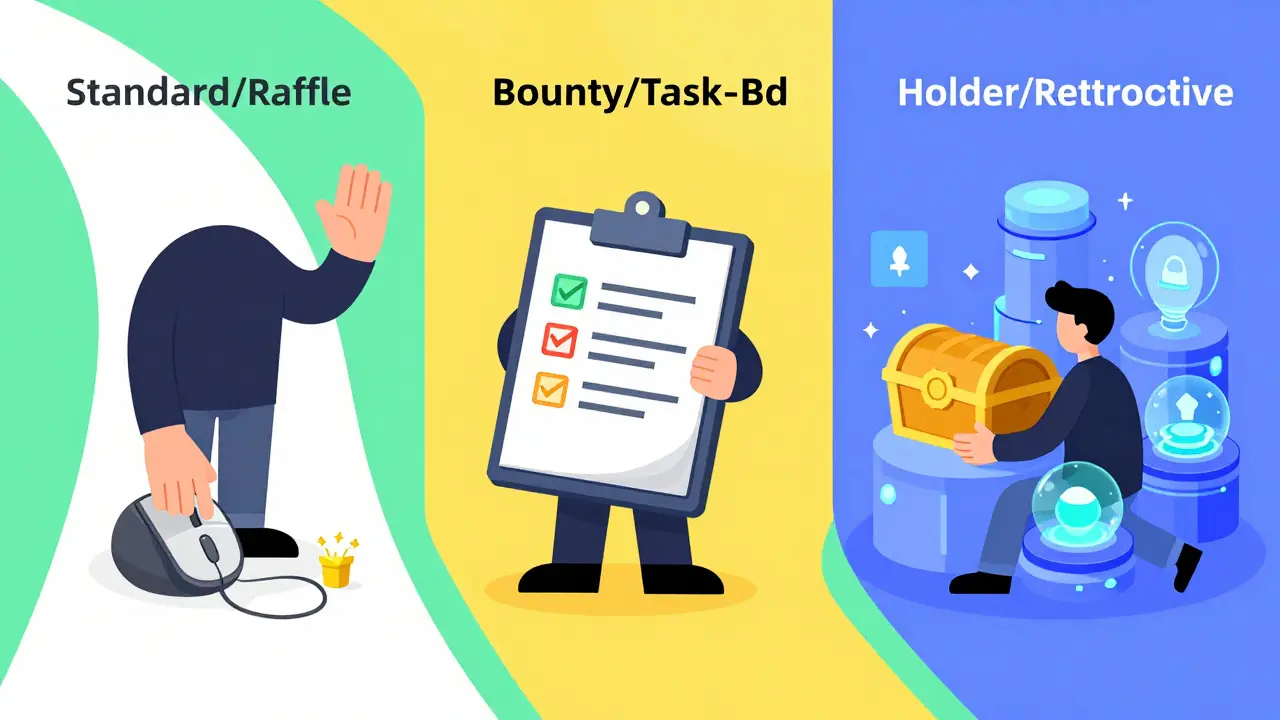
Not all airdrops work the same way. Projects design their eligibility rules based on what they want to achieve: marketing, community building, or rewarding loyalty. Generally, you’ll encounter three distinct categories of requirements.
| Airdrop Type | Primary Requirement | Effort Level | Risk Factor |
|---|---|---|---|
| Standard / Raffle | Registration or social follow | Low | High (often scams) |
| Bounty / Task-Based | Completing specific actions (tasks) | Medium | Medium (time cost) |
| Holder / Retroactive | Past on-chain activity or holding assets | High (requires capital/time) | Low (if using reputable protocols) |
1. Standard or Raffle Airdrops
These are the most accessible but also the least valuable. They typically require you to sign up for a waitlist, join a Discord server, or follow a Twitter account. Because the barrier to entry is so low, thousands of people qualify. To manage this, projects often use a raffle system, randomly selecting winners from the eligible pool. While easy to enter, the payout is usually small, and these are the most common vectors for phishing scams.
2. Bounty or Task-Based Airdrops
Here, you trade labor for tokens. Projects ask you to promote them on social media, refer friends, or create content. These aren’t entirely "free" because you’re working as an unpaid marketer. The eligibility requirement is proof of completion. You might need to submit a screenshot of a tweet or a link to a blog post. These are legitimate but require significant time investment.
3. Holder or Retroactive Airdrops
This is where the big payouts happen. These airdrops reward early adopters. The eligibility requirement is simply having used the protocol before a certain date. You didn’t know you were farming; you were just using the tool. For instance, if you bridged funds to a Layer 2 network during its beta phase, you might automatically qualify later. This requires financial commitment (gas fees, slippage) and patience, but it rewards genuine utility usage.
Ecosystem Participation: Beyond Simple Transactions
In 2026, simply swapping tokens isn’t enough. Projects are looking for deep ecosystem engagement. They want to know if you are a real user or a bot. This means your eligibility depends on how deeply you integrate into their world.
To maximize your chances, consider these high-value activities:
- Staking: Locking up tokens to support network security shows long-term commitment. Many protocols weight staked balances heavily in their distribution formulas.
- Liquidity Provision: Adding pairs to decentralized exchanges (DEXs) demonstrates you are helping the market function. This is often viewed as higher value than simple trading.
- Governance Voting: Participating in DAO proposals proves you care about the project’s direction. Even casting a single vote can flag your wallet as "engaged."
- Cross-Protocol Interaction: Using multiple tools within the same ecosystem (e.g., borrowing against collateral you deposited) creates a richer data profile for your wallet.
Projects use sophisticated on-chain analysis to detect "Sybil attackers"-people who create dozens of wallets to farm rewards. If your wallet only performs one type of transaction repeatedly, you may be flagged as a bot and excluded. Diversity in your activity makes you look like a human user.
Wallet Selection: The Technical Gatekeeper
Your choice of wallet can make or break your eligibility. Many projects explicitly exclude wallets associated with centralized exchanges (CEXs). If you leave your crypto on Binance or Coinbase, you likely won’t qualify for decentralized airdrops because the project cannot verify that *you* are the user, not the exchange.
You need a non-custodial wallet. Popular options include MetaMask, Trust Wallet, and Rabby. However, compatibility matters. An Ethereum-based airdrop requires a wallet that supports ERC-20 tokens. A Solana airdrop requires SPL token support. Make sure your wallet connects to the correct network.
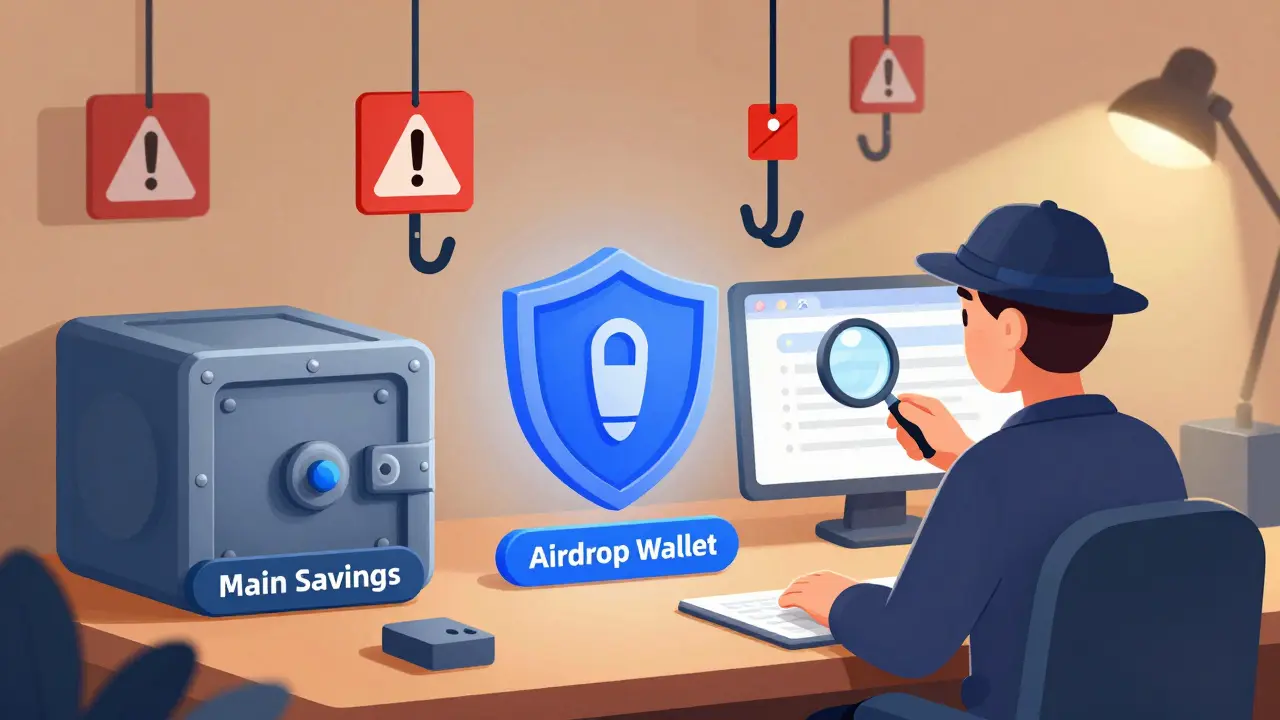
Crucially, you should use a dedicated wallet for airdrop hunting. Never use your main savings wallet. Connect a fresh wallet to new protocols. This limits your exposure if a project turns out to be malicious or if you accidentally approve a bad contract. It also keeps your airdrop activity separate, making it easier to track which wallets qualified for which campaigns.
Security First: Avoiding the Scam Trap
The desire for free tokens makes users vulnerable. Scammers know this. They create fake claim portals that look identical to official sites. The rule is simple: legitimate airdrops will never ask for your private key or seed phrase. Ever.
When claiming tokens, always verify the URL. Check the project’s official Twitter or Discord for the correct link. Do not click links sent via direct message. Be wary of transactions that ask for unlimited approval allowances. Use tools that scan smart contracts before you sign them.
If an airdrop seems too good to be true, it probably is. High-yield promises with vague eligibility criteria are red flags. Stick to well-known protocols or those backed by reputable venture capital firms. The cost of a hacked wallet far exceeds the value of any speculative airdrop.
Strategic Positioning for Future Rewards
You can’t predict which project will launch an airdrop next, but you can position yourself to benefit if they do. The best strategy is proactive exploration. Identify emerging sectors-like Real World Assets (RWA), decentralized physical infrastructure networks (DePIN), or new Layer 2 solutions-and start using their products today.
Treat gas fees and small deposits as research costs. Interact with testnets if available. Join their communities early. Vote in governance forums. By acting like a loyal user rather than a mercenary farmer, you build a robust on-chain identity. When a snapshot finally drops, your wallet will show a history of genuine engagement, maximizing your eligibility score.
How do I know if I am eligible for an airdrop?
You usually won't know until the project announces the results. Eligibility is determined by a snapshot of your on-chain activity. Check aggregator sites like Ecos.am or Dune Analytics dashboards for unofficial estimators, but remember these are guesses. Official confirmation comes only from the project team.
Can I use my main exchange wallet for airdrops?
Generally, no. Most decentralized airdrops require a non-custodial wallet (like MetaMask) because they need to verify individual user activity. Tokens held on centralized exchanges like Binance are often excluded from eligibility snapshots.
What is a snapshot in crypto?
A snapshot is a record of all wallet addresses and their activity on a blockchain at a specific point in time. Projects use this data to determine who qualifies for token distributions. If you weren't active before the snapshot date, you likely won't be eligible.
Are airdrops taxable?
In many jurisdictions, including Australia and the US, receiving an airdrop is considered taxable income at the fair market value of the tokens at the time of receipt. Always consult a local tax professional for advice specific to your situation.
How can I avoid Sybil detection?
Avoid creating multiple wallets to farm rewards. Projects analyze wallet age, transaction diversity, and interaction patterns. Use one wallet per household, engage in diverse activities (staking, voting, swapping), and maintain a consistent history over time to appear as a genuine user.