
DLT isn't blockchain. That’s the first thing you need to understand. Most people hear "distributed ledger" and immediately think Bitcoin or Ethereum. But that’s like saying all cars are Teslas. Blockchain is just one way to build a distributed ledger - not the only way. DLT is the bigger idea: a system where data is shared, verified, and stored across many computers, without needing a central boss like a bank or government to say what’s true.
Imagine a shared Google Sheet that everyone in a group can see and update, but no one can secretly change past entries. Every time someone adds a new row, the system checks with everyone else to make sure it’s valid. Once agreed on, that row is locked in. No one can delete it. No one can fake it. That’s DLT in simple terms. It’s not about crypto. It’s about trust without middlemen.
How DLT Works - No Blockchain Required
Traditional databases live in one place - a server owned by a company. If that server goes down, the data is lost. If someone hacks it, they can change records. DLT flips this. Copies of the ledger exist on dozens, hundreds, or even thousands of machines around the world. Each machine is called a node. When a new piece of data comes in - say, a shipment of coffee beans leaving Colombia - every node checks it against the rules. If enough nodes agree, it gets added to the ledger. No single person or company controls it.
This isn’t magic. It’s built on three core pieces: replication, consensus, and cryptography. Replication means every node has the same copy. Consensus is how they all agree on what’s true - without voting or emailing each other. Cryptography locks each entry so it can’t be tampered with later. Together, these make DLT tamper-resistant and always available.
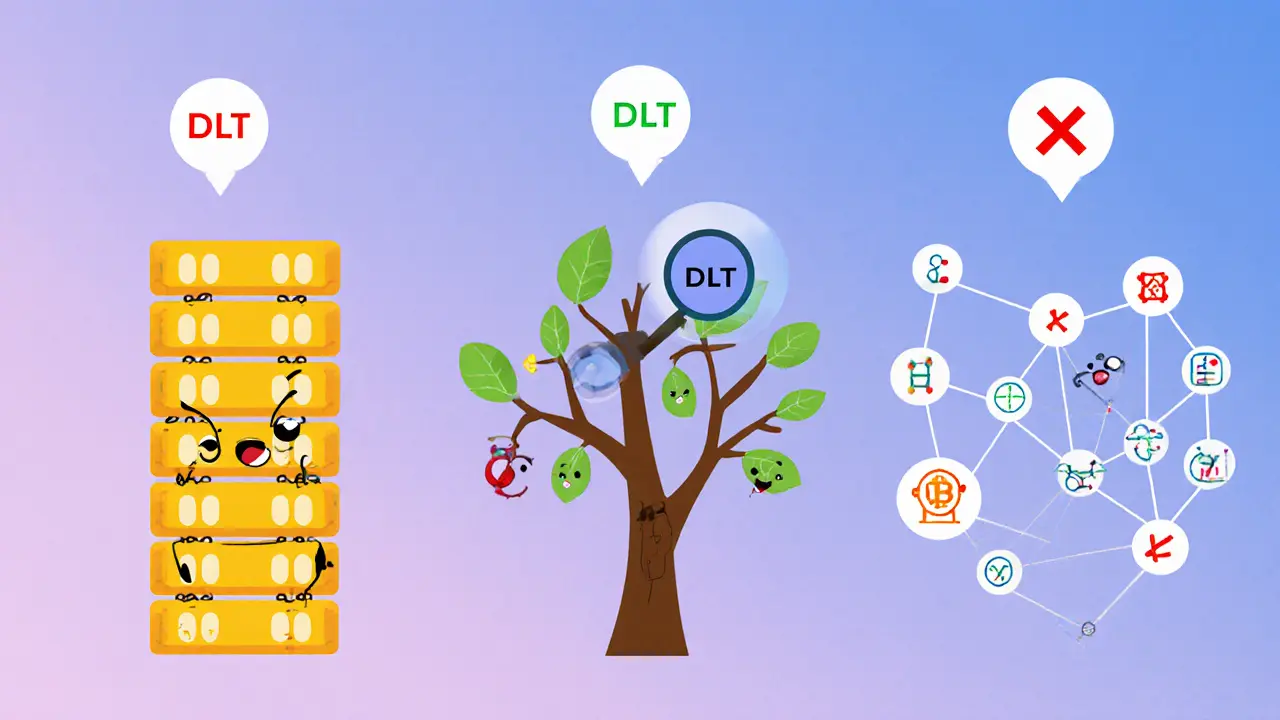
Here’s where it gets different from blockchain. Blockchain forces every piece of data into a "block," and those blocks must be chained together in strict order. DLT doesn’t care. Data can be stored in trees, graphs, or even separate ledgers that sync up. No chain. No rigid sequence. That’s why DLT can scale faster. It doesn’t need every node to validate every single transaction like Bitcoin does.
Why Blockchain Isn’t the Whole Story
Blockchain became famous because of Bitcoin. It solved the "double-spend problem" - making sure you can’t spend the same digital dollar twice. It did that with proof-of-work: miners competing to solve hard math puzzles. That’s energy-heavy. Slow. Expensive. And it requires a token - Bitcoin - to make it work.
DLT doesn’t need any of that. You can build a distributed ledger that uses proof-of-stake, practical Byzantine fault tolerance, or even a simple voting system among known participants. No mining. No crypto tokens. Just a group of trusted banks, hospitals, or shipping companies agreeing on updates. That’s what BBVA and other big financial players are doing. They use DLT to track cross-border payments, reduce paperwork, and cut fraud - without ever touching Bitcoin.
Think of it this way: Blockchain is like a public highway where anyone can drive, but traffic jams are common. DLT is like a private toll road, a shared warehouse, or even a sealed envelope passed between five known couriers. Different tools for different jobs.
Real Uses - Beyond Crypto
DLT isn’t just for finance. It’s already being used in places you wouldn’t expect.
BitTorrent, launched in 2001, was one of the first real-world DLT systems. It didn’t call itself that, but it worked exactly like one: files were split into pieces and shared directly between users. No central server. No middleman. If one user went offline, the file didn’t disappear. Others still had the pieces. Today, the U.K.’s Combined Online Information System uses similar tech to securely share medical records across hospitals.
In supply chains, companies track fish from ocean to plate. Each step - catch, transport, inspection, sale - gets recorded on a DLT. If a shipment is delayed or contaminated, you know exactly where it happened. No guessing. No forged certificates.
Hospitals use private DLTs to share patient data without giving full access to everyone. A doctor in Sydney can see a patient’s allergy history. A pharmacist in Perth can check prescriptions. But no one can alter past records. The system logs who saw what and when. That’s accountability without central control.
Even land registries are switching. In Georgia and Sweden, property deeds are now stored on DLT. No more lost paperwork. No more disputes over signatures. Just a single, unchangeable record that anyone authorized can verify.
DLT vs. Blockchain: What’s the Difference?
Let’s make this clear with a quick comparison.
| Feature | DLT | Blockchain |
|---|---|---|
| Data Structure | Flexible - can be graph, tree, or chain | Strict linear chain of blocks |
| Consensus Method | Varies - voting, PoS, PBFT, etc. | Usually PoW or PoS |
| Token Required? | No - can run without any cryptocurrency | Yes - needs native token for incentives |
| Scalability | Higher - no need for global consensus on every update | Lower - slower due to chain structure and mining |
| Transparency | Configurable - public, private, or permissioned | Usually public (unless private blockchain) |
| Energy Use | Can be very low - especially in permissioned systems | High with PoW (Bitcoin uses more power than some countries) |
The bottom line? Blockchain is a subset of DLT. DLT is the umbrella. If you need a public, token-based, energy-intensive system - go with blockchain. If you need speed, privacy, and low cost among known partners - go with DLT.
Who’s Using DLT Today?
You don’t need to be a tech giant to use it. Even small organizations are starting to adopt it.
LCX, a regulated tech provider in Liechtenstein, builds DLT platforms for asset tokenization - but not for crypto trading. They help companies digitize shares, bonds, or real estate ownership. Investors get proof of ownership without paper certificates. The system can’t be forged. It’s auditable. It’s fast.
Merchants in Australia are testing DLT for wine provenance. A bottle of Barossa Valley Shiraz gets a digital ID when it’s bottled. Every time it changes hands - warehouse, shipping, retail - that update is recorded. Buyers scan a QR code and see the full journey. No more fake labels. No more overpriced knockoffs.
Even local governments are experimenting. In Western Australia, a pilot project is using DLT to track the issuance of fishing licenses. No more lost forms. No more delays. Fishermen get instant approval. Regulators see real-time data. Fraud drops.
The common thread? These aren’t crypto projects. They’re efficiency projects. Trust projects. Paper-reduction projects.

What’s Next for DLT?
The next five years will see DLT move from pilot programs to real infrastructure. Interoperability is the big challenge - making different DLT systems talk to each other. Right now, a hospital’s ledger can’t easily share data with a supplier’s ledger. Standards are still being written.
Consensus mechanisms will get smarter. Instead of mining or staking, we’ll see systems that use AI to predict trustworthiness, or combine biometrics with digital signatures for identity verification.
Energy use will keep dropping. Private DLTs using permissioned nodes and efficient consensus can run on a single laptop. No data centers. No carbon footprint.
And the biggest shift? People will stop saying "blockchain" when they mean DLT. The term is becoming outdated. Just like we don’t say "email protocol" when we mean Gmail - we just say email. Soon, we’ll just say DLT.
Should You Care?
If you work in finance, logistics, healthcare, or even government - yes. DLT isn’t a fad. It’s a better way to store and share data. It reduces fraud, cuts costs, and builds trust without needing to trust each other.
But if you’re looking to invest in crypto or buy NFTs? DLT won’t help you there. That’s blockchain’s playground. DLT is for the quiet, serious stuff - the kind that changes how systems work behind the scenes.
DLT is the quiet revolution. No hype. No memes. Just better databases. And that’s why it’s going to last.
Is DLT the same as blockchain?
No. Blockchain is one type of DLT, but not all DLTs are blockchains. DLT is the broader category - it includes any system where data is shared across multiple computers without a central authority. Blockchain adds a specific structure: data must be grouped into blocks chained together in order. DLT can use other structures like trees or graphs and doesn’t require a chain.
Do I need cryptocurrency to use DLT?
No. Cryptocurrency is only needed if you’re using a public blockchain like Bitcoin or Ethereum. Most enterprise DLT systems - used by banks, hospitals, and governments - run without any tokens. They rely on permissioned access and trusted participants, not economic incentives.
Is DLT more secure than a regular database?
Yes, in key ways. A regular database can be hacked or altered if someone gains access to the server. DLT has no single server - data is copied across many locations. To change a record, you’d need to hack most of those copies at once, which is nearly impossible. Plus, every change is cryptographically sealed and timestamped, making tampering detectable.
Can DLT be private?
Absolutely. Many DLT systems are private or permissioned. Only approved participants can view or add data. This is common in industries like healthcare or finance, where privacy is required. Public blockchains are open to anyone - DLT gives you the choice.
Why is DLT becoming popular now?
Because organizations are tired of slow, paper-heavy, error-prone systems. DLT solves real problems: fraud in supply chains, lost medical records, delayed payments, forged certificates. It’s not about hype - it’s about efficiency. With better tools, lower costs, and growing standards, companies are finally seeing DLT as practical, not theoretical.
What industries benefit most from DLT?
Finance, healthcare, supply chain, government services, and energy. Any field that deals with trust, records, or multiple parties needing to verify the same data. For example: tracking pharmaceuticals from factory to pharmacy, verifying land titles, or managing cross-border payments without banks acting as intermediaries.


gerald buddiman
Oh my GOD, I just realized I’ve been saying "blockchain" for everything for years like a total idiot 😭
This post just rewired my brain. DLT isn’t crypto? It’s just… better databases? Like, the quiet hero of the tech world?
I work in logistics and we’re still using Excel sheets with password protection-like, what even is this?!
And the part about fish from ocean to plate?? I cried. Not because I’m emotional-well, okay, I am-but because it’s SO obvious now.
Why didn’t anyone tell me this before?! Why is everyone still talking about Bitcoin like it’s the only thing that matters??
It’s like saying all music is hip-hop because you heard one Drake song.
I’m going to print this out and tape it to my monitor.
Thank you. From the bottom of my heart. I feel seen.