

Imagine holding your digital assets in a vault that is legally required to keep them separate from the company's own money. That is the core promise of crypto custody regulations in Germany. For institutions and serious investors, this isn't just red tape; it is the difference between sleeping well at night and worrying about counterparty risk. Germany has built one of the most structured environments for digital asset storage in Europe, blending strict national laws with new EU-wide standards.
The landscape shifted significantly as of 2025. The European Union's Markets in Crypto-Assets Regulation (MiCAR) became fully applicable, and Germany implemented its provisions through national legislation effective January 1, 2025. This means the old rules are being harmonized into a tighter, more predictable framework. If you are looking to store significant amounts of Bitcoin or Ether in German hands, understanding these rules is no longer optional-it is essential for protecting your capital.
The Dual Regulatory Framework: MiCAR and KWG
To navigate German crypto custody, you need to understand two main pillars: the EU-level MiCAR (Regulation (EU) 2023/1114) and Germany's national Banking Act, known as the Kreditwesengesetz or KWG. Before 2025, Germany relied heavily on the KWG, which was introduced in 2020. It made Germany one of the first countries in the EU to have specific rules for crypto custody. Now, MiCAR overlays this national law, creating a dual-track system.
This setup creates a clear distinction based on what you are holding:
- Cryptocurrencies like Bitcoin and Ether: These fall under MiCAR's scope. They are treated as crypto-assets, not securities.
- Security Tokens: If a token qualifies as a security under civil law, it remains regulated under MiFID II and the KWG. This is a critical nuance that affects which license a custodian needs.
The primary regulator here is BaFin (Bundesanstalt für Finanzdienstleistungsaufsicht). BaFin oversees all licensed providers, ensuring they meet both the technical and financial requirements of this dual framework. The goal is simple: legal certainty for market participants while guaranteeing that client assets are protected even if the custodian goes bankrupt.
Licensing Requirements and Capital Thresholds
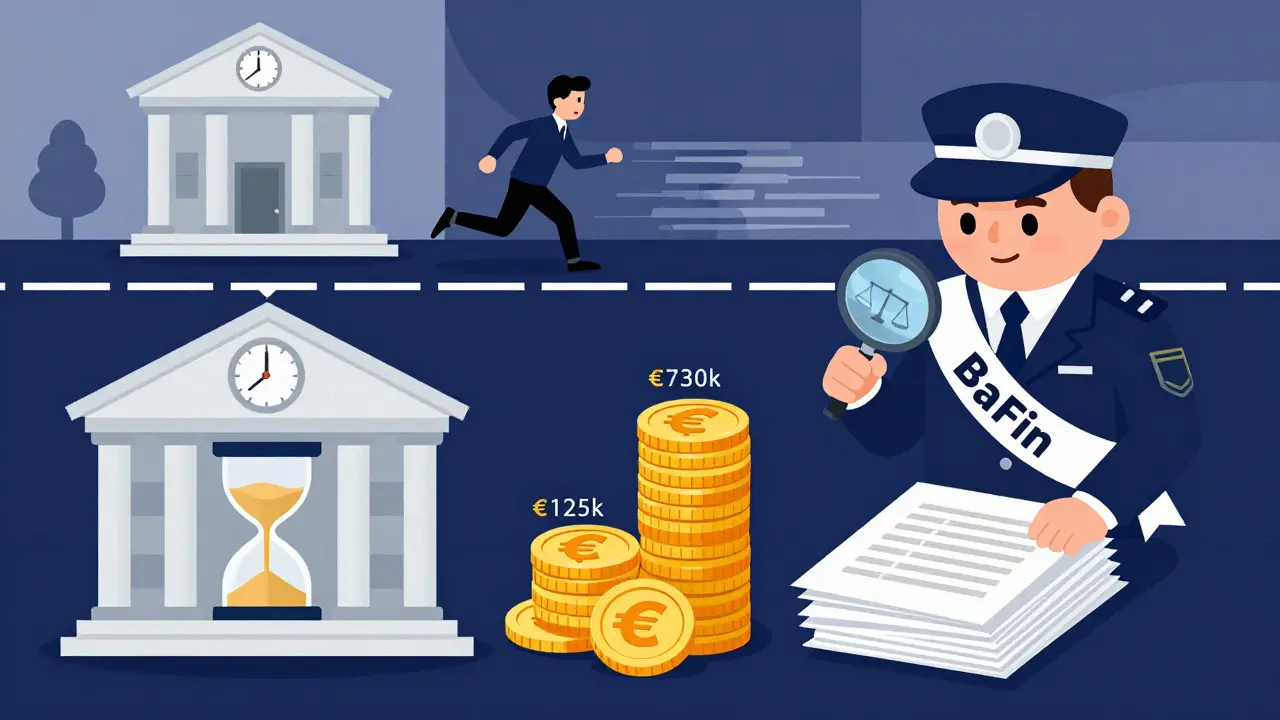
You cannot offer crypto custody services in Germany without an explicit license from BaFin. The process is rigorous, designed to weed out fly-by-night operators. For pure custody providers-those who only safeguard private keys-the minimum operational capital requirement is €125,000. However, if a provider offers multiple services, such as exchange or administration, the capital requirement jumps significantly, up to €730,000 under Article 6 of MiCAR.
The licensing timeline is a major factor for new entrants. On average, it takes 6 to 9 months to get approved. BaFin requires 47 distinct documentation components, including detailed business plans, IT security architecture diagrams, and proof of capital. A notable shortcut exists for traditional banks. Financial institutions already licensed under MiFID II can use an accelerated notification procedure, reducing the wait time to about three months. Deutsche Bank successfully used this path in early 2025, highlighting how established players benefit from the existing regulatory infrastructure.
| Provider Type | Minimum Capital | Average Timeline | Key Regulatory Basis |
|---|---|---|---|
| Pure Custody (Bitcoin/Ether) | €125,000 | 6-9 months | MiCAR + KWG |
| Multi-Service Provider | Up to €730,000 | 6-9 months | MiCAR Article 6 |
| Existing MiFID II Bank | Varies by bank size | ~3 months | MiCAR Article 91(2) |
Technical and Operational Standards
Getting the license is only half the battle. Maintaining it requires meeting stringent technical standards. BaFin’s guidance notes emphasize robust internal controls. The most critical requirement is the segregation of client assets. Your crypto must be physically or logically separated from the custodian’s own holdings. This ensures that if the company fails, your coins aren’t part of the bankruptcy estate.
Beyond segregation, providers must implement advanced cybersecurity protocols. These standards align with the Digital Operational Resilience Act (DORA), which mandates comprehensive business continuity planning. Specifically, systems must be capable of withstanding disruptions for at least 72 hours. Hardware wallet providers must comply with Common Criteria EAL 4+ security certification, while software solutions require regular penetration testing by independent third parties. Results of these tests must be submitted to BaFin quarterly.
For the actual storage of assets, the standards are precise:
- Cold Storage: At least 95% of assets should be kept in cold storage.
- Multi-Signature Schemes: Wallets must use multi-signature setups, typically requiring a 3-of-5 signature scheme for transactions.
- Access Control: Physical facilities housing hardware wallets require biometric access controls.
Implementation costs reflect this rigor. Basic compliant setups start around €500,000, while enterprise-grade solutions can exceed €2 million. This high barrier to entry helps ensure that only well-capitalized firms survive, increasing overall market stability.
Market Impact and Institutional Adoption
Despite the complexity, the German market is growing rapidly. As of June 30, 2025, total assets under custody reached €48.7 billion, marking a 28.3% year-over-year increase. This growth is driven largely by institutional adoption. In fact, 63% of DAX 30 companies now utilize licensed German custody providers, according to data from Q2 2025. This signals a shift from speculative retail trading to serious institutional integration.
The market is dominated by traditional financial giants. Deutsche Bank, Commerzbank, and DZ Bank collectively hold 58% of the market share by assets under custody. Specialized crypto-native providers like Coinbase Custody and Finoa hold about 27% combined. This mix suggests that trust in traditional banking infrastructure is a key driver for large-scale adoption in Germany.
However, the regulatory burden is real. A survey by Blockchain Bundesverband found that 54% of German crypto firms spent over €250,000 on regulatory compliance in the previous year. This is significantly higher than the EU average of €175,000. Smaller firms often cite the bureaucratic weight as a challenge, with some reporting processing times that feel excessive. Yet, for investors, this cost translates directly into better protection and lower risk of fraud or mismanagement.

Upcoming Changes: DAC 8 and Tax Reporting
The regulatory landscape is not static. Two major changes are on the horizon that will impact custody providers and their clients. First, the introduction of DAC 8 reporting requirements, set to take effect on January 1, 2026, will mandate that custody providers report crypto transactions to tax authorities. This aligns with the OECD’s Crypto-Asset Reporting Framework and is expected to increase compliance costs by 15-20% for providers.
Second, Germany is revising its civil securities law, with completion planned for Q2 2026. This revision will determine whether certain crypto assets qualify as securities under civil law. If they do, custody of those assets might trigger banking licenses instead of the current financial service licenses. Analysts predict that by 2027, 70-80% of security tokens could be classified this way, fundamentally reshaping who can act as a custodian for these specific assets.
Additionally, the income tax treatment of staking has been clarified. Active staking is now taxed as commercial income, while passive staking follows different rules. This differentiation requires custody platforms to track user activity more granularly, adding another layer of operational complexity but providing much-needed clarity for taxpayers.
Why Choose German Custody?
So, why bother with such a complex regime? The answer lies in investor protection. BaFin President Claudia Olafsson emphasized that the primary objective is ensuring client assets remain protected even in insolvency scenarios. This is backed by strengthened provisions under MiCAR Article 54. For institutional investors, this legal certainty is invaluable. BlackRock’s European Digital Assets Head noted that the detailed guidance from BaFin enabled them to build compliant solutions with confidence.
Compared to other jurisdictions, Germany offers a middle ground. Switzerland’s FINMA provides more flexibility with sandbox approaches, but less long-term certainty. France’s AMF allows faster market entry with registration rather than full licensing, but potentially weaker investor protections. Germany’s structured pathway may be slower, but it creates a stable environment where assets are truly segregated and audited. For those prioritizing security over speed, Germany’s framework is currently one of the strongest in Europe.
Do I need a license to hold my own crypto in Germany?
No, individual holders do not need a license. The licensing requirement applies to professional service providers (CASP) who offer custody services to clients for a fee. If you hold your own keys or use a non-custodial wallet, you are outside the scope of professional custody regulation.
What happens if a German crypto custodian goes bankrupt?
Under the current MiCAR and KWG framework, client assets must be strictly segregated from the custodian’s own assets. This means your crypto should not be part of the bankruptcy estate. BaFin enforces this segregation requirement to ensure that even in insolvency scenarios, client holdings remain protected and accessible.
How long does it take to get a crypto custody license in Germany?
For new applicants, the process typically takes 6 to 9 months. However, financial institutions already licensed under MiFID II can use an accelerated notification procedure, which reduces the timeline to approximately 3 months. The duration depends on the completeness of the application and the complexity of the proposed services.
Are security tokens regulated differently from Bitcoin in Germany?
Yes. Cryptocurrencies like Bitcoin and Ether fall under MiCAR. Security tokens, however, may remain regulated under MiFID II and the KWG if they qualify as securities under civil law. This distinction affects the type of license required and the specific compliance obligations for custodians handling these assets.
What are the minimum capital requirements for a custody provider?
Pure crypto custody providers must maintain a minimum operational capital of €125,000. Providers offering multiple services, such as exchange or portfolio management, face higher requirements, up to €730,000, depending on the specific activities authorized under MiCAR.