
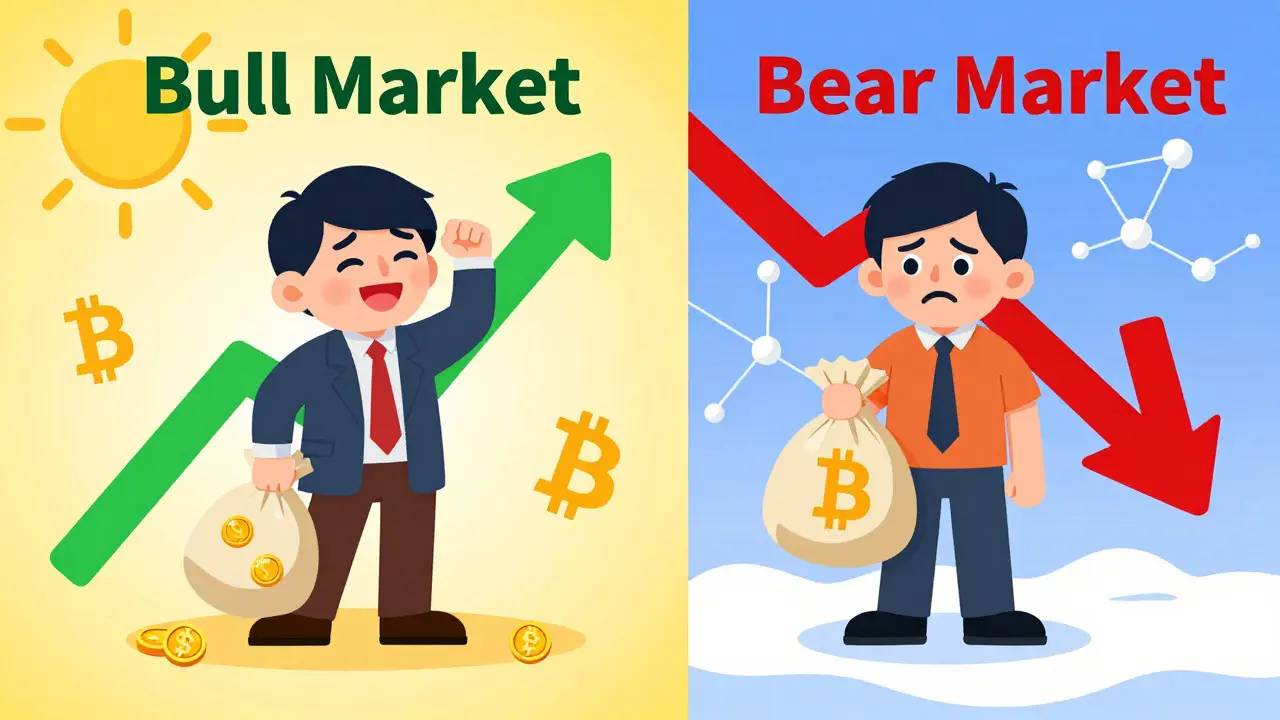
Imagine you have $500 to invest in Bitcoin, a decentralized digital currency that operates on blockchain technology. The price is soaring. Every news headline screams about new all-time highs. Your instinct might be to buy everything right now, fearing you’ll miss the boat. Or, imagine the opposite scenario: the price has crashed by 40%. Fear grips the community. You hesitate, waiting for it to drop further so you can buy at the absolute bottom. Both reactions are human, but both are dangerous.
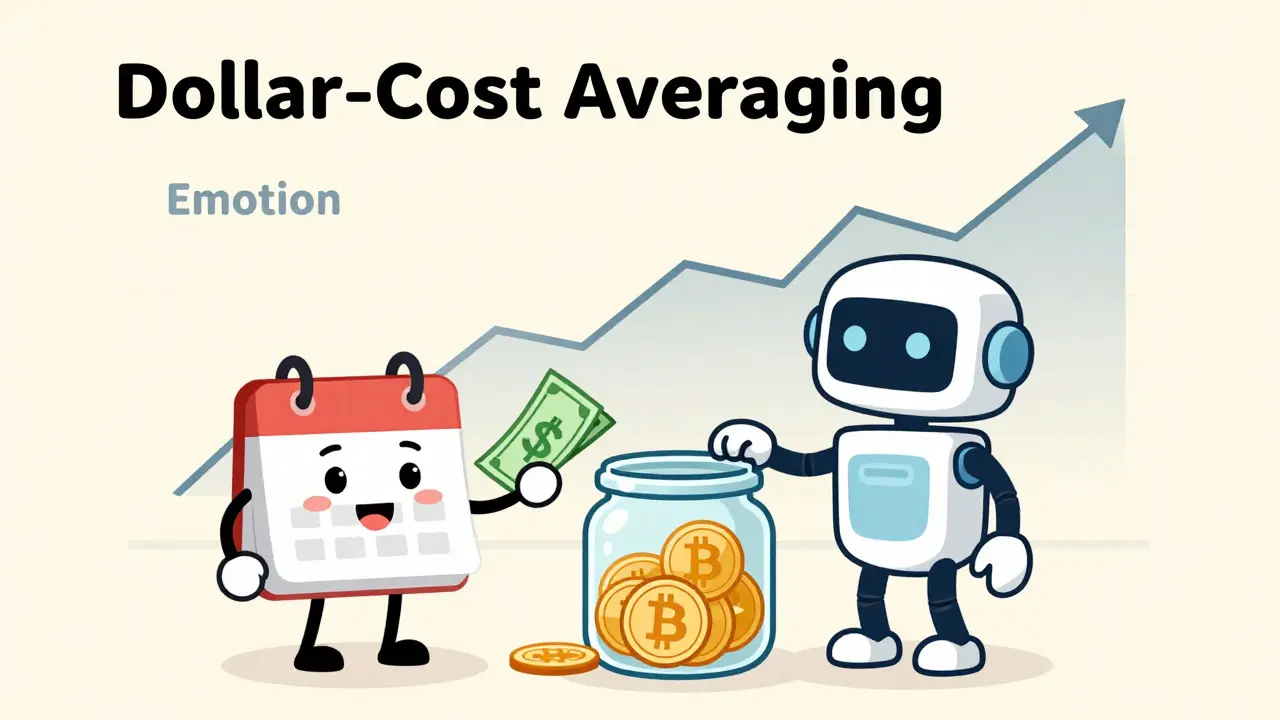
This is where Dollar-Cost Averaging (DCA) comes in as a systematic investment strategy that involves dividing an intended investment into equal parts and investing them at regular intervals. DCA isn’t just a passive habit; it’s a psychological shield against the chaos of market cycles. Whether we are in a raging bull run or a freezing bear winter, understanding how DCA behaves in each environment changes how you build wealth in the cryptocurrency market, a global financial system based on digital assets and blockchain networks.
The Mechanics of Dollar-Cost Averaging
At its core, DCA removes the need to predict the future. Instead of trying to time the market-a task even professional fund managers struggle with-you commit to buying a fixed dollar amount at set intervals. If you invest $100 every Monday, you do so regardless of whether Bitcoin is up 5% or down 10% that week.
The math works in your favor over time because you naturally buy more units when prices are low and fewer units when prices are high. This lowers your average cost per unit over the long term. According to data from Fidelity Investments, a major American multinational financial services corporation, this approach helps "take the emotions out of your investing decisions." In a volatile asset class like crypto, where swings of 20% or more can happen in days, emotion is often the biggest enemy of profit.
DCA in a Bull Market: The Comfort Zone
A bull market, defined as a period of rising stock prices characterized by investor optimism and economic growth feels great. Your portfolio turns green. Friends ask for advice. But this is where DCA faces its first test of discipline.
In a bull market, your fixed monthly investment buys fewer shares each time because the price is going up. It can feel inefficient. You might think, "Why am I only getting 0.01 BTC this month when last month I got 0.02?" The temptation to stop DCAing and wait for a dip is strong. However, historical data shows that bull markets tend to last longer than bear markets. Research from Russell Investments, a global investment management company spanning 92 years indicates that average bull markets sustain for almost 51 months, compared to bear markets averaging just 15 months.
If you pause your DCA during a bull market hoping for a correction, you risk missing out on significant gains. The compounding effect of staying invested during these extended upward trends typically outweighs the temporary disadvantage of buying higher-priced shares. The key takeaway here is consistency: keep buying, even when it feels expensive, because the trend is likely to continue longer than you expect.
DCA in a Bear Market: The Opportunity Zone
Now flip the script. A bear market, defined as a decline of 20% or more in major indices characterized by widespread pessimism and selling pressure sets in. Prices plummet. Headlines warn of recession. This is psychologically painful, but it is mathematically powerful for a DCA investor.
During a bear market, your same $100 weekly investment buys significantly more shares. You are accumulating assets at a discount. Fidelity’s analysis highlights that in a declining market, "your monthly investment goes further-letting you buy more shares with the same amount of money." This lowers your average cost basis dramatically.
Consider the pandemic-fueled crash in early 2020. Data from Charles Schwab, a leading American multinational financial corporation shows this bear market lasted only 33 days-the shortest on record. Investors who paused their DCA during those 33 days missed the front-loaded recovery. Those who kept buying accumulated massive amounts of cheap assets just before prices surged back up. The pain of seeing paper losses is real, but the reward of acquiring undervalued assets is substantial.
The Cost of Trying to Time the Market
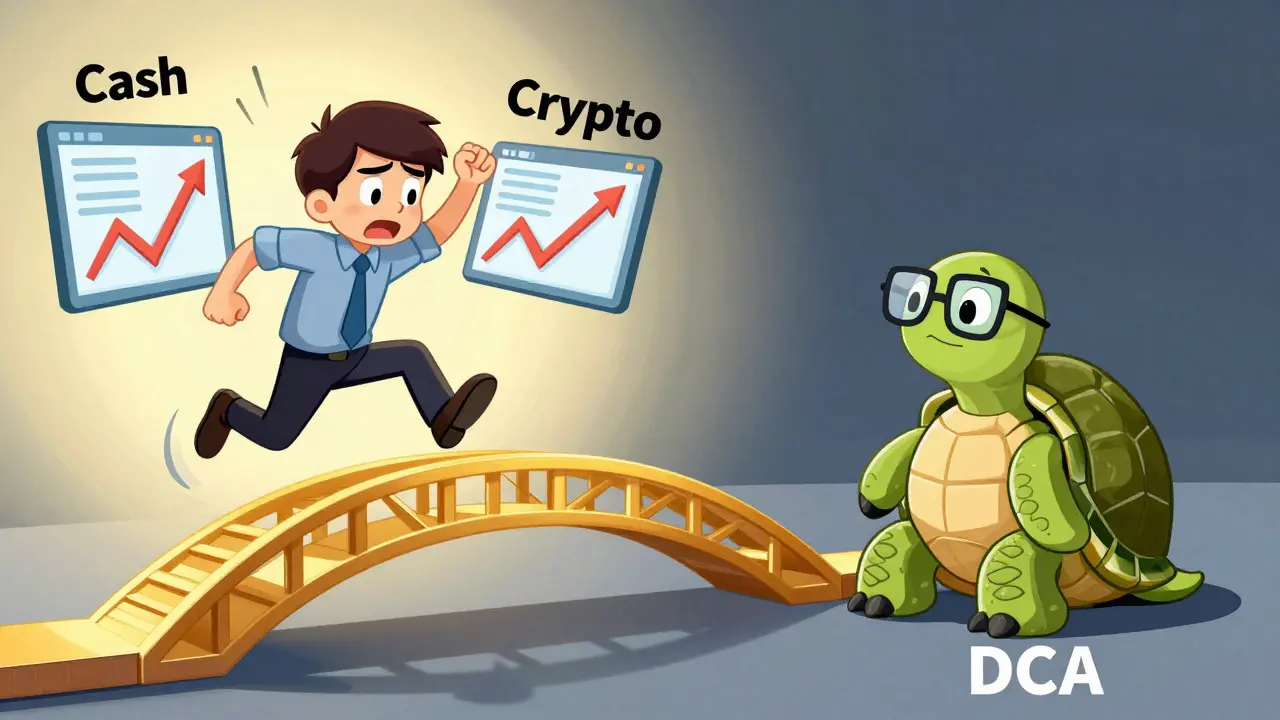
The alternative to DCA is lump-sum investing or market timing. Many investors believe they can sell before a crash and buy back at the bottom. The data suggests this is nearly impossible to do consistently.
Charles Schwab’s research reveals a stark reality: portfolios fully invested through bear market bottoms achieved 47% cumulative returns over 12 months following recovery. In contrast, portfolios that shifted to cash equivalents for just one month after the market bottom achieved only 26% returns over the same period. Waiting six months reduced returns to 14%. You don’t just lose money by sitting on the sidelines; you lose the most profitable days of the recovery.
Scotiabank, a Canadian multinational banking and financial services corporation analyzed three major crashes over 150 years, including the Great Depression. They found that consistent investors who maintained positions through downturns ultimately recovered and grew wealth substantially during subsequent bull markets. The lesson is clear: being out of the market is riskier than being in it.
| Market Condition | Share Accumulation | Psychological Challenge | Strategic Advantage |
|---|---|---|---|
| Bull Market | Fewer shares bought per interval | FOMO (Fear Of Missing Out) & Impatience | Capturing sustained upward trends (avg. 51 months) |
| Bear Market | More shares bought per interval | Fear & Panic Selling | Lowering average cost basis & accumulating discounted assets |
| Volatile/Sideways | Variable share accumulation | Frustration with lack of progress | Averaging out entry points without directional bias |
Behavioral Finance: Why We Fail Without DCA
Investing isn’t just about numbers; it’s about psychology. Behavioral finance, a field of study that combines psychology and economics to explain irrational financial behaviors explains why most active traders underperform the market. We suffer from loss aversion-the pain of losing $1,000 feels twice as bad as the pleasure of gaining $1,000.
Etinosa Agbonlahor, director of behavioral research at Fidelity, notes that DCA addresses "emotional decisions that undermine overall financial state-like selling into a down market and not reinvesting the proceeds." By automating your investments, you remove the decision-making process from the equation. You don’t get to panic-sell because you haven’t bought yet. You don’t get to greed-buy because the schedule is set.
In the context of cryptocurrency, where 24/7 trading and social media hype amplify emotions, this automation is critical. Tools offered by platforms like Plynk, a fintech platform offering investment and savings solutions allow users to set up recurring deposits easily. This simplicity is a feature, not a bug. It forces discipline.
Implementing DCA in Your Crypto Portfolio
To make DCA work for you, follow these practical steps:
- Choose Your Interval: Weekly, bi-weekly, or monthly? Monthly is common and aligns with paychecks, but weekly may smooth out volatility better in highly erratic crypto markets. There is no perfect answer, but consistency matters more than frequency.
- Select Your Assets: Stick to established cryptocurrencies with long-term fundamentals. Avoid chasing meme coins with DCA, as they lack the historical resilience needed for this strategy.
- Automate Everything: Use exchange features or third-party apps to automate purchases. If you have to manually click "buy" every time, you will likely skip weeks during bear markets due to fear.
- Ignore Short-Term Noise: Remember Russell Investments’ finding: bull markets last longer. Don’t stop DCAing because the market looks "too high." Don’t stop because it looks "too low." Keep going.
- Define Your Horizon: DCA is a long-term strategy. If you need the money in less than two years, crypto might be too risky regardless of your method. As Scotiabank advises, long-term investors building wealth have time on their side.
Conclusion: Discipline Over Prediction
Whether the market is roaring or retreating, DCA provides a steady hand. It doesn’t guarantee profits, but it guarantees participation. It prevents you from making the catastrophic mistake of buying all-in at the top or staying in cash during the recovery. In the world of blockchain and cryptocurrency, where volatility is the norm, DCA is not just a strategy-it’s a survival mechanism. Stay invested, stay disciplined, and let the math work for you.
Is DCA better than lump-sum investing in crypto?
For most retail investors, yes. While lump-sum investing theoretically yields higher returns if the market only goes up, it carries immense timing risk. DCA mitigates the risk of buying at a peak and reduces emotional stress, which is crucial in the volatile cryptocurrency market.
Should I stop DCAing during a bear market?
No. Stopping during a bear market means you miss the opportunity to buy more shares at lower prices. Historical data shows that bear markets are shorter than bull markets, and pausing your investments risks missing the rapid recovery phase that follows.
How often should I perform DCA?
The frequency depends on your income and preference. Weekly or bi-weekly DCA may smooth out volatility slightly better than monthly, but the most important factor is consistency. Choose an interval you can maintain without fail.
Does DCA work for all cryptocurrencies?
DCA works best for established assets with long-term utility and adoption, such as Bitcoin or Ethereum. For highly speculative or new tokens, there is no guarantee of recovery, so DCA carries higher risk of permanent capital loss.
What is the main psychological benefit of DCA?
DCA removes the need to time the market, reducing anxiety and emotional decision-making. By automating investments, you avoid the fear of missing out during bull runs and the panic of selling low during bear markets.


Matthew Smith
the moral failing here is not the market but our own greed we treat money like a god instead of a tool and wonder why we suffer