

Imagine running a business where one wrong move doesn't just mean a fine-it means you lose your license and potentially face criminal charges. That is the reality for cryptocurrency exchanges operating in Japan today. The Financial Services Agency (FSA) has built what many consider the most rigorous regulatory environment for digital assets in the world. It’s not just about rules; it’s about survival.
If you are an investor looking at the Japanese market, or a developer planning to launch a token there, understanding this framework isn't optional. It is the barrier to entry. But here is the twist: while these rules are tough, they have created a level of trust that other markets struggle to match. Let’s break down exactly how the FSA keeps the crypto wild west tamed in Japan, and why their recent moves in 2025 and 2026 are changing the game forever.
The Evolution from Chaos to Control
To understand where we are, you have to look back at the disaster that started it all. In 2014, Mt. Gox, which handled over 70% of global Bitcoin trades at the time, collapsed due to massive security failures and mismanagement. The loss of hundreds of thousands of bitcoins shook the entire financial world. This wasn't just a tech glitch; it was a systemic failure that demanded a government response.
Japan didn’t wait around. The FSA stepped in with a heavy hand. They revised the Payment Services Act (PSA) in 2017, creating a legal definition for "crypto-assets" that separated them from traditional fiat money but also subjected them to strict banking-like regulations. Before this, anyone could set up an exchange. After the PSA revision, if you wanted to trade crypto in Japan, you had to register with the FSA. There were no gray areas. If you weren't on the list, you were out.
This shift moved Japan from being a haven for unregulated trading to a fortress of compliance. Today, as of September 2026, the landscape is even tighter. The FSA operates under a dual-framework system that covers everything from payment tokens to investment securities, ensuring that no corner of the digital asset space is left unchecked.
Core Pillars of FSA Compliance
What does "strict compliance" actually look like on the ground? It’s not just paperwork. It involves specific operational mandates that force exchanges to operate almost like banks. Here are the non-negotiables:
- Mandatory Registration: Every Crypto-Asset Exchange Service Provider (CAESP) must be registered with the FSA. Unregistered entities are banned from offering services to Japanese residents.
- Physical Presence: You cannot run a Japanese-facing exchange from a server farm in Singapore alone. The business must have physical operations within Japan.
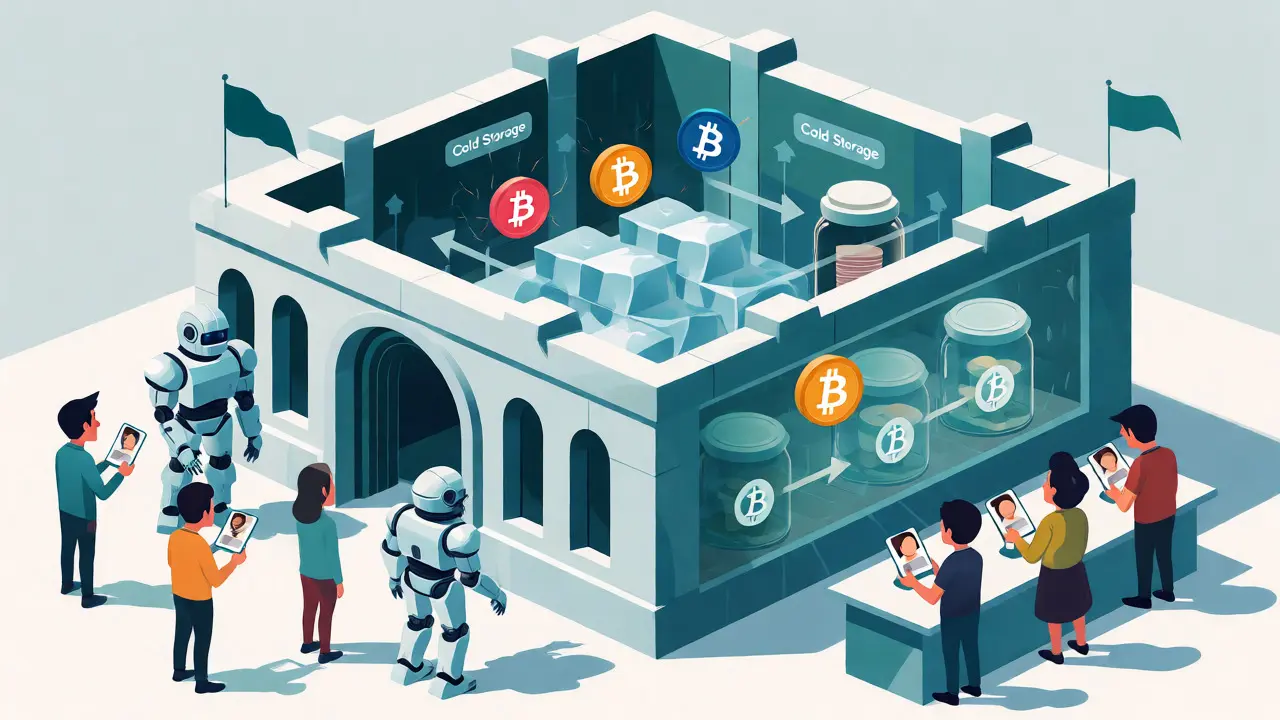
- Cold Storage Mandate: Exchanges are required to keep at least 95% of customer assets in offline cold wallets. This drastically reduces the risk of hacking incidents draining hot wallets.
- Fund Segregation: Customer funds must be completely segregated from the company’s operational capital. If the exchange goes bankrupt, your Bitcoin isn't used to pay their office rent.
- AML and KYC Protocols: Anti-Money Laundering (AML) and Know Your Customer (KYC) checks are rigorous. Identity verification is mandatory before any significant trading activity can occur.
These rules sound simple, but implementing them is expensive. Industry sources indicate that full registration processes take 6-12 months and ongoing compliance costs eat up 15-20% of operational expenses for major exchanges. Why do companies put up with this? Because the trust factor allows them to charge higher fees and attract conservative investors who prioritize safety over speed.
The 2025 Shift: Moving Under Securities Law
Here is where things get interesting for the future. For years, crypto lived under the Payment Services Act, which treated it mostly as a method of payment. But in June 2025, during the 55th Financial System Council meeting, the FSA made a landmark announcement. They began moving to reclassify certain digital assets under the Financial Instruments and Exchange Act (FIEA). This is the same law that governs stocks, bonds, and derivatives.
Why does this matter? Because it changes the legal status of tokens with investment characteristics. If your token looks like a security and acts like a security, the FSA now treats it like a security. This brings in mandatory disclosures for issuers, insider trading regulations, and clearer paths for regulated products like spot Bitcoin ETFs.
| Feature | Payment Services Act (PSA) | Financial Instruments and Exchange Act (FIEA) |
|---|---|---|
| Primary Focus | Payment methods and utility tokens | Investment contracts and securities-like tokens |
| Disclosure Requirements | Basic transaction records and user protection | Detailed prospectus and periodic reporting similar to stocks |
| Insider Trading Rules | Limited applicability | Strict prohibition and enforcement |
| Target Assets | Bitcoin, Ethereum (as payment), stablecoins | Governance tokens, equity-linked tokens, DeFi yield-bearing assets |
This transition signals maturity. Japan is no longer trying to figure out if crypto is real money. They are integrating it into the established financial system. By early 2026, the formal bill implementing this reclassification is expected to finalize, making Japan’s token regulation framework arguably the most comprehensive globally.
Self-Regulatory Organizations: The First Line of Defense
The FSA doesn’t police every single transaction alone. They rely on self-regulatory organizations (SROs) to handle the day-to-day standards. Two key players dominate this space:
- The Japan Virtual Currency Exchange Association (JVCEA): This body sets industry standards for listing new cryptocurrencies. Before a coin can be traded on a registered exchange, it often needs JVCEA approval. They scrutinize whitepapers, technology, and governance structures rigorously.
- The Japan Security Token Offering Association (JSTOA): As the focus shifts toward security tokens, JSTOA provides guidelines for issuing and trading these regulated digital securities.
These associations work closely with the FSA. If an exchange violates JVCEA guidelines, they risk losing their FSA registration. It creates a layered defense system. The SROs catch the minor infractions, allowing the FSA to focus on major systemic risks and enforcement actions.
DeFi and Stablecoins: The Next Frontier
Decentralized Finance (DeFi) poses a unique challenge. How do you regulate a platform with no central operator? The FSA hasn’t ignored this. They established a formal DeFi Study Group that meets every two to three months. Representatives from the FSA, industry leaders, and academics discuss how to apply existing laws to smart-contract-based services.
Currently, the stance is cautious. If a DeFi protocol offers yield that resembles interest payments on a deposit, it might fall under banking regulations. If it involves lending and borrowing, it might trigger money transmission laws. The FSA is actively evaluating whether to create a specific sandbox for DeFi innovations or strictly enforce existing interpretations.
Stablecoins are also under the microscope. With the rise of yen-backed stablecoins, the FSA ensures that issuers maintain 1:1 reserves with high-quality liquid assets. The goal is to prevent another Terra/Luna-style collapse by ensuring transparency and auditability of reserves.

Tax Reforms and Investor Impact
Regulation isn't just about restrictions; it's also about incentives. On August 21, 2025, the FSA proposed significant tax reforms aimed at boosting market participation. Historically, crypto profits in Japan were taxed as miscellaneous income, with rates reaching up to 55%. This discouraged long-term holding and institutional adoption.
The proposed reforms aim to bring crypto under a flat 20% tax bracket, aligning it with stocks and mutual funds. Additionally, investors would be allowed to carry forward losses for three years. These changes, if fully implemented, remove a major barrier for retail investors. It shows the FSA understands that strict compliance works best when combined with fair economic treatment.
Challenges and Criticisms
Is the system perfect? Not quite. Critics argue that the strictness stifles innovation. Startups often find the cost of compliance prohibitive, leading some to launch in more relaxed jurisdictions like Singapore or Dubai before returning to Japan later. Users on platforms like Reddit frequently note that Japanese exchanges have higher trading fees compared to global competitors. These fees directly reflect the cost of maintaining cold storage, conducting audits, and employing large compliance teams.
There is also the issue of accessibility. The KYC process can be cumbersome for foreigners living in Japan, requiring specific residency cards and local bank accounts. While this protects against money laundering, it limits the ease of entry for international participants.
Why Japan’s Model Matters Globally
Despite the challenges, Japan’s approach is gaining respect worldwide. Regulators in Europe, the US, and Asia are studying the FSA model. The clarity provided by having distinct laws for payment tokens versus security tokens reduces legal ambiguity. When investors know exactly what they own and what rights they have, confidence grows.
The balance between protecting consumers and allowing innovation is delicate. Japan has leaned heavily toward protection, but the recent shifts suggest a maturing view. By bringing crypto under the FIEA, they are acknowledging its role in capital markets. This isn't about banning crypto; it's about legitimizing it within the traditional financial ecosystem.
For developers and investors, the takeaway is clear: if you want to play in Japan, you must follow the rules. But doing so grants access to one of the most stable, trusted, and increasingly sophisticated crypto markets in the world.
Do I need to pay taxes on crypto gains in Japan?
Yes. Historically, crypto gains were taxed as miscellaneous income with rates up to 55%. However, recent proposals from 2025 aim to reduce this to a flat 20% rate, similar to stock investments, and allow loss carryforwards for three years. Always consult a local tax professional for current applications.
Can I use an overseas exchange in Japan?
You can technically access overseas exchanges, but they cannot legally offer services to Japanese residents unless they are registered with the FSA. Many global exchanges restrict sign-ups from Japanese IP addresses or require strict KYC to comply with local laws. Using unregistered offshore exchanges carries risks regarding fund recovery and legal recourse.
What happens if an exchange fails in Japan?
Thanks to strict segregation requirements, customer assets held in cold storage should remain safe even if the exchange company goes bankrupt. The law mandates that customer funds are kept separate from operational capital. However, assets held in hot wallets or lent out may still be subject to creditor claims depending on the specific contract terms.
Are DeFi protocols regulated in Japan?
Indirectly. While pure decentralized protocols without intermediaries are hard to regulate, the FSA monitors the front-end interfaces and service providers interacting with users. If a DeFi service resembles a bank or broker function, it may need to comply with relevant financial laws. The FSA is actively studying this area through dedicated working groups.
How long does it take to register a crypto exchange with the FSA?
The process typically takes 6 to 12 months. It involves extensive documentation, security audits, proof of capital reserves, and demonstration of robust AML/KYC systems. The complexity requires specialized legal expertise, contributing to the high barrier to entry for new operators.