

Ever watched a coin with zero utility jump 500% in an hour just because a comedian tweeted a picture of it? You’re not alone. In the world of memecoins, traditional financial metrics like revenue or user growth barely matter. Instead, price action is dictated by something far more volatile and human: attention. If you’ve ever wondered why your favorite dog-themed token skyrocketed after a TikTok trend or crashed when a Reddit thread died out, you’re looking at the core mechanic of this market. Social media isn’t just a place to talk about these assets; it’s the engine that drives their value.
The Shift from Fundamentals to Hype
For decades, asset valuation relied on fundamentals. But memecoins flipped the script. They are digital assets whose value is derived primarily from community engagement and internet culture rather than underlying technology. This shift created a unique ecosystem where platforms like Twitter (now X), TikTok, and Reddit serve as the primary catalysts for price discovery. The numbers back this up. In 2024, the memecoin market cap surged from under $60 billion to nearly $100 billion. That’s a 50% year-over-year increase, driven almost entirely by social speculation. Daily trading volumes rose by 45% in the first three quarters of that same year, proving that people aren't buying these tokens for their code-they're buying them for the story being told online.
This isn't just anecdotal. Research using multimodal sentiment analysis shows that combining signals from TikTok and Twitter can improve cryptocurrency return forecasts by up to 20%. Specifically, TikTok sentiment has been shown to improve short-term predictions for major coins like Dogecoin by 35%. It sounds counterintuitive if you come from a traditional finance background, but in the memecoin space, a viral video is worth more than a whitepaper.
Platform Dynamics: Where the Money Moves
Not all social media platforms affect prices in the same way. Each serves a distinct role in the lifecycle of a memecoin pump. Understanding which platform is driving the current narrative can help you time your entry and exit better.
| Platform | Primary Influence Type | Time Horizon | Key Mechanism |
|---|---|---|---|
| TikTok | Short-term Speculation | Hours to Days | Viral visual content, FOMO triggers, algorithmic amplification |
| Twitter (X) | Long-term Trends & News | Days to Weeks | Influencer endorsements, technical analysis, breaking news |
| Community Building | Weeks to Months | Detailed discussion, coordinated buying (e.g., WallStreetBets) | |
| YouTube | Educational & Deep Dive | Medium Term | Comprehensive reviews, influencer credibility, long-form analysis |
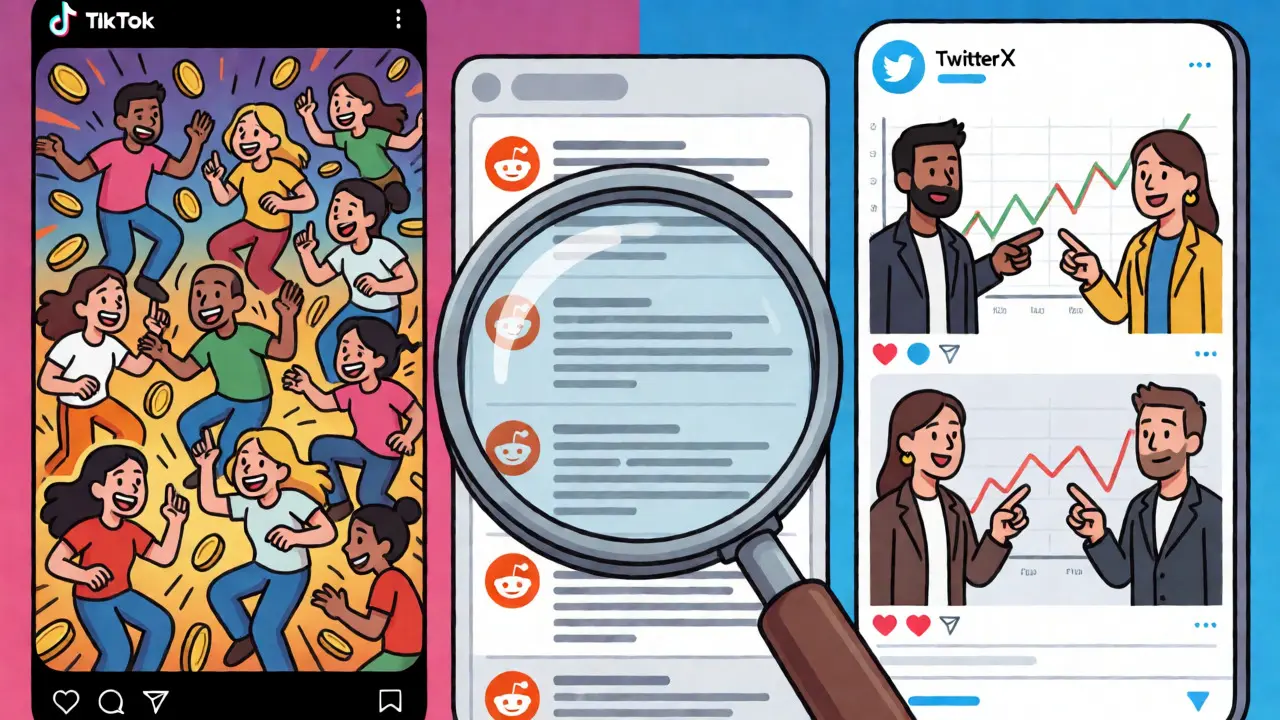
TikTok is the rocket fuel. Its algorithm favors high-engagement, short-form content, making it perfect for spreading simple, catchy narratives. When a coin goes "viral" on TikTok, you often see immediate, sharp price spikes. Twitter, on the other hand, acts as the newsroom. It’s where influencers drop tickers ($DOGE, $PEPE) and where the broader market sentiment shifts. Studies indicate that Twitter receives significant volatility shocks, with data showing it transmits volume spillovers effectively. Reddit is slower but steadier. Subreddits like r/CryptoCurrency or specific project communities build the foundational hype that sustains a coin beyond its initial viral moment.
The Mechanics of Viral Sentiment
So, how does a tweet actually move money? It comes down to correlation and causation. There is a high correlation coefficient of 0.85 between Bitcoin and major memecoins like DOGE and SHIB. However, social media amplifies these movements well beyond what Bitcoin's price action would justify on its own. This is known as volatility transmission. When social media discussions surge, memecoin prices experience fluctuations within hours. Why? Because most retail investors operate on Fear Of Missing Out (FOMO). If everyone on your feed is talking about a new cat coin, you buy it to avoid feeling left out.
Academic research analyzed over 1.3 million tweets to track these patterns. They used "powertags"-dollar signs followed by ticker symbols-as markers for cryptocurrency mentions. The findings were clear: engagement metrics (likes, retweets, comments) directly precede volume increases. It’s a feedback loop. Price goes up → people post about gains → more people see posts → more people buy → price goes up further. This loop can create massive bubbles that burst just as quickly when sentiment turns negative.
Risks: When Hype Meets Reality
While the upside is exciting, the downside is brutal. Social media-driven markets are prone to manipulation. A classic example is the $WOLF memecoin case study. Initial hype from the WallStreetBets community drove its market cap to $40 million. Then, on-chain analysis revealed that 82% of the supply was held by just a handful of wallets. Once those whales sold, the price collapsed. This highlights a critical risk: concentration. Just because a coin is trending doesn't mean it's decentralized or safe.
Furthermore, distinguishing between organic virality and coordinated pump schemes is tough. Influencers often promote projects they hold large positions in without disclosing it. By the time you see a sponsored YouTube video explaining why a coin is "the next big thing," the smart money may have already exited. This information asymmetry means retail investors are often the last ones in line, holding the bag when the music stops.

Tools for Navigating the Noise
If you want to trade memecoins based on social signals, you need more than just a gut feeling. Successful traders use sophisticated tools to filter signal from noise. Sentiment analysis platforms scan millions of posts to gauge overall mood. On-chain analysis software helps verify wallet distributions, ensuring that no single entity controls the supply. You also need to understand platform algorithms. Knowing that TikTok favors visual humor while Twitter favors hot takes allows you to predict where the next wave of attention will hit.
It requires constant monitoring. Unlike blue-chip stocks you can check once a week, memecoins demand real-time attention. Many successful traders describe it less like investing and more like gambling with an edge. They look for early signs of engagement before a coin hits mainstream awareness. For instance, spotting a rising number of powertag mentions on Twitter before a coin trends on CoinMarketCap can provide a crucial head start.
The Future of Social-Driven Crypto
The landscape is evolving. Institutional players are starting to take notice. Traditional financial firms are developing cryptocurrency sentiment indexes that incorporate data from Twitter, Reddit, and TikTok. This suggests that social sentiment is becoming a legitimate market indicator, not just a fringe curiosity. Meanwhile, platforms are tightening regulations around crypto promotions. Twitter’s integration of tipping features and NFT profiles has monetized influence, potentially changing how creators engage with audiences. TikTok’s stricter advertising policies aim to curb misleading promotional content.
Looking ahead, we expect AI-driven sentiment analysis to become standard. As regulatory scrutiny increases, the extreme volatility might dampen slightly, leading to more mature evaluation models that blend fundamental project traits with social momentum. But for now, the rule remains: follow the conversation, not the code.
Why do memecoins react so strongly to social media?
Memecoins lack intrinsic utility or cash flow, so their value is determined purely by community consensus and attention. Social media platforms facilitate rapid dissemination of narratives, triggering FOMO (Fear Of Missing Out) among retail investors, which leads to sudden price spikes or crashes based on sentiment shifts rather than fundamental changes.
Which social media platform has the biggest impact on memecoin prices?
It depends on the timeframe. TikTok tends to drive short-term, speculative pumps due to its viral nature and younger demographic. Twitter (X) influences longer-term trends and serves as a hub for influencers and breaking news. Reddit builds sustained community interest, while YouTube provides deeper analysis that can validate or debunk a project's potential.
Can social media sentiment be manipulated?
Yes, heavily. Coordinated groups can artificially inflate engagement metrics through bots or paid promotions. Influencers may promote coins they hold without disclosure, creating a "pump and dump" scenario. Investors should cross-reference social buzz with on-chain data, such as wallet distribution, to detect manipulation.
What are "powertags" and why do they matter?
Powertags are dollar signs followed by a ticker symbol (e.g., $DOGE). They are used on platforms like Twitter to tag cryptocurrencies. Tracking the volume of powertag mentions helps analysts measure organic interest and identify emerging trends before they appear in mainstream market data.
Is investing in memecoins based on social media risky?
Extremely. The reliance on sentiment makes prices highly volatile. Coins can lose 90% of their value if a key influencer abandons them or if the community loses interest. Many users report treating it as gambling rather than investing, requiring strict risk management and quick decision-making.