

Vietnam Crypto Payment Fine Calculator
This tool calculates the USD equivalent of Vietnam's 150-200 million VND fine for using cryptocurrency as payment. The fine applies to businesses and individuals accepting crypto for goods or services.
Using Bitcoin or any other cryptocurrency to pay for goods or services in Vietnam isn’t just risky-it’s illegal. And if you get caught, you could face a fine of 150 to 200 million VND (roughly $6,500 to $8,900 USD). This isn’t a warning from some distant government agency. It’s the law, enforced since January 1, 2018, and still active today in 2025.
Why Is Crypto Payment Banned in Vietnam?
The State Bank of Vietnam (SBV) made it clear: cryptocurrencies are not money. They can’t be used to buy coffee, pay rent, or settle bills. The reason isn’t about fear of technology-it’s about control. The SBV doesn’t want a parallel financial system running outside its reach. Bitcoin transactions are anonymous, irreversible, and don’t leave a paper trail. That makes it easy for tax evasion, money laundering, and untracked payments to slip through the cracks. In 2017, the SBV issued a formal statement saying: "The issuance, supply, and use of bitcoin and other similar virtual currencies as a means of payment is a prohibited activity in Vietnam." They didn’t ban owning Bitcoin. You can hold it. You can trade it. But if you use it to pay your electric bill or buy a phone from a local store, you’re breaking the law.Who Gets Fined-and How?
The fine of 150-200 million VND applies to businesses and individuals who accept cryptocurrency as payment. That includes shops, online sellers, restaurants, even universities. Back in 2017, a university in Hanoi tried to let students pay tuition in Bitcoin. The SBV stepped in immediately. The plan was scrapped within days. The law doesn’t target people who just buy Bitcoin for investment. It targets those who use it as currency. So if you’re a vendor on Facebook Marketplace and you say, "I’ll take BTC," you’re at risk. If you run a small online store and integrate a Bitcoin payment button, you’re violating Decree No. 96/2014/ND-CP, specifically Clause 6, Article 27. Enforcement isn’t constant. You won’t see police raids on every crypto-using café. But when the SBV does act, they go hard. High-profile cases-like a major e-commerce platform accepting crypto-get publicized. Smaller cases? They’re handled quietly. But the threat is real. The General Department of Vietnam Customs reported in 2017 that Bitcoin transactions were growing rapidly, with daily values in the thousands of USD. That means people are still doing it. The question isn’t whether it’s happening-it’s whether you’re willing to risk the fine.It’s Not a Ban on Crypto-Just on Payments
This is where things get confusing. You can legally own Bitcoin in Vietnam. You can trade it on peer-to-peer platforms like Paxful or LocalBitcoins. You can even hold it as an investment. But you can’t use it to pay for anything. The SBV draws a hard line: asset vs. payment method. Think of it like gold. You can own gold bars. You can sell them. But you can’t walk into a supermarket and hand over a gold bar to pay for rice. Vietnam treats crypto the same way. The law doesn’t say you can’t have it. It says you can’t spend it. This creates a strange gray zone. Many Vietnamese traders buy Bitcoin on exchanges, then sell it for VND on P2P platforms. They never use it to pay for goods. They convert it to cash first. That’s legal. But if you skip the conversion and pay directly with crypto? That’s where the fine kicks in.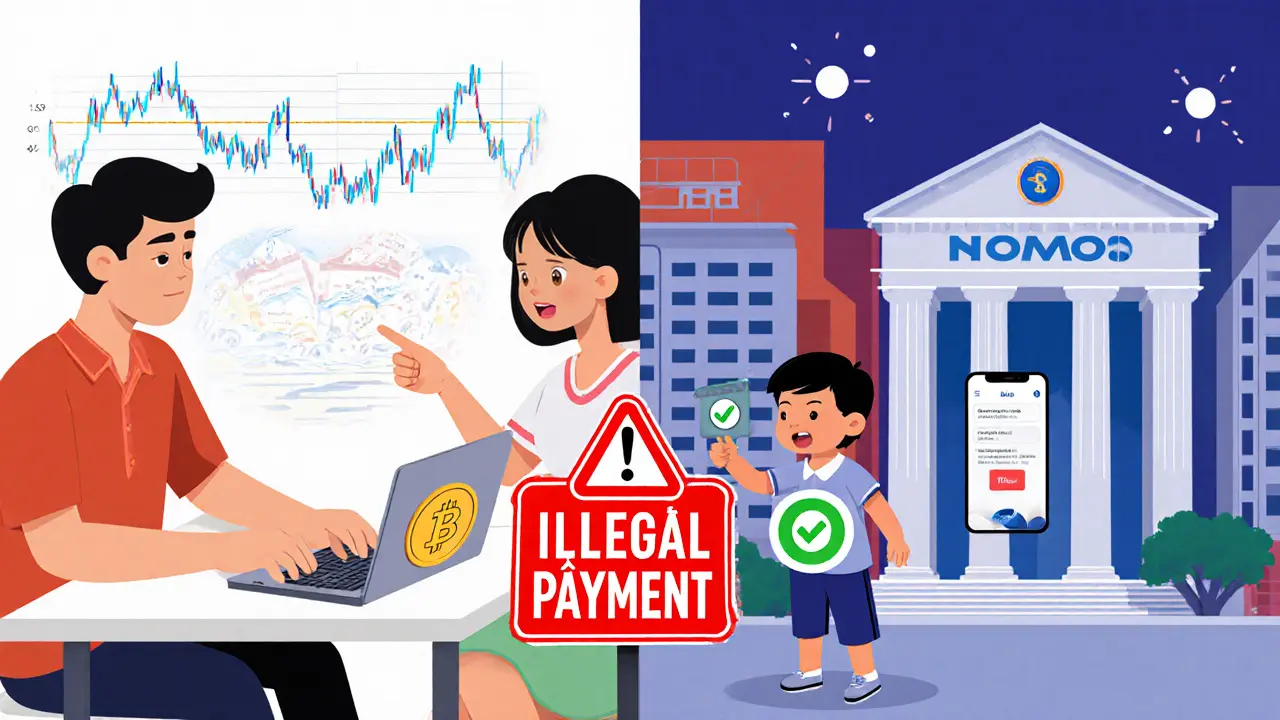
Why Is This Still the Law in 2025?
Vietnam’s crypto adoption ranks 8th globally, according to Chainalysis’ 2021 report. Millions of people are using crypto. The government knows it. So why keep the ban? The SBV’s stance hasn’t changed. Their 2022 Monetary Policy Report still says: "Cryptocurrencies are not recognized as legal tender or lawful means of payment in Vietnam." They’re not moving toward regulation like Singapore or Thailand. Instead, they’re doubling down on control. There’s also a financial inclusion angle. Vietnam has pushed hard to get people using digital payments-bank apps, QR codes, e-wallets like Momo and ZaloPay. The government wants those transactions tracked, taxed, and regulated. Crypto doesn’t fit into that system. So they’re trying to steer people toward approved channels. But here’s the problem: people still want crypto. The 2020 World Bank report showed 43% of Vietnamese adults used digital payments. That’s a huge market. And when official options feel slow or expensive, people turn to alternatives. The ban isn’t stopping adoption-it’s just pushing it underground.What Happens If You Get Caught?
If you’re a small business owner and you accept crypto, you might get a warning first. But if you keep doing it, or if you’re flagged for large transactions, you’ll get hit with the fine. The 150-200 million VND penalty is steep. For a small shop, that’s months of profit wiped out. There’s no jail time for this offense-it’s an administrative fine, not a criminal charge. But the financial hit can be devastating. And there’s no appeal process built into the law. Once the SBV issues the fine, you pay it or face asset freezes. The good news? Most enforcement targets businesses, not individuals. But if you’re a freelancer and you invoice a client in Bitcoin, and they pay you directly, you could still be liable. The law doesn’t make exceptions.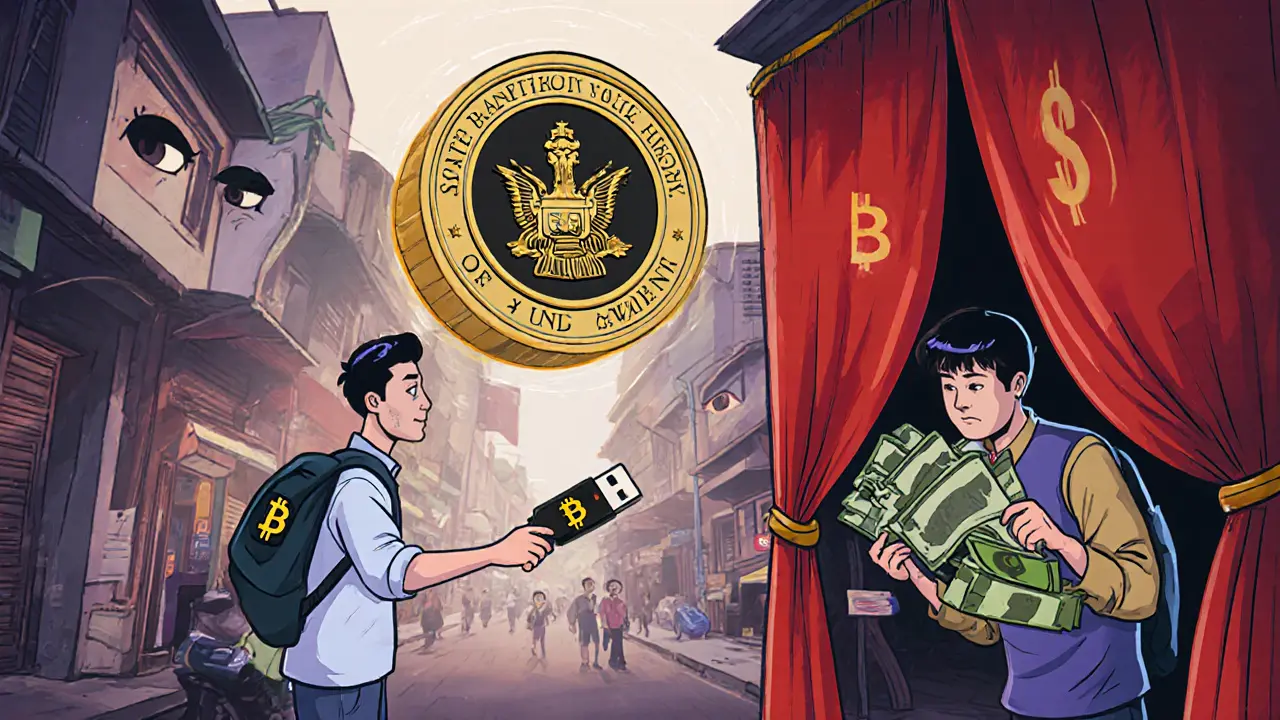
How Do People Still Use Crypto in Vietnam?
Despite the ban, crypto use is thriving. How? People avoid the trap. Most users stick to peer-to-peer trading. They buy Bitcoin on LocalBitcoins or Binance P2P, then sell it for VND. They never use it to pay for anything. Others use crypto for cross-border transfers-sending money to family abroad through crypto wallets instead of Western Union. That’s technically legal because it’s not a domestic payment. Some businesses use crypto as a backdoor. They list prices in VND, then accept crypto at the current exchange rate. They convert it immediately to VND. It’s a loophole-but the SBV has warned this still counts as using crypto as payment. The law doesn’t care if you convert it right away. If crypto was involved in the transaction, you’re on the hook.Is the Law Going to Change?
There’s been talk. In 2021, Vietnam drafted new rules to treat crypto as a taxable asset-not a currency. That suggests the government might be ready to acknowledge crypto’s role in the economy. The Ministry of Finance even started drafting rules to tax crypto gains. But the payment ban? Still there. The SBV has shown no sign of lifting it. Dr. Tran Ngoc Ca, a former deputy director at Vietnam’s Academy of Finance, said in 2023: "The 150-200 million VND fine remains technically enforceable but has become increasingly difficult to implement as cryptocurrency usage grows." That’s the real story. The law exists. The fine is real. But enforcement is patchy. The government knows it can’t stop crypto. So they’re holding onto the ban as a tool-not to stop use, but to control it.What Should You Do?
If you’re in Vietnam:- Don’t accept crypto as payment for goods or services. Even if you convert it right away.
- Don’t advertise that you take Bitcoin, Ethereum, or any other crypto. That’s a red flag.
- If you trade crypto, keep it separate from payments. Buy, hold, sell for VND-don’t spend it.
- Use Momo, ZaloPay, or bank transfers for everyday spending. They’re legal, fast, and safe.
- Don’t set up crypto payment gateways for Vietnamese customers.
- Don’t assume that because crypto is legal elsewhere, it’s okay here.
- Work with local partners who understand the rules. Ignorance won’t protect you.
Is it illegal to own Bitcoin in Vietnam?
No, owning Bitcoin or other cryptocurrencies is not illegal in Vietnam. You can buy, hold, and trade them on peer-to-peer platforms. The ban only applies to using crypto as a payment method-for example, paying for goods, services, or bills. Holding it as an investment is allowed.
How much is the fine for using crypto as payment?
The fine ranges from 150 million to 200 million Vietnamese Dong (VND), which is about $6,500 to $8,900 USD. This applies to individuals or businesses that accept cryptocurrency in exchange for goods or services. The amount depends on the severity and frequency of the violation.
Can I use crypto to pay for something online from a foreign company?
Technically, yes-if the transaction is cross-border and doesn’t involve a Vietnamese business accepting crypto as payment. If you’re buying from a U.S. website that accepts Bitcoin and you’re in Vietnam, the SBV doesn’t regulate that. But if a Vietnamese company accepts crypto from you, even for an international service, you’re violating the law.
Are there any exceptions for freelancers or remote workers?
No. If you’re a freelancer based in Vietnam and you invoice a client in crypto, or if your client pays you in Bitcoin, that’s considered using crypto as payment. Even if the client is overseas, the act of receiving crypto as payment within Vietnam triggers the fine. The safest route is to receive payment in VND or foreign currency via bank transfer.
Has anyone actually been fined for this?
Yes. While the State Bank of Vietnam doesn’t publish detailed enforcement records, multiple cases have been reported by local media and financial regulators. In 2017, a university that planned to accept Bitcoin for tuition was forced to cancel the program after SBV intervention. In 2019, the SBV confirmed it had coordinated additional penalties for crypto payment violations. Enforcement is selective, but it happens.
What’s the difference between Vietnam’s crypto rules and Thailand or Singapore?
Thailand and Singapore created licensing systems for crypto exchanges and payment services. They regulate crypto as a financial product. Vietnam took a different path: a complete ban on crypto as payment, while allowing ownership. Vietnam doesn’t license crypto businesses. It just says: don’t use it to pay for anything. That makes Vietnam’s approach one of the strictest in Southeast Asia.
Will Vietnam ever allow crypto payments in the future?
It’s possible-but not soon. The government is moving toward taxing crypto as an asset, which shows they recognize its presence. But the payment ban remains unchanged as of 2025. The State Bank of Vietnam still prioritizes control over innovation. Any change would require a major policy shift, and there’s no sign that’s coming yet.


Derayne Stegall
Bro this is wild 😱 I just bought a coffee with BTC last week and thought I was being cool... turns out I was just funding the Vietnamese government's next vacation. 🤦♂️