
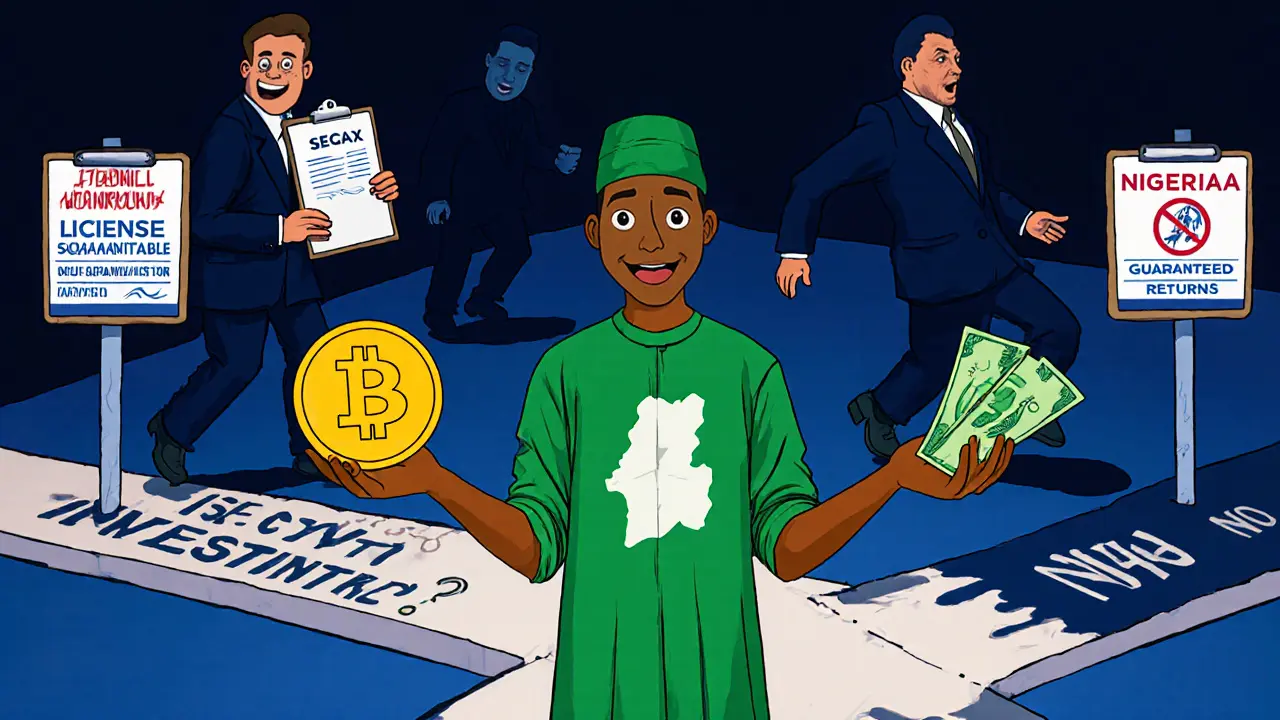
Nigeria Crypto Tax Calculator 2025
Calculate Your Crypto Tax Liability
Under Nigeria's new Investments and Securities Act (ISA) 2025 and Nigeria Tax Administration Act (NTAA) 2025, crypto gains are taxable. This calculator estimates your tax based on current regulations.
Your Estimated Tax Liability
Important Notes:
- Tax implementation begins in 2026 under NTAA 2025
- Short-term gains taxed at 20%, long-term gains at 10%
- VASPs must collect and report your transaction data
Back in 2021, if you traded Bitcoin in Nigeria, your bank could shut down your account. By 2023, they started letting you open accounts again-if you were licensed. And now, in 2025, Nigeria has its first full-blown law that actually recognizes cryptocurrencies as securities. It’s not about banning anymore. It’s about controlling, taxing, and bringing crypto into the formal economy.
Bitcoin and crypto aren’t illegal in Nigeria-just not legal tender
You can still buy, sell, and hold Bitcoin, Ethereum, or any other crypto in Nigeria. No one’s going to jail for owning it. But you can’t use it to pay your electricity bill, buy fuel at the pump, or settle a salary. The Nigerian naira is the only official currency. Crypto is treated like stocks or bonds-not money. This distinction matters. It means crypto isn’t banned, but it’s also not protected like cash. If you send someone 1 BTC and they disappear, you have no legal recourse under currency laws. But if that same BTC was sold as an investment product and turned out to be a scam, you now have real protection under the new law.The Investments and Securities Act (ISA 2025) changed everything
On March 25, 2025, President Tinubu signed the Investments and Securities Act 2025 into law. This 226-page document didn’t tweak rules-it rebuilt them. For the first time, Nigeria defined what a crypto asset is: "a digital representation of value that can be transferred, digitally traded and used for payment or investment purposes." Crucially, it excluded digital versions of the naira or other fiat currencies. So, if you’re using a CBDC (Central Bank Digital Currency) in the future, it won’t fall under this law. But if you’re trading Solana, Dogecoin, or even an NFT marketed as an investment, you’re now under SEC supervision. The law made the Securities and Exchange Commission (SEC) Nigeria’s main crypto cop. They now have the power to:- Approve or deny licenses for crypto exchanges
- Suspend or shut down platforms breaking the rules
- Remove executives from their jobs for fraud
- Access telecom records to track suspicious activity
- Impose fines and freeze assets
Not all crypto is treated the same
The law draws a sharp line between financial crypto and artistic crypto. If you mint an NFT of a digital painting and sell it as art? No problem. No SEC involvement. But if you sell an NFT and say, "Buy this and get 10% monthly returns," or "This NFT represents shares in a startup," now you’re selling a security. That’s illegal unless you’re registered with the SEC. This stops countless Ponzi schemes that used NFTs as bait. The same applies to forex trading apps and crypto lending platforms. If they promise fixed returns, they’re now considered investment products. And that means they need SEC approval-or they’re operating illegally.Who’s watching? It’s not just the SEC
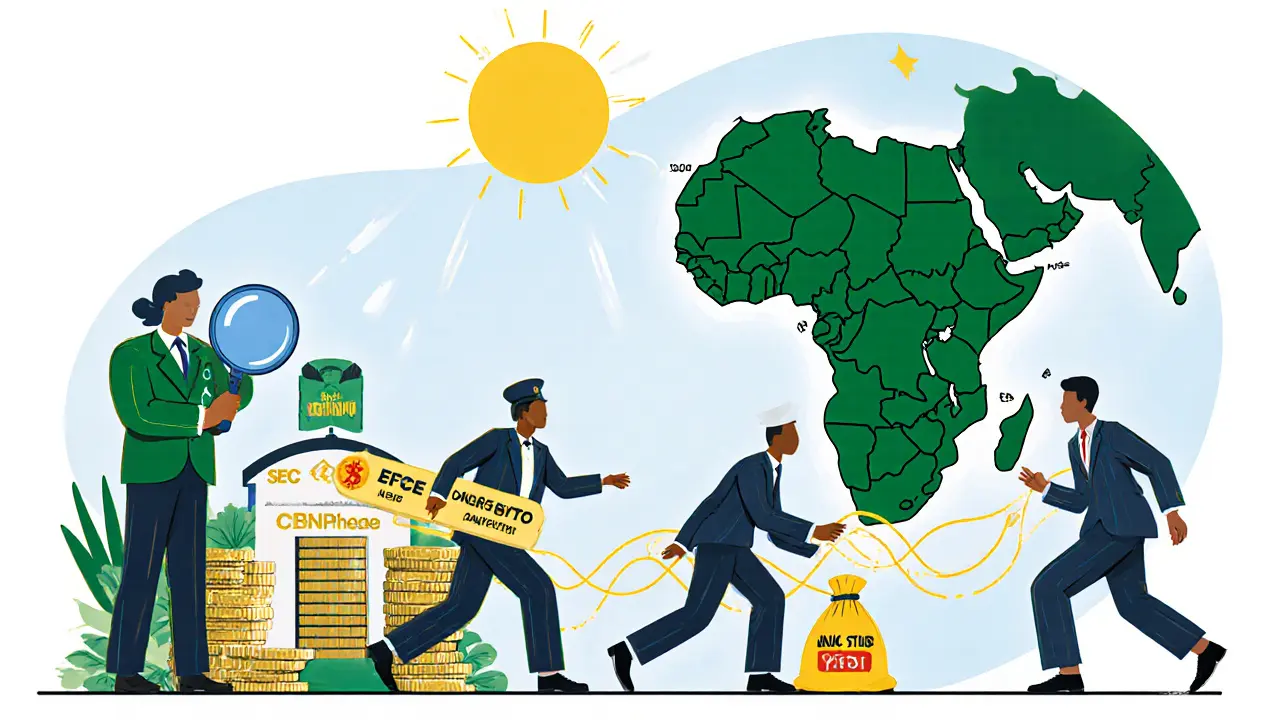
Nigeria didn’t just give one agency power. They built a team.- SEC: Handles licensing, investor protection, and market integrity.
- CBN: Still controls banking rules. Banks can’t process crypto payments unless the platform is licensed. They also monitor for money laundering.
- EFCC: The economic crimes unit. They investigate fraud, scams, and large-scale theft.
- NFIU: The Financial Intelligence Unit. They track suspicious transactions across all platforms and report to global watchdogs.
Crypto taxes are now real-and expensive to ignore
In June 2025, Nigeria passed the Nigeria Tax Administration Act (NTAA) 2025. It takes effect in 2026, but the message is clear: crypto income is taxable. Virtual Asset Service Providers (VASPs)-that’s exchanges, wallets, and trading platforms-must now:- Collect and report user transaction data
- Withhold taxes on trading profits
- Submit monthly reports to the tax authority
- ₦10 million ($6,693) for the first month of non-compliance
- ₦1 million ($669) for every additional month
- License suspension or revocation
Why did Nigeria change its mind?
In 2021, the Central Bank banned banks from dealing with crypto. The goal? Stop money laundering and protect the naira. But it backfired. Nigerians didn’t stop using crypto. They just moved to peer-to-peer trading. Local platforms like Paxful and Binance P2P exploded. Nigeria became the #1 country in the world for P2P crypto volume. People used crypto to send remittances, save money, and hedge against inflation. The CBN realized they couldn’t stop adoption-they could only control it. By 2023, they allowed licensed VASPs to open bank accounts. Then came the regulatory sandbox in 2024. And now, the full law. This wasn’t a surrender. It was strategy. Recognize the market. Regulate it. Tax it. Protect users. Stop the chaos.What does this mean for regular users?
If you’re just buying and holding Bitcoin for the long term? You’re fine. No one’s auditing your wallet. But if you’re trading frequently, running a crypto business, or offering investment products:- Register with the SEC if you’re a platform
- Keep records of all trades
- Understand that profits are taxable
- Avoid platforms that promise guaranteed returns

What’s still unclear?
The law is a big step, but it’s not perfect.- How exactly will personal crypto gains be taxed? The NTAA 2025 doesn’t specify rates for individuals yet.
- Will decentralized exchanges (DEXs) like Uniswap be required to register? The law focuses on centralized platforms.
- What happens if you use a foreign exchange? Are you personally liable for taxes?
The bigger picture: Nigeria as a model for Africa
Africa has 1.4 billion people. Most countries still treat crypto like a gray zone-either ignored or banned. Nigeria’s move shows it’s possible to embrace innovation without losing control. Other African nations are watching closely. Ghana, Kenya, and South Africa are already drafting similar laws. Nigeria’s framework-combining licensing, taxation, and multi-agency oversight-could become the blueprint. It’s not about stopping crypto. It’s about making sure it works for the economy, not against it.What should you do now?
If you’re in Nigeria:- Use only SEC-licensed exchanges (Quidax, Busha, and others as they’re approved)
- Keep records of all buys, sells, and transfers
- Don’t trust platforms promising "guaranteed profits"
- Start preparing for 2026 tax reporting-track your crypto income like you would salary
Is cryptocurrency legal in Nigeria in 2025?
Yes, cryptocurrency is legal in Nigeria as of 2025, but it is not legal tender. The Investments and Securities Act (ISA 2025) recognizes crypto assets as securities, making them regulated under capital market laws. You can buy, sell, and hold crypto, but you cannot use it to pay for goods and services in place of the Nigerian naira.
Can I use crypto to pay bills or salaries in Nigeria?
No. The Nigerian naira is the only legal tender for official payments. While peer-to-peer crypto transactions are allowed, businesses and government agencies cannot accept crypto as payment for taxes, utilities, or salaries. Any service claiming to accept crypto as legal tender is operating outside the law.
Which agency regulates cryptocurrency in Nigeria?
The Securities and Exchange Commission (SEC) is the primary regulator for cryptocurrency in Nigeria under the ISA 2025. It oversees all crypto exchanges, investment platforms, and token sales. The Central Bank of Nigeria (CBN), Economic and Financial Crimes Commission (EFCC), and Nigerian Financial Intelligence Unit (NFIU) also play supporting roles in banking compliance, fraud investigations, and anti-money laundering efforts.
Are crypto taxes enforced in Nigeria?
Yes. The Nigeria Tax Administration Act (NTAA) 2025, effective from 2026, requires Virtual Asset Service Providers (VASPs) to collect and report user transaction data and withhold taxes on crypto gains. Individuals who trade crypto are also expected to declare profits as income. Non-compliant platforms face penalties of up to ₦10 million ($6,693) per month, plus license suspension.
What happens if I use an unlicensed crypto exchange in Nigeria?
Using an unlicensed exchange is risky but not automatically illegal for individual users. However, the platform itself can be shut down, frozen, or prosecuted. If you lose funds on an unlicensed platform, you have no legal recourse. Only SEC-licensed exchanges like Quidax and Busha offer consumer protections and compliance with AML rules.
Are NFTs legal in Nigeria?
Yes, but only if they’re not sold as investment products. Artistic NFTs-like digital art or collectibles-are not regulated. However, if an NFT is marketed as a security, offering profit-sharing, dividends, or ownership rights in a company, it falls under SEC regulation and must be registered. Selling unregistered investment NFTs is illegal.
Will the Nigerian government ban crypto in the future?
It’s highly unlikely. Nigeria’s new laws show the government has accepted crypto as a major economic force. With $92.1 billion in crypto inflows in 2024-2025, banning it would hurt millions of users and damage the fintech sector. The focus is now on regulation, taxation, and consumer protection-not prohibition.


Sonu Singh
bro this is huge for us in India too - we’ve been stuck in this gray zone for years. nigeria’s move is like a roadmap. finally someone got it right: don’t ban, regulate. the sec having power over exchanges? yes please. i’ve lost money on unlicensed platforms before. no recourse, no nothing. this law actually protects people, not just the state.