
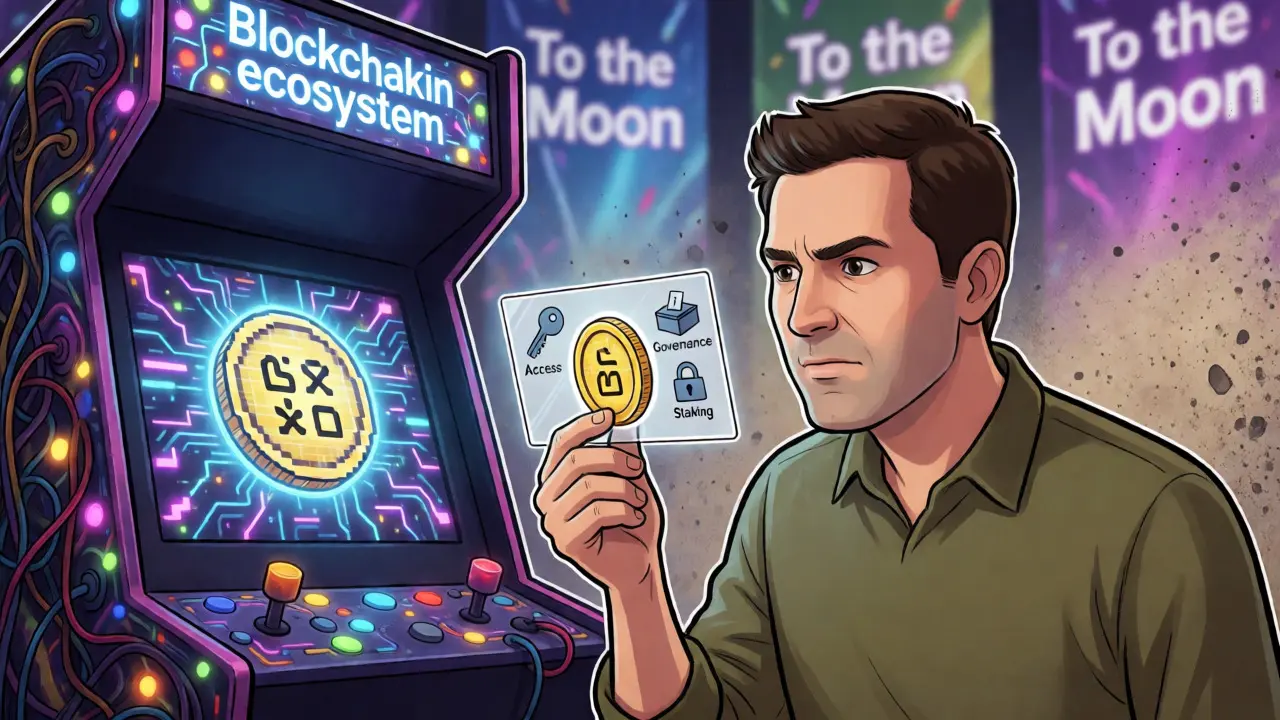
You see a new utility token project with a flashy website and a promise of "revolutionizing data storage." You want in. But how do you know if it’s the next Chainlink or just another ghost town? Most people lose money because they look at price charts instead of actual usage. Here is the hard truth: a utility token is a digital asset that grants access to a specific service or product within a blockchain ecosystem. It is not a stock certificate. If you treat it like one, you will get burned.
Evaluating these projects isn't about guessing the future. It is about checking if the machine actually works. Today, we are breaking down exactly how to vet these assets using real metrics, not hype. Whether you are an investor, a developer, or just curious, this guide gives you the checklist you need to separate signal from noise.
The Core Definition: Why "Utility" Matters More Than Hype
Before you dig into numbers, you need to understand what you are buying. The term "utility token" gets thrown around loosely, but legally and functionally, it has a specific meaning. Unlike security tokens, which represent ownership or debt, utility tokens exist to fuel a network. Think of them as arcade tokens. You buy them so you can play games. If no one plays the games, the tokens have no value, regardless of how many people bought them hoping for a jackpot.
The U.S. Securities and Exchange Commission (SEC) uses the Howey Test to determine if a token is a security. If a project promises profits derived primarily from the efforts of others, it might be a security, even if they call it a utility token. In fact, SEC Commissioner Hester Peirce noted that 72% of tokens investigated failed this test due to bad marketing. So, your first job is to ignore the "to the moon" tweets and ask: What does this token actually let me do?
- Access: Does it pay for transaction fees or premium features?
- Governance: Does holding it allow you to vote on protocol changes?
- Staking: Do you lock it up to secure the network and earn rewards?
If the answer is vague, walk away. Successful projects like Ethereum's ERC-20 standard or Filecoin have crystal-clear use cases. They solve a problem. Your job is to find the problem before you find the solution.
Tokenomics: Follow the Money Supply
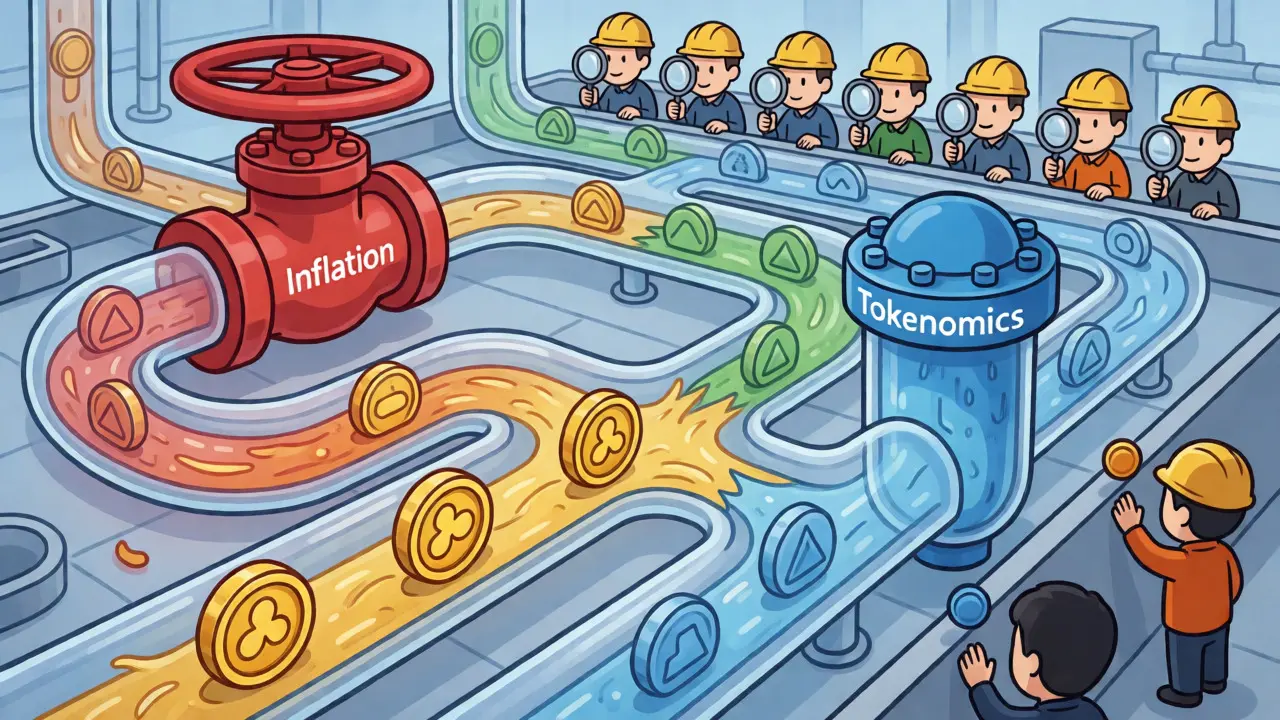
Once you know what the token does, you need to know how it behaves economically. This is called tokenomics. Bad tokenomics can kill a great technology. You need to look at supply, distribution, and inflation.
Start with the total supply. Is it capped? Unlimited supplies often lead to hyperinflation unless there is a strong burn mechanism. For example, Filecoin has a hard cap of 2 billion FIL. Compare this to tokens with no cap where new coins are minted endlessly to pay validators. That dilutes your holdings every single day.
| Metric | What to Look For | Red Flag |
|---|---|---|
| Total Supply | Capped or deflationary mechanisms (burns) | Unlimited supply with high inflation rate |
| Distribution | Broad decentralization; low team allocation (<15%) | >35% held by top 10 wallets |
| Vesting Schedule | Long lock-ups for team/investors (1-4 years) | Immediate unlock of all tokens at launch |
| Velocity | Low turnover (<0.8 daily); tokens are held, not flipped | High velocity indicating pure speculation |
Distribution is critical. If the founders and early investors hold 50% of the supply, they control the market. When their vesting period ends, they might dump their tokens, crashing the price. Always check the vesting schedule. You want a slow drip of tokens into the market, not a flood.
Technical Health: Audits and Infrastructure
A pretty whitepaper means nothing if the code is broken. Smart contracts are immutable once deployed. If there is a bug, hackers will find it. You must verify that the project has undergone rigorous security audits.
Look for audits from reputable firms like OpenZeppelin or CertiK. These audits cost between $15,000 and $50,000. If a project skips this step to save money, they are cutting corners. But don't just look for the logo. Read the audit report. Did they fix the critical issues? Are the results publicly available? A private audit is worth less than a public one because you cannot verify the claims.
Next, consider the infrastructure. Where does the token live? If it is on Ethereum, gas fees can eat up small transactions. Layer 2 solutions now handle 2,000 transactions per second (TPS) compared to Ethereum's base layer 15-30 TPS. If your utility token requires frequent micro-transactions, such as gaming or social media interactions, high fees are a dealbreaker. Interoperability also matters. Can the token move across chains? Projects using cross-chain bridges like Chainlink CCIP tend to integrate better with other ecosystems, driving higher demand.
Real Usage vs. Speculative Noise
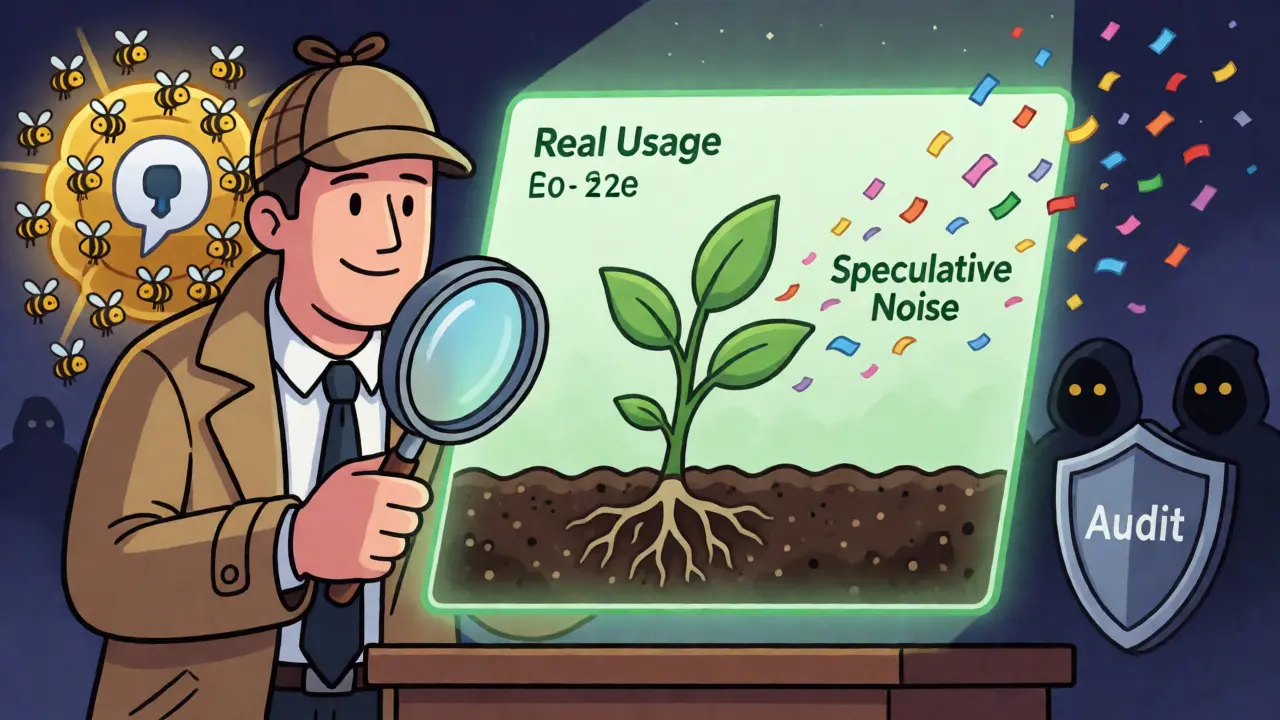
This is where most evaluations fail. People confuse trading volume with utility. Just because a token trades millions of dollars a day doesn't mean anyone is using its services. It might just be traders gambling on the price movement.
You need on-chain data. Tools like Dune Analytics or Nansen allow you to track real activity. Look for metrics like Daily Active Users (DAU) per holder. Dr. Garrick Hileman from Blockchain.com suggests a minimum viable ratio of 0.35 DAU per holder. If you have 100,000 holders but only 1,000 active users, the ecosystem is stagnant.
Another key metric is revenue per token. Does the protocol generate real income? Uniswap generates fees from swaps. Those fees accrue to the ecosystem. If a project has zero revenue after two years, its long-term viability is questionable. Vitalik Buterin proposed a "Value Accrual Test," requiring tokens to capture more than 15% of ecosystem value through direct utility mechanisms. If the token captures none of the value created by the network, why hold it?
The Team and Community Reality Check
Technology doesn't build itself. You need a competent team. But beware of anonymous teams or those with inflated LinkedIn profiles. Check their GitHub activity. Are developers committing code weekly? A healthy project should have more than 50 weekly commits. Silence on GitHub often means development has stalled.
Community sentiment is tricky. Twitter hype can be bought. Reddit and Discord discussions are harder to fake. Look for complaints. Are users complaining about bugs, poor support, or broken promises? Trustpilot reviews show that transparent projects score significantly higher (4.2/5) than opaque ones (2.1/5). If the community is asking basic questions that the team ignores, that is a warning sign.
Also, check for regulatory clarity. Has the project received a no-action letter from regulators? Or are they operating in a gray area? Jurisdictions vary. Switzerland requires 70% of value to derive from usage, while Singapore demands a 12-month operational history. Non-compliance can lead to sudden delistings or fines, wiping out value overnight.
Putting It All Together: A Step-by-Step Workflow
Evaluating a project takes time. Experts spend 8-12 hours on deep dives. Here is a streamlined workflow you can use:
- Define the Utility: Can you explain in one sentence what the token does? If not, skip it.
- Check Tokenomics: Review supply caps, distribution charts, and vesting schedules. Ensure no single entity holds too much power.
- Verify Security: Find public audit reports. Confirm critical vulnerabilities were patched.
- Analyze On-Chain Data: Use Dune or Nansen to check DAU, transaction volume, and revenue. Ignore price; look for usage.
- Assess Development Activity: Check GitHub commits and roadmap updates. Is the team shipping products?
- Evaluate Regulatory Risk: Determine if the token could be classified as a security in your jurisdiction.
Remember, utility decay is real. 68% of failed tokens lost their utility relevance within nine months. Continuous monitoring is required. Don't set it and forget it.
Frequently Asked Questions
What is the main difference between a utility token and a security token?
A utility token provides access to a service or product within a blockchain ecosystem, similar to an arcade token. A security token represents an investment contract, implying ownership or a claim on future profits, similar to a stock. The legal distinction often depends on whether profits are expected primarily from the efforts of others, as defined by the Howey Test.
Why are smart contract audits important for utility tokens?
Smart contracts govern how tokens function and transfer. Since blockchain code is immutable, bugs cannot be easily fixed after deployment. Audits by firms like OpenZeppelin identify vulnerabilities before they are exploited by hackers, ensuring the security and reliability of the token's functionality.
How can I tell if a token's value comes from utility or speculation?
Look at on-chain metrics rather than trading volume. Check Daily Active Users (DAU), transaction counts for service usage, and protocol revenue. If trading volume is high but user activity is low, the value is likely driven by speculation. Sustainable projects typically have utility transactions accounting for more than 60% of network activity.
What is token velocity and why does it matter?
Token velocity measures how frequently a token is used or traded. High velocity indicates rapid turnover, often associated with speculative trading. Low velocity suggests holders are retaining the token for its utility or staking rewards. Ideally, you want moderate velocity where tokens are used for services but not constantly flipped for quick profits.
Do I need to worry about regulatory risks when evaluating utility tokens?
Yes. Regulatory bodies like the SEC may reclassify tokens as securities if they are marketed with profit promises. This can lead to lawsuits, fines, or delistings. Check if the project has clear compliance strategies, such as obtaining no-action letters or adhering to local frameworks like FINMA in Switzerland or MAS in Singapore.