
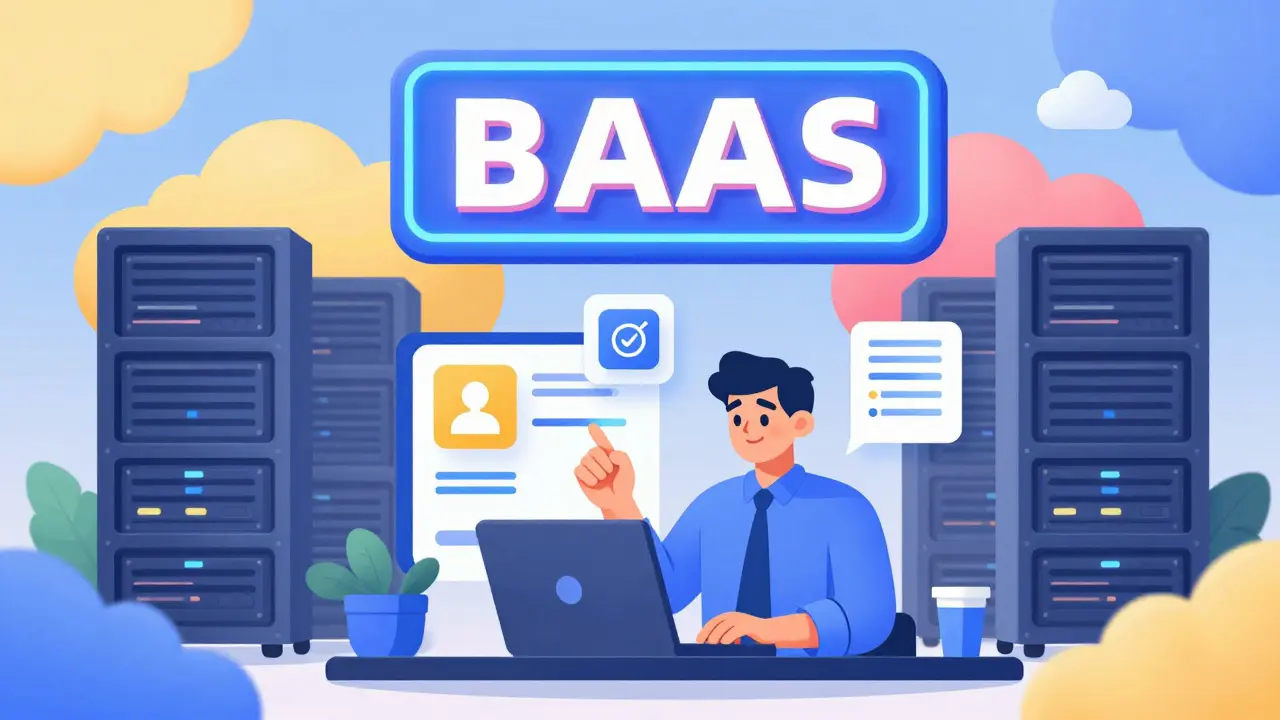
Think of blockchain as a digital ledger that records transactions across many computers-so no single company owns it. Sounds powerful, right? But setting up your own blockchain from scratch? That’s expensive, complicated, and needs a team of experts. Enter Blockchain-as-a-Service (BaaS). It’s like renting a blockchain instead of building one. Companies use BaaS to get all the benefits of blockchain without the headache of managing servers, consensus protocols, or security patches themselves.
How BaaS Works
BaaS is a cloud-based offering. Think of it like Amazon Web Services (AWS) or Microsoft Azure, but instead of renting servers or databases, you’re renting a blockchain network. The provider handles everything: the nodes, the software, the updates, the backups. You just log in, pick a template, and start building smart contracts or tracking assets. No need to hire blockchain engineers or buy hardware. You pay for what you use-monthly, hourly, or per transaction.
Behind the scenes, the BaaS provider runs secure, scalable blockchain infrastructure in the cloud. They manage proof-of-stake or proof-of-work consensus, node synchronization, data encryption, and network monitoring. You don’t touch any of that. You focus on what matters: your business logic. Want to track medicines from factory to pharmacy? Build a smart contract. Need to verify supplier documents? Use a BaaS platform to create a permissioned ledger. All without touching a single server.
Why Companies Choose BaaS
Most businesses don’t need to reinvent blockchain. They just need to use it. Here’s why BaaS is becoming the go-to choice:
- Lower costs - No upfront investment in hardware or specialized staff. A startup can start using blockchain for under $500/month.
- Faster deployment - Pre-built templates let you launch a supply chain tracker in days, not months.
- Scalability - Need to handle 10,000 transactions a day? BaaS platforms auto-scale. No downtime. No over-provisioning.
- Security - Providers use enterprise-grade encryption, multi-factor authentication, and regular audits. Many are compliant with ISO 27001 and GDPR.
- Integration - BaaS tools connect easily with existing systems like ERP, CRM, or inventory software. No need to rebuild your tech stack.
For example, a food retailer in Australia used BaaS to track seafood shipments from Perth docks to supermarkets in Sydney. Before, they relied on paper logs and emails. Now, every shipment is timestamped, geolocated, and signed digitally. If a shipment is delayed, they instantly know why-and who’s responsible.
Who Uses BaaS?
BaaS isn’t just for tech companies. It’s being adopted across industries:
- Supply chain - Track goods from raw material to shelf. Reduce fraud, improve recalls, prove ethical sourcing.
- Finance - Automate cross-border payments, settle trades faster, reduce reconciliation errors.
- Healthcare - Securely share patient records between clinics without risking privacy leaks.
- Government - Issue digital IDs, track public contracts, prevent voter fraud.
- Logistics - Verify shipping documents, reduce paperwork, cut delays at ports.
Major cloud providers like AWS, Microsoft Azure, and IBM Cloud all offer BaaS. In 2025, over 60% of enterprises using blockchain did so through BaaS platforms-not self-hosted networks. That’s because managing nodes, validating blocks, and patching vulnerabilities is too risky for non-experts.
The Catch: Is BaaS Really Decentralized?
This is the big question. Blockchain’s whole promise is decentralization-no single point of control. But with BaaS, you’re relying on one company’s cloud infrastructure. That means:
- Your data flows through their servers.
- They control the network rules (unless you’re on a fully permissioned chain).
- If their service goes down, your blockchain stops.
So, is it still blockchain? Technically, yes-but it’s a managed blockchain. Think of it like a private club instead of a public park. You still get the benefits: tamper-proof records, transparency, automation. But you trade some decentralization for convenience and control.
For most businesses, that’s a fair trade. You don’t need to be fully decentralized to cut fraud, improve traceability, or automate contracts. You just need to know who did what, when, and why.
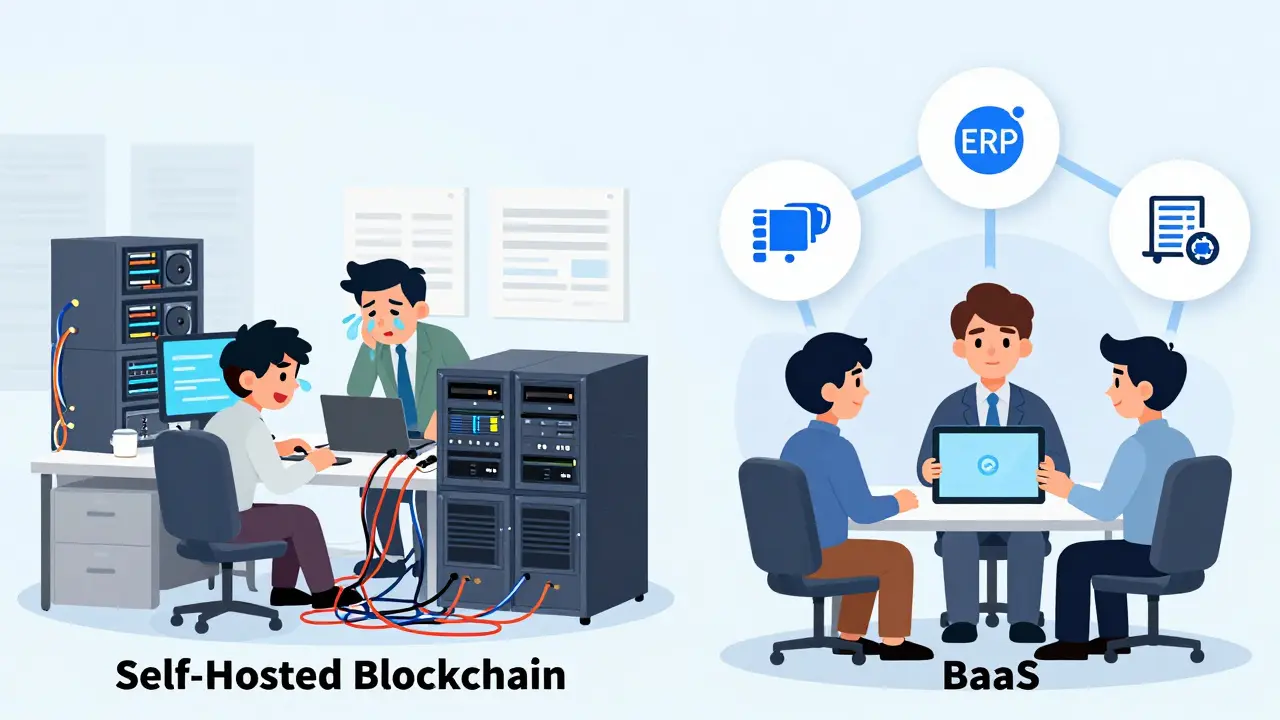
BaaS vs. Building Your Own Blockchain
| Feature | BaaS | Self-Hosted |
|---|---|---|
| Setup Time | Hours to days | Months to years |
| Cost (Year 1) | $5k-$50k | $200k-$1M+ |
| Team Needed | 1-2 developers | 5-10 specialists |
| Scalability | Automatic | Manual upgrades |
| Security | Provider-managed | Your responsibility |
| Decentralization | Controlled | Full |
If you’re a Fortune 500 bank trying to launch a global settlement network? Maybe you build your own. If you’re a mid-sized logistics firm trying to cut document errors? BaaS is the smarter move.

Real-World BaaS Use Cases
- Perth Seafood Co. - Used IBM BaaS to track tuna shipments. Reduced traceability time from 7 days to 2 hours. Cut waste by 18%.
- MediTrack Australia - Built a BaaS-based patient consent system. Now, patients control who accesses their records. Compliance with Australian privacy laws built in.
- Global Freight Alliance - Replaced paper bills of lading with BaaS-powered digital ones. Saved $4.2 million in administrative costs last year.
These aren’t theoretical. They’re happening right now-in Australia, the U.S., and across Asia. BaaS isn’t a future idea. It’s a working tool for businesses that want to move faster and stay secure.
Getting Started with BaaS
- Define your goal - Are you tracking goods? Automating payments? Verifying identities? Be specific.
- Choose a provider - AWS Managed Blockchain, Azure Blockchain Service, or IBM Blockchain Platform are the top three.
- Pick your network type - Permissioned (private) or permissionless (public)? Most businesses start with permissioned.
- Use templates - All major BaaS platforms offer ready-to-use smart contract templates for supply chain, identity, or payments.
- Integrate - Connect your ERP or CRM system. Most BaaS tools have APIs for this.
- Test and launch - Run a pilot with one supplier or one product line. Scale from there.
You don’t need to be a coder to start. Many platforms have drag-and-drop interfaces for creating basic blockchain workflows.
What’s Next for BaaS?
BaaS is still young. But it’s growing fast. By 2027, Gartner predicts over 70% of enterprises will use BaaS for at least one blockchain application. The next wave includes:
- Hybrid chains - Combine public and private ledgers for better transparency and control.
- AI integration - Use machine learning to detect fraud patterns on blockchain data.
- Regulatory compliance tools - Built-in audit trails for GDPR, AML, and local laws.
- Carbon tracking - Record emissions data on-chain for ESG reporting.
The goal isn’t to replace the internet. It’s to make it more trustworthy. And BaaS is how most companies will get there.
Is Blockchain-as-a-Service the same as cryptocurrency?
No. Cryptocurrency is a digital money system built on blockchain. BaaS is a service that lets businesses use blockchain technology-whether for tracking goods, managing contracts, or verifying identities-without creating a cryptocurrency. You can use BaaS without ever touching Bitcoin or Ethereum.
Can I use BaaS if I don’t have a tech team?
Yes. Many BaaS platforms are designed for non-technical users. You can build workflows using visual tools, drag-and-drop interfaces, and pre-built templates. You might need one person to manage the integration, but you don’t need blockchain engineers.
Is BaaS secure?
Yes, and often more secure than self-hosted setups. Leading BaaS providers use military-grade encryption, regular security audits, and 24/7 monitoring. They also handle patching and updates automatically. Most data breaches happen because of human error-BaaS reduces that risk by removing manual setup.
What’s the biggest downside of BaaS?
You’re relying on a third party. If the provider has an outage, your blockchain stops. Also, you’re not fully decentralized-your data flows through their servers. For industries that demand absolute decentralization (like some crypto-native projects), BaaS isn’t ideal. But for 95% of businesses, the trade-off is worth it.
Which BaaS provider is best?
It depends on your needs. AWS Managed Blockchain is great for users already in the AWS ecosystem. Azure Blockchain Service works well with Microsoft tools like Teams and Power BI. IBM Blockchain Platform is strong for supply chain and enterprise compliance. Start with a free trial from each to see which interface you like.
Does BaaS work with existing software?
Yes. All major BaaS platforms offer APIs and connectors for popular systems like SAP, Oracle, Salesforce, and QuickBooks. You can plug blockchain into your current workflow without replacing your entire tech stack.


Florence Pardo
Man, I’ve been watching this BaaS stuff unfold for years now. It’s wild how much it’s changed the game for small businesses. I used to think blockchain was only for crypto bros or Fortune 500 companies with armies of devs. But now? My cousin runs a local coffee roaster and she’s using Azure BaaS to track bean origins from Colombia to her shop. No servers. No headaches. Just a dashboard. It’s like magic if you don’t overthink it.
And honestly? The fact that you don’t need to be a coder is the real win. I’ve seen so many startups die because they tried to build their own chain. Too expensive. Too slow. Too much ego. BaaS lets you test, fail, pivot-all without burning cash. It’s the ultimate MVP tool.
Yeah, sure, it’s not ‘true’ decentralization. But who cares? Most of us aren’t trying to overthrow the banking system. We just want to know where our stuff came from, who touched it, and if it’s legit. That’s what matters. The rest is philosophy.
I remember when IBM first launched their BaaS. People were like ‘this is just AWS with a blockchain label.’ And yeah, kinda. But guess what? It worked. And now everyone’s doing it. That’s not a bug. That’s progress.
Also, the carbon tracking thing? Huge. My brother works in logistics and they just started recording emissions on-chain. Now auditors can see it in real time. No more spreadsheets. No more lies. Just data. That’s the future. Not crypto. Not NFTs. Just honest records.
Don’t let the elitists tell you it’s not real blockchain. It’s blockchain optimized for humans. And that’s the most revolutionary thing of all.