

You might have stumbled upon Blue Protocol while scrolling through a list of old coins or checking an obscure exchange. The ticker symbol is simple: BLUE. It sounds promising, doesn't it? But here is the hard truth you need to hear before you spend even one second looking into this project. Blue Protocol is not just struggling; it is effectively dead.
If you are asking "what is Blue Protocol" in hopes of finding your next big investment, stop right there. This article will explain what the project actually was, why it failed spectacularly, and how you can spot similar abandoned projects so you don't lose money on them. We will look at the technical claims, the market reality, and the red flags that should have been obvious years ago.
The Original Promise: Security for Ethereum
To understand why Blue Protocol exists as a digital ghost, we first need to look at what it claimed to be. Launched in 2017 during the height of the Initial Coin Offering (ICO) boom, Blue Protocol positioned itself as a security solution for Ethereum the leading smart contract blockchain platform. The founder, Chris McCarl, identified a real problem: private keys are easy to lose, steal, or forget. If you lose your password, you lose your money. Period.
The whitepaper promised a decentralized two-factor authentication (2FA) system. Instead of relying on a central server to verify your identity, Blue Protocol used smart contracts to hold funds in "meta-wallets." The idea was elegant on paper. You would use the BLUE SDK a software development kit for integrating Blue Protocol security to build apps, and users would secure their assets with the BLUE Wallet. They also introduced the BLUE Standard, a set of guidelines for token developers to follow.
Sounds solid, right? Many projects start with strong ideas. The issue wasn't the concept; it was the execution. In the fast-moving world of crypto, having a good idea isn't enough. You need a working product, active developers, and user adoption. Blue Protocol had none of these after its launch year.
Market Reality: Zero Volume and Negligible Value
Let's look at the numbers because they tell a stark story. As of late 2023 and continuing into 2024, the BLUE token has virtually no economic activity. Here is what the data shows:
- Total Supply: 42,000,000 BLUE tokens.
- Circulating Supply: Approximately 36.6 million tokens.
- Market Cap: Around $29,000 (extremely low).
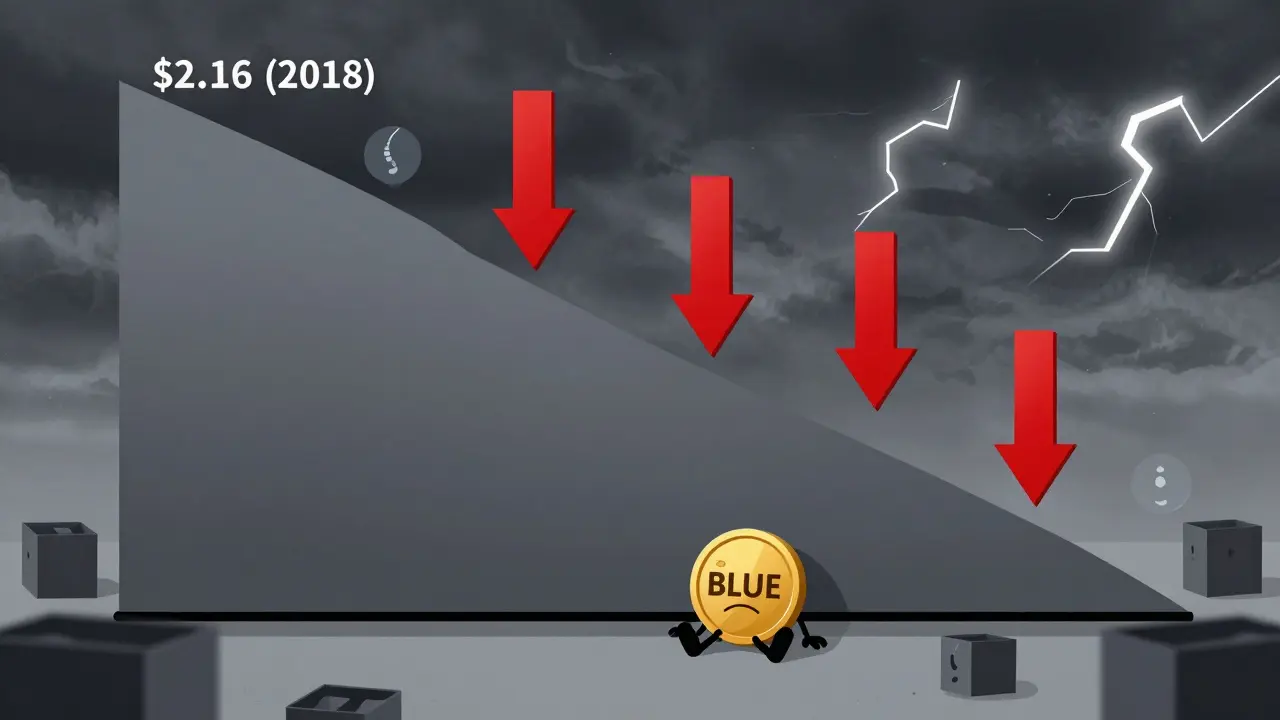
- All-Time High: $2.16 (reached in January 2018).
- Current Price: Fractions of a cent (often below $0.001).
Notice the drop from $2.16 to less than a penny? That is a loss of over 99%. More importantly, look at the trading volume. On most days, the 24-hour trading volume is zero. This means no one is buying or selling. The liquidity is non-existent. If you somehow managed to buy some BLUE tokens today, you likely wouldn't be able to sell them without crashing the price further or waiting months for a single buyer to appear.
| Feature | Blue Protocol (BLUE) | Active Competitors (e.g., MetaMask, Ledger) |
|---|---|---|
| Status | Defunct / Abandoned | Active Development |
| Last Code Commit | December 2018 | Daily/Weekly |
| User Base | ~4,300 holders (mostly inactive) | Millions of active users |
| Exchange Listings | None on major exchanges | Listed on Binance, Coinbase, Kraken, etc. |
| Utility | Non-functional wallet/app | Working wallets, staking, DeFi integration |
This table highlights the gap between a defunct project and living ecosystems. While competitors like MetaMask a popular cryptocurrency browser extension and mobile app serve millions of users and integrate with thousands of decentralized applications, Blue Protocol sits idle. Its market cap ranking is often below #6,000, meaning it is buried under thousands of more viable projects.
Red Flags: How to Spot an Abandoned Project
Why did Blue Protocol fail? It serves as a textbook case study for what happens when a team publishes a whitepaper but never builds the product. If you are researching any crypto coin, check for these specific red flags that apply directly to BLUE:
- Github Silence: Developers leave traces on GitHub. The official Blue Protocol repository shows its last commit was in December 2018. After that? Nothing. No bug fixes, no updates, no new features. For a tech project, silence for years is death.
- Dead Social Media: Their Twitter account (@blueprotocol) stopped posting in June 2019. With only 1,200 followers, there is no community left to rally behind the project.
- Broken Links: The official website mentioned in the whitepaper no longer works or redirects to unrelated domains. When a project can't maintain its own URL, it certainly isn't maintaining its code.
- No Exchange Support: Major exchanges like Binance explicitly list BLUE as "Not Listed." Without access to reputable exchanges, retail investors cannot easily trade the token, killing demand.
These aren't minor issues. They are fatal wounds. A project that stops updating its code in 2018 is vulnerable to security exploits that didn't even exist back then. Using the BLUE Wallet today would be risky, if it worked at all, because it hasn't been patched for modern threats.
Is There Any Utility Left?
You might wonder if there is still some niche use for BLUE. Perhaps it has value in a specific decentralized application (dApp)? Unfortunately, the answer is no. The BLUE Standard, which was meant to guide other developers, was never adopted by the wider Ethereum ecosystem. Standards gain power through network effects-when everyone uses them. Since no major dApps integrated Blue Protocol's security layer, the standard became irrelevant.
Some people hold onto these tokens hoping for a "revival." In crypto, revivals are incredibly rare. Usually, when a project dies, the team moves on to something else, leaving the old token as a souvenir. There are no announcements, no roadmap updates, and no new partnerships. The University of Wyoming's Blockchain Research Center even cites Blue Protocol in publications about failed crypto projects, using it as an example of how not to execute a vision.

Alternatives: Where Security Coins Actually Go
If you are interested in blockchain security or self-custody solutions, there are thriving alternatives that offer real utility. Unlike Blue Protocol, these projects have active teams, regular audits, and real users.
- Ledger: Provides hardware wallets that store private keys offline. They generate hundreds of millions in revenue and are trusted by institutions.
- Quantstamp (QSP): Focuses on smart contract auditing. They help prevent hacks by checking code before it goes live. Their market cap is significantly higher, reflecting actual business activity.
- Forta Network: A decentralized monitoring network for blockchain security. It actively scans for anomalies and has secured substantial funding and adoption.
When choosing a security-focused crypto asset, look for transparency. Do they publish audit reports? Do they have a visible team on LinkedIn? Is their GitHub active? These are the signs of a living project, not a zombie chain.
Final Thoughts on Blue Protocol
So, what is Blue Protocol? It is a relic of the 2017 ICO era. It started with a valid problem statement but failed to deliver a working solution. Today, it holds negligible value, has no development activity, and poses potential risks if anyone attempts to interact with its outdated smart contracts.
For investors, the lesson is clear: do not buy based on a whitepaper alone. Check the current date of the last code commit. Look for recent social media engagement. Verify if the project is listed on major exchanges. If the answers are negative, walk away. Your capital is better spent on projects that are building the future, not preserving the past.
Is Blue Protocol (BLUE) a scam?
While it may not have been an intentional "scam" in the sense of a rug pull where founders stole funds immediately, it behaves like one for current investors. The project raised funds via ICO, failed to deliver the promised technology, and abandoned development. Holding the token now results in a total loss of value, which is functionally similar to being scammed.
Can I still buy Blue Protocol tokens?
Technically, yes, but it is highly discouraged. BLUE is not listed on major exchanges like Binance or Coinbase. You might find it on very small, obscure peer-to-peer platforms, but the lack of liquidity means you could buy tokens and never be able to sell them. The risk of losing your entire investment is near 100%.
What happened to the Blue Protocol team?
The team, led by Chris McCarl, ceased public communication around 2019. Their social media accounts are inactive, and their professional profiles show no ongoing work related to the project. It is common in the crypto industry for teams to move on to new ventures when a project fails to gain traction, leaving the original token behind.
Is the BLUE Wallet safe to use?
No. The BLUE Wallet has not been updated since 2018. Cybersecurity threats evolve rapidly, and an unpatched application from eight years ago is vulnerable to known exploits. Additionally, there is no customer support to help you if you encounter issues. Use established wallets like MetaMask, Trust Wallet, or Ledger instead.
Will Blue Protocol ever recover?
It is extremely unlikely. Reviving a dead crypto project requires significant capital, a new team, and a compelling reason for users to return. Given that the technology is obsolete and better alternatives exist, there is no market incentive for Blue Protocol to restart. It is considered abandonware by the industry.