
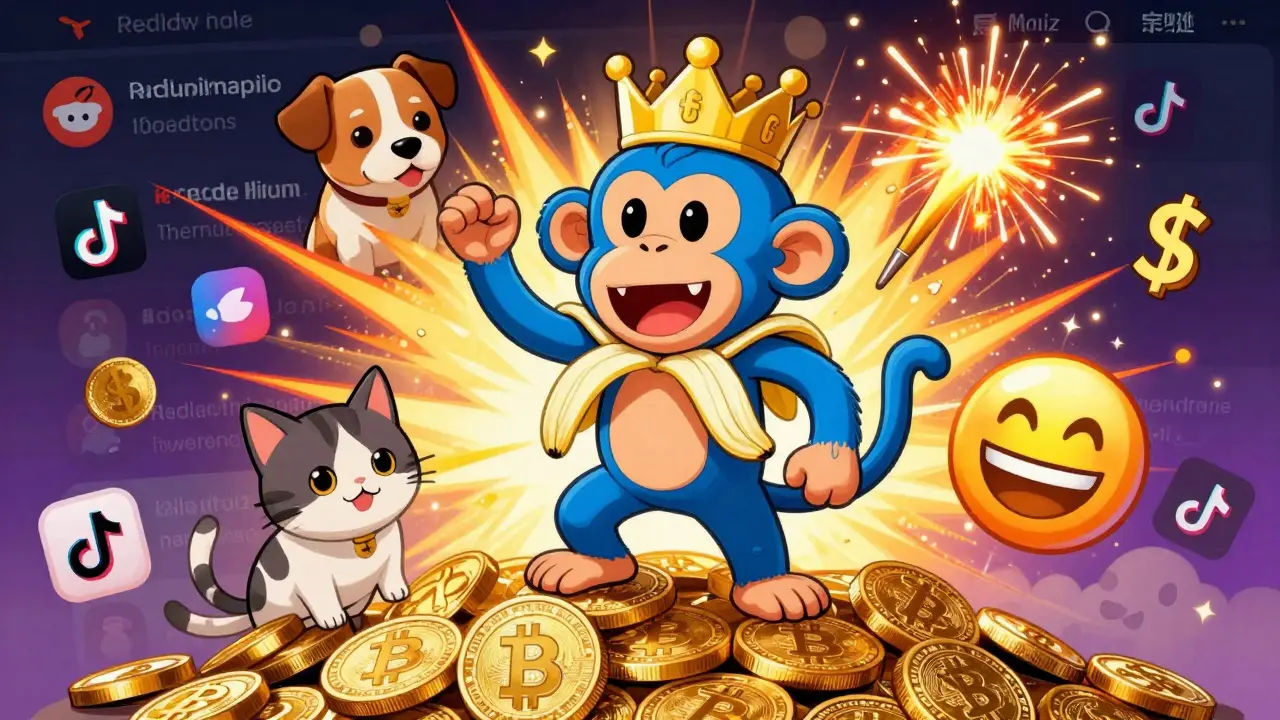
Bonkey (BONKEY) isn’t a coin built to change the world. It doesn’t power smart contracts, fix blockchain scaling issues, or offer DeFi yields. Instead, it’s a meme coin - a digital asset born from internet jokes, chaotic social media hype, and zero serious utility. If you’ve ever seen a dog, cat, or monkey-themed crypto token explode overnight only to crash harder than a dropped phone, you’re already familiar with the Bonkey story.
Where did Bonkey come from?
Bonkey launched as a joke. Its entire backstory is fictional: it’s supposedly the "degenerate brother" of another meme token called Ponke. According to the lore, Bonkey got its blue skin after choking on a banana. Yes, really. That’s the entire origin story. No whitepaper. No team of developers. No roadmap. Just a funny narrative, a token symbol (BONKEY), and a launch on the Fair Launchpad on Ape.Store.
It’s not unique. Meme coins like Dogecoin and Shiba Inu started the same way - absurd humor turned into a cultural moment. But Bonkey took it further. It didn’t just copy the formula. It leaned into the chaos. Its branding is intentionally messy. Its community thrives on absurdity. And that’s exactly why people bought in.
Technical specs: Supply, blockchain, and basics
Bonkey has a total supply of 1 billion tokens. As of early 2026, about 889 million are already in circulation. That means almost 90% of all BONKEY tokens are out there - no big unlock events coming. That’s unusual. Most meme coins hoard a chunk for team or marketing, then release it slowly. Bonkey didn’t. It dumped everything upfront.
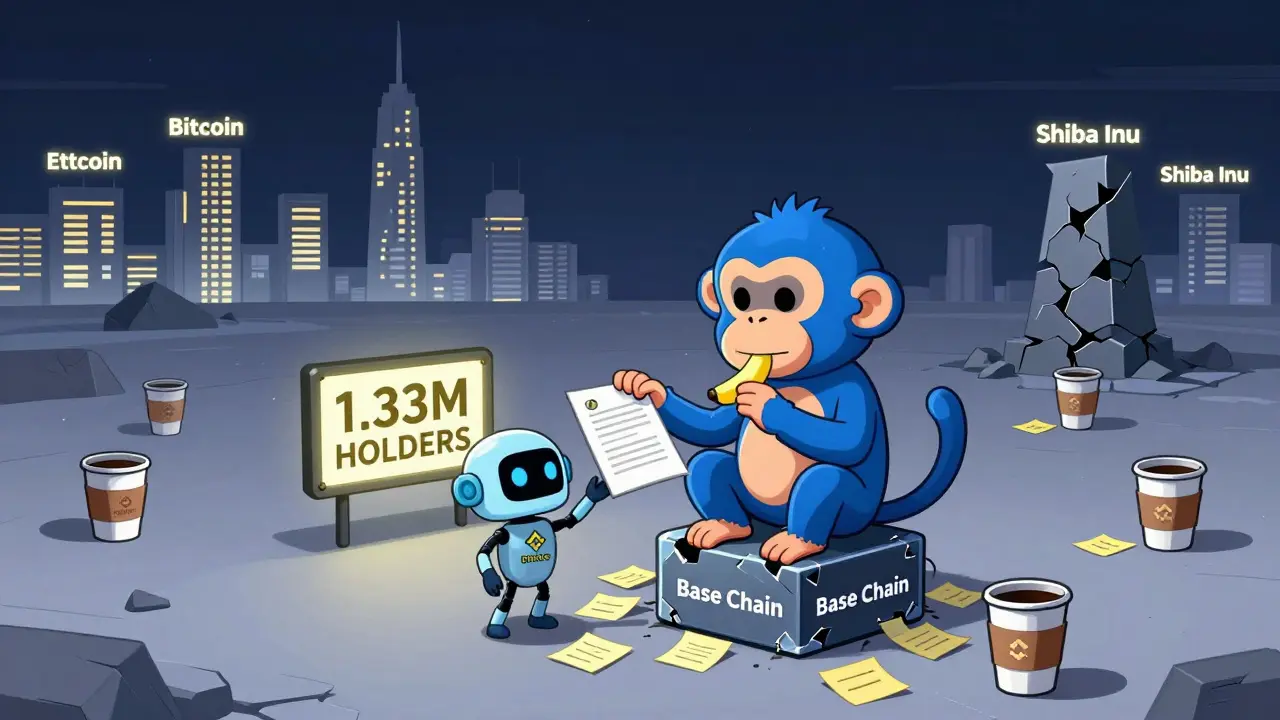
The token lives on the Base Chain, Ethereum’s Layer 2 network built by Coinbase. This matters because Base is fast, cheap, and growing fast. Most new meme coins now launch here instead of Solana or Ethereum mainnet. But here’s the twist: some sources claim Bonkey is on Solana. That’s not a mistake. It’s a red flag. In crypto, when two different tokens share the same name on different blockchains, it usually means one is a copycat, a scam, or just badly documented. The real Bonkey - the one with millions of holders - is on Base Chain.
Price history: From $0.005 to $0.000017
Bonkey’s price is a rollercoaster with no seatbelts.
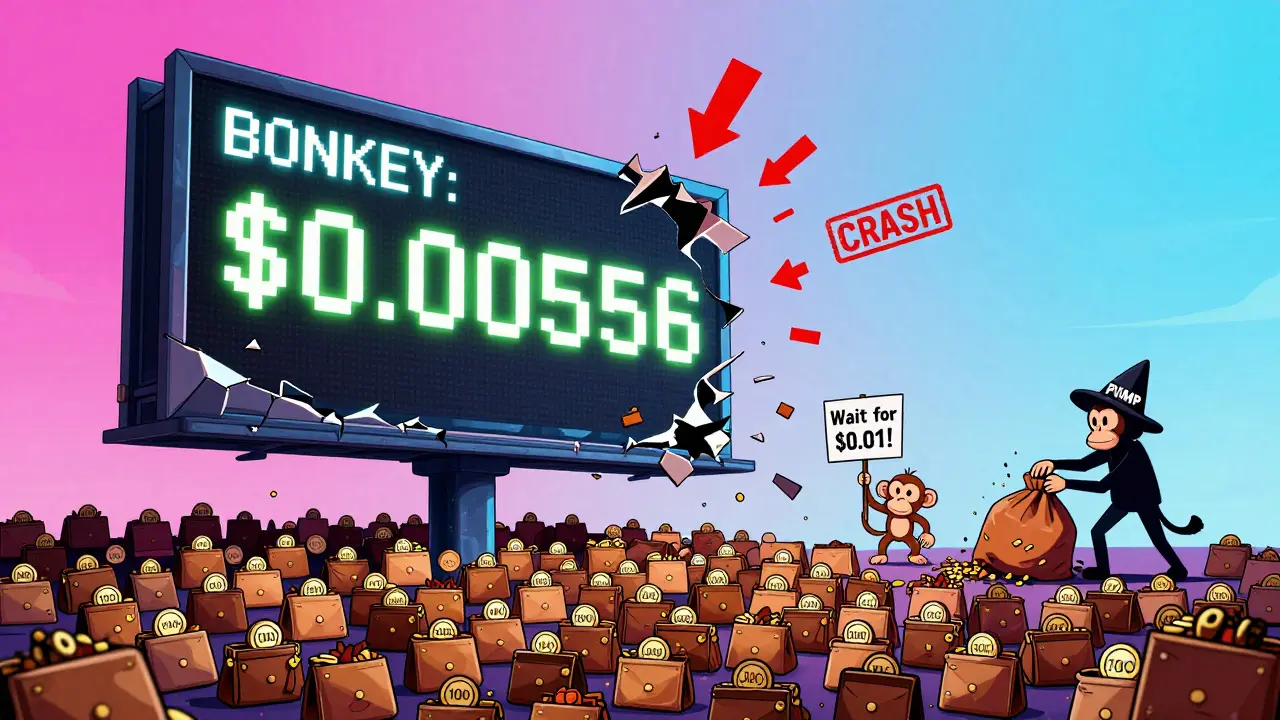
On December 9, 2024, it hit an all-time high of $0.00556. That’s a big number for a meme coin. People made money. Stories spread. Reddit threads exploded. Then came the crash.
By February 6, 2026, it dropped to $0.00001677 - a 99.7% loss from its peak. That’s not a correction. That’s a collapse. And it didn’t stop there. In the 90 days leading up to March 2026, BONKEY lost 84.6% of its value. The 60-day drop? 63%. The 30-day drop? Over 50%.
Even the daily swings are wild. One day, it might trade at $0.000017. The next, it hits $0.000023. That’s a 35% swing in 24 hours. For comparison, Bitcoin rarely moves more than 5% in a day. Bonkey moves like a stock that just got a TikTok trend.
Market data: Tiny market cap, huge holder count
Bonkey’s market cap hovered around $20 million in early 2026. That’s tiny. Bitcoin’s is over $1 trillion. Even smaller coins like Dogecoin sit at $10 billion. Bonkey? It’s ranked #8,520 on CoinMarketCap.
But here’s the weird part: CoinMarketCap says it has over 1.33 million token holders. That’s more than most established cryptocurrencies. How? Because each holder owns maybe 100 tokens. Or 500. Or 1,000. The average wallet balance is microscopic. This isn’t a project with whales. It’s a project with millions of small-time buyers who bought because they saw a meme, not because they did research.
Trading volume tells the same story. On most exchanges, BONKEY trades under $2,000 a day. That’s not enough to move the price. But on CoinGecko, volume spiked to over $1 million in a day. Why? Because one exchange had a liquidity pump, or a bot was buying, or someone dumped a big bag. That’s how volatile meme coins work. One trade can move the price 20%.
Where can you trade Bonkey?
You can buy BONKEY on a few exchanges: Bybit, MEXC, Binance, CoinGecko, and CoinSwitch. But don’t expect smooth sailing. Most of these platforms have thin order books. That means if you try to sell 100,000 BONKEY, you might not find buyers. Or worse - you’ll get a terrible price because the market is so shallow.
Some exchanges list it. Others don’t. Prices vary wildly. On Binance, it might be $0.000025. On CoinGecko, $0.000017. On Bybit, $0.000022. That’s not normal. That’s a sign of a fragmented, illiquid market. If you’re thinking of trading it, be ready for slippage. And don’t trust any price you see on one site - check three.
Why does anyone still hold it?
It’s not about utility. There’s no app. No wallet integration. No staking. No burning mechanism. No team updating the code. Bonkey exists because people believe in the meme. Because they think the next viral post will make it explode again. Because they bought at $0.00001 and now they’re waiting for $0.0001. Or $0.001. Or $0.01. That’s the dream.
But the math doesn’t work. To get back to its all-time high, Bonkey would need to rise over 33,000%. That’s not a pump. That’s a miracle. And miracles don’t happen often in crypto - especially for tokens with no real foundation.
The real risk: You could lose everything
Bonkey is not an investment. It’s a gamble. A high-stakes bet on internet culture. There’s no safety net. No regulation. No backup plan. If the community loses interest tomorrow, the price could drop to $0.00001 again - or lower.
And here’s the quiet truth: most meme coins die. Dogecoin survived because Elon Musk kept tweeting about it. Shiba Inu survived because of its ecosystem. Bonkey? It has no ecosystem. No team. No future plan. Just a blue monkey and a joke.
If you’re holding BONKEY, you’re not investing. You’re speculating. And speculation in crypto without fundamentals is the riskiest thing you can do.
Bottom line: What should you do?
If you already own Bonkey - don’t panic. But don’t expect it to recover. Treat it like a lottery ticket. If you bought it for fun, fine. If you bought it hoping to get rich, you’re in for a long, painful wait.
If you’re thinking of buying - don’t. Unless you’re okay with losing every dollar you put in. There are thousands of better crypto projects with real teams, real use cases, and real development. Bonkey isn’t one of them.
It’s a meme. Not a currency. Not a technology. Just a digital joke with a price tag.
Is Bonkey (BONKEY) a good investment?
No, Bonkey is not a good investment. It’s a meme coin with no utility, no development team, and no long-term roadmap. Its value depends entirely on hype and social media trends. With a 99.7% drop from its all-time high and daily price swings of over 30%, it’s extremely high-risk. Most holders have tiny amounts, and the market is illiquid. If you buy BONKEY, assume you could lose everything.
What blockchain is Bonkey on?
The original and most widely recognized Bonkey (BONKEY) token runs on the Base Chain - Coinbase’s Layer 2 Ethereum network. Some websites mistakenly list it on Solana, but that’s likely a different token with the same name. Always verify the contract address before trading. The Base Chain version has the highest holder count and is the one referenced by major data providers like CoinMarketCap and Bybit.
How many BONKEY tokens are in circulation?
As of early 2026, approximately 889.44 million BONKEY tokens are in circulation out of a maximum supply of 1 billion. That means nearly 89% of all tokens are already out in the market. There’s no planned release schedule, so supply won’t increase. This is unusual - most meme coins hold back tokens for team or marketing use, but Bonkey didn’t.
Why is Bonkey’s price so volatile?
Bonkey’s price swings because of low trading volume and a huge number of small holders. With daily volumes as low as $1,500 on most exchanges, even a single large trade can move the price dramatically. Add in the fact that it’s a meme coin with no real utility, and you get extreme sensitivity to social media trends, influencer posts, or pump-and-dump schemes. Its 24-hour price swings often exceed 30%, making it one of the most unstable tokens in crypto.
Can I buy Bonkey on Coinbase?
No, you cannot buy Bonkey directly on Coinbase’s main app. However, it is listed on Bybit, MEXC, Binance, and CoinGecko. Since Base Chain - where Bonkey lives - is built by Coinbase, some users assume it’s supported. But Coinbase only lists major, liquid assets. Bonkey is too small and too volatile for their standards. To buy it, you’ll need to use a third-party exchange like Bybit or MEXC.


Steph Andrews
I just bought 500 BONKEY tokens for $2 because it made me laugh. Not an investment, just a digital meme I can hold onto. If it goes to zero, I laugh harder. If it moon? Cool, I got a free vacation fund.
That's crypto for you.