
TNC Coin vs. Gaming Tokens Comparison Tool
This tool compares key metrics between TNC Coin and major gaming-focused cryptocurrencies to help you understand their relative positions in the market.
TNC Coin
Market Cap: $9,000
Daily Volume: $8,000
Developer Tools: TNC-20 standard, low-fee mainnet
Notable Games: None publicly documented
Enjin Coin (ENJ)
Market Cap: $450,000,000
Daily Volume: $12,000,000
Developer Tools: Enjin SDK, Unity & Unreal plugins
Notable Games: Lost Relics, The Six Dragons
Gala Games (GALA)
Market Cap: $250,000,000
Daily Volume: $5,000,000
Developer Tools: Gala SDK, cross-chain support
Notable Games: Town Star, Mirandus
The Sandbox (SAND)
Market Cap: $600,000,000
Daily Volume: $20,000,000
Developer Tools: Voxel-based builder, marketplace API
Notable Games: The Sandbox world-building platform
Key Insights
Market Position: TNC Coin stands out due to its TNC-20 token standard, but lacks real-world adoption compared to ENJ, GALA, and SAND.
Development Support: While TNC offers a low-fee mainnet, the lack of notable games built on it limits its appeal.
Liquidity Concerns: TNC's daily volume is significantly lower than competitors, potentially causing price volatility.
TNC Coin often pops up in newsfeeds about niche gaming tokens, but most readers still wonder what it actually does and whether it’s worth a glance. This guide breaks down the coin’s purpose, tech roots, market performance, and the risks you’ll face if you consider buying or building on it.
Quick facts at a glance
- Issued by TNC IT Solutions Group for gaming‑focused blockchain use.
- Price (Oct2025): $0.000257 per token.
- Market cap: under $10K, trading volume around $8K daily.
- Two core roles - token swaps for crypto M&A and a platform for developers to launch TNC-20 token standard gaming currencies.
- Competes with Enjin Coin, Gala Games, The Sandbox but has far smaller adoption.
What is TNC Coin?
In its simplest form, TNC Coin is the native utility token of the TNC ecosystem. The ecosystem was built by TNC IT Solutions Group, a company that wanted a blockchain specially tuned for video‑game economics. Unlike Bitcoin, which is primarily a store of value, TNC Coin is meant to move value inside games and to settle corporate token‑swap deals during crypto M&A activities.
The token’s official ticker is “TNC” and it sometimes appears on market sites as “TECHIE”. A separate token called Trinity Network Credit also uses the TNC label, but it operates on a different chain and has its own tiny market cap of roughly $9200. When you read “TNC” in a price chart, make sure you’re looking at the gaming‑coin version, not the credit token.
How the TNC‑20 token standard works
Developers who want to issue their own in‑game currencies can fork the open‑source TNC-20 token standard. Think of it as the ERC‑20 blueprint for Ethereum, but optimized for the TNC mainnet. When a game launches a TNC‑20 token, the token inherits the mainnet’s security model, transaction fees, and the ability to swap back to TNC Coin for broader crypto markets.
The process looks like this:
- Clone the TNC‑20 smart‑contract repo from the official GitHub.
- Set token name, symbol, and total supply that matches your game’s economy.
- Deploy the contract to the TNC mainnet using a compatible wallet (e.g., MetaMask configured for TNC).
- Integrate the contract address into your game’s backend so players can earn, spend, or trade the new token.
- Optionally register the token on the TNC explorer so it shows up in wallets and exchanges.
Because the mainnet is comparatively low‑traffic, transaction fees stay in the sub‑cent range-an advantage over Ethereum’s pricey gas fees. However, the low activity also means liquidity can dry up quickly, especially if few players actually hold the token.
Market performance as of October2025
Price data shows a volatile but still‑alive market for TNC Coin. The 50‑day Simple Moving Average (SMA) sits at $0.000265, while the 200‑day SMA is $0.000207, indicating a modest upward trend over the long term. The 14‑day Relative Strength Index (RSI) is 47.32, essentially neutral-neither overbought nor oversold.
The Fear & Greed Index reading is 75, which leans toward greed. In practice, that means traders are buying on speculation despite analysts labeling the coin “bearish.” Over the last 30 days, the token closed green on 14 occasions (47% success rate), and volatility clocks in at 15.79%.
Forecasts for early 2026 suggest a high of $0.000475 and a low of $0.000341. A back‑of‑the‑envelope calculation: a $1,000 stake held until mid‑December 2025 could theoretically earn about $267 in profit, a 26.75% return, ignoring fees. Those numbers look attractive, but they hinge on continued trading volume-something that has slipped since the ecosystem’s reported shutdown in October2024.
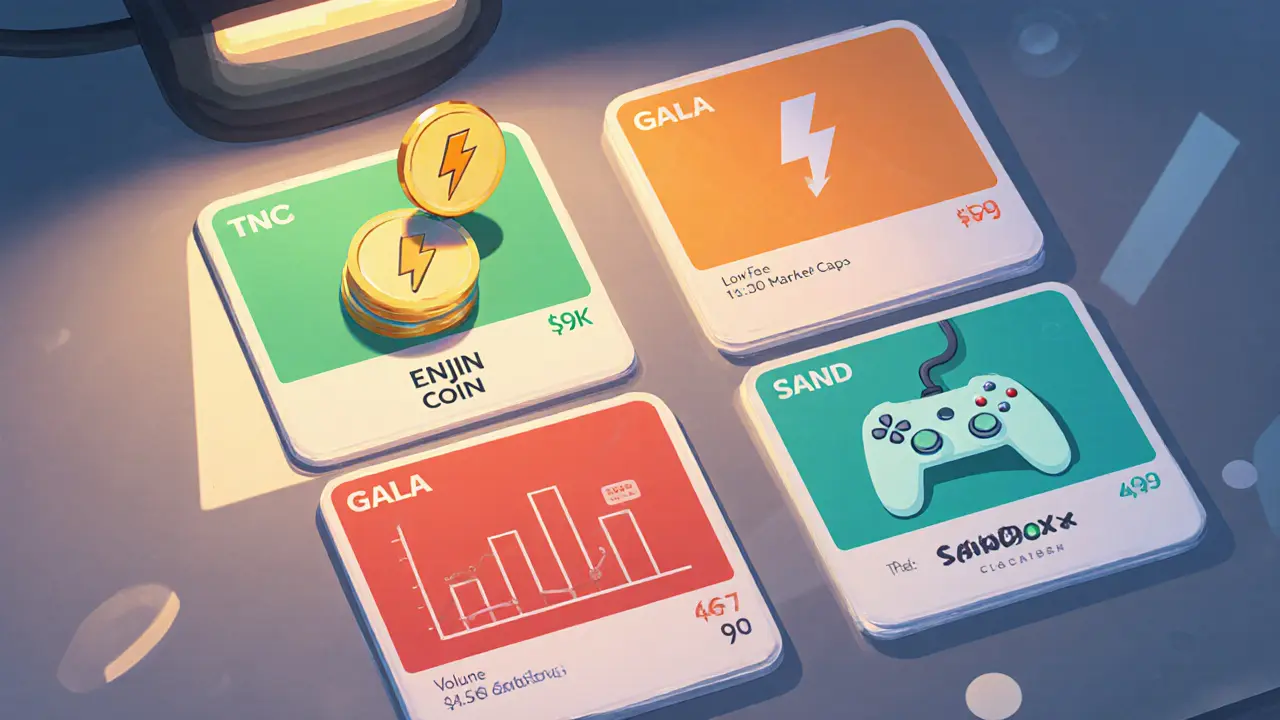
How TNC Coin stacks up against other gaming tokens
| Token | Market cap (approx.) | Daily volume | Developer tools | Notable games |
|---|---|---|---|---|
| TNC Coin | $9K | $8K | TNC‑20 standard, low‑fee mainnet | None publicly documented |
| Enjin Coin (ENJ) | $450M | $12M | Enjin SDK, Unity & Unreal plugins | Lost Relics, The Six Dragons |
| Gala Games (GALA) | $250M | $5M | Gala SDK, cross‑chain support | Town Star, Mirandus |
| The Sandbox (SAND) | $600M | $20M | Voxel‑based builder, marketplace API | The Sandbox world‑building platform |
From a numbers standpoint, TNC Coin trails its peers by orders of magnitude. The biggest differentiator is the TNC‑20 token standard, which gives developers a ready‑made blueprint. Yet the lack of live games built on that standard erodes any practical advantage.
Risks, challenges, and why adoption stalls
Several factors keep TNC Coin from gaining traction:
- Liquidity crunch: With daily volumes under $10K, even modest sell orders can swing the price dramatically.
- Developer learning curve: Integrating a brand‑new blockchain requires solid knowledge of smart contracts, which many indie studios lack.
- Regulatory gray area: Gaming tokens can be classified as gambling instruments in some jurisdictions, prompting platforms to shy away.
- Operational uncertainty: Reports that the TNC ecosystem halted operations in October2024 raise questions about ongoing support.
- Competitive pressure: Established ecosystems like Enjin already offer polished SDKs, marketplaces, and big‑name partners.
If you’re a developer, weigh the low fees against the minimal player base. If you’re an investor, remember that price projections assume a functioning network-something still unproven.
Investment considerations and how to protect yourself
Before putting money into TNC Coin, run through this quick checklist:
- Confirm the token you’re buying is the gaming version, not Trinity Network Credit.
- Check recent activity on the TNC explorer-are new blocks being minted?
- Assess liquidity on the exchange you plan to use; low‑volume markets can trap funds.
- Allocate only a small portion of your crypto portfolio (e.g., <5%) to high‑risk, low‑cap tokens.
- Set stop‑loss orders if the price slides 20% below your entry point.
For those eyeing a longer‑term play, keep an eye on any announced updates from TNC IT Solutions Group. A fresh developer partnership could revive the mainnet, but until then, treat the coin as speculative.
Next steps for developers and investors
If you’re a game studio, start by cloning the TNC‑20 repo and running a local testnet. This will let you gauge the integration effort without spending real tokens. For investors, monitor the Fear & Greed Index and the token’s SMA crossovers-these simple signals often flag moments when the market sentiment shifts.
Frequently Asked Questions
Is TNC Coin the same as Trinity Network Credit?
No. TNC Coin is the gaming‑focused utility token created by TNC IT Solutions Group. Trinity Network Credit is a separate, far smaller token that shares the same three‑letter ticker but operates on a different blockchain.
Can I use TNC Coin to buy items in existing games?
Only if the game has integrated the TNC‑20 token standard. To date, no major titles have publicly announced support, so most players cannot spend TNC Coin directly in games.
What are the main technical indicators to watch for TNC Coin?
Key metrics include the 50‑day and 200‑day Simple Moving Averages, the 14‑day RSI, and the Fear & Greed Index. As of October2025 the SMA’s suggest a slight upward bias, while the RSI hovers near neutral.
How risky is investing in TNC Coin compared to other gaming tokens?
TNC Coin is considerably riskier. Its market cap is under $10K, daily volume is under $10K, and the ecosystem may be inactive. In contrast, tokens like Enjin or The Sandbox have multi‑million‑dollar market caps and active developer communities.
Where can I view real‑time price data for TNC Coin?
Major crypto aggregators such as CoinGecko list TNC (often under the symbol “TECHIE”). Look for the daily trading volume and check the token’s contract address to avoid confusion with Trinity Network Credit.


Maggie Ruland
Oh great, another token that thinks low fees can win over actual games.