
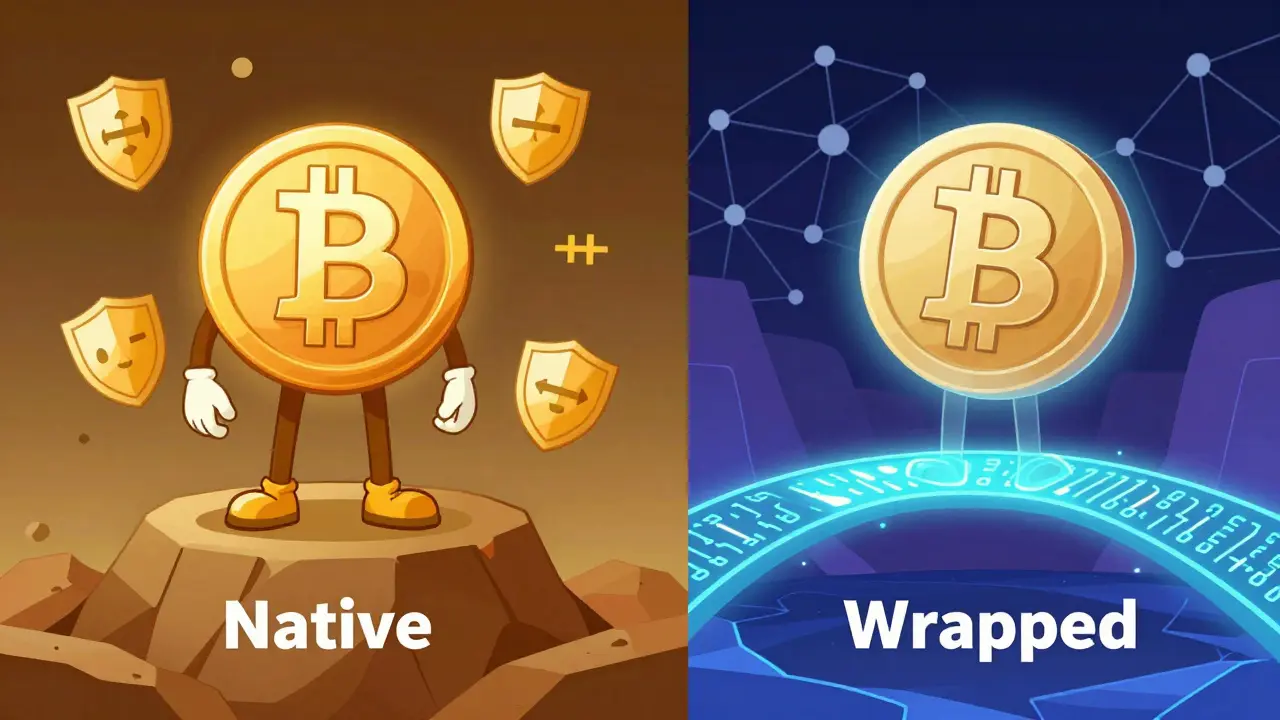
You hold Bitcoin. You want to earn yield on Ethereum. To do this, you need a bridge. That bridge is usually a wrapped asset is a tokenized representation of a native cryptocurrency that exists on a different blockchain network. But here is the catch: when you wrap your coins, you are trading absolute security for convenience. You are moving from the most secure network in history to a system that relies on trust, custodians, and smart contracts.
This is the core tension in modern decentralized finance (DeFi). On one side, you have native assets, which are cryptocurrencies operating exclusively on their original, home blockchain networks under their native consensus rules. These are the originals-Bitcoin on Bitcoin, Ether on Ethereum. They require no middlemen. On the other side, you have wrapped versions like WBTC or wETH, which allow these assets to function in foreign ecosystems. Understanding the difference isn't just academic; it determines whether your funds are safe, liquid, or stuck in a broken bridge.
The Anatomy of Native Assets: Pure and Uncompromising
Let’s start with what you already know. A native asset is digital money living in its natural habitat. When you send BTC from one wallet to another, you are interacting directly with the Bitcoin protocol. There is no intermediary. There is no contract that can fail. The security comes from the sheer computational power of the network-the hashrate.
For Bitcoin, this means over 300 exahashes per second protecting your transaction. For Ethereum, it’s the staked ETH securing the proof-of-stake chain. This is "sovereign" ownership. If the network goes down, your keys still work. If a company goes bankrupt, your native BTC is unaffected. It is cold, hard, mathematical truth.
However, native assets have a major flaw: isolation. Bitcoin cannot talk to Ethereum. Solana cannot interact with Polygon. Your BTC sits idle in a wallet, earning nothing, because it cannot participate in lending protocols, automated market makers, or derivative markets built on other chains. This silo effect is why wrapped assets exist.
How Wrapped Assets Work: The Minting and Burning Mechanism
To move value across chains without building a single universal blockchain, developers created wrapping. The process is mechanical but introduces critical points of failure. Here is how it typically works for a token like WBTC is the most widely adopted wrapped Bitcoin token, representing Bitcoin on the Ethereum network.:
- Lock: You send your native BTC to a custodian (like BitGo) or a multisig vault.
- Mint: Once the deposit is confirmed, a smart contract on Ethereum mints an equivalent amount of WBTC and sends it to your Ethereum wallet.
- Use: You use WBTC in DeFi protocols like Aave or Compound to earn interest or provide liquidity.
- Burn: When you want your BTC back, you send WBTC to the burn address. The smart contract destroys the tokens, and the custodian releases your native BTC.
This creates a 1:1 peg. One WBTC always equals one BTC. But notice the new entities involved: the custodian, the merchant partners, and the smart contract code. Each of these is a potential point of failure. Unlike native BTC, where the network secures your funds, WBTC relies on the honesty of the custodian and the correctness of the code.
Security Models: Trustless vs. Trusted Systems
This is where the risk profile diverges sharply. Native assets operate on a "trustless" model. You don’t need to trust anyone; you only need to trust the math and the network decentralization. Wrapped assets operate on a "trusted" or "semi-trusted" model.
Consider the security implications:
- Custodial Risk: Most major wrapped assets, including WBTC, rely on centralized custodians. If the custodian is hacked, goes insolvent, or acts maliciously, your wrapped tokens could become worthless paper. The $600 million Nomad bridge hack in 2022 demonstrated how quickly cross-chain trust can evaporate.
- Smart Contract Risk: The minting/burning logic lives in code. Code has bugs. In 2022, security researcher Samczsun found critical vulnerabilities in 63% of major wrapping protocols. Even if the custodian is honest, a bug in the Ethereum contract can drain the pool.
- Regulatory Risk: Because wrapped assets often involve centralized entities, they face scrutiny from regulators like the SEC. If a wrapped token is classified as a security, it could be delisted from exchanges, trapping users.
Native Bitcoin has none of these risks. It cannot be delisted from the Bitcoin network. It has no central admin key. This is why purists prefer native assets, even if it means missing out on DeFi yields.
Liquidity and Interoperability: The Trade-Off
So why do we use wrapped assets at all? Liquidity. As of late 2023, over $12.5 billion was locked in wrapped token implementations. WBTC alone commands roughly 78% of the wrapped Bitcoin market share. Why? Because Ethereum’s DeFi ecosystem holds tens of billions in total value locked (TVL), while Bitcoin’s native DeFi scene is negligible by comparison.
By wrapping BTC into WBTC, Bitcoin holders gain access to:
- Lending Markets: Earn 4-6% APY on stablecoins or variable rates on crypto loans.
- Yield Farming: Provide liquidity to pools and earn trading fees plus incentive tokens.
- Synthetic Exposure: Create leveraged positions or hedge against market downturns using derivatives.
Without wrapping, Bitcoin would remain a store of value with zero utility beyond peer-to-peer payments and speculation. Wrapping turns dead capital into productive capital. But this productivity comes at the cost of introducing counterparty risk.
| Feature | Native Asset (e.g., BTC) | Wrapped Asset (e.g., WBTC) |
|---|---|---|
| Security Model | Trustless (Network Consensus) | Trusted (Custodian + Smart Contract) |
| Interoperability | None (Siloed) | High (Cross-Chain) |
| Transaction Speed | Slow (10 mins for BTC) | Fast (15-30 secs on Ethereum L2/EVM) |
| Fees | Variable ($1-$25) | Gas Fees + Minting/Burning Fees (0.2%-0.9%) |
| Primary Use Case | Store of Value / Payments | DeFi Participation / Yield Generation |
| Censorship Resistance | High | Low (Can be frozen by custodian) |
Common Pitfalls and User Errors
Even if you understand the theory, practical execution is fraught with danger. Data from MetaMask support tickets shows that 37% of errors related to wrapped assets stem from network configuration mistakes. Users frequently send WBTC to a native BTC address, resulting in lost funds. While some services can recover these, many cannot.
Another common issue is ignoring the fee structure. Minting WBTC costs around 0.875%. Burning it may incur additional gas fees. If you are making small trades, these fees eat into your profits faster than the yield you earn. Furthermore, not all wrapped assets are created equal. WBTC is heavily audited and backed by institutional players. Smaller wrappers, like those for obscure altcoins, may lack proper reserves or active maintenance. The collapse of the Wrapped Dogecoin project left 4,300 users stranded with $87,000 in assets because the developers abandoned the codebase.

The Future: Decentralized Bridges and Zero-Knowledge Proofs
The industry is aware of these flaws. The next generation of interoperability aims to remove the custodian entirely. Projects like Chainlink’s Cross-Chain Interoperability Protocol (CCIP) and various zero-knowledge (ZK) bridge solutions are trying to create "trust-minimized" wrapping. Instead of locking assets in a bank vault, these systems use cryptographic proofs to verify that assets exist on one chain before minting them on another.
Vitalik Buterin, co-founder of Ethereum, advocates for native cross-chain messaging as the ultimate solution, which would reduce the need for wrapped tokens altogether. However, Gavin Wood of Polkadot predicts wrapped assets will remain essential for the next 5-7 years as the industry matures. Expect consolidation: the current dozens of wrapped Bitcoin variants will likely shrink to 5-7 major, highly secure protocols by 2026.
When to Use Which?
Your choice should depend on your goal. If you are holding long-term as savings, stick to native assets. Keep your BTC in a hardware wallet on the Bitcoin network. Do not wrap it unless you have a specific, high-yield strategy that outweighs the risk.
If you are actively trading or providing liquidity in DeFi, wrapped assets are necessary tools. Just treat them like cash in a checking account rather than gold in a vault. Only wrap what you intend to use immediately. Never leave large amounts of wrapped assets sitting idle in a smart contract for months on end. The longer the exposure, the higher the probability of a systemic failure or exploit.
Is WBTC safe to hold?
WBTC is relatively safe compared to smaller wrapped tokens due to its institutional backing and regular audits, but it is not risk-free. It carries custodial risk (reliance on BitGo and merchants) and smart contract risk. It is safer than native BTC only in terms of utility, but less secure in terms of sovereignty. Never hold more WBTC than you are willing to lose to a bridge hack.
What happens if the wrapped token price drops below 1:1?
This is called de-pegging. It usually happens during periods of extreme market stress or loss of confidence in the custodian. Arbitrageurs typically buy the discounted wrapped token, redeem it for the native asset, and sell the native asset, restoring the peg. However, if the custodian is insolvent, the token may never re-peg.
Can I convert native ETH to Wrapped ETH (WETH)?
Yes. WETH is a standard ERC-20 version of Ether used in DeFi protocols that require token standards for compatibility. You can wrap ETH via platforms like Uniswap or official WETH contracts. This process is non-custodial and instant, unlike WBTC which requires a third-party custodian.
Why do I need wrapped assets if blockchains are becoming interconnected?
While cross-chain communication is improving, most DeFi protocols are still built on specific EVM-compatible chains. They expect assets in ERC-20 format. Native Bitcoin does not speak this language. Until every chain natively supports every other asset (which is unlikely soon), wrapped assets serve as the universal translator for value.
Are there any truly decentralized wrapped assets?
Projects like renBTC attempt to be decentralized by using a distributed network of nodes to lock and release funds, rather than a single custodian. However, they still rely on complex smart contracts and economic incentives, which carry different types of risks compared to the simplicity of native assets.