
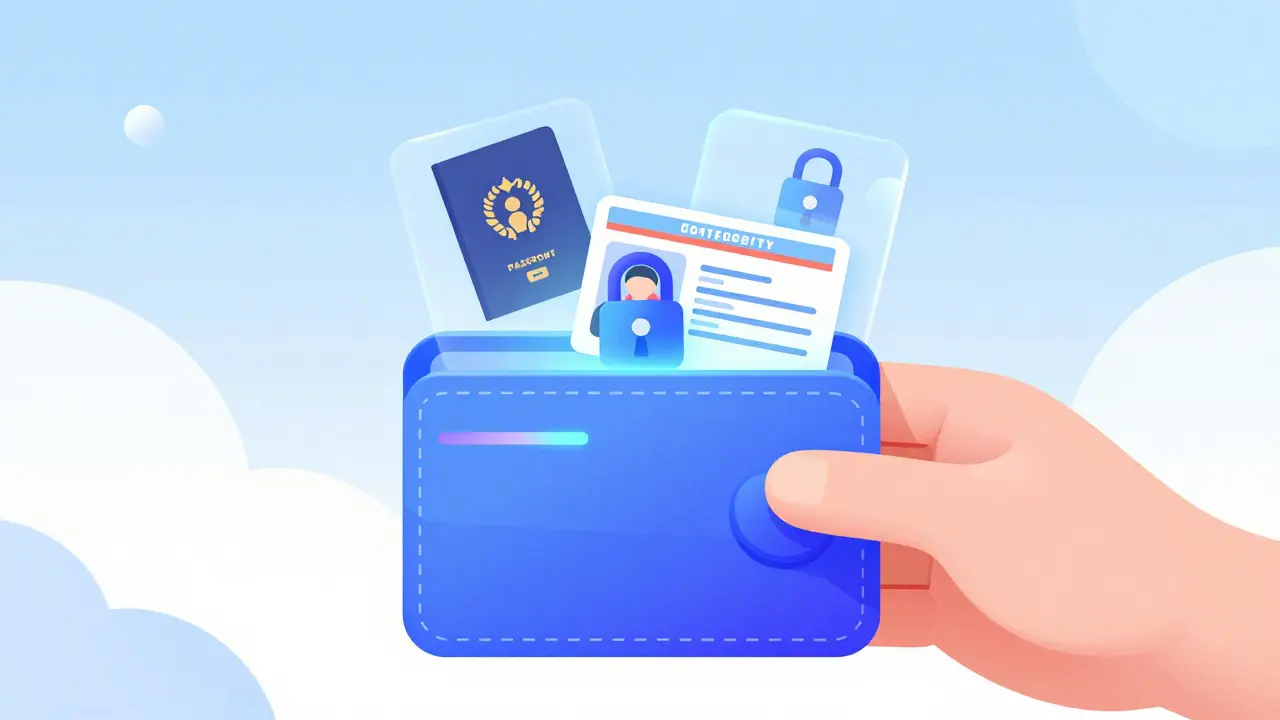
Imagine proving your age to buy a drink without handing over your entire driver's license. Or getting hired for a job where the company verifies your degree in seconds, not weeks. This is the promise of blockchain-based identity verification, a decentralized system that uses distributed ledgers and cryptographic keys to let individuals control their own digital identities. Instead of relying on a single bank, government agency, or tech giant to hold your data, you hold it yourself. This approach eliminates single points of failure and gives you true ownership over who sees what.
The technology isn't just theoretical anymore. It’s moving from pilot programs into real-world use in banking, healthcare, and government services. But how does it actually work? And is it ready for everyday use? Let’s break down the mechanics, the benefits, and the hurdles you might face if you’re looking to adopt this technology.
How Blockchain Identity Actually Works
At its core, blockchain identity relies on three main components: Decentralized Identifiers (DIDs), Verifiable Credentials, and Digital Signatures. You don’t need to be a cryptographer to understand the basics, but knowing how these pieces fit together helps explain why the system is so secure.
- Decentralized Identifiers (DIDs): Think of a DID as a unique, universal username that no one else controls. Unlike an email address managed by Gmail or Microsoft, a DID is yours. It’s stored on a distributed ledger, meaning there’s no central server that can go down or be hacked to wipe out your identity.
- Verifiable Credentials: These are digital versions of physical documents like passports, diplomas, or driver’s licenses. When a trusted issuer (like a university) sends you a credential, they sign it with their private key. Anyone can verify that signature using the issuer’s public key, ensuring the document hasn’t been altered.
- Digital Signatures & Smart Contracts: Every time you share a piece of information, you sign it digitally. Smart contracts automate the rules of engagement. For example, a smart contract might specify that a landlord can only see that you have a valid lease, but not your social security number.
A crucial detail here is where the data lives. Most systems don’t store your actual passport scan on the blockchain because blockchains aren’t great for large files. Instead, they store a "hash"-a digital fingerprint-on the chain. The actual file sits in off-chain storage, often on the InterPlanetary File System (IPFS). If someone tries to change your passport image, the hash won’t match, and the blockchain will flag it as invalid. This ensures immutability without bloating the network.
Why Self-Sovereign Identity Matters
Traditional identity verification is a bit of a privacy nightmare. To prove you’re over 18, you show your whole ID. To get a loan, you hand over pay stubs, tax returns, and bank statements. You rarely get to choose *what* to share; you just hand over everything you have.
Self-sovereign identity flips this script. It uses Zero-Knowledge Proofs (ZKPs) to allow selective disclosure. Here’s a practical example: A bar wants to know if you’re 21+. With ZKPs, your wallet can mathematically prove you are over 21 without revealing your birthdate, name, or photo. The bar gets the "yes," and your personal details stay private.
This shift reduces the risk of massive data breaches. In centralized systems, if a hospital gets hacked, millions of patient records are exposed. In a decentralized model, your data is encrypted and held by you. Even if a verifier’s database is compromised, they only have hashes, not readable files. As Dr. Gavin Woods, co-founder of Ethereum, noted, this returns control of personal data to individuals, which is a fundamental change in how we interact with institutions.
Comparison: Traditional vs. Blockchain Identity
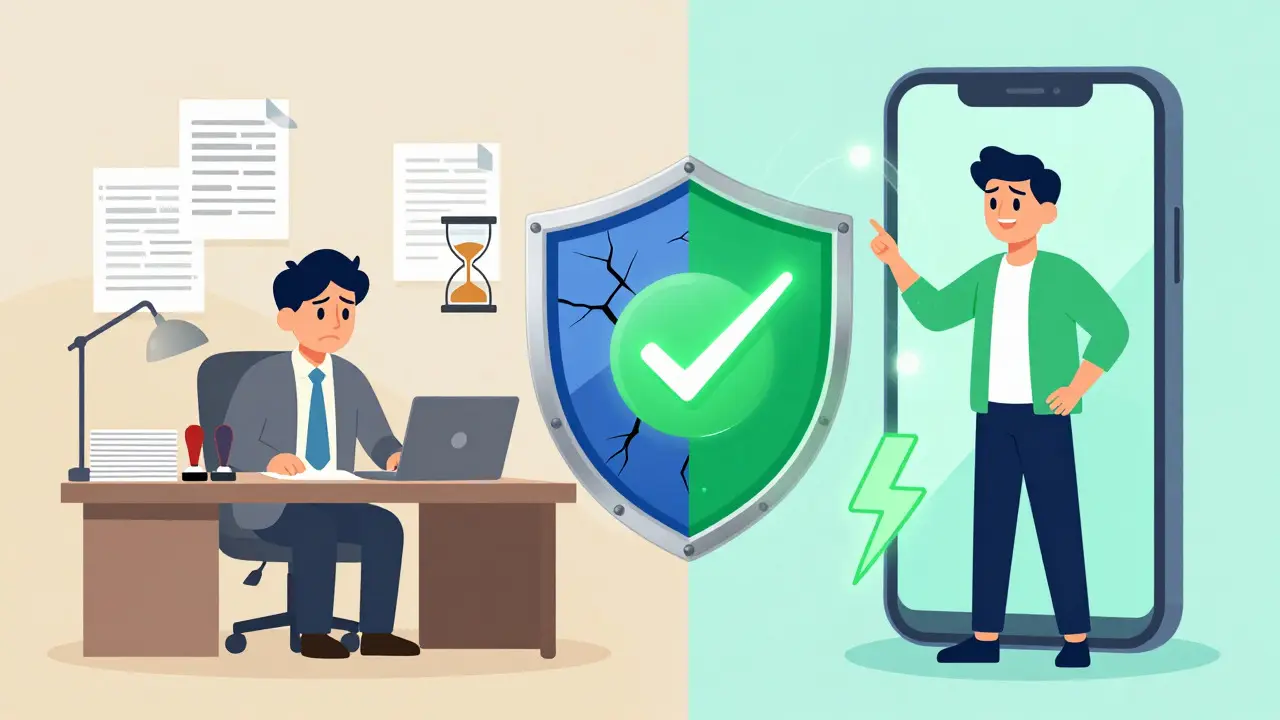
To really grasp the difference, let’s look at how the two systems stack up against each other in key areas.
| Feature | Traditional Centralized System | Blockchain-Based System |
|---|---|---|
| Data Control | Held by banks, governments, or corporations | Held by the individual (user) |
| Security Risk | High (single point of failure/data breach) | Low (decentralized, encrypted, immutable) |
| Verification Speed | Days to weeks (manual checks) | Seconds (automated smart contracts) |
| Privacy Level | Low (full document sharing required) | High (selective disclosure via ZKPs) |
| Interoperability | Siloed (hard to move between platforms) | High (W3C standards enable cross-platform use) |
Notice the speed difference. IBM reports that blockchain verification can occur in just seconds. Compare that to the traditional process where HR might spend hours calling a university registrar to confirm a degree. That efficiency saves money and time for both employers and employees.
Real-World Applications & Case Studies
This isn’t just sci-fi. Several sectors are already seeing tangible results.
- Healthcare: Patient onboarding is notoriously slow. One case study from Dock.io showed that using blockchain credentials reduced patient onboarding time from 45 minutes to under 5 minutes. Doctors can instantly verify insurance and medical history without faxing forms around.
- Government Services: Estonia has been a pioneer here. Their e-residency program uses blockchain-like principles for digital identity. In a 2022 pilot, 87% of participants reported higher satisfaction with their control over data compared to traditional methods. While setup was complex for some, the long-term benefit of seamless access to state services was clear.
- Financial Services: Know Your Customer (KYC) compliance is expensive and slow. Banks are adopting blockchain to share verified customer data across institutions. If you’ve been vetted by Bank A, Bank B can trust that verification without re-doing the entire background check.
However, user feedback is mixed. On Reddit, users praise the convenience of verifying professional credentials for job applications. But others note that managing cryptographic keys can be intimidating. Losing your private key means losing access to your identity unless you have a robust recovery method. This is a significant usability hurdle that developers are actively trying to solve with biometric-bound credentials and mobile-first interfaces.
Challenges & Limitations to Watch Out For
Don’t expect blockchain identity to fix every problem overnight. There are real-world friction points.
Key Management Complexity: In a self-sovereign model, you are responsible for your keys. For tech-savvy users, this is fine. For the average person, it’s a steep learning curve. Surveys indicate that 28% of enterprise users cite key management as their top challenge. If you lose your phone and don’t have a backup, you might be locked out of your digital life.
Regulatory Uncertainty: Laws vary wildly by region. The European Union’s eIDAS 2.0 framework supports blockchain identity, making it easier to deploy there. But in other jurisdictions, regulations are still catching up. Companies report that GDPR compliance is a major hurdle, specifically regarding the "right to be forgotten." Since blockchain is immutable, deleting data is hard. Solutions involve storing only hashes on-chain and keeping raw data off-chain, but legal interpretations are still evolving.
Integration with Legacy Systems: Most companies run on older software that expects centralized databases. Connecting a decentralized identity layer to these legacy systems takes time and money. Enterprise implementations typically require 8-12 weeks for full deployment. Technical staff often need 40 hours of training on blockchain fundamentals before they can effectively manage the system.

Market Growth & Future Outlook
Despite the challenges, the market is booming. The blockchain identity verification sector grew from $0.87 billion in 2021 to $1.84 billion in 2023. Analysts project it will reach $17.24 billion by 2030, growing at a 38.2% compound annual rate. This growth is driven by increasing adoption in financial services (42% of implementations), government (28%), and healthcare (19%).
Looking ahead, several trends are shaping the next phase:
- Standardization: The W3C finalized the Verifiable Credentials Data Model 2.0 in January 2023. This is huge because it means different platforms can now talk to each other. Your credential issued on one platform should be verifiable on another, breaking down silos.
- DeFi Integration: 78% of providers plan to integrate with Decentralized Finance (DeFi) by 2025. This means your identity could be used to access loans, trade assets, or participate in governance without intermediaries.
- AI Fraud Detection: Companies like 1Kosmos are rolling out AI-enhanced fraud detection. By analyzing patterns in identity transactions, AI can spot anomalies faster than human reviewers.
Forrester predicts that by 2027, blockchain-based identity verification will handle 30% of digital identity transactions in developed economies. It’s becoming foundational infrastructure, not just a niche experiment.
Frequently Asked Questions
Is blockchain identity completely anonymous?
Not necessarily. It depends on how you configure your wallet. You can use pseudonymous DIDs that don’t link directly to your name, allowing you to transact privately. However, if you issue a verifiable credential linked to your legal name (like a passport), that data is tied to your identity. The power lies in choosing *when* and *where* to reveal your true identity.
What happens if I lose my private key?
If you lose your private key without a backup, you may lose access to your specific DID. However, most modern solutions offer social recovery or multi-signature setups where trusted contacts or hardware devices can help restore access. Always use a reputable wallet provider that offers recovery mechanisms beyond just a seed phrase.
Do I need to know how to code to use it?
No. End-users interact with mobile apps or web interfaces. The complexity is handled behind the scenes. You’ll likely just upload a document, approve a request, and share a QR code. The coding is for the developers building the platforms, not for the people using them.
Is it more secure than a password?
Generally, yes. Passwords are static and easily phished. Blockchain identity uses cryptographic keys that are harder to steal and can be rotated if compromised. Additionally, because there’s no central database to hack, the attack surface is significantly smaller. However, security also depends on your device hygiene (e.g., not clicking phishing links).
Which industries are adopting this first?
Financial services lead the way, followed by government and healthcare. These sectors deal with high-value transactions and sensitive data, making the security and speed benefits of blockchain identity particularly attractive. Supply chain and education are also emerging strong adopters.