
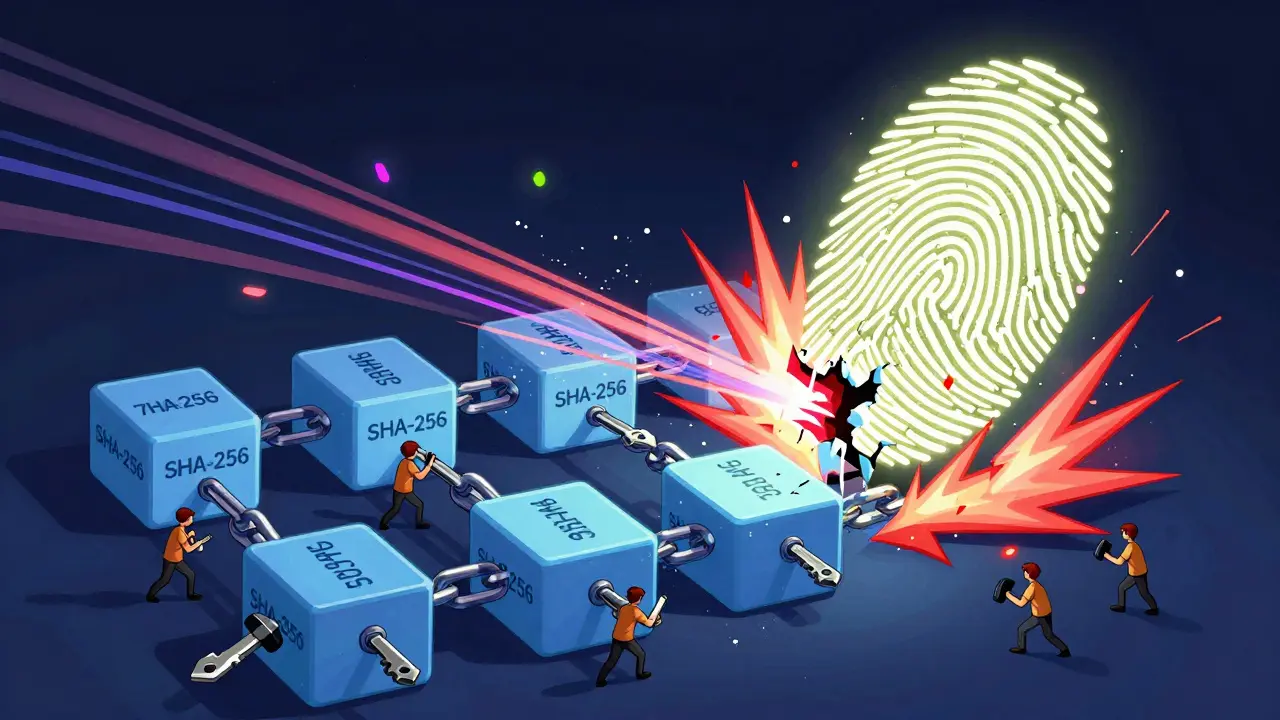
Without cryptographic hash functions, blockchain wouldn’t work. Not even close. It’s not just a feature-it’s the foundation. Every transaction, every block, every link in the chain depends on these mathematical tools to keep everything honest, unchangeable, and trustworthy. If you’ve ever wondered how a decentralized system like Bitcoin stays secure without banks or central authorities, the answer starts with cryptographic hashes.
What Exactly Is a Cryptographic Hash?
A cryptographic hash takes any amount of data-whether it’s a single word or a 10GB file-and turns it into a fixed-size string of characters. For Bitcoin, that’s always 64 characters long, using the SHA-256 algorithm. Change one letter in the input? The whole output flips completely. That’s not magic. It’s design.
Think of it like a fingerprint for data. Every unique input gets a unique hash. Even if two files are 99.9% identical, their hashes will look totally different. That’s the avalanche effect in action. And here’s the kicker: you can’t reverse it. You can’t take the hash and figure out what the original data was. That’s intentional.
Collision Resistance: No Two Inputs, Same Hash
Imagine someone tries to swap a real Bitcoin transaction with a fake one-but makes the hash match. If that worked, they could spend the same coins twice. That’s called a double-spend attack. Collision resistance stops this dead in its tracks.
This property means it’s computationally impossible to find two different inputs that produce the same hash output. The number of possible SHA-256 outputs is around 2²⁵⁶. That’s more than the number of atoms in the observable universe. Even with the fastest supercomputers, finding a collision would take longer than the age of the universe. That’s not theory-it’s math.
Blockchain relies on this to ensure each transaction has a unique, tamper-proof signature. If a hacker alters a transaction in a block, the hash changes. And since each block includes the hash of the previous one, that one change breaks the whole chain. Nodes immediately reject it.
Preimage Resistance: You Can’t Go Backwards
Let’s say you see a hash: 3a5f8b2c.... Can you figure out what data created it? No. Not unless you brute-force every possible input-which is impossible at this scale.
This is preimage resistance. It’s the reason your password isn’t stored as plain text in databases. Instead, systems store its hash. Even if a hacker steals the database, they can’t reverse those hashes to get your password. Same logic applies to blockchain. A transaction’s details are hashed, not stored raw. That protects privacy and prevents reverse-engineering.
For miners, this means they can’t cheat by predicting which input will give them a winning hash. They have to guess randomly. That’s what makes proof-of-work fair. It’s not about skill or insider knowledge-it’s about computational power and luck.
Second Preimage Resistance: One Input, Only One Match
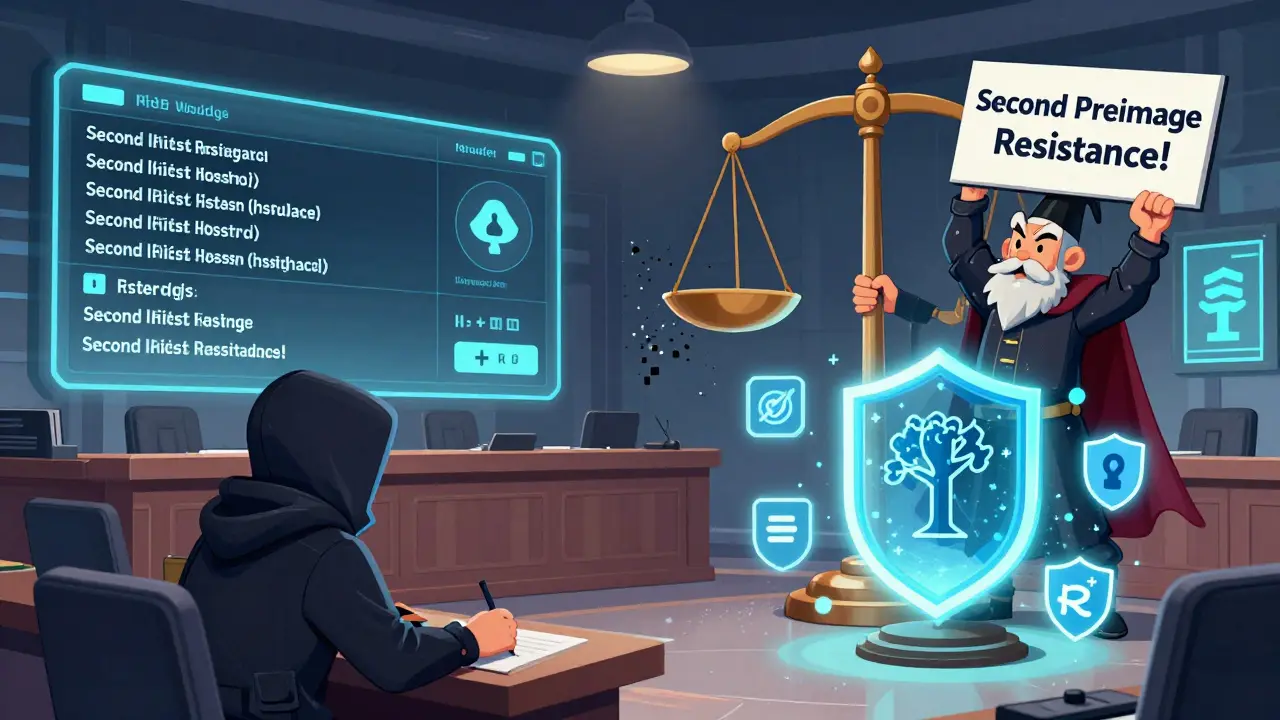
This one is subtle but critical. Second preimage resistance says: if I give you a specific input (say, a real Bitcoin transaction), you can’t find a *different* input that hashes to the same value.
Think of it like this: you have a signed contract. Someone tries to create a fake version that looks different but has the same hash. If they could do that, they could replace your transaction with a fraudulent one-and the network would accept it because the hash matches.
Second preimage resistance blocks that. Even if you know the original input, you still can’t craft a different one that matches its hash. This isn’t just redundancy-it’s layered security. Collision resistance stops random matches. Second preimage stops targeted attacks.

Deterministic: Always the Same, Every Time
Blockchain is a distributed system. Thousands of computers around the world verify transactions independently. For them to agree on what’s valid, they need to get the exact same result every time they run the same input through the hash function.
Determinism ensures that. Give the same transaction data to a node in Tokyo, Toronto, or Perth, and they’ll all produce the exact same 64-character hash. No randomness. No variation. That’s how consensus works without a central authority.
If hashes weren’t deterministic, the whole network would fall apart. One node might say a transaction is valid. Another says it’s not. Chaos. Determinism is what makes trustless systems possible.
Avalanche Effect: Tiny Change, Total Chaos
Change one bit in a Bitcoin transaction-say, flip a 0 to a 1-and the resulting hash becomes completely unrecognizable. That’s the avalanche effect. A single bit flip should change roughly half the bits in the output.
This property makes tampering obvious. If someone tries to alter a transaction after it’s been added to the blockchain, the hash changes. That change propagates to the next block’s hash, then the next, and so on. The entire chain becomes invalid. Nodes detect this instantly and reject the block.
It’s like trying to change one word in a locked safe. The lock doesn’t just break-it explodes. The avalanche effect turns small fraud into obvious, system-wide failure.
Puzzle Friendliness: Mining Can’t Be Gamed
Proof-of-work mining requires finding a hash below a certain target. Miners tweak a value called a nonce until they get a valid result. Puzzle friendliness means that even if you know part of the input (like the transaction data), you still can’t predict what the nonce should be.
You can’t use logic or patterns. You can’t shortcut it. You just have to guess. Over and over. Billions of times per second.
This is what makes mining fair and energy-intensive. If miners could calculate the right nonce based on partial knowledge, they’d dominate the network. Puzzle friendliness ensures that success depends on computational power, not cleverness. It levels the playing field.
Fixed-Length and Large Output Space: Size Doesn’t Matter
No matter how big your data is-10 bytes or 10 gigabytes-the hash is always the same length. SHA-256? Always 256 bits. That’s fixed-length mapping. It makes storage and comparison efficient. Nodes don’t need to store entire transactions to verify them. Just the hash.
And the output space? Massive. With 2²⁵⁶ possible hashes, the chance of two inputs matching is so small it’s practically zero. That’s why even with billions of transactions, Bitcoin’s blockchain remains collision-free after 15+ years.
How Hashes Power the Whole System
These properties aren’t just theoretical-they’re the gears that turn the blockchain machine.
- Merkle Trees: Transactions in a block are hashed in pairs, then those hashes are hashed again, and so on, until one root hash represents all transactions. This lets nodes verify a single transaction without downloading the whole block.
- Digital Signatures: Hashes are used to create signatures. Your private key signs the hash of a transaction, not the transaction itself. That’s faster and more secure.
- Block Linking: Each block contains the hash of the previous block. That’s what makes it a chain. Break one link, and the whole chain becomes invalid.
- Zero-Knowledge Proofs: Some blockchains use hashes to prove you know something (like a password or private key) without revealing it. That’s how privacy coins like Zcash work.
Even outside blockchain, these same properties power password storage, file integrity checks, Git version control, and SSL certificates. But in blockchain, they’re not optional. They’re non-negotiable.
SHA-256 vs. SHA-3: Why Bitcoin Stuck With One
Bitcoin uses SHA-256. It’s been rock-solid since 2009. But newer algorithms like SHA-3 and BLAKE2 exist. Why not switch?
Because stability matters more than novelty. Changing the hash function would break every existing node. It would require a hard fork. And if you’re building a global financial system, you don’t mess with the foundation unless you absolutely have to.
SHA-3 is more resistant to quantum attacks. But even if quantum computers become viable in the next 10-20 years, SHA-256’s 256-bit length still gives it a long runway. The real threat isn’t today’s computers-it’s future breakthroughs. That’s why some newer blockchains are already exploring post-quantum hash functions.
What Happens When Hashes Fail?
So far, they haven’t. SHA-256 has never been broken. Not even close. But if a collision were ever found, it would be catastrophic. Hackers could forge transactions, rewrite history, and destroy trust in the entire network.
That’s why the community watches closely. Any hint of weakness in SHA-256 would trigger an emergency upgrade. For now, the math holds. The hashes are secure. The chain stays intact.
That’s the quiet power of cryptographic hashes. They don’t make headlines. They don’t need to. They just work-every second, every transaction, every block. Invisible. Unbreakable. Essential.
Why can’t you reverse a cryptographic hash to find the original data?
You can’t reverse a cryptographic hash because it’s designed as a one-way function. It takes any input and turns it into a fixed-size output using complex mathematical operations that lose information in the process. There’s no formula to undo it. The only way to find the original input is to guess every possible input until you find a match-which is impossible at scale. For SHA-256, there are 2²⁵⁶ possible outputs. Even if you tried a billion guesses per second, it would take trillions of years to cover them all.
What’s the difference between collision resistance and second preimage resistance?
Collision resistance means you can’t find any two different inputs that produce the same hash. Second preimage resistance is more specific: if you’re given one input, you can’t find a *different* input that hashes to the same value. Think of it like this: collision resistance stops random matches. Second preimage stops targeted attacks. Both are needed to fully secure a blockchain.
Does quantum computing threaten cryptographic hashes in blockchain?
Quantum computers could theoretically speed up attacks on hashes using Grover’s algorithm, which reduces the time to find a preimage from 2²⁵⁶ to 2¹²⁸. That sounds scary, but 2¹²⁸ is still an astronomically large number-far beyond what any foreseeable quantum computer could handle. SHA-256 and SHA-3 are considered quantum-resistant for now. If a real threat emerges, blockchains can upgrade to longer hash lengths or post-quantum algorithms without breaking the entire system.
Why does Bitcoin use SHA-256 instead of a newer hash function?
Bitcoin uses SHA-256 because it was proven, secure, and widely adopted when the network launched in 2009. Changing the hash function now would require every node in the world to upgrade simultaneously-a near-impossible coordination task. Stability is more valuable than novelty in a global financial system. SHA-256 has never been broken, and its security margin is still massive. Unless a real vulnerability appears, there’s no reason to change it.
How do hash functions help with blockchain scalability?
Hash functions make scalability possible by reducing data size. Instead of storing entire transactions, nodes only need to store their hashes. Merkle trees use hashes to summarize thousands of transactions into one root hash, letting wallets verify a single transaction without downloading the whole block. This cuts bandwidth, storage, and sync times. Without hashing, blockchains would be too slow and too heavy to run on regular devices.
If you’ve ever wondered how a digital ledger stays tamper-proof without a central authority, the answer is simple: math. Cryptographic hashes turn chaos into order, randomness into certainty, and trust into code. They’re not flashy. But they’re the reason blockchain works at all.


Bruce Morrison
Hashes are the silent heroes of blockchain. No fanfare, no press releases. Just math doing its job so we don't have to trust people.
Simple. Elegant. Unbreakable.