

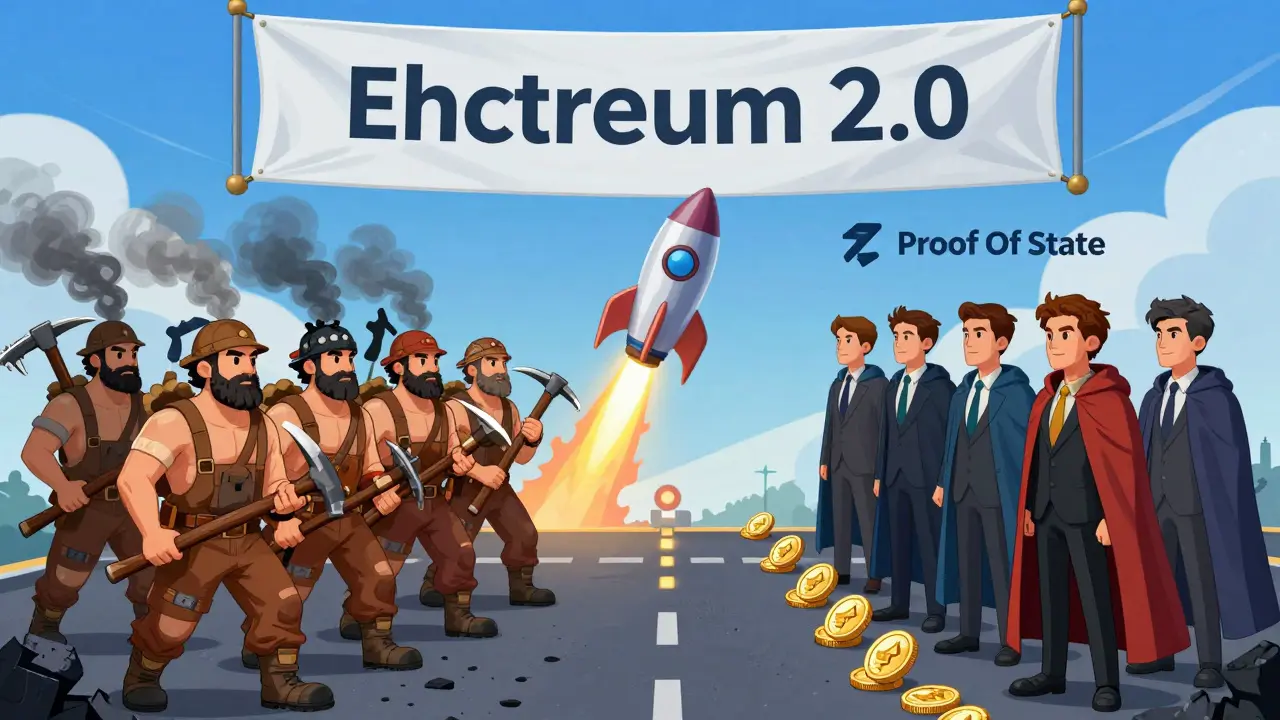
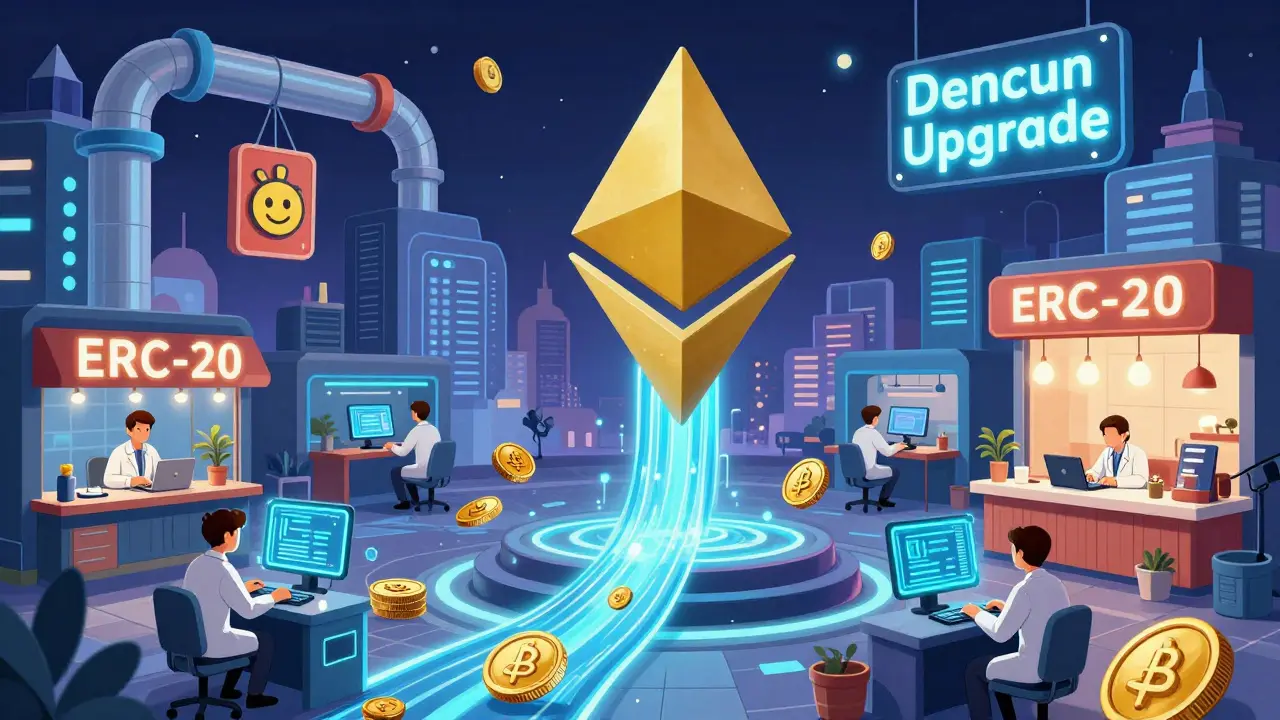
Ethereum isn't just another cryptocurrency. It's the foundation of everything modern blockchain does beyond sending money. While Bitcoin showed the world that digital cash was possible, Ethereum made it possible to build entire systems on top of a blockchain - systems that run themselves. Think of it as a global computer that never goes offline, where code replaces middlemen and contracts can’t be changed once they’re live. This isn’t theory. It’s running right now, handling billions in assets, powering decentralized finance, and even storing digital art. Since its launch in 2015, Ethereum has become the default choice for developers building decentralized apps. Why? Because it was the first to make smart contracts truly usable. Unlike Bitcoin’s simple scripting language, Ethereum uses a full programming language called Solidity. That means developers can write logic like: "If Alice sends 1 ETH to this address on Friday, automatically send her 10 NFTs." No bank. No lawyer. Just code executing exactly as written. The Ethereum Virtual Machine (EVM) is what makes this possible. It’s the engine that runs every smart contract on the network. Every node in the Ethereum network runs the EVM, so every transaction gets verified the same way, everywhere. That’s what gives Ethereum its security and trust. And because the EVM is open and standardized, other blockchains like Binance Smart Chain or Polygon built their own versions of it. They didn’t invent it - they copied it. That’s how dominant Ethereum’s architecture has become. Smart contracts are written in Solidity, a language that looks a lot like JavaScript. That’s no accident. When Ethereum launched, most web developers already knew JavaScript. Suddenly, front-end coders could jump into blockchain without learning a whole new stack. Today, over 44 million smart contracts have been deployed on Ethereum. Most of them follow standard templates like ERC-20 for tokens and ERC-721 for NFTs. These aren’t obscure specs - they’re the building blocks of DeFi, gaming, and digital ownership. If you’ve ever bought a CryptoPunk or traded on Uniswap, you used an ERC-20 or ERC-721 contract. Before 2022, Ethereum ran on Proof of Work - the same energy-hungry system Bitcoin uses. Mining required massive hardware, and transactions cost a fortune during peak times. In September 2022, Ethereum switched to Proof of Stake (PoS) in what’s now called Ethereum 2.0. This change cut its energy use by over 99%. Instead of miners solving puzzles, validators stake ETH to secure the network. If they cheat, they lose their stake. It’s more secure, more efficient, and far more sustainable. The Shanghai upgrade in mid-2023 made it even better by letting people withdraw their staked ETH without waiting weeks. Now, staking isn’t just for institutions - regular users can do it too. But Ethereum still has a speed problem. On its main network, it handles about 1,200 transactions per second. Visa clears 7,400. That’s why Layer 2 solutions exploded. Projects like Optimism, Arbitrum, and Polygon don’t replace Ethereum - they build on top of it. They process thousands of transactions off-chain, then bundle them into one proof that gets posted back to Ethereum. This keeps the security of the main chain while slashing fees. A simple swap on Ethereum mainnet might cost $3. On Arbitrum? It’s often under $0.10. These Layer 2s are why Ethereum still dominates despite slower base-layer speeds. Gas fees - the cost to run a transaction - are still the biggest pain point for users. In late 2023, a basic transfer cost around $1.27. During NFT drops or DeFi booms, that number spiked to $50 or more. That’s why most developers test on testnets like Sepolia first. You get free test ETH from faucets to try out contracts without spending real money. But even seasoned devs have lost thousands in failed transactions. One developer on Reddit reported spending $2,347 in failed gas fees during a single congestion event in September 2023. That’s not unusual. The fix? Layer 2s and better gas optimization tools. The real power of Ethereum isn’t just in its tech - it’s in its network. Over 550,000 active addresses use it daily. More than $34.7 billion in value is locked in DeFi protocols built on it. That’s more than all other smart contract platforms combined. Why? Because trust builds over time. Developers don’t just pick a blockchain - they pick an ecosystem. Ethereum has the biggest developer community, the most tutorials, the most tools, and the most institutional backing. JPMorgan uses it for cross-border payments. BlackRock filed for an Ethereum spot ETF. Fidelity offers ETH custody. Governments are testing it for digital identity. That kind of adoption doesn’t happen overnight - and no other chain has built this. Still, Ethereum isn’t perfect. Smart contracts are immutable. If there’s a bug, you can’t just patch it. You need a hard fork - a community vote to rewrite history. That happened in 2016 after the DAO hack, and again in 2020 after a critical bug in a popular DeFi protocol. These forks are rare, but they show that Ethereum’s decentralization isn’t magic - it’s messy. It requires consensus. That’s a strength and a risk. Looking ahead, Ethereum’s roadmap is focused on scaling. The Dencun upgrade in early 2024 introduced proto-danksharding, a major step toward handling 100,000 transactions per second. It won’t happen overnight, but the direction is clear: make Ethereum faster, cheaper, and more accessible. Meanwhile, competitors like Solana and Cardano offer speed or formal verification, but they lack Ethereum’s depth. Solana might process more transactions in a month, but Ethereum holds 70% of all tokenized assets. That’s the difference between raw speed and real-world adoption. For developers, learning Solidity and the EVM is still the best investment. For users, using Layer 2s makes Ethereum affordable. For institutions, Ethereum is the only blockchain with proven, long-term stability. It’s not the fastest. It’s not the cheapest. But it’s the most trusted. And in blockchain, trust matters more than anything else.
What makes Ethereum different from Bitcoin?
Bitcoin is a digital currency. Ethereum is a programmable platform. Bitcoin lets you send money. Ethereum lets you build apps that send money, manage property, run voting systems, or automate contracts - all without a company in the middle. Bitcoin’s scripting is limited. Ethereum’s is Turing-complete, meaning it can run any program you can write in code.
Is Ethereum still the best choice for building apps?
Yes, for now. It has the largest developer base, the most tools, and the most secure ecosystem. If you’re building something that needs trust, long-term stability, and deep integration with DeFi or NFTs, Ethereum is still the default. Alternatives are faster or cheaper, but none have the same network effects.
How much does it cost to use Ethereum today?
On the main network, a simple transaction costs about $1.27 on average. During high demand, it can jump to $10 or more. Layer 2 solutions like Arbitrum or Optimism reduce this to under $0.10. Most users now interact with Ethereum through these faster, cheaper layers.
Can I stake ETH myself?
Yes. After the Shanghai upgrade in 2023, you can now withdraw staked ETH anytime. You need 32 ETH to run a full validator, but you can stake smaller amounts through exchanges or staking pools like Lido or Coinbase. It’s one of the easiest ways to earn passive income in crypto.
Are smart contracts really unbreakable?
They’re immutable, yes - but not infallible. Bugs in code can be exploited, and if enough people agree, a hard fork can reverse damage. The DAO hack in 2016 was reversed by a fork. So while the code can’t be changed after deployment, the network can. That’s a trade-off between security and flexibility.
What’s next for Ethereum?
The next major upgrade is "The Surge," part of the broader roadmap to reach 100,000 TPS. This includes sharding - splitting the network into smaller, parallel chains - and better data storage. The goal is to make Ethereum scalable without sacrificing decentralization. If it works, Ethereum could handle global-scale applications, from payments to identity to supply chains.


Kaitlyn Clark
Ethereum is literally the only reason I got into crypto 🤯 I thought Bitcoin was cool but then I saw what devs could build on top of it-NFTs, DeFi, DAOs-and I was like... this is the future. Also, gas fees are still a nightmare but Layer 2s saved my wallet. 🙏💸