

You probably hate paying that extra 3% fee when you buy a coffee with your credit card. Now imagine if that fee vanished, the money hit the seller’s account in seconds instead of days, and no bank needed to approve it first. That isn't science fiction; it's the core promise of Decentralized Finance (DeFi), a financial ecosystem built on blockchain technology that removes middlemen like banks and brokers. For years, DeFi was a playground for crypto enthusiasts dealing with clunky interfaces and scary security risks. But as we settle into September 2026, the landscape has shifted dramatically. The barriers of regulation, complex tech, and poor user experience are crumbling, pushing DeFi toward the mainstream stage it has long promised.
Key Takeaways
- Cost Efficiency: DeFi transactions cost fractions of traditional payment fees, saving small businesses significant revenue previously lost to processors.
- Speed & Access: Cross-border settlements happen in minutes, not days, offering instant liquidity without geographic restrictions.
- Regulatory Clarity: Clearer government frameworks and the rise of Central Bank Digital Currencies (CBDCs) are legitimizing DeFi protocols.
- User Experience: New wallet technologies with biometric auth and multi-chain support have lowered the technical barrier to entry.
- Hybrid Future: DeFi won't replace banks entirely but will run parallel systems for efficiency, while banks handle consumer protection-heavy tasks.
Why Traditional Banking Feels Like a Legacy System
Think about the last time you sent money internationally. You likely waited three to seven business days, paid opaque exchange rates, and filled out forms that felt like tax audits. This friction exists because traditional finance relies on intermediaries-correspondent banks, clearinghouses, and payment processors-to verify trust. Each layer adds cost and time. In contrast, DeFi uses smart contracts, which are self-executing codes on a blockchain that automatically enforce agreements when conditions are met. There is no human banker checking your ID; there is only code executing logic. This programmability allows for operations like lending, borrowing, and trading to happen peer-to-peer, 24/7, without closing hours or holiday delays.
The economic impact is stark. A local restaurant owner might lose thousands annually just in credit card processing fees. With DeFi stablecoin payments, those fees drop to near-zero network costs. It’s not just about saving pennies; it’s about cash flow velocity. When a transaction settles in minutes rather than days, businesses can reinvest capital faster. This efficiency is why industry experts predict that small and medium-sized businesses (SMBs) with strong brand loyalty will be the first major adopters, bypassing legacy banking rails entirely for daily operations.
The Tech Stack That Makes It Work
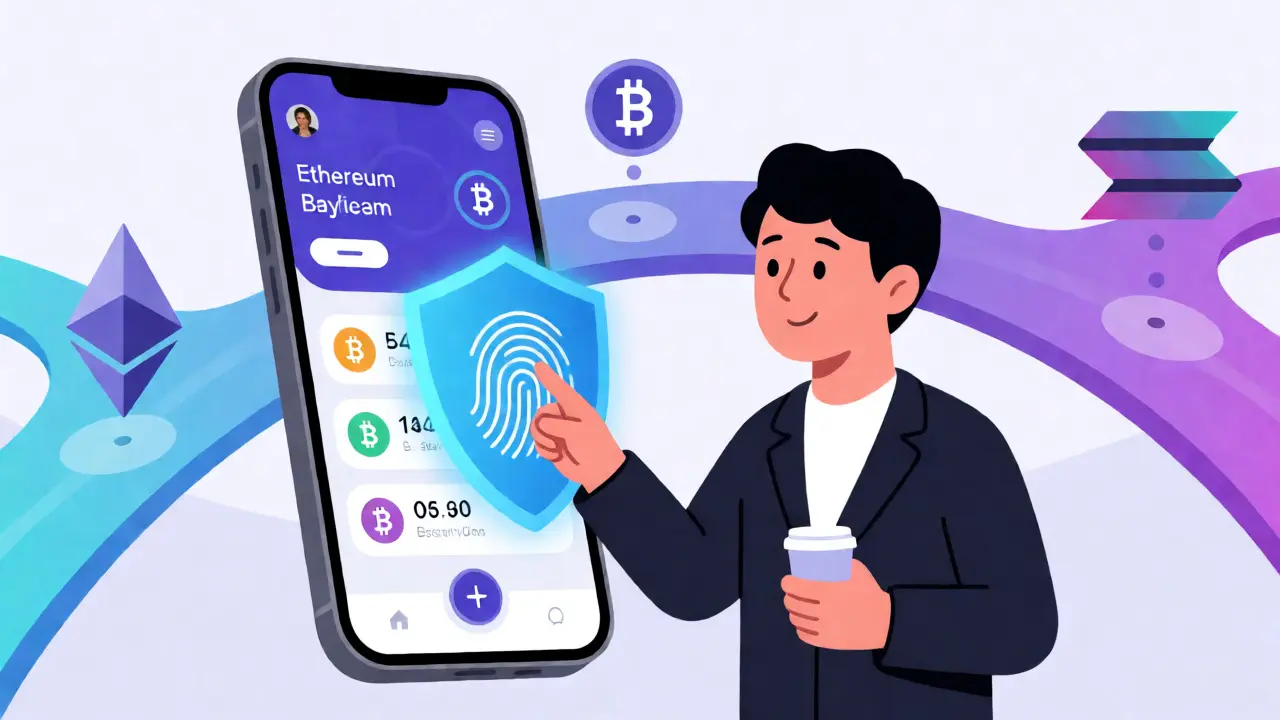
Five years ago, using DeFi meant managing multiple browser extensions, fearing phishing scams, and losing sleep over private keys. Today, the infrastructure has matured. DeFi wallets have evolved from simple storage tools into comprehensive financial hubs. Modern wallets now integrate biometric authentication, making them as secure and easy to use as Apple Pay, while still giving users full custody of their assets. They support multiple blockchains simultaneously, so you don’t need different apps for Ethereum, Solana, or Layer-2 networks.
Under the hood, scalability solutions have solved the congestion issues that once made transactions slow and expensive. Layer-2 rollups bundle hundreds of transactions into one batch, reducing costs and increasing speed. Furthermore, hardware wallet integration provides an air-gapped security layer for larger holdings, addressing the fear of online hacks. The result is a system where complex financial operations-like yield farming or providing liquidity-are accessible through intuitive dashboards that look less like code editors and more like standard banking apps.
| Feature | Traditional Finance (TradFi) | Decentralized Finance (DeFi) |
|---|---|---|
| Intermediaries | Banks, Brokers, Processors | Smart Contracts, Nodes |
| Transaction Speed | Days (Cross-border), Hours (Domestic) | Minutes or Seconds (Global) |
| Cost Structure | High fees (1-3% + fixed) | Low network fees (fractions of cents) |
| Access Requirements | ID, Credit Check, Branch Visit | Internet Connection, Wallet Address |
| Transparency | Ledger hidden from public view | All transactions publicly verifiable |
| Consumer Protection | FDIC Insurance, Chargebacks | Code-based, Irreversible (No chargebacks) |
Regulation and CBDCs: The Bridge to Mainstream
For a long time, the biggest threat to DeFi wasn't technical failure but regulatory uncertainty. Would governments ban it? Tax it into oblivion? By 2026, the answer has settled into a clearer framework. Governments aren't trying to kill DeFi; they are integrating with it. The rise of Central Bank Digital Currencies (CBDCs) is a pivotal development. Unlike volatile cryptocurrencies, CBDCs are government-backed digital dollars or euros. They offer the stability people trust with the programmability of blockchain.
This convergence creates a hybrid environment. Tokenized government bonds, for instance, allow investors to hold interest-bearing digital assets that can be used as collateral in DeFi lending protocols. This injects institutional-grade integrity into the decentralized system. Regulatory sandboxes, like those operated by the UK’s Financial Conduct Authority, have allowed companies to test these models safely. As regulations clarify how taxes apply to staking rewards and NFT sales, hesitant enterprises are finally moving in. They see DeFi not as a wild west gamble, but as a regulated, efficient alternative for specific financial workflows.
Who Is Actually Using DeFi Right Now?
You might assume only tech-savvy traders use DeFi, but the user base has diversified. Early adopters were driven by high yields in yield farming protocols, where users lend assets to earn interest. While those astronomical returns have normalized, the utility remains. Unbanked populations in developing nations use DeFi to access savings accounts and loans without needing a physical branch or credit history. A farmer in Southeast Asia can borrow against their crop tokenization instantly, something impossible with traditional rural banking.
On the enterprise side, large corporations are experimenting with stablecoins for treasury management. Instead of keeping millions idle in low-yield bank accounts, they deploy capital in DeFi protocols to earn competitive returns. However, they do this cautiously, often using permissioned DeFi chains that restrict access to verified entities. This tiered approach ensures that while retail users enjoy open access, institutions maintain compliance controls. The common thread is value capture: whether it’s a student avoiding overdraft fees or a multinational cutting foreign exchange costs, DeFi solves specific pain points better than legacy systems.

Challenges That Still Exist
Let’s be real: DeFi isn't perfect. The most glaring issue is the lack of consumer protection. If you send money to the wrong address or get scammed by a malicious smart contract, there is no customer service hotline to call. Transactions are irreversible. This places a heavy burden on the user to manage security properly. Losing your private key means losing your funds forever. While wallet recovery features are improving, they don't match the ease of resetting a bank password.
Additionally, the learning curve persists for advanced strategies. Basic payments are easy, but understanding impermanent loss in liquidity pools or gas optimization across different networks requires study. Most new users spend two to four weeks getting comfortable with basic proficiency. Technical complexity also leads to fragmentation; navigating between Ethereum, Arbitrum, and Base networks can still feel disjointed despite cross-chain bridges. Until interoperability becomes seamless-where moving assets feels as smooth as switching tabs in a browser-mass adoption will remain gradual rather than explosive.
The Road Ahead: Parallel Systems, Not Replacement
Don't expect banks to disappear next year. The future of decentralized finance is not total replacement but coexistence. Traditional finance excels at areas requiring extensive legal recourse, insurance, and personalized advisory services. DeFi excels at efficiency, transparency, and automated execution. We are heading toward a dual-rail financial system. Your primary checking account might stay with a traditional bank for salary deposits and bill pay, while your investment portfolio and international transfers run on DeFi rails for lower costs and higher yields.
Over the next three to five years, expect deeper integration. Banks may embed DeFi protocols directly into their apps, allowing customers to interact with blockchain benefits without seeing the underlying tech. Tokenization of real-world assets-from real estate to carbon credits-will expand the asset classes available on-chain. The winners will be platforms that prioritize user experience, hiding the complexity of private keys and gas fees behind familiar interfaces. The goal isn't to make everyone a crypto expert; it's to make finance invisible, fast, and fair.
Is DeFi safe for everyday transactions?
DeFi is generally safe regarding protocol integrity, especially on established blockchains like Ethereum or Solana. However, user error is the main risk. Unlike banks, there are no chargebacks. If you send funds to the wrong address or fall for a phishing scam, recovery is difficult. Using reputable wallets and double-checking addresses mitigates most risks.
Do I need to understand coding to use DeFi?
No. Modern DeFi interfaces are designed for non-coders. You click buttons to swap tokens, lend assets, or stake coins, similar to using a mobile banking app. Understanding the basic concepts of wallets and gas fees is helpful, but you don't need to write smart contracts yourself.
How do CBDCs affect DeFi?
CBDCs provide stable, government-backed digital currencies that can interact with DeFi protocols. They reduce volatility concerns for users and add legitimacy to the sector. CBDCs can serve as reliable collateral in lending markets and facilitate smoother transitions between traditional fiat and decentralized assets.
Can DeFi replace my bank account?
Not entirely, at least not yet. DeFi lacks FDIC-style insurance and robust fraud protection mechanisms found in traditional banks. Many users prefer a hybrid approach, keeping emergency funds in insured bank accounts while using DeFi for investments, international transfers, and earning yield.
What happens if I lose my private key?
In pure DeFi, losing your private key or seed phrase usually means permanent loss of funds. There is no central authority to reset your password. Some newer wallet solutions offer social recovery or multi-signature setups, allowing trusted friends or devices to help restore access, bridging the gap between security and convenience.