

Imagine waking up in 2031 to find that your life savings in Bitcoin have vanished. Not because of a hack, not because you lost your password, but because a machine calculated the key to your wallet faster than you could blink. This isn't science fiction anymore; it is a mathematical certainty if we do nothing. The threat is real, and the clock is ticking toward a deadline most people haven't even heard of.
The core problem is simple: Bitcoin relies on Elliptic Curve Digital Signature Algorithm (ECDSA) for security. Today's computers cannot break this code. But future quantum computers can. Specifically, they can use Shor's algorithm to derive private keys from public keys almost instantly. If a quantum computer with enough stable qubits exists, any Bitcoin address where the public key has been exposed is vulnerable. That includes over 6.65 million BTC-worth hundreds of billions of dollars-that sits in addresses reused or generated before privacy enhancements like SegWit were common.
So, how does Bitcoin survive? It doesn't just 'patch' itself. It needs a fundamental overhaul of its cryptographic backbone. Here is exactly how that transition works, who is leading the charge, and what you need to know before the window closes.
The Technical Fix: Replacing ECDSA with Lattice-Based Cryptography
To make Bitcoin quantum-resistant, developers must replace ECDSA with algorithms that are resistant to quantum attacks. The National Institute of Standards and Technology (NIST) standardized these new methods in August 2024. The winner for digital signatures is ML-DSA (Module-Lattice-based Digital Signature Algorithm), formerly known as CRYSTALS-Dilithium.
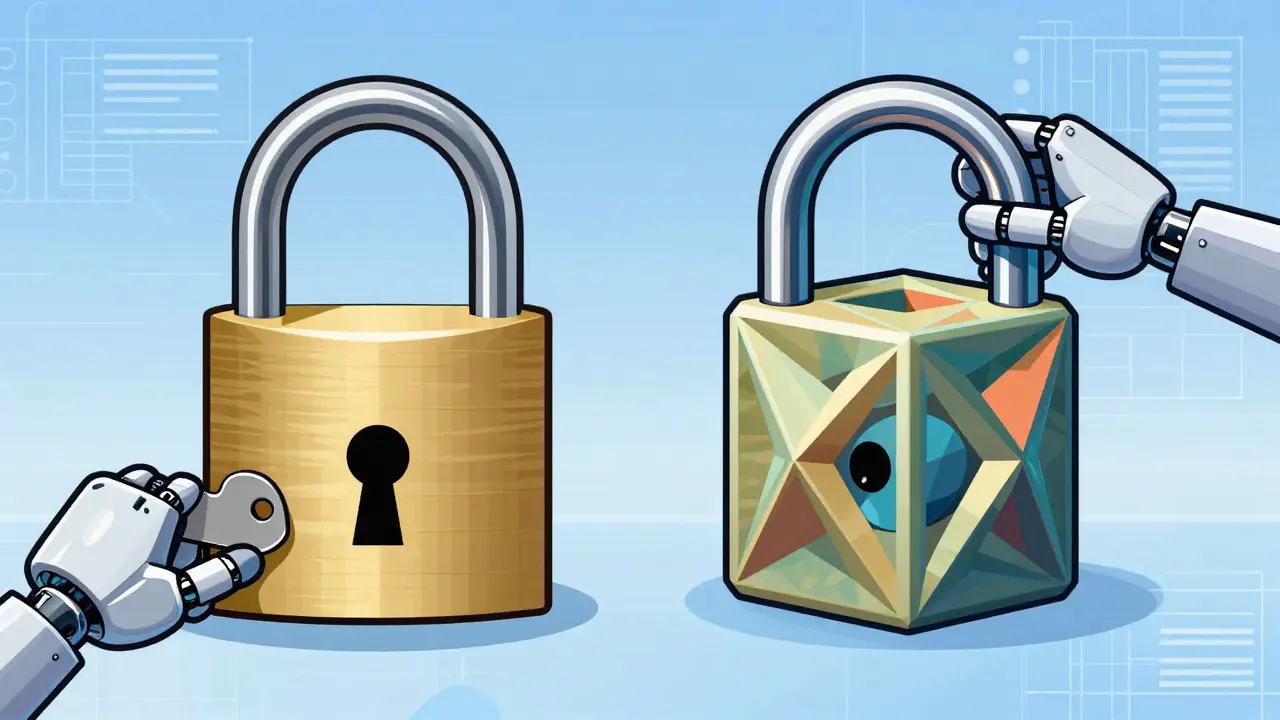
Think of ECDSA as a lock that requires a specific key shape. Quantum computers can mold that key shape instantly. ML-DSA, however, is based on lattice mathematics-a structure so complex that even quantum computers struggle to navigate it. It provides 128-bit post-quantum security, which is considered equivalent to AES-128 against classical attacks but robust against quantum ones.
Here is the catch: size matters. An ECDSA signature is tiny-about 0.0625 KiB. An ML-DSA signature is massive-between 2 to 4 KiB. That is roughly 1,000 times larger. You cannot simply swap them out without breaking the network's storage and transmission limits. This size difference drives every other change in the migration plan.
Why can't we just update the software?
Because Bitcoin is a decentralized ledger. Changing the signature algorithm changes the rules of consensus. Every node, miner, and wallet must agree on the new math simultaneously. If half the network uses old rules and half uses new rules, the chain splits. This requires a coordinated hard fork, not just a software update.
The Three Main Migration Strategies
There is no single way to save Bitcoin. Developers and companies are currently testing three distinct approaches. Each has trade-offs between speed, security, and complexity.
| Strategy | Key Mechanism | Pros | Cons | Current Status |
|---|---|---|---|---|
| Direct Replacement | Hard fork replacing all ECDSA with ML-DSA | Strongest security; clean break from legacy vulnerabilities | Requires 16x block size increase; forces immediate user migration | Implemented by BTQ Technologies (Testnet) |
| Hybrid Signatures | Combines ECDSA + PQC in one transaction | Backward compatible; gradual transition | Doubles signature size overhead; slower verification | Explored by Cardano; proposed for Bitcoin |
| Address Migration (QRAMP) | Users move funds to new quantum-safe addresses | No protocol change needed initially; preserves current blockchain | Relies on user action; estimated 30-60% adoption rate | Proposed by Agustin Cruz (Jan 2025) |
Who Is Leading the Charge? BTQ Technologies and the Core Team
While the Bitcoin Core development team debates the path forward, private entities are moving fast. BTQ Technologies made headlines on October 16, 2025, by demonstrating the first successful quantum-resistant Bitcoin implementation. They used NIST-standardized ML-DSA signatures in their "Bitcoin Quantum Core Release 0.2."
BTQ’s approach is aggressive. To handle the larger signatures, they increased the block size limit from 4 MiB to 64 MiB. This allows each block to hold about 12,500 quantum-secured transactions, compared to Bitcoin’s current ~2,500. However, this comes at a cost. Full nodes now require significantly more storage. In BTQ’s testnet, full node storage grew from 500 GB to 8 TB in just six months. For the average user running a node on a laptop, this is prohibitive.
On the official side, the Bitcoin Core team established a Quantum Readiness Working Group in November 2025, co-chaired by Matt Corallo and Dr. Neha Narula. Their goal is to submit a Bitcoin Improvement Proposal (BIP) by January 31, 2026. This group represents the conservative, community-driven approach, prioritizing consensus over speed.
The Timeline: Why 2030 Is the Hard Deadline
You might wonder, "Quantum computers aren't here yet, why rush?" The answer lies in the timeline of quantum hardware development. IBM projects machines with 1,000+ logical qubits by 2028. Google demonstrated 49 logical qubits in late 2025. Théau Peronnin, CEO of Alice & Bob, warned in November 2025 that quantum computers will be a threat "a bit later than 2030," but emphasized that Bitcoin "needs to fork by 2030, basically."
Why the rush? Because migration takes time. Chainalysis estimates an 18-24 month migration timeline. If a quantum computer capable of breaking ECDSA appears in 2030, and you start migrating in 2030, you are already too late. The "harvest now, decrypt later" attack vector means bad actors can steal public keys today and store them until they have the quantum power to crack them tomorrow.

Challenges for Users and Node Operators
This transition won't be seamless. Early testers on the BTQ testnet reported significant friction. Wallet synchronization times jumped from 2 minutes to 22 minutes. Transaction signing on mobile devices slowed from 0.8 seconds to 5.2 seconds. These delays matter when you are trying to send money quickly.
For node operators, the barrier to entry rises sharply. Current requirements are modest: 2 TB storage and 8 GB RAM. Post-quantum Bitcoin may require 16 TB storage, 32 GB RAM, and an 8-core CPU. This risks centralizing the network among those who can afford enterprise-grade hardware, undermining Bitcoin's decentralized ethos.
Furthermore, governance is a hurdle. Bitcoin requires near-unanimous consensus. A survey by BTC Sessions in November 2025 showed only 68% miner support for major upgrades. Achieving the 95% threshold needed for a safe hard fork is historically difficult. Deloitte noted that Bitcoin's conservative governance makes rapid adoption harder than on Ethereum, which has already integrated PQC testnets via EIP-7212.
What Should You Do Now?
If you hold Bitcoin, you are not powerless. While you wait for the protocol-level fix, you can mitigate risk immediately:
- Never reuse addresses. As long as your public key remains hidden (which happens only when you broadcast a transaction), your funds are safe from quantum attacks. Use a fresh address for every receipt.
- Monitor the BIP process. Watch for the Quantum Readiness Working Group's proposal in early 2026. Understand whether it favors direct replacement or hybrid models.
- Prepare for wallet updates. When the mainnet launch occurs (targeted for Q4 2026 by BTQ, potentially later by Core), you will need to upgrade your wallet software. Legacy hardware wallets may become obsolete unless manufacturers release firmware updates.
- Consider diversification. If you are deeply concerned about the transition risk, consider holding assets on chains that have already deployed quantum-resistant measures, such as Solana's testnet implementations.
The quantum threat is not a hypothetical. It is a engineering challenge with a clear solution, but a tight deadline. Bitcoin's survival depends on balancing its rigid consensus model with the urgent need for cryptographic evolution. The technology exists. The question is whether the community can unite in time.
Is my Bitcoin safe right now?
Yes, provided you do not reuse addresses. Quantum computers cannot currently break ECDSA. The risk arises only if a sufficiently powerful quantum computer exists AND your public key is exposed. By using unique addresses for every transaction, you keep your private key hidden.
Will I lose my coins during the migration?
Not if you follow the migration instructions. Most strategies involve moving funds to new quantum-safe addresses or updating your wallet to sign with new algorithms. Failure to upgrade your wallet software after a hard fork could result in being unable to access your funds, similar to the Bitcoin Cash split.
What is ML-DSA?
ML-DSA (Module-Lattice-based Digital Signature Algorithm) is a post-quantum cryptographic standard selected by NIST in 2024. It replaces older signature schemes like ECDSA with math problems that are hard for both classical and quantum computers to solve.
When will Bitcoin actually become quantum-resistant?
The target is before 2030. BTQ Technologies aims for a mainnet launch in late 2026. The Bitcoin Core team plans to submit a proposal in early 2026. Actual adoption depends on miner and node operator consensus, which typically takes 12-24 months after a proposal is accepted.
Does this affect Ethereum too?
Yes. Ethereum also uses ECDSA for signatures. However, Ethereum has a more agile governance model and has already integrated PQC testnets. Bitcoin's stricter decentralization makes its transition slower but potentially more secure in the long run due to broader consensus.