

Remember the days when trading on a decentralized exchange meant paying $4.50 or more in gas fees for a single swap? If you were active on Ethereum DEXs back in 2021, that pain is real. That was exactly the problem IDEX BSC was built to solve. Launched in February 2021 as an expansion of the original IDEX platform, this hybrid exchange brought high-performance order book trading to the Binance Smart Chain (now often referred to as BNB Chain). But does it still hold up in 2026?
You might be wondering if a platform launched five years ago can compete with today’s lightning-fast aggregators and Layer-2 solutions. The short answer is yes, but with some important caveats regarding its unique hybrid model. IDEX BSC isn’t just another automated market maker (AMM) like PancakeSwap. It offers something rarer in the DeFi space: a professional-grade order book experience without forcing you to deposit your funds into a centralized wallet.
How IDEX BSC Actually Works: The Hybrid Model
To understand why IDEX BSC feels different from other decentralized exchanges, you need to look under the hood. Most DEXs use liquidity pools where your trade gets matched against a pool of tokens provided by others. This often leads to slippage and impermanent loss for providers. IDEX takes a different approach.
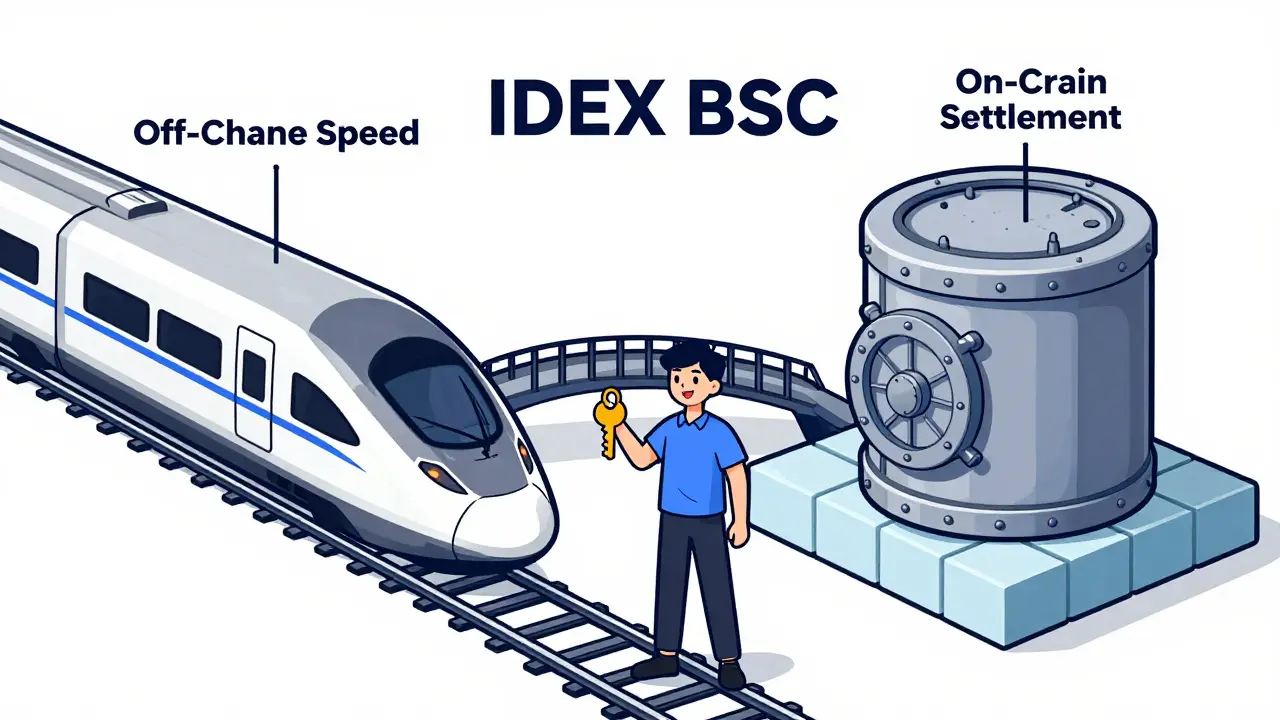
IDEX uses a semi-decentralized architecture. Here is how it breaks down:
- Centralized Matching: An off-chain matching engine finds the best buyer and seller prices instantly. This gives you the speed and precision of a centralized exchange like Binance or Coinbase.
- Decentralized Settlement: The actual transfer of assets happens on the blockchain via smart contracts. You never give up custody of your private keys or your funds to the exchange.
This separation is crucial. By handling the matching off-chain, IDEX avoids the "gas wars" that plague fully on-chain DEXs during volatile markets. You get instant balance updates and execution speeds that rival traditional finance platforms, while retaining the security guarantee that only you can authorize a withdrawal.
| Feature | IDEX BSC (Hybrid) | Standard AMM (e.g., PancakeSwap) |
|---|---|---|
| Custody | Non-custodial (You hold keys) | Non-custodial (Smart contract holds pool) |
| Order Types | Limit, Market, Stop-Loss, Take-Profit | Market swaps only |
| Slippage Control | Precise via Order Book | Dependent on pool depth |
| Transaction Cost (Historical) | < $0.10 per tx | Variable, often higher on congested chains |
| Front-Running Protection | Yes (Controlled transaction ordering) | No (MEV bots common) |
Cost Efficiency: Why BSC Matters
When IDEX launched on Binance Smart Chain, the headline feature was cost. At the time, Ethereum DEX users were paying approximately $4.50 per transaction due to network congestion. IDEX BSC promised transactions for less than $0.10. That is roughly 49 times cheaper.
In 2026, Ethereum gas fees have fluctuated significantly with the rise of Layer-2 networks, but BSC remains one of the most cost-effective mainnets for frequent traders. For scalpers or day traders executing dozens of trades a day, those small savings compound quickly. More importantly, IDEX allows for gas-free order cancellations. On many other platforms, canceling a limit order costs you gas even if the trade didn't execute. IDEX removes that penalty entirely.
The platform also supports filling multiple trades simultaneously. If you are running a strategy that requires buying three different tokens at specific price points, IDEX can bundle these actions efficiently, reducing the total number of blockchain interactions required.
Security and Custody: The Non-Custodial Promise
The biggest fear for any crypto trader using a centralized exchange is the risk of insolvency or hacking. Look at what happened with FTX or Mt. Gox. When an exchange goes down, your money is gone because you don’t control it.
IDEX BSC operates on a non-custodial model. Your funds remain in your personal wallet (like MetaMask or Trust Wallet) until the moment you approve a trade. The smart contract handles the settlement, ensuring that once a trade is matched, it cannot be reversed by either party. This prevents the exchange from initiating unauthorized trades and stops users from rescinding completed ones.
However, there is a nuance here. While the *settlement* is decentralized, the *matching engine* is operated by the IDEX team. This means the system is censorship-resistant in theory-no single entity can shut down the smart contracts-but the infrastructure relies on IDEX maintaining their servers. It is not a purely autonomous protocol like Uniswap. For most retail traders, this trade-off is acceptable because they get superior performance and lower fees, but purists may argue it doesn't qualify as a "true" DEX.
User Experience and Advanced Features
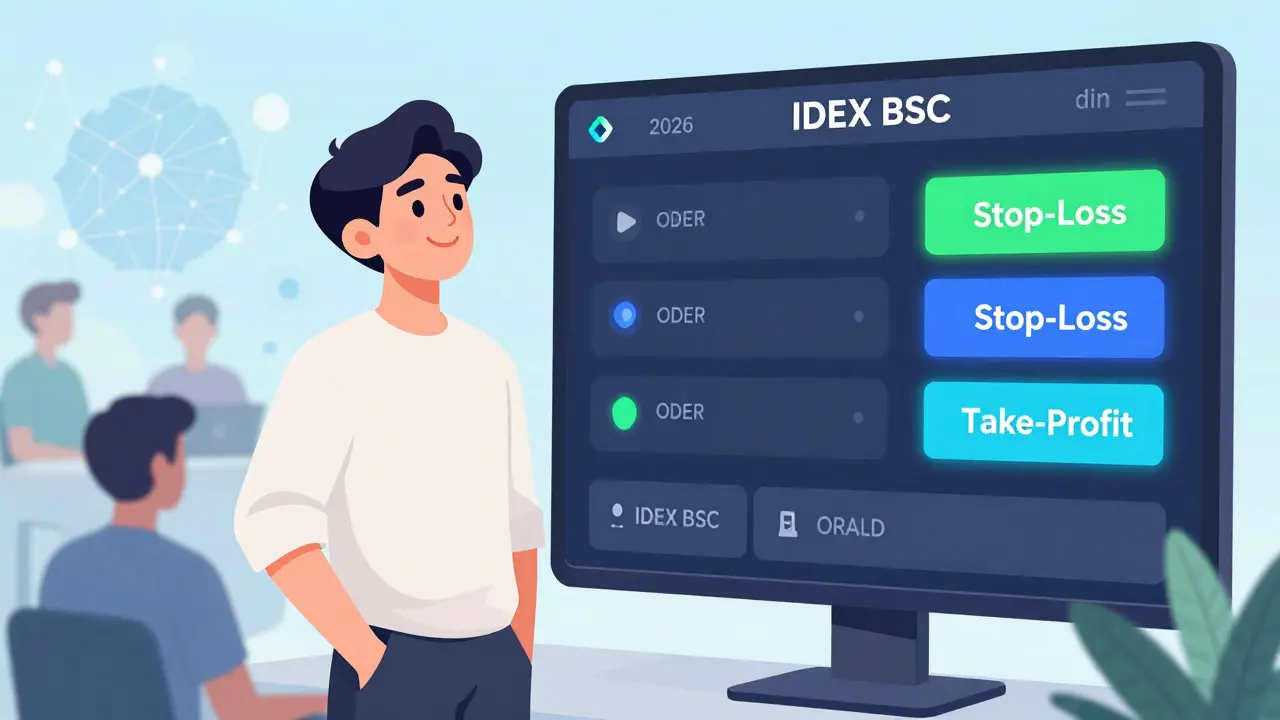
If you have ever tried to set a stop-loss order on a standard AMM DEX, you know it’s a headache. Usually, you have to rely on third-party tools or complex keeper networks. IDEX BSC builds these features directly into the interface.
You can set:
- Stop-Loss Orders: Automatically sell if the price drops below a certain level to limit losses.
- Take-Profit Orders: Automatically sell when the price hits your target gain.
- Limit Orders: Buy or sell at a specific price, waiting for the market to come to you.
This functionality makes IDEX BSC particularly attractive for algorithmic traders. The platform offers friendly API integration with tools like Hummingbot, allowing developers to deploy arbitrage strategies across different venues. For manual traders, the interface is clean and intuitive, supporting multiple languages including English, Spanish, Russian, Korean, Vietnamese, and Mandarin.
The KYC Catch: Privacy vs. Compliance
Here is where things get tricky. One of the core tenets of early cryptocurrency was anonymity. You could trade without showing ID. IDEX BSC requires Know Your Customer (KYC) verification and an email address to use the platform.
This requirement stems from regulatory pressures. As governments worldwide tighten rules around financial services, exchanges-even decentralized ones-face scrutiny. By requiring KYC, IDEX aims to stay compliant and avoid being blacklisted by banks or payment processors. However, this alienates users who value privacy above all else.
If you are looking for a completely anonymous trading experience, IDEX BSC is not the right choice. Platforms like ThorChain or older iterations of SushiSwap might offer more privacy, though often at the cost of ease of use or advanced order types. You have to decide what matters more to you: regulatory safety and professional tools, or absolute anonymity.
Liquidity and Market Integration
A DEX is only as good as its liquidity. Without enough buyers and sellers, you face high slippage. IDEX has worked hard to attract market makers by offering easy API integration. Because the order book model is familiar to institutional traders, integrating with IDEX is easier for them than adapting to liquidity pool mechanics.
While exact current Total Value Locked (TVL) metrics fluctuate, IDEX benefits from the broader Binance Smart Chain ecosystem. BSC remains a hub for high-volume trading, hosting popular platforms alongside IDEX such as PancakeSwap and TrustSwap. The competition keeps liquidity deep, but IDEX’s niche is specifically for those who want order-book precision rather than pool-based swapping.
Is IDEX BSC Still Relevant in 2026?
Five years after its launch on BSC, IDEX has expanded further into the multi-chain world through its Multiverse initiative, adding support for Polkadot and other networks. This shows the project is still active and evolving.
For the average user, the decision comes down to your trading style. Are you a casual holder swapping ETH for USDT once a month? A standard AMM might be simpler. Are you an active trader who needs stop-losses, precise limit orders, and low fees? IDEX BSC offers a compelling middle ground between the security of DeFi and the usability of CeFi.
Just remember to do your own diligence. Check the current supported pairs on the platform, verify the latest fee structure, and ensure your wallet is compatible. The crypto landscape changes fast, and while IDEX’s hybrid model remains robust, always confirm the current state of the network before depositing significant capital.
Does IDEX BSC require KYC verification?
Yes, IDEX BSC requires users to complete Know Your Customer (KYC) verification and provide an email address. This is a deviation from fully anonymous DEXs but aligns with regulatory compliance standards in many jurisdictions.
Is IDEX BSC safe to use?
IDEX BSC is considered safe because it is non-custodial. You retain control of your private keys and funds until the moment of trade settlement. However, the matching engine is centralized, meaning you rely on IDEX's infrastructure for order processing.
What are the fees on IDEX BSC?
Transaction costs on IDEX BSC are historically very low, often less than $0.10 per transaction due to the efficiency of the Binance Smart Chain. Additionally, order cancellations are gas-free, saving users money on failed or changed trades.
Can I use stop-loss orders on IDEX BSC?
Yes, unlike many standard Automated Market Maker (AMM) DEXs, IDEX BSC supports advanced order types including stop-loss and take-profit orders directly within its interface.
How does IDEX BSC differ from PancakeSwap?
PancakeSwap uses an Automated Market Maker (AMM) model with liquidity pools, while IDEX BSC uses a hybrid order book model. IDEX offers professional trading features like limit orders and stop-losses with lower slippage, whereas PancakeSwap is simpler but lacks advanced order types.
Is IDEX BSC available on Ethereum?
Yes, IDEX originally launched on Ethereum in 2016. IDEX BSC is a specific version optimized for the Binance Smart Chain to reduce costs. The platform also supports other chains through its Multiverse initiative, including Polkadot.