
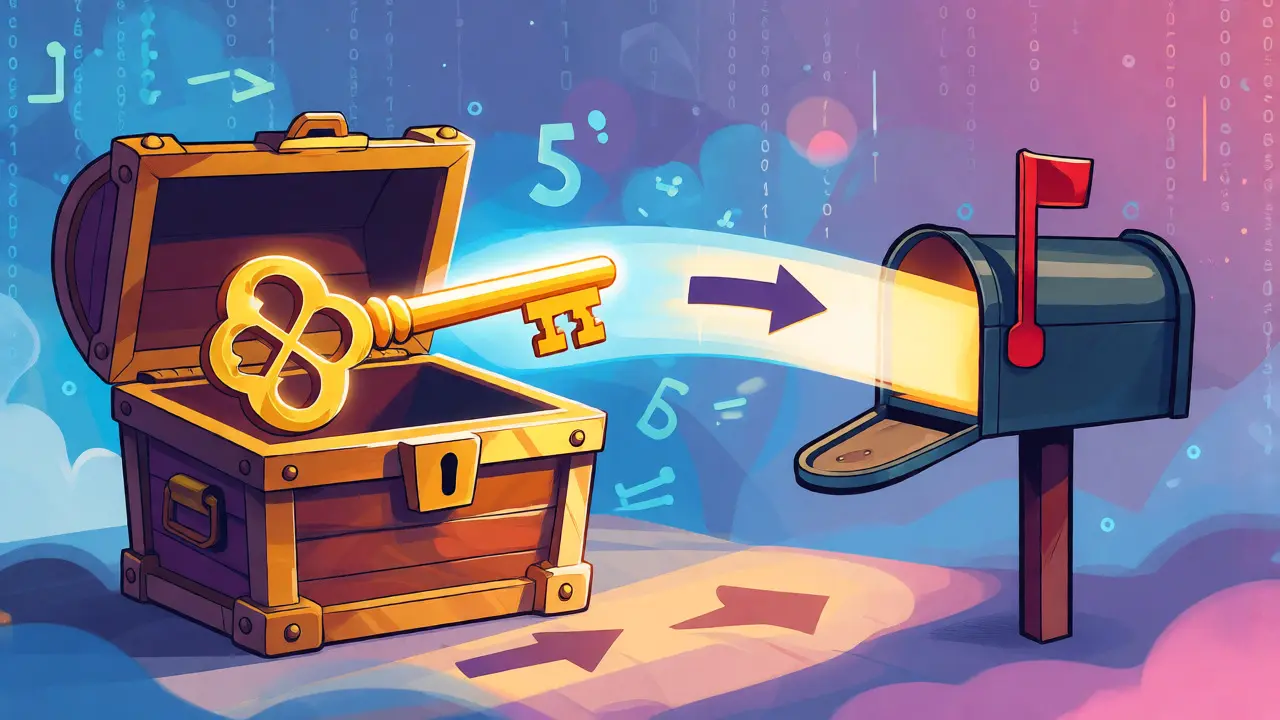
You’ve probably heard the warning a thousand times: "Not your keys, not your coins." It’s catchy, sure, but what does it actually mean when you’re staring at a string of random characters on your screen? Most people think their Bitcoin or Ethereum lives in an app like Coinbase or MetaMask. But that’s not true. Your digital assets don’t live in the cloud; they exist on the blockchain, locked behind a mathematical puzzle that only one specific piece of data can solve.
That piece of data is your private key. Understanding how this key relates to your crypto address isn’t just academic trivia-it’s the difference between owning your money and trusting someone else with it. If you lose the connection between these two things, you might as well have thrown your savings into a volcano.
The One-Way Street of Cryptography
At its core, blockchain technology relies on asymmetric cryptography. Think of it like a mailbox. You have a private key (the physical key that opens the box) and a public key (the address written on the outside where anyone can drop mail). The magic trick here is that while anyone can send mail to your address, only you can open the box and take the contents out.
This relationship is strictly one-way. Math allows you to derive a public key from a private key easily. But trying to reverse that process-guessing the private key by looking at the public key-is computationally impossible with current technology. We’re talking about numbers so large that even if every computer on Earth worked together for millions of years, they wouldn’t crack a single standard Bitcoin private key. This asymmetry is what secures billions of dollars without needing banks, governments, or middlemen.
But wait, there’s a third player in this game: the address. Why do we need an address if we already have a public key? It comes down to usability and safety. Public keys are long, ugly strings of hexadecimal characters. They are prone to human error. If you mistype one character in a 65-character public key, your money is gone forever. An address is essentially a shorter, checksum-protected version of the public key. When you share your address, you’re sharing a safe, user-friendly wrapper around your actual public key.
From Seed to Address: The HD Wallet Hierarchy
If you use a modern hardware wallet like Ledger or Trezor, you didn’t generate a single private key. You generated a seed phrase. This is usually 12 or 24 words. This seed is the master password for your entire financial history. From this single seed, your wallet software uses a process called Hierarchical Deterministic (HD) derivation to create thousands of different private keys.
Here’s the flow:
- The Seed: Your 12-24 word recovery phrase. Keep this offline. Never type it into a website.
- Master Private Key: Derived directly from the seed.
- Child Private Keys: Generated from the master key using a specific path (like m/44'/0'/0'/0/0).
- Public Keys: Derived mathematically from each child private key.
- Addresses: Hashed versions of those public keys, ready to be shared.
This structure means you only need to back up one thing-the seed-to recover infinite addresses. If you ever need to restore your wallet, you enter the seed, and the software deterministically recreates all the keys and addresses you ever used. No guesswork required.
| Item | Who Sees It? | Risk if Exposed | Primary Function |
|---|---|---|---|
| Private Key | Only You | Total Loss of Funds | Signs transactions to prove ownership |
| Seed Phrase | Only You | Total Loss of All Accounts | Backups and restores the entire wallet |
| Public Key | Anyone (on-chain) | Privacy Leak (linkability) | Verifies signatures; basis for address |
| Address | Anyone | None (Safe to share) | Receiving funds; looks like an account number |
Why Addresses Are Not Just Shortened Keys
A common misconception is that an address is just the first few letters of a public key. It’s more complex than that. In Bitcoin, for example, the address is created by hashing the public key twice (using SHA-256 and RIPEMD-160 algorithms) and then adding a checksum. That checksum is crucial. It allows wallets to detect typos. If you paste an address into a wallet and it says "Invalid Address," it’s because the checksum failed. Without this step, sending money to a mistyped address would be a silent disaster.
Different blockchains handle this differently. Ethereum addresses are derived from the last 40 hex digits of the Keccak-256 hash of the public key, prefixed with '0x'. Solana uses Base58 encoding. Despite these technical differences, the principle remains identical: the address is a derivative of the public key, which is a derivative of the private key. You never expose the private key itself during a transaction.

The Role of Digital Signatures
So, how does spending work? Let’s say you want to send 1 BTC to Alice. You tell your wallet to sign the transaction. Your wallet takes the details of the transaction (who, what, how much) and runs them through a cryptographic algorithm along with your private key. This produces a unique digital signature.
You broadcast the transaction, the signature, and your public key to the network. Nodes on the network check two things:
- Does the signature match the public key? (Mathematical verification)
- Is the public key associated with the unspent output you’re trying to spend? (Ledger verification)
If both are true, the network accepts the transaction. Notice that your private key was never sent over the internet. It stayed safely inside your device. The signature proves you had the key without revealing the key itself. This is the elegance of elliptic curve cryptography (ECDSA), the standard used by Bitcoin and Ethereum.
Security Pitfalls and Best Practices
Knowing the theory is great, but most losses happen due to human error, not broken math. Here’s where people get tripped up:
Storing Seeds Online: Taking a photo of your seed phrase and saving it to your phone’s camera roll is risky. Cloud backups sync that photo to servers. If your email is hacked, your seed is exposed. Use paper or steel. Write it down. Bury it if you have to.
Confusing Testnet and Mainnet: Sometimes developers test on networks that look exactly like real ones but use worthless tokens. Sending real funds to a testnet address won’t crash the chain, but you’ll lose access to those funds unless you import the key into a mainnet wallet correctly. Always double-check the network identifier.
Reusing Addresses: While reusing addresses doesn’t break security, it hurts privacy. On Bitcoin, once you spend from an address, the public key is revealed. If you reuse that address, anyone can link your incoming payments to your outgoing payments, potentially clustering your identity. Generate new addresses for each transaction.

What Happens If You Lose the Link?
If you lose your private key but know your address, you can see your balance on a block explorer, but you cannot move the funds. You are effectively locked out. Conversely, if you lose your address but keep your private key, you can always regenerate the address. The private key is the source of truth. The address is just a pointer.
This is why "not your keys" is such a critical concept. When you keep coins on an exchange, you hold a database entry, not a private key. The exchange holds the keys. If they go bankrupt, freeze accounts, or get hacked, your claim to those coins becomes a legal dispute rather than a cryptographic certainty. With self-custody, you hold the math. And math doesn’t go bankrupt.
Frequently Asked Questions
Can I convert my crypto address back to a private key?
No. The relationship is one-way. You can derive an address from a private key, but you cannot derive a private key from an address. If you lose your private key, knowing the address alone is not enough to recover your funds.
Is it safe to share my public key instead of my address?
Technically yes, but it’s not recommended for general use. Addresses are designed to be shorter and include checksums to prevent typing errors. Sharing a raw public key increases the risk of human error when copying and pasting, which could lead to lost funds.
Do I need a new private key for every address?
In an HD wallet, you don't manually manage individual private keys. You manage one seed phrase. The wallet automatically generates new private keys and corresponding addresses for you. You only need to back up the seed phrase once.
What happens if quantum computers break the encryption?
Quantum computers could theoretically derive private keys from public keys. However, this mainly affects addresses where the public key has been revealed (i.e., after you've spent from it). Unused addresses remain secure until the public key is exposed. Blockchains are also developing post-quantum cryptography standards to mitigate this future risk.
Can I change my address without changing my private key?
Yes. Since HD wallets derive multiple addresses from one seed, you can generate unlimited new addresses without ever touching your original private key or seed. This is a standard feature for improving privacy.