
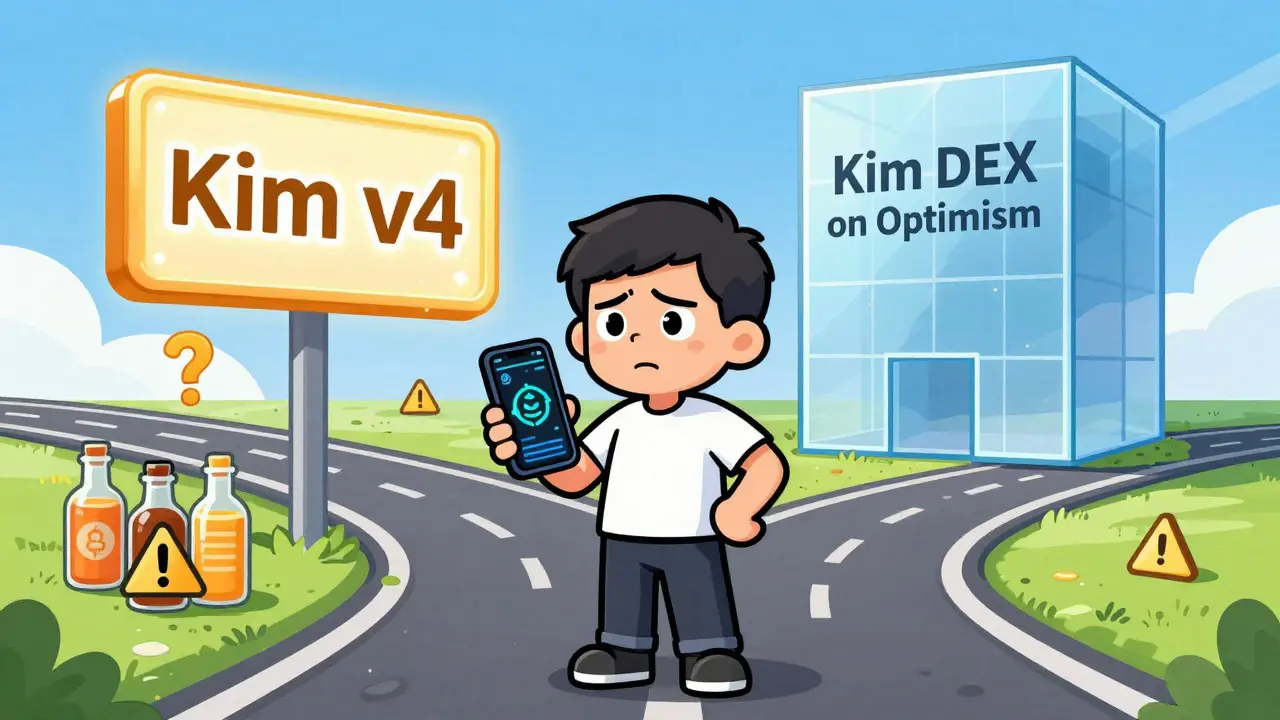
Are you looking for a high-yield spot to park your crypto assets in 2026? You might have stumbled upon Kim Exchange, a decentralized platform that promises boosted yields through its unique tokenomics. But here is the catch: if you are searching specifically for "Kim v4," you need to pause and verify what you are actually looking at. The crypto space is flooded with version numbers, and confusing a major protocol upgrade with a marketing label can cost you dearly.
This review cuts through the noise. We will break down what Kim Exchange actually is, how its decentralized trading mechanism works on the Optimism Superchain, and whether those promised 4x yields are worth the risk. We will also address the "v4" confusion head-on, because understanding the technology under the hood is the only way to protect your capital.
What Is Kim Exchange?
At its core, Kim DEX is not a centralized broker like Coinbase or Binance. It is an Automated Market Maker (AMM) built on the Optimism Superchain. This means it operates without a central authority holding your funds. Instead, it uses smart contracts to facilitate trades between users directly. If you are familiar with Uniswap, think of Kim as a specialized cousin that focuses heavily on liquidity management and yield optimization rather than just simple swapping.
The platform serves as a primary liquidity hub within the Mode ecosystem. It relies on a mathematical pricing model to determine asset values, eliminating the need for traditional order books. This makes it faster and often cheaper to trade, but it requires you to trust the code and the underlying mathematics. The architecture is modular, allowing developers to plug in custom features called "hooks." These hooks are essentially plugins that can tweak how liquidity is managed, offering flexibility that rigid exchanges simply cannot match.
The "Kim v4" Confusion: What Are You Actually Seeing?
Here is where things get tricky. As of mid-2026, there is no widely recognized official release labeled "Kim v4" in the same vein as the industry-standard Uniswap v4. Most references to "v4" in relation to Kim are likely conflating two different things:
- Uniswap v4 Hooks: Kim Exchange utilizes a hook-based architecture similar to the upcoming or recently released standards in the broader Ethereum ecosystem. Some marketers may loosely refer to this advanced plugin capability as a "v4-style" feature set.
- Marketing Hype: Scams and low-quality wrapper sites often append "v4" or "latest version" to their titles to appear cutting-edge. Always check the contract address. If the URL looks suspicious or the contract hasn't been audited by a top-tier firm, walk away.
For this review, we will focus on the current stable iteration of Kim Exchange, which leverages these advanced architectural principles regardless of the specific version number slapped on the marketing banner.
How the Tokenomics Work: $KIM and $xKIM
Understanding the tokens is crucial because they drive the entire economy of the exchange. Kim introduces a dual-token system designed to separate utility from governance.
| Token | Type | Primary Function | Transferable? |
|---|---|---|---|
| $KIM | Utility | Liquidity provision, staking base | Yes |
| $xKIM | Governance | Voting, allocating rewards to plugins | No (Soulbound) |
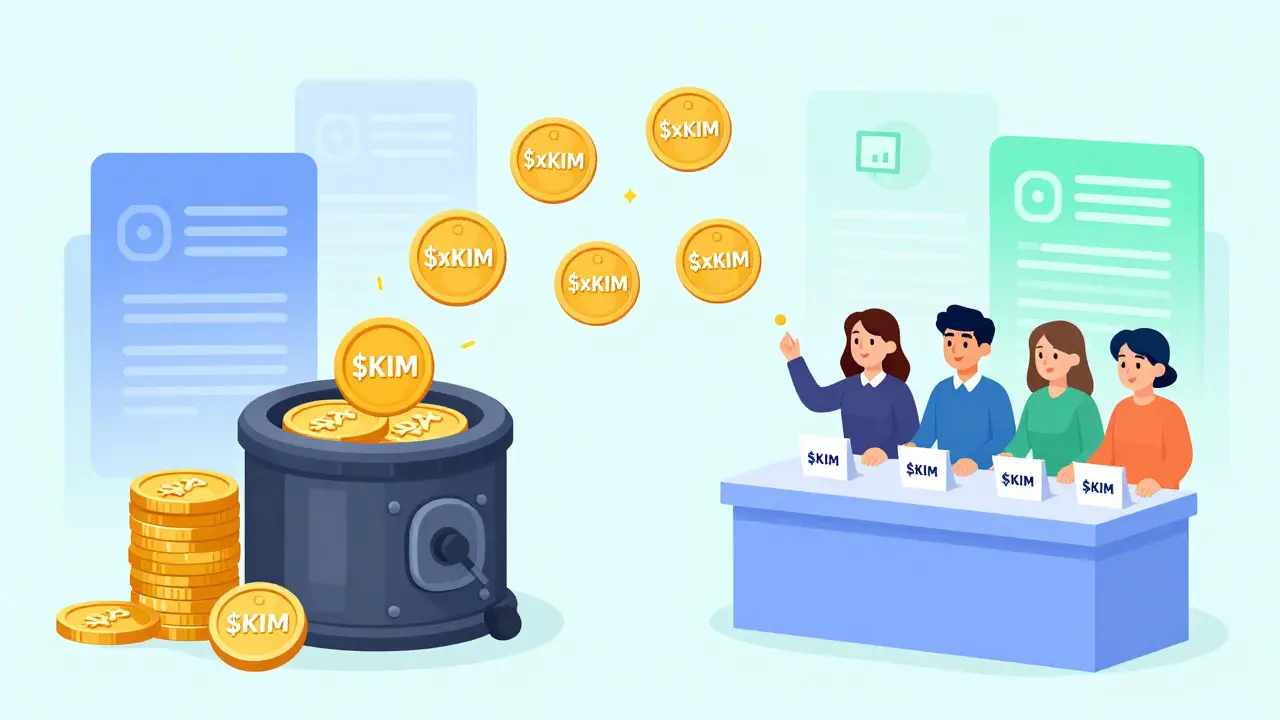
You start by providing liquidity using $KIM. When you stake your $KIM tokens, you earn $xKIM. The key difference is that $xKIM is non-transferable. This is a common trend in modern DeFi to prevent whale manipulation of governance votes. Your $xKIM balance represents your influence and your share of the rewards generated by the pool. You use $xKIM to vote on which plugins (hooks) should receive incentives, effectively steering the development and reward distribution of the exchange.
The Yield Engine: kpNFTs and Concentrated Liquidity
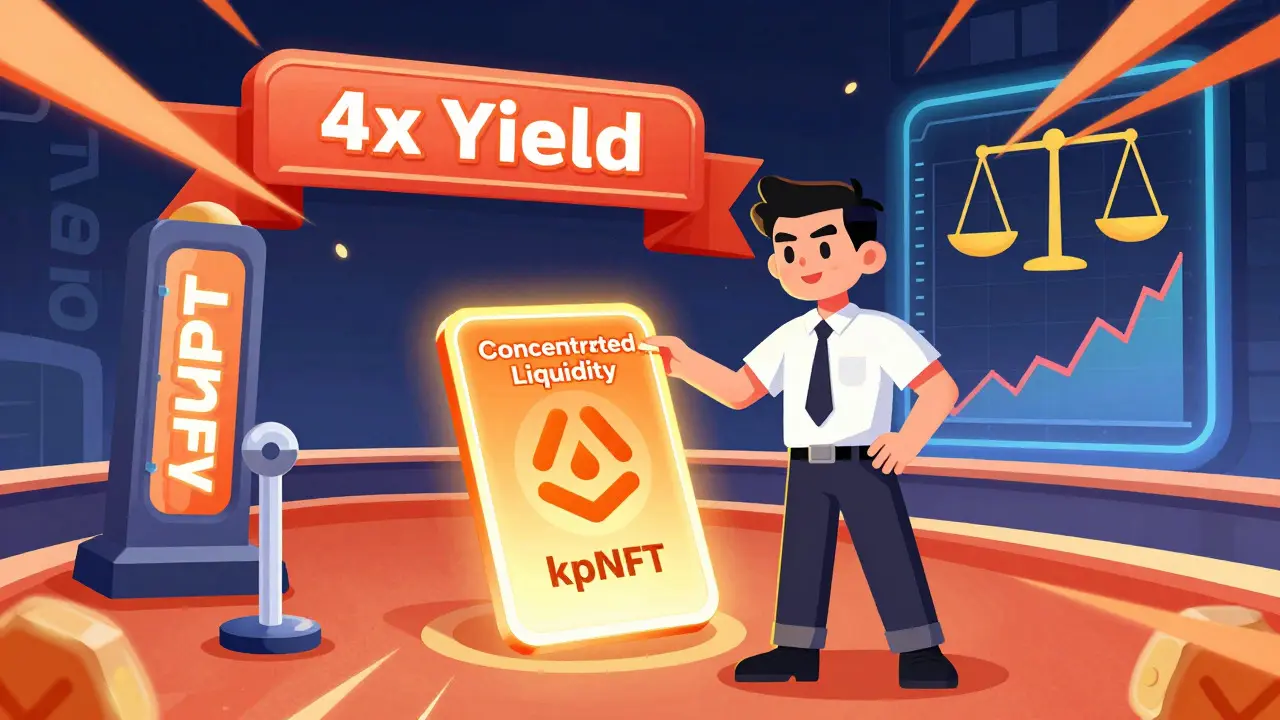
This is the feature that draws most users in. Kim Exchange promotes kpNFTs, which are yield-generating non-fungible tokens. How does this work? When you provide liquidity, you don't just get a standard LP token. Depending on your strategy and staking depth, you can mint kpNFTs. These NFTs act as multipliers for your earnings.
The platform claims users can achieve up to 4x yield on their investments through these NFTs. Here is the reality check: higher yield always equals higher risk. This boost comes from concentrated liquidity strategies. By narrowing the price range in which your liquidity is active, you earn more fees per unit of capital. However, if the price moves out of your range, your position stops earning until you rebalance. This requires active management. If you are a "set it and forget it" investor, concentrated liquidity can lead to impermanent loss if you aren't careful.
Security and Technology: MPC and Audits
Security in DeFi is never guaranteed, but Kim employs some robust measures. The platform uses Multi-Party Computation (MPC) technology. In simple terms, MPC allows multiple parties to jointly compute a function over their inputs while keeping those inputs private. For a DEX, this enhances security by ensuring that no single entity has full control over the cryptographic keys needed to move assets. It adds a layer of protection against single-point failures.
However, technology alone isn't enough. You need to look at audits. While Kim integrates with established chains like Optimism, you must verify if the specific smart contracts governing the kpNFTs and the $KIM/$xKIM staking mechanisms have been audited by firms like CertiK, OpenZeppelin, or Trail of Bits. As of late 2025 and into 2026, many new DeFi protocols launch with partial audits. Never deposit life savings into a protocol that hasn't had its core vaults reviewed by independent experts.
Fees and User Experience
Trading on Kim involves several layers of fees:
- Trading Fees: A percentage taken from each swap, paid to liquidity providers.
- Protocol Fees: A small cut retained by the Kim team for maintenance and development.
- Gas Fees: Since it runs on the Optimism Superchain, gas fees are significantly lower than on Ethereum Mainnet. This is a major advantage for frequent traders.
The user interface is designed to be modular. Because of the hook system, the dashboard can look different depending on which plugins are active. For beginners, this can be overwhelming. You might see options for complex yield strategies that you don't fully understand. Stick to the basic swap and standard liquidity pools until you are comfortable with the mechanics of concentrated liquidity.
Is Kim Exchange Right for You?
Kim Exchange is not for everyone. It is best suited for intermediate to advanced DeFi users who understand the risks of impermanent loss and want to actively manage their liquidity positions. If you are looking for a simple place to buy Bitcoin with a credit card, this is not it. If you want to maximize yields on ETH or OP tokens using sophisticated strategies and are willing to monitor your positions daily, Kim offers compelling tools.
The "v4" label should not be your deciding factor. Focus on the fundamentals: the security of the smart contracts, the transparency of the tokenomics, and the depth of liquidity in the pools you intend to use. Always start with a small amount to test the waters. In the world of decentralized finance, your due diligence is your best defense.
Is Kim Exchange a centralized or decentralized exchange?
Kim Exchange is a decentralized exchange (DEX). It operates on the Optimism Superchain and uses smart contracts to facilitate trades without a central intermediary holding your funds.
What is the difference between $KIM and $xKIM?
$KIM is the transferable utility token used for liquidity provision. $xKIM is a non-transferable governance token earned by staking $KIM. $xKIM allows you to vote on protocol upgrades and allocate rewards to specific plugins.
Does Kim Exchange really offer 4x yields?
The platform claims up to 4x yields through kpNFTs and concentrated liquidity strategies. However, these high yields come with increased risk, including impermanent loss and the need for active position management. Past performance does not guarantee future results.
What does "Kim v4" mean?
There is no official "Kim v4" release comparable to Uniswap v4. References to "v4" likely refer to the platform's hook-based architecture or are marketing terms. Always verify the contract address and audit status before interacting with any protocol claiming to be a new version.
Is Kim Exchange safe to use?
Kim uses Multi-Party Computation (MPC) for enhanced security. However, all DeFi platforms carry smart contract risk. Always check for recent security audits from reputable firms and start with small amounts to test the platform yourself.


Dina Lazarova
It is truly exhausting to read yet another superficial analysis of a protocol that clearly lacks the foundational rigor of established financial institutions. The author seems to labor under the delusion that 'decentralized' automatically equates to 'superior,' ignoring the glaring inefficiencies inherent in such systems. One must wonder if the writer has ever actually managed capital in a regulated environment or merely skimmed whitepapers for buzzwords. The distinction between $KIM and $xKIM is presented as novel, whereas it is merely a rehashing of vesting schedules we have seen for years. Furthermore, the reliance on 'hooks' suggests a patchwork architecture rather than a cohesive design philosophy. It is pretentious to claim this offers any real innovation when the underlying mechanics are so rudimentary.