
You want to trade crypto without handing over your identity to a centralized company. That’s the promise of decentralized exchanges (DEXs). But when you land on Libre Swap, a platform launched in 2023 and incorporated in Panama, things get confusing. The data is messy. One site says there’s zero volume; another shows active pairs. One source lists one token; another lists several. If you’re looking for a clear answer on whether this platform deserves your money right now, you’ve come to the right place.
I’ve dug into the codebases, the tracking sites, and the lack of community chatter to give you the straight truth about Libre Swap in 2026. Spoiler alert: it’s not ready for serious trading yet. Here is what you need to know before you connect your wallet.
What Exactly Is Libre Swap?
At its core, Libre Swap is an open-source, permissionless swap protocol built on the Libre blockchain. Unlike traditional exchanges like Coinbase or Kraken, where a company holds your funds, Libre Swap operates directly on-chain. You connect your wallet, approve the transaction, and the smart contract handles the rest. No registration forms. No email verification. Just code.
The project was established in 2023 by development teams from Costa Rica and Argentina, with frontend work handled by Libre Tech. It’s positioned as a native solution for the Libre ecosystem. This means it isn’t trying to be the next Uniswap or 1inch that supports hundreds of chains. It’s designed specifically for assets living on the Libre network.
For most users, this sounds great until you look closer. Being "permissionless" means anyone can add liquidity, which is good for decentralization but risky if there’s no quality control. Being "open-source" means the code is public, which is excellent for security audits-provided someone actually audited it.
The Data Problem: Conflicting Volumes and Pairs
If you’ve ever tried to research a new crypto project, you know that data consistency is rare. With Libre Swap, it’s practically non-existent. This is your first red flag.
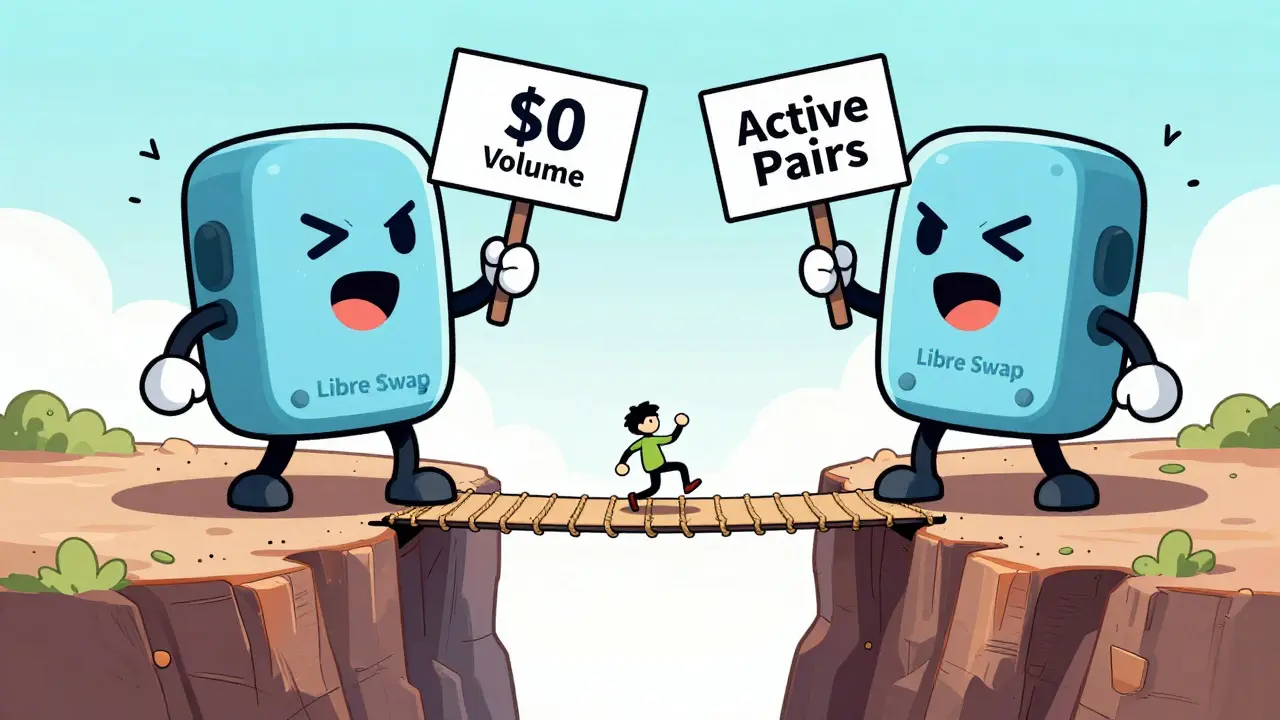
Let’s look at the numbers. According to CoinGecko, the 24-hour trading volume is $0.00. Zero. Yet, on the same page, they list a BTC/LIBRE pair with $54,276 in volume. How can total volume be zero while a specific pair has activity? It suggests broken data feeds or extremely fragmented liquidity pools that trackers aren’t aggregating correctly.
CoinMarketCap takes a different approach entirely. They classify Libre Swap as an "Untracked Listing." Their reasoning? The project falls under their Listings Review Criteria Section B-(3), which usually implies the project doesn’t meet standard transparency or liquidity thresholds for full tracking. Essentially, the big data providers don’t trust the data enough to display it reliably.
| Metric | CoinGecko Report | CoinMarketCap Report | Reality Check |
|---|---|---|---|
| 24h Volume | $0.00 | Unavailable / Untracked | Liquidity is likely too thin for reliable metrics |
| Supported Tokens | 1 Cryptocurrency | Multiple (pBTC/pUSDT, pBTC/LIBRE) | Inconsistent API reporting |
| Primary Pair | BTC/LIBRE | pBTC/pUSDT | Confusion between wrapped assets and native tokens |
| Status | Active | Untracked Listing | Platform exists but lacks market presence |
This inconsistency matters because volume equals liquidity. Low liquidity means high slippage. If you try to swap $1,000 worth of LIBRE on a pool with only $500 in depth, you won’t get the price you see on the screen. You’ll get much less. In 2026, when top DEXs offer automated smart routing to minimize slippage across multiple chains, Libre Swap’s fragmented data makes it a dangerous place for anything other than micro-trades.
Security Risks: The Silent Killer
When you trade on a centralized exchange, you worry about the company going bankrupt. When you trade on a DEX like Libre Swap, you worry about the code breaking. Smart contracts are immutable once deployed. If there’s a bug, your funds can be drained instantly.
Here is the hard truth about Libre Swap’s security posture: There is no public record of a third-party smart contract audit.
Major competitors like Uniswap or Symbiosis Finance publish their audit reports from firms like CertiK or Trail of Bits. These audits cost tens of thousands of dollars and provide peace of mind. Libre Swap, despite being open-source, lacks this critical validation layer. The developers from Costa Rica and Argentina may have tested the code internally, but without external verification, you are essentially beta-testing their software with your own capital.
Furthermore, the platform’s incorporation in Panama offers regulatory ambiguity. While this might sound appealing for privacy, it means fewer legal protections if something goes wrong. There is no customer support team to call. There is no insurance fund. If the contract fails, you file a claim against the void.
How Libre Swap Compares to Established DEXs
To understand why Libre Swap struggles, we have to compare it to what the market expects in 2026. The bar for decentralized finance has risen significantly.
Take Symbiosis Finance, a leading cross-chain swap platform. It offers native cross-chain functionality, meaning you can swap Bitcoin on Ethereum for Solana tokens seamlessly. It uses automated smart routing to find the best price across dozens of liquidity pools. It supports thousands of tokens.
Now look at Libre Swap. It is restricted to the Libre blockchain. It has limited trading pairs. It lacks cross-chain bridges. In a world where interoperability is the standard, Libre Swap is isolated. It’s like having a phone that only works in one specific neighborhood. Sure, it’s convenient if you live there, but useless if you travel.
Even older, simpler DEXs offer more clarity. Uniswap, despite its age, has massive liquidity, transparent fee structures, and a global developer community. Libre Swap’s fee structure remains undisclosed. Are you paying 0.3%? 1%? Who gets the fees? Without transparency, you can’t calculate your true cost of trading.

User Experience and Community Silence
A healthy crypto project has noise. People complain about bugs on Twitter. They discuss strategies on Reddit. They create tutorials on YouTube. Libre Swap is silent.
I searched for user reviews, forum threads, and social media engagement. The result? Almost nothing. There are no dedicated subreddits. There are no active Discord channels with thousands of members. This absence of user-generated content is terrifying for a financial product.
Why does this matter? Because community feedback drives improvement. If a feature is broken, users report it. If the interface is confusing, designers fix it. Without a vocal user base, Libre Swap is developing in a vacuum. The "permissionless" nature means anyone *can* use it, but without guidance, onboarding is difficult. New users don’t know how to bridge assets to the Libre chain. They don’t know which wallets are compatible. They just click around and hope for the best.
Verdict: Wait Before You Swap
So, should you use Libre Swap in 2026? For now, the answer is no.
The platform is stuck in early-stage limbo. It has conflicting data, no visible security audits, zero community traction, and limited utility outside its own niche blockchain. While the concept of a permissionless, open-source swap protocol is sound, the execution here lacks the maturity required for real-world trading.
If you hold LIBRE tokens and need to move them, proceed with extreme caution. Use tiny amounts to test the waters. Check the current liquidity pool depth manually before confirming any transaction. But for general crypto trading, stick to established platforms with proven track records, transparent fees, and active communities.
Libre Swap has potential, but potential doesn’t pay bills. Until the team publishes audit reports, clarifies their fee structure, and builds a consistent data feed, treat this platform as a laboratory experiment, not a financial tool.
Is Libre Swap safe to use in 2026?
Currently, Libre Swap carries higher-than-average risk due to the lack of public smart contract audits and inconsistent volume data. While the decentralized nature reduces custodial risk, unverified code poses a threat to user funds. Proceed with caution and small amounts only.
What cryptocurrencies can I trade on Libre Swap?
Data sources conflict on this issue. CoinGecko lists only one cryptocurrency, while CoinMarketCap mentions pairs involving pBTC, pUSDT, and LIBRE. The primary confirmed pair is BTC/LIBRE. Expect limited options compared to major DEXs.
Does Libre Swap require KYC (Know Your Customer)?
No. As a decentralized, permissionless protocol, Libre Swap does not require traditional registration or identity verification. You simply connect your compatible wallet to the Libre blockchain to begin trading.
Who developed Libre Swap?
The platform was built by antelope teams from Costa Rica and Argentina, with frontend development handled by Libre Tech. Specific team member names and credentials are not publicly disclosed.
Why is the trading volume data so inconsistent?
Libre Swap suffers from poor integration with major data aggregators. CoinGecko reports $0 volume alongside active pairs, and CoinMarketCap marks it as "Untracked." This indicates low liquidity and fragmented data feeds, making accurate assessment difficult.
How do fees work on Libre Swap?
The fee structure is currently undisclosed in available documentation. This lack of transparency is a significant drawback compared to competitors like Uphold or Uniswap, which clearly state their percentage-based fees.
Is Libre Swap better than Uniswap or Symbiosis?
Not yet. Uniswap and Symbiosis offer multi-chain support, deep liquidity, and verified security. Libre Swap is restricted to the Libre blockchain with limited pairs and no public audits, making it a niche choice rather than a superior alternative.