

You can buy Bitcoin in Mexico. You can sell it. You can even use it to pay for a coffee if the vendor accepts it. But if you try to move that money through a traditional bank account, you hit a wall. That wall is not just policy; it is law. Specifically, it is a set of rules that effectively bans most banks from touching cryptocurrency.
This creates a strange split in the financial landscape. On one side, you have millions of Mexicans using digital wallets and peer-to-peer apps to trade crypto. On the other, you have Banxico (the Bank of Mexico) and major commercial banks standing firm against direct integration. If you are trying to understand how to operate, invest, or build fintech products in Mexico right now, you need to know exactly where the lines are drawn. They are sharper than most people realize.
The Core Restriction: Banxico Rule 4/2019
The single biggest hurdle for cryptocurrency in the Mexican banking sector is Rule 4/2019 issued by Banxico. This regulation does not ban individuals from owning crypto. Instead, it severely limits what licensed financial institutions can do with it.
Under this rule, banks and fintech companies registered as payment institutions are prohibited from offering cryptocurrency services directly to clients. This means:
- No Custody: Banks cannot hold your Bitcoin or Ethereum in their vaults or servers on your behalf.
- No Exchange: Banks cannot facilitate the buying or selling of virtual assets for their customers.
- No Transmission: Banks cannot transfer funds between accounts if those transfers involve the conversion or movement of cryptocurrencies.
There is a narrow exception. Banxico allows limited internal operations, such as using virtual assets for back-end settlements between institutions. However, this requires prior authorization. As of 2026, there is no public record of Banxico granting any such authorizations. In practice, this door is closed.
If you are a user, this explains why you cannot simply log into your BBVA or Santander app and click "Buy Crypto." Those banks are legally barred from providing that service. If you are a business, this means you cannot partner with a traditional bank to offer crypto payments without navigating a complex regulatory workaround.
The Regulatory Trio: Who Watches What?
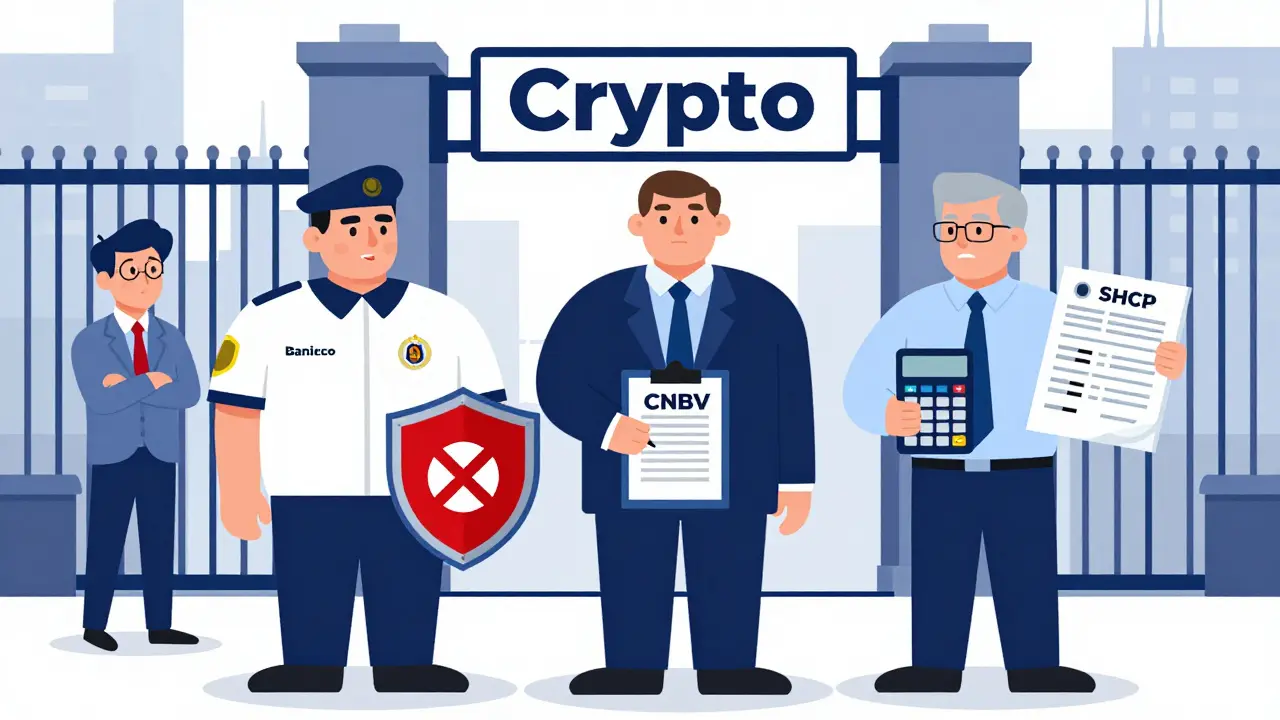
Mexico’s regulatory framework is not managed by one agency. It is a three-way split that often confuses newcomers. Understanding who does what is critical for compliance.
| Agency | Primary Role | Crypto Responsibility |
|---|---|---|
| Banxico | Central Bank | Enforces Rule 4/2019; restricts banks from handling crypto. |
| CNBV | National Banking and Securities Commission | Licensed entities must register here; oversees AML compliance for fintechs. |
| SHCP | Ministry of Finance | Handles tax collection and anti-money laundering (AML) reporting. |
The CNBV (Comisión Nacional Bancaria y de Valores) is where the action happens for non-bank entities. While banks are blocked by Banxico, other fintech companies can operate if they register with the CNBV. This registration is not a "crypto license" per se, but it is a mandatory step for any entity dealing with virtual assets. Without it, you are operating illegally.
The SHCP (Secretaría de Hacienda y Crédito Público) focuses on the money trail. They care less about the technology and more about whether you are washing dirty money or paying taxes. Their stance has been clear: virtual assets are not legal tender, and profits from them are taxable income.
The Legal Definition: Not Money, But Assets
A crucial part of understanding these restrictions lies in how Mexico defines cryptocurrency. The Fintech Law (Law for the Regulation of Financial Technology Institutions), enacted in 2018, provides the foundation.
Under this law, virtual assets are defined as digital representations of value that can be used as a means of payment. However, the law explicitly states they are not legal tender. This distinction matters immensely. Because they are not legal tender, banks are not required to accept them, and they are not protected by deposit insurance schemes like the IPAB.
Instead, virtual assets are treated as intangible assets. This classification subjects them to specific legal treatments depending on context. For example, if you hold Bitcoin as an investment, it is treated similarly to other capital gains assets for tax purposes. If you use it to pay for goods, it is treated as a sale of goods. There is no special "crypto tax rate," which simplifies things in some ways but adds complexity in others.
The Grey Area: Lending and Unregulated Services
While the rules for exchanges and custody are strict, other areas remain murky. Take lending, for instance. The current legislation does not explicitly regulate cryptocurrency lending as a financial activity. This has led to a boom in platforms offering loans backed by crypto collateral.
These platforms operate in a regulatory grey area. They are not supervised by the CNBV or Banxico unless they also engage in other regulated financial services. However, they are not entirely free from oversight. Under the Anti-Money Laundering Law, offering loans-even by non-financial entities-can classify as a "vulnerable activity."
If your platform falls into this category, you must:
- Identify your clients rigorously.
- File reports with the SHCP when transactions reach certain thresholds.
- Include disclaimers stating that your services are not regulated by financial authorities.
This puts the risk squarely on the user. If a lending platform collapses, there is no government safety net. This is a key point for investors to remember: innovation in Mexico is happening, but it is largely outside the protective umbrella of the banking sector.
Taxation: The 2021 Clarification
For years, taxpayers were unsure how to report crypto gains. In 2021, the Mexican Tax Ombudsman provided clarity. Profits from cryptocurrency should be treated as income from the sale of goods. This means every time you sell crypto for fiat currency, or swap one crypto for another, you may trigger a taxable event.
The Ministry of Finance issued Press Release No. 039, stating that virtual assets are electronic information storage mechanisms with no intrinsic value. This language underscores the cautious approach. You are responsible for tracking your cost basis and reporting gains annually. Failure to do so can lead to significant penalties during audits.

The Future: Project Agorá and CBDC
While private banks are restricted, the central bank is moving forward. Banxico is actively developing a Central Bank Digital Currency (CBDC). Known internally as Project Agorá, this initiative aims to release a digital peso by the end of 2025 or early 2026.
Project Agorá reflects a shift in attitude. Banxico acknowledges the potential of blockchain technology to improve financial infrastructure. The goal is financial inclusion, providing secure digital payment methods to unbanked populations. However, this CBDC will be distinct from decentralized cryptocurrencies like Bitcoin. It will be a digital version of the peso, fully controlled by the state.
This dual approach-restricting private crypto while building public digital currency-is common globally. It allows the government to maintain control over monetary policy while exploring technological benefits. For users, this means the future of digital payments in Mexico may look very different from the decentralized vision many crypto enthusiasts hold.
Basel III and Bank Stability
Another factor influencing the restrictive stance is Mexico’s adoption of Basel III guidelines. These international standards require banks to maintain higher capital ratios to absorb losses. Mexico has implemented a total capital ratio requirement of 10.5%, including a conservation buffer.
Systemically important banks face even stricter requirements, ranging from 0.6% to 2.25% additional capital. These measures are designed to prevent excessive risk-taking. Since cryptocurrencies are highly volatile and illiquid compared to traditional assets, allowing banks to hold them would conflict with these stability goals. Regulatory incentives discourage high-risk activities, making it unlikely that banks will seek exemptions anytime soon.
Can I open a crypto account at a Mexican bank?
No. Under Banxico Rule 4/2019, traditional banks are prohibited from offering cryptocurrency services, including custody, exchange, or transmission. You must use non-bank fintech platforms registered with the CNBV.
Is cryptocurrency legal in Mexico?
Yes, owning and trading cryptocurrency is legal. However, it is not legal tender. It is classified as an intangible asset under the Fintech Law, subject to specific tax and anti-money laundering regulations.
Do I need a license to run a crypto exchange in Mexico?
You must register with the CNBV as a Financial Technology Institution. While there is no specific "crypto license," failure to register makes your operation illegal. You must also comply with AML laws enforced by the SHCP.
How are crypto profits taxed in Mexico?
Profits from cryptocurrency are treated as income from the sale of goods. You must report capital gains on your annual tax return. The tax rate depends on your overall income bracket, as there is no separate flat tax for crypto.
What is Project Agorá?
Project Agorá is Banxico's initiative to develop a Central Bank Digital Currency (CBDC). It aims to provide a digital version of the Mexican peso for efficient payments and financial inclusion, separate from decentralized cryptocurrencies.